Albania spent 23 years as the only country in modern history with no legal religion of any kind.
In November 1967, after a months-long campaign of speeches, demolitions, and forced closures, the People’s Republic of Albania declared itself the world’s first officially atheist state. Mosques, churches, Catholic cathedrals, and Bektashi teqes (Sufi lodges) were sealed, repurposed, or dynamited. Clergy of every faith were arrested, sent to labor camps, or executed. Religious names were banned for newborns. The policy was later written into Article 37 of the 1976 constitution, which prohibited the state from supporting any religion and outlawed religious organizations of every kind.
The ban held until late 1990 and ended only with the communist regime that imposed it. Pope John Paul II’s visit in April 1993 — three years after restrictions lifted — is widely treated as the symbolic closing of the chapter.
This article walks the arc from the religious pluralism of pre-1944 Albania, through the mechanics of the 1967 campaign and the long quiet decades that followed, to the post-1990 revival and the particular role the Albanian-American diaspora played in keeping traditions alive while they could not be practiced at home. The point isn’t to litigate the regime or to advocate for any faith. The facts are heavy enough on their own, and they shape how a lot of Albanian Americans now in the US understand where they came from.
What “first atheist state” actually means
The phrase gets used loosely, so it’s worth being precise about what Albania did in 1967 that no other state had done.
State atheism — official government promotion of non-belief — existed elsewhere in the communist world. The Soviet Union after 1917 ran extensive anti-religious campaigns, and Mao’s China during the Cultural Revolution (1966–1976) attacked religious institutions on a vast scale. But the USSR’s 1936 and 1977 constitutions still nominally guaranteed “freedom of religious worship” alongside freedom of “anti-religious propaganda.” China never formally outlawed religion in its constitution. What set Albania apart was a clean constitutional ban on religion itself, combined with the physical closure of every house of worship in the country.
The legal architecture moved in two steps. The first was the 1967 decree that shuttered every mosque, church, and teqe and prohibited religious practice in public. The second was the 1976 constitution, whose Article 37 read in part that “the state recognizes no religion and supports atheist propaganda for the purpose of inculcating the scientific materialist world outlook in people.” Article 55 prohibited the creation of any organization of a “religious” character. Religion was not regulated. It was deleted from the legal map.
Per the Wikipedia entry on State atheism, no other 20th-century state — communist or otherwise — went this far. The closest analog was Mongolia’s earlier purges of Buddhist monasteries in the 1930s, but Mongolia never formalized the policy in constitutional text. Albania did, and held the position for fifteen years of constitutional law and twenty-three years of practice.
For Albanian Americans trying to explain this to non-Albanian neighbors, the one-line version is usually: the Soviet Union persecuted believers; Albania outlawed belief. That isn’t a perfect summary — Soviet practice was harsh in different ways — but it captures the structural distinction.
How religion functioned in Albania before 1967
To understand what was lost in 1967, it helps to see what existed before.
Pre-1944 Albania was one of Europe’s most religiously plural societies. The standard demographic breakdown, going back to the 1930s and confirmed in later scholarship (see Religion in Albania, Wikipedia), was roughly 70% Muslim — including both Sunni and the Bektashi Sufi order — 20% Eastern Orthodox, and 10% Roman Catholic. The geography was layered: Sunni communities across most of the country, Bektashi concentrated in the south and central regions, Orthodox in the south (Korçë, Berat, Gjirokastër), and Catholic in the northern highlands (Shkodër, Mirdita, Malësi e Madhe).
The Bektashi Order had a special place. After Mustafa Kemal Atatürk’s 1925 closure of Sufi orders in Turkey, the Bektashi world headquarters was formally established in Tirana in 1930, where it remains today. Albania thus hosted a globally headquartered Sufi tariqa alongside Sunni, Catholic, and Orthodox hierarchies — an unusual concentration for a country of roughly one million people.
The pluralist character was something Albanians often noted about themselves. Pashko Vasa’s 19th-century line — “The faith of Albanians is Albanianism” — captured a real social fact: that confessional identity rarely became a primary political fault line in modern Albanian history the way it did in some neighboring states. Catholic and Muslim fis (clans) intermarried in the north. The wartime sheltering of Jewish refugees under the customary code of besa — the binding word — crossed every religious line. By 1945, Albania was one of the few European countries whose Jewish population had grown during the Second World War.
This pluralism was the context in which the communist regime came to power in November 1944. Enver Hoxha, leader of the wartime Albanian Communist Party, took control of Tirana and within two years had abolished the monarchy and proclaimed the People’s Republic. Religion was tolerated — barely — for the regime’s first two decades, with Orthodox and Sunni hierarchies forced into state-controlled bodies and Catholic clergy treated as a political enemy (Vatican loyalty being read as foreign allegiance). The Catholic Church lost dozens of priests in the late 1940s alone.
But 1967 was a different order of operation. It was not regulation. It was elimination.
Hoxha’s 1967 campaign
The trigger was a speech.
On 6 February 1967, Hoxha addressed the Party of Labour and called for an “ideological and cultural revolution” modeled in part on what he had been watching in China. Mao’s Cultural Revolution had begun in 1966, and Hoxha — by then estranged from Moscow and aligned with Beijing — read it as a confirmation of his own instincts. He framed religion as feudal residue and an obstacle to the new socialist person. The party press picked it up. Within weeks, organized youth brigades began moving on religious buildings across the country.
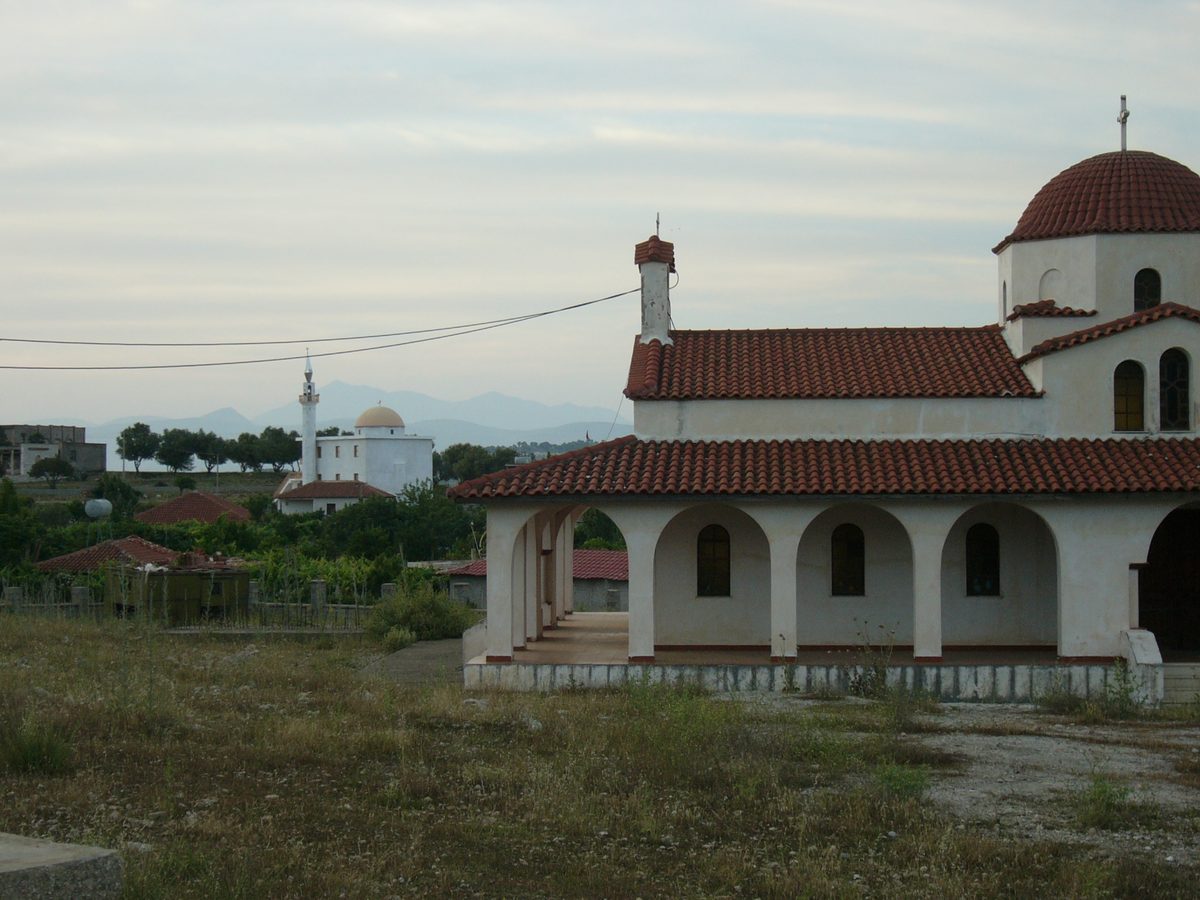
The mechanics were brutal and fast. Volunteer student squads marched into village mosques and parish churches, forced the doors, seized icons and liturgical books, and either burned the contents or hauled them to municipal warehouses. Buildings were inventoried by the state and reassigned. A mosque in Berat became a sports hall. The Catholic cathedral in Shkodër — built in the 19th century, the largest in Albania — was turned into a sports arena and later a multi-purpose municipal facility. Orthodox churches in the south were converted into cinemas, granaries, or workers’ clubs. Many Bektashi teqes in the highlands, often modest stone structures, were simply demolished for their materials.
The totals are documented variably across sources, but the consolidated figure cited by Religion in Albania and corroborated by later Albanian government accountings is roughly 2,169 religious buildings closed, repurposed, or destroyed in the campaign — mosques, Orthodox churches and monasteries, Catholic churches, and the country’s Bektashi teqes. The remaining buildings were absorbed into state inventories or left to decay.
By the end of 1967, no place of public worship operated legally anywhere in Albania. A November 1967 government decree formally annulled the legal charters of all religious communities. The country’s Sunni müftülük, Orthodox archbishopric, Catholic dioceses, and Bektashi kryegjyshata (world headquarters) ceased to exist as recognized institutions.
The 1976 constitution closed the legal loop. Article 37’s language — “the state recognizes no religion” — and Article 55’s prohibition on religious organizations gave the policy a permanent constitutional anchor. From that point until 1990, religion in Albania existed only outside the law.
Persecution of clergy
The closures targeted buildings. The arrests targeted people.
Catholic clergy faced the heaviest documented losses, partly because the Catholic Church kept the most complete records and partly because the regime treated Vatican-linked priests as an external security threat from the late 1940s onward. In 2016, Pope Francis beatified 38 Albanian Catholic martyrs — bishops, priests, seminarians, and lay Catholics — killed between 1945 and 1974. The roster included Archbishop Vinçenc Prennushi of Durrës, who died of torture in prison in 1949, and Father Dom Shtjefën Kurti, executed in 1971 — four years into the atheism era — for performing a clandestine baptism. The beatification ceremony took place in Shkodër, in front of the cathedral that had spent decades as a sports hall (see the Catholic Church in Albania Wikipedia entry for the full list).
Orthodox clergy faced parallel persecution, though the documentation is thinner. The Albanian Orthodox Autocephalous Church, with its archbishopric in Tirana, was effectively decapitated in 1967. Archbishop Damianos had been deposed earlier; his successors served at the regime’s pleasure or in confinement. Many parish priests were sent to labor camps in the swamps around Maliq or to the copper mines at Rubik. When the church re-emerged in the early 1990s, only about 22 of the pre-1967 clergy were still alive and physically able to serve.
Sunni and Bektashi leaders were silenced in the same wave. Senior Bektashi dervishes were imprisoned at the Burrel and Spaç labor camps — names that recur throughout the regime’s political-prisoner literature. Some were executed. The kryegjyshi (world Bektashi head) Baba Ahmed Myftari died in detention in 1980. Sunni imams and hoxhë faced the same fate, often locally and quietly.
Across all four faiths, the consistent pattern was the same. Practicing clergy who refused to renounce their office were imprisoned or killed. Those who recanted were absorbed into agricultural collectives or state factories. Those who continued in secret risked decades in the camp system if caught by the Sigurimi (state security service). The Albanian Helsinki Committee, working from regime archives after 1991, has documented at least several hundred religious figures killed and several thousand imprisoned over the 1944–1990 period, though the exact totals remain contested.
Life under the ban (1967–1990)
For ordinary Albanians, the ban reshaped daily life in ways large and small.
Religious names were banned for newborns in 1976. A government list of approved “Illyrian-sounding” given names — Arben, Bardha, Drilon, Mirjeta — replaced the saints’ names and Quranic names that had been standard for centuries. Children born after the decree often grew up with no link to the religious tradition their grandparents had practiced. Families adjusted; the names stuck even after 1990, and many Albanian Americans born in the 1970s and 1980s carry these names today.
Private practice continued, quietly. Older Albanians — those who remembered the pre-1967 world — kept fasts, recited prayers, baptized children in basins of household water, and wrapped a few preserved icons or Qurans in cloth at the back of cupboards. Catholic lay Catholics in the northern highlands ran improvised home liturgies. Bektashi adherents kept the order’s calendar of feast days as private family rituals. The Sigurimi was not omnipresent, but the risk was real, and informants existed. A baptism performed at the wrong neighbor’s house could send a parent to a labor camp.
Two generations grew up under the ban. The cohort born between roughly 1955 and 1985 came of age with no public religious instruction, no operating houses of worship, no clergy to consult, and no religious holidays observed outside the home. For many, religion existed only as a half-remembered fragment from a grandmother — a particular gesture made before eating, a phrase muttered at the threshold of a doorway, an icon hidden in a drawer.
That memory gap is part of what makes the post-1990 revival uneven. There is no continuous transmission. The chain was deliberately broken, and the rebuild after 1990 had to start from family scraps, returning émigré clergy, and the institutional memory preserved abroad.
The thaw of 1990 and the return of religion
The end of the ban came faster than anyone expected.
Mother Teresa, born Anjezë Gonxhe Bojaxhiu to an ethnic Albanian Catholic family from Skopje, visited Tirana in August 1989 at the regime’s invitation — a small diplomatic opening from a government beginning to recognize that Albania’s international isolation could not continue indefinitely. Her visit included a stop at her mother’s and sister’s graves in Tirana. It was the first sign that the regime was prepared to acknowledge that Catholicism, at least in symbolic form, still existed inside Albania.
By 1990, the regime under Ramiz Alia — Hoxha’s successor after the latter’s death in April 1985 — was visibly losing control. Mass student protests in Tirana in December 1990 forced the legalization of opposition parties. In the same window, the religious ban quietly ended. There was no single dramatic decree, but by November 1990 public religious practice was no longer being prosecuted.
The breakthrough moment came on 4 November 1990, when Catholic priest Don Simon Jubani — recently released from political prison — celebrated the first public Mass in Albania since 1967, in the burned-out chapel of the Rrëmajt cemetery in Shkodër. By contemporary accounts, roughly 200 to 300 believers attended. Mosques and Orthodox churches reopened across the country in the following weeks. The Albanian Orthodox Autocephalous Church recalled Anastasios Yannoulatos from Greece to begin rebuilding the hierarchy; he would serve as archbishop for the next three decades.
The 1991 multi-party elections, and the formal end of the People’s Socialist Republic in 1992, made the reopening permanent. The 1998 constitution restored full religious freedom and the secular character of the state — meaning a state that takes no position on religion, rather than a state opposed to religion. By that point, hundreds of churches and mosques had been rebuilt or reclaimed, often with funding from émigré communities abroad.
Pope John Paul II’s 1993 visit
Three years after the ban lifted, Pope John Paul II arrived in Tirana on 25 April 1993 — the first papal visit to Albania in modern history, and the first to a formerly atheist state.
The symbolism was deliberate on both sides. John Paul II’s broader pontificate had been organized around the moral and political collapse of European communism (covered in our pope-john-paul-ii-communism piece), and Albania was the most extreme case in the region. The visit included an open-air Mass in Tirana attended by hundreds of thousands and, in Shkodër, the consecration of four Albanian bishops to restore the country’s Catholic hierarchy — the first new bishops on Albanian soil in 47 years. Among them was Frano Illia, who became Archbishop of Shkodër and had been imprisoned under the communist regime.
For the Catholic Church, the visit was a formal re-foundation. For Orthodox and Muslim Albanians, it was a marker that international recognition of Albania’s religious recovery was now in motion. For the Albanian diaspora — particularly the older Albanian-American Catholic communities in the Bronx, Worcester, and Detroit — it was the day many had been praying about for two generations.
John Paul II returned the gesture in subsequent years through Vatican diplomatic recognition of Albania’s renewed bishops and through canonization processes that, two decades later, would produce the 2016 beatification of the 38 martyrs. The 1993 visit set the template: a Catholic re-entry, conducted publicly, treated by the Albanian state as a normal diplomatic event, with the regime that had banned the faith having dissolved without leaving an institutional heir.
The papal visit did not “restore” Albanian religion — that had happened in late 1990, organically, in cemeteries and reclaimed buildings. But it gave the restoration a global signature, and it cemented the perception (correctly or not) that the post-communist Albanian state was now formally back in the family of religiously plural European societies.
The diaspora’s role
While religion was banned at home, it persisted abroad — and that fact shapes the modern Albanian-American story.
The oldest Albanian-American parishes predated the ban by decades. Fan S. Noli was ordained a priest in 1908 and conducted the first Albanian-language Orthodox liturgy that year, laying the groundwork for what became the Albanian Orthodox Diocese of America, formally established in Boston in 1949; Vatra (the Pan-Albanian Federation of America) was founded in 1912. Albanian Catholic parishes took root in the Bronx and Detroit through the early-20th-century migrations. By 1967, when religion was outlawed in Albania itself, these US communities had already been celebrating the Albanian liturgical calendar in Albanian — in some cases for sixty years.
When the ban took effect, these parishes became something more than community centers. They became repositories. Worcester, Boston, Detroit, the Bronx — these were the places where the Divine Liturgy of St. John Chrysostom continued to be celebrated in Albanian during years when no Albanian Orthodox church operated inside Albania. Albanian-language Catholic missals were printed and preserved abroad. The Bektashi tradition kept a smaller foothold in Detroit, where the Albanian-American Islamic Center (founded 1949) and the later First Albanian Teqe in America (Taylor, Michigan) maintained Sunni and Bektashi practice respectively. (See our albanian-catholic-church piece for the longer history of US Catholic parishes.)
When the ban lifted in 1990, the flow reversed. Albanian-American clergy — some now in their seventies and eighties — traveled to Albania to help rebuild parishes and train new clergy. Émigré donations financed cathedral restorations, mosque reopenings, and the reconstitution of seminaries. The first new generation of post-1990 Albanian priests was trained in part with help from the diaspora that had kept the tradition warm.
For Albanian Americans today, this is a piece of family history that often goes unspoken. A grandmother who emigrated to New York in 1969 may have left precisely because her brother in Shkodër had been sent to a labor camp for refusing to renounce the priesthood. The Worcester family whose grandfather was baptized in a basement in 1972 may have left in 1991 specifically so the children could grow up in a country where that question wasn’t dangerous. These are not abstractions. They are the reasons a substantial share of the US Albanian community is here.
Religion in Albania today
Three decades after the ban lifted, Albania’s religious landscape has reassembled — but not into its pre-1967 shape.
The 2011 Albanian census — the first to ask about religious identification since the communist era — reported approximately 58.8% Muslim (Sunni and Bektashi combined, with the Bektashi sometimes counted separately at roughly 2%), 10.1% Roman Catholic, 6.8% Eastern Orthodox, about 2.5% “believers without denomination,” 5.5% atheist, and roughly 17% declining to answer or unclassified. Multiple religious communities, particularly the Orthodox Church and the Bektashi Order, formally rejected the census figures as undercounts, arguing that procedural and methodological issues suppressed their headcounts. The 2023 census, with revised methodology, is expected to produce different totals.
What the data does suggest is that Albania remains religiously plural, with no single faith holding majority dominance once non-practicing identification is factored in. The “famous Albanian tolerance” narrative — the line that gets quoted in every travel article — is not invented, but it is more complicated than the slogan. Decades of forced cohabitation under a regime that suppressed every faith produced a generation that genuinely views religion as a low-salience identity marker. Mixed-faith marriages are common. Religious holidays of every faith are nationally observed.
At the same time, the post-1990 rebuild has not been frictionless. Property disputes over communist-era seizures continue. Some Catholic and Orthodox properties are still in state or municipal use; some have been returned. The Bektashi Order has internationally raised the profile of its Tirana headquarters and in 2024 announced plans for a small sovereign micro-state within Tirana modeled loosely on Vatican City — a development covered widely in international press and still under discussion as of 2026.
The shorthand “first atheist state” remains accurate as a historical label for the 1967–1990 period. As a description of contemporary Albania, it is misleading. Modern Albania is a constitutionally secular republic with a religiously plural population, a functioning Sunni müftülük, a restored Orthodox archbishopric, a Catholic episcopal conference, and the global headquarters of the Bektashi Order — all operating in the same country, often within walking distance of one another in central Tirana.
The texture, in other words, is what the one-line summary misses. The ban was real, the persecution was real, the silence was real, and so is the recovery.
The National Albanian Registry counts US-based Albanians of every faith and of none — Sunni, Bektashi, Orthodox, Catholic, secular, and the substantial number who don’t fit any of those boxes. If you’re Albanian American, get counted.