
For Albanian-American families, the question of when Albania left communism is rarely asked in those words. It’s more often asked sideways. When did your family come over? When did your grandparents finally see their sisters again? When did the letters stop being read by someone else first? The answers cluster around the same span of months — late 1990 through 1992 — even when the people answering don’t have the political timeline in front of them.
The timeline does exist, and it’s clearer than most casual histories suggest. Albania’s exit from communism wasn’t a single day. It was an incremental unraveling that ran from the Tirana student protests in early December 1990, through the legalization of opposition parties later that month, the first multi-party elections on March 31, 1991, the formal renaming of the country to the Republic of Albania on April 29, 1991, and finally the March 22, 1992 election that ended the Party of Labour’s continuous rule since 1944.
This piece walks that 16-month transition and the emigration waves it produced. The same months that ended communism inside Albania produced the largest movement of Albanians out of the country in modern history — and most of today’s Albanian-American community traces its family arrival, directly or by a generation, to the door that opened during this window.
The short answer: a 16-month timeline
If a single chronology is what you came here for, here it is.
- April 11, 1985 — Enver Hoxha dies after 41 years in power; Ramiz Alia takes over the Party of Labour (Hoxha, Alia).
- July 1990 — Roughly 5,000 Albanians scale the walls of foreign embassies in Tirana and are evacuated to Western Europe (Albanian diaspora).
- December 8–11, 1990 — Student protests at Enver Hoxha University spread nationwide; on December 11 the Politburo authorizes a multi-party system (1990–1991 Albanian protests).
- December 12, 1990 — The Democratic Party of Albania is founded by Sali Berisha, Azem Hajdari, and others.
- February 20, 1991 — A crowd in Tirana topples the bronze statue of Enver Hoxha on Skanderbeg Square.
- March 31, 1991 — First multi-party elections since 1923. The Party of Labour wins on rural votes; the Democratic Party wins the cities.
- April 29, 1991 — The People’s Assembly passes the Law on Major Constitutional Provisions; the country is renamed the Republic of Albania.
- June 1991 — A coalition government under Ylli Bufi forms after a general strike forces the all-Socialist cabinet out.
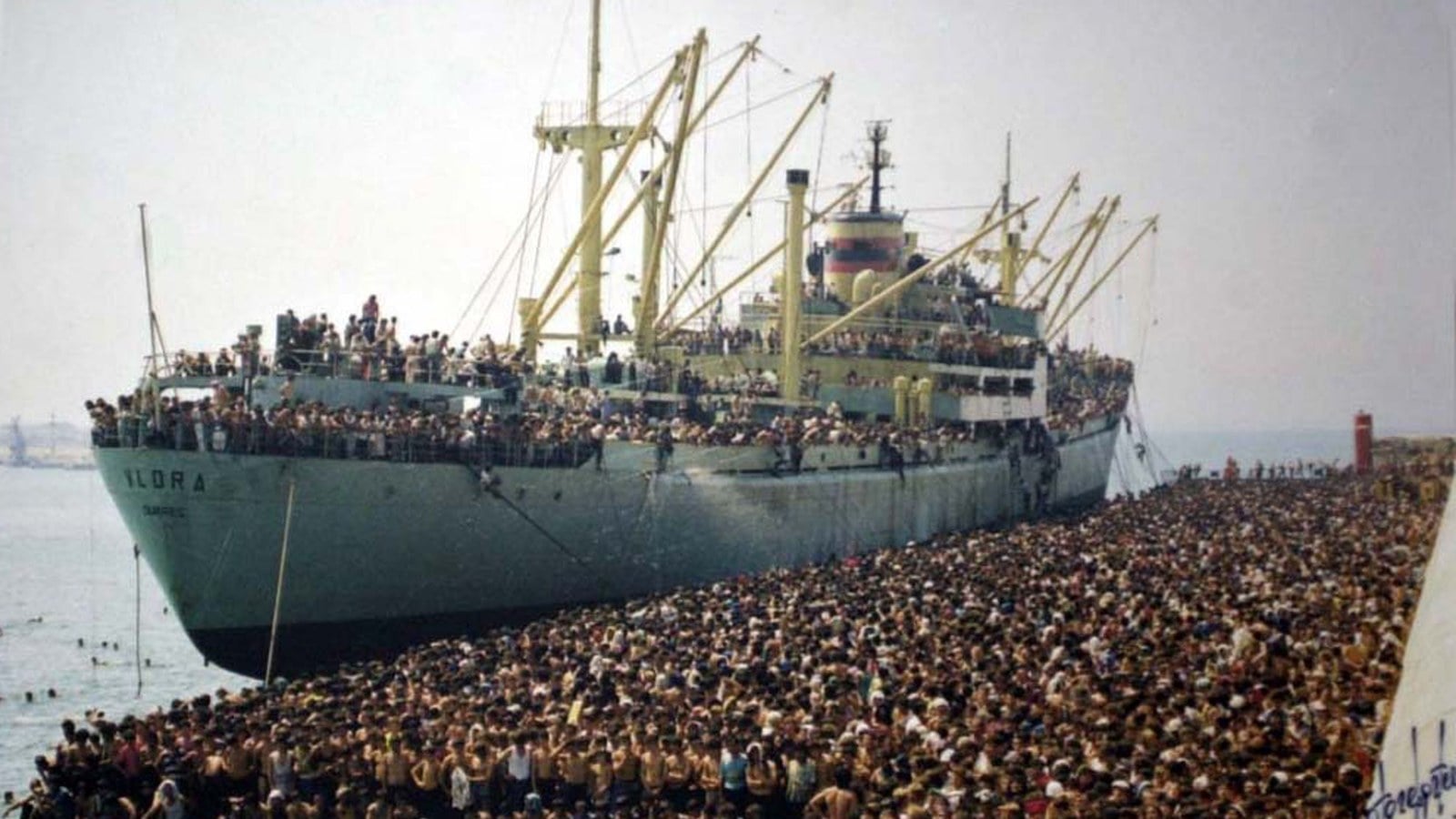
- August 8, 1991 — The cargo ship Vlora arrives in Bari, Italy with roughly 20,000 Albanians aboard.
- March 22, 1992 — Early elections give the Democratic Party 62.1%; Sali Berisha is elected president on April 9, 1992, ending the continuous rule of the Party of Labour.
The next sections fill that in.
Why Albania’s communism was different to begin with
To understand the speed of the 1990–1992 collapse, it helps to remember what was collapsing.
The communist state — proclaimed the People’s Republic of Albania on January 11, 1946, and renamed the People’s Socialist Republic of Albania under the 1976 constitution (Wikipedia) — was the most closed in Europe. Enver Hoxha, the wartime leader of the Albanian Communist Party (later the Party of Labour), ran the country from 1944 until his death in 1985. The regime aligned successively with Yugoslavia until 1948, the Soviet Union until 1961, and China until 1978, then broke with all three and stayed politically alone for its last twelve years.
The internal architecture was severe by any neighbor’s standard. Agriculture was collectivized in the 1950s and 1960s. Religion was banned outright in 1967, when Hoxha declared Albania the world’s first officially atheist state and roughly 2,169 mosques, churches, and Bektashi teqes (Sufi lodges) were closed or destroyed — long version in our first atheist country piece. Emigration was a felony, foreign travel required Politburo approval, and foreign radio was jammed.
The instrument of internal control was the Sigurimi — Drejtoria e Sigurimit të Shtetit, the State Security Directorate — with a documented network of informants and a prison and labor-camp archipelago that included Spaç (a chrome and copper mine in Mirdita), Burrel (the political prison north of Tirana), and Qafë-Bari. The Albanian Institute for the Study of Crimes and Consequences of Communism has documented roughly 6,000 political executions and 34,000 political prisoners across the regime’s 46-year span.
These facts are not introduced to relitigate the regime. They explain the paradox the rest of this article makes sense of: a system this fortified collapsed in 16 months once it moved at all.
Hoxha dies, Alia inherits
When Enver Hoxha died on April 11, 1985, the succession had been planned for years. Ramiz Alia — born in Shkodër in 1925, a longtime Politburo member and head of state since 1982 — became First Secretary of the Party of Labour. He inherited a regime designed to outlast its founder and an economy that had been visibly stagnating since the break with China in 1978.
Alia’s first years were cautious. He preserved the broad architecture of Hoxha’s system — one-party rule, the religious ban, closed borders, central planning — but loosened it at the edges. Some restrictions on foreign trade were relaxed. By 1989, Albania had restored partial diplomatic relations with West Germany and was negotiating with several Western European states.
This was nowhere near perestroika. Alia had spent his career inside Hoxha’s apparatus. But he was watching the rest of the Eastern Bloc through 1989 — the fall of the Berlin Wall in November, the Ceaușescu execution in Romania in December — with the awareness of a leader who could read maps. The Romanian case was the one Albanian officials reportedly studied most closely. Ceaușescu had run the only other Balkan regime of comparable severity, and his end had been short, public, and lethal.
Alia’s response across 1990 was a controlled opening. In May 1990, the Plenum legalized private commerce in small goods, restored some judicial independence, and softened travel restrictions. Article 37 of the 1976 constitution — under which the state recognized no religion — was effectively suspended in late 1990, and the first public Catholic Mass since 1967 was celebrated in Shkodër on November 4, 1990.
The opening meant to be controlled almost immediately ceased to be.
July 1990: the embassy crisis
The first inflection point came in early July 1990. Albanian families had been seeking refuge inside foreign embassies in Tirana for months, and on July 2, 1990 the situation escalated. Crowds began climbing the walls of the West German, Italian, French, Czechoslovak, Greek, Hungarian, and Polish embassies, often by the hundreds. By July 6, the total inside the compounds had reached approximately 5,000.
The government’s initial response was to surround the embassies with troops and demand the foreigners hand the refugees back. Western governments refused. After several days of negotiation, Alia authorized the evacuation. Between July 10 and July 13, 1990, the refugees were bussed to Durrës and put on ferries to Brindisi and other Italian ports, and from there flown onward to West Germany, France, and other countries that had agreed to receive them.
The embassy crisis was the first visible crack in the regime’s claim that no Albanian wished to leave. It was reported in detail internationally and traveled inside Albania by word of mouth and via smuggled radios. For a regime that had spent four decades insisting its citizens were content, the spectacle of 5,000 people scaling walls to leave was a hinge.
December 1990: the Tirana student protests
The political collapse came five months later.
On the evening of December 8, 1990, students at Enver Hoxha University in Tirana — the country’s largest university, named for the late dictator — began protesting dormitory conditions after a loss of electricity. Within hours the demands turned political: an end to one-party rule, free elections, and the removal of Hoxha’s name from the university itself. Azem Hajdari, a philosophy student, emerged as one of the recognized student spokesmen.
Across December 9 and 10, crowds in Tirana reached the tens of thousands and demonstrations spread to Durrës, Elbasan, and Shkodër. State media initially blacked out the protests; the news traveled through neighborhoods and into the countryside within days. The Politburo, in emergency session, debated whether to use force.
The decision Alia made on December 11, 1990 is the central political event of the transition. The Politburo authorized — and Alia announced — the legalization of independent political parties. The constitutional monopoly of the Party of Labour was over. The next day, December 12, 1990, Sali Berisha, a cardiologist at the Tirana University Hospital and a former Party member, joined Hajdari and others to found the Democratic Party of Albania — the first legal opposition party in 46 years.
Students kept pressing through the following weeks. Hoxha’s name was removed from the university in February 1991. On February 20, 1991, a crowd in central Tirana pulled down the bronze statue of Enver Hoxha on Skanderbeg Square. The image became the international shorthand for what had happened.
The Vlora ship and the 1991 emigration wave
The Vlora episode is the one most Albanian-American families either lived or watched.
On the morning of August 7, 1991, the cargo ship Vlora — an Italian-built freighter (launched at Cantieri Navali Riuniti in Ancona in 1960) owned by an Albanian shipping company — arrived at the port of Durrës to unload sugar it had carried back from Cuba. Within hours, word spread that the ship would attempt to sail to Italy. By that evening, an estimated 20,000 people had boarded — climbing ropes, gangways, anything they could find. Photographs from the time show every flat surface of the ship — decks, lifeboats, masts, container roofs — covered in people standing shoulder to shoulder.
The Vlora left Durrës overnight, captain reportedly under duress, and arrived at the Italian port of Bari on the afternoon of August 8, 1991. The Italian government, which had already received tens of thousands of Albanians earlier in 1991, was unprepared for a single arrival of this size. The passengers were held in the Stadio della Vittoria soccer stadium in Bari for several days under conditions of severe overcrowding. Most were repatriated within weeks; several thousand remained in Italy on humanitarian or family grounds.
The Vlora was the most photographed event of the wave but not the only one. Across March and August 1991, Italian authorities recorded at least 45,000 Albanian arrivals by sea, most in small boats landing in Puglia and Calabria. The Greek border absorbed an even larger, longer-building movement: Albanians continued crossing into Greece on foot through the southern mountains throughout the decade, and Greece’s recorded Albanian immigrant population reached roughly 443,550 by the 2001 census. A smaller flow reached the United States through family reunification, the Diversity Visa lottery (begun in 1990 and immediately drawing heavy Albanian participation), and asylum tracks. American parishes, civic groups, and Vatra — the Pan-Albanian Federation of America, founded in 1912 in Boston (Vatra) — were among the institutions that resettled the new arrivals.
For Albanian-American families, the Vlora arrival is often the moment older relatives describe as the point at which it became possible to imagine the family being whole again. By the end of 1991, cumulative emigration from a country of roughly 3.3 million ran into the hundreds of thousands — proportionally one of the largest single emigration episodes in postwar Europe.
The March 1991 elections and the renaming of the republic
Parallel to the emigration wave, the formal political transition was moving.
The first multi-party elections in Albania since 1923 were held on March 31, 1991. The Party of Labour won 169 of 250 seats — a majority — largely on rural southern votes, where the party retained organizational depth. The Democratic Party won 75 seats, concentrated in Tirana, the other major cities, and the northern districts. Turnout was about 98%.
The new People’s Assembly took its seats in April 1991 and passed the Law on Major Constitutional Provisions (Ligji nr. 7491) on April 29, 1991. The law renamed the country from the People’s Socialist Republic of Albania to the Republic of Albania, removed the word socialist from the official designation, separated party and state, and established the framework for a parliamentary democracy. Ramiz Alia resigned as First Secretary of the Party of Labour and became the first president of the new Republic.
The first all-Socialist post-election government, under Prime Minister Fatos Nano, lasted barely two months. A general strike in May 1991 over food shortages forced Nano’s cabinet to resign. On June 5, 1991, a coalition — the Qeveria e Stabilitetit, the Government of Stability — formed under Ylli Bufi, with Democratic Party ministers including Berisha taking key portfolios. This was the first non-communist-led government in Albania since 1944.
The Government of Stability lasted six months. By December 1991 the Democratic Party had withdrawn over disputes about the pace of reform, and Albania headed toward early elections.
March 1992: the end of the People’s Republic
The March 22, 1992 elections were the decisive break.
The Democratic Party won 62.1% of the vote and 92 of 140 seats. The Socialist Party — the renamed Party of Labour — fell to 25.7% and 38 seats. Smaller parties took the rest. Turnout was again high; the result was clear and not contested.
Ramiz Alia resigned the presidency on April 3, 1992. The People’s Assembly elected Sali Berisha president on April 9, 1992 — the first non-communist head of state in Albania in 47 years. Aleksandër Meksi, a Democratic Party MP, became prime minister. The continuous rule of the Party of Labour, begun with the proclamation of the People’s Republic in January 1946, was over.
Alia was later arrested and tried for abuses committed under the regime. He was convicted in 1994 of nine charges including misuse of power, sentenced to nine years, then amnestied in 1995. He died in 2011. The broader reckoning — lustration, the opening of Sigurimi files, compensation for political prisoners — became a recurring debate of post-communist Albanian politics, and the 2008 lustration law was ultimately struck down by the Constitutional Court. The legal closing of the communist period is, in that narrower sense, still being written.
How this period created the modern Albanian-American community
Albanian settlement in the United States is older than the 1990s wave by almost a century. The first known Albanian immigrant, Kolë Kristofori (Nicholas Christopher), arrived in Boston in the mid-1880s. The first major wave came in the 1900s through the 1920s, settling factory cities in Massachusetts, Connecticut, Michigan, and New York. A second wave followed World War II — anti-communist refugees admitted under the Displaced Persons Act and later the Refugee Relief Act. A third wave ran through the 1960s and 1980s from Yugoslav-controlled Kosovo and present-day North Macedonia.
The 1990–1992 wave is the largest of them, and the one that explains the shape of the community today.
By the 2024 American Community Survey (ACS B04006), there are roughly 230,000 Albanian Americans — up from 47,710 in the 1990 Census, the first year the ACS broke out Albanian ancestry. Most of that 4.7× increase reflects post-1990 arrival and their American-born children. The top three states — New York (~56,000), Michigan (~27,000), and Massachusetts (~21,000) — are the same three centers that received the 1900s wave a century earlier, now thickened by post-communist arrivals. Community estimates including ethnic Albanians from Kosovo, North Macedonia, and Montenegro plus second- and third-generation Americans run closer to one million. Longer treatment in our Albanian Americans piece.
The institutions that received the 1990s wave were mostly older than the wave itself. Vatra — Federata Panshqiptare e Amerikës — was founded in 1912 in Boston and has functioned as a continuity organization across four immigration waves. The Albanian-American Civic League (AACL) has organized on Kosovo and broader policy concerns since the late 1980s. AANO chapters and the Arbëresh associations (the Italo-Albanian community whose ancestors arrived in southern Italy in the 15th century) form a second layer. Parishes — Albanian Orthodox in Boston and Worcester; Catholic in the Bronx and Detroit; mosques in Hartford, Waterbury, and the Detroit metro — form the third.
The 1990s wave didn’t replace those institutions. It walked into them.
What to do with the family history
For families whose arrival traces to the 1990–1992 window, the historical record is often clearer than the household record. The political dates above are documented. The personal dates — who left first, who sent for whom, what date the visa was stamped — usually are not.
Capture the oral history while it can still be captured. The 1990–1992 generation is now in its 50s, 60s, and 70s. An hour with a parent or grandparent and a phone recorder, walking through the week they left and the first month they arrived, produces a document future generations cannot otherwise recover.
Locate the documents that exist. Passport stamps, refugee paperwork, INS or DHS green-card files, school enrollment records, baptism or nikah certificates from the destination parish. Consolidating them into one folder is a one-afternoon project descendants will quietly thank someone for.
Get counted. The U.S. Census undercounts Albanian Americans by a large margin — the 230,000 ACS figure against community estimates of 750,000–1,000,000. The National Albanian Registry is building a community-led count, including descendants of the 1990–1992 wave. Registration takes about three minutes, the data stays private, and registrants receive a recognition certificate — a recognition document, not a government ID, not citizenship, and not legally binding, stated plainly on the certificate itself.
If your family’s American story begins in the months between the Tirana student protests and the Vlora ship, this is the period that put you here. Get counted.