
This article covers who they are, how they came to live there, what happened in 2001, and what the Ohrid Framework Agreement changed. For the broader question of how Kosovo and Albania relate to each other, see our separate explainer on Kosovo vs Albania.
By the numbers
The 2021 census — North Macedonia’s first in twenty years — counted 446,245 ethnic Albanians among the resident population, or 24.3 percent. When citizens living abroad are included, the figure rises to 619,187, or 29.5 percent of the total registered population.
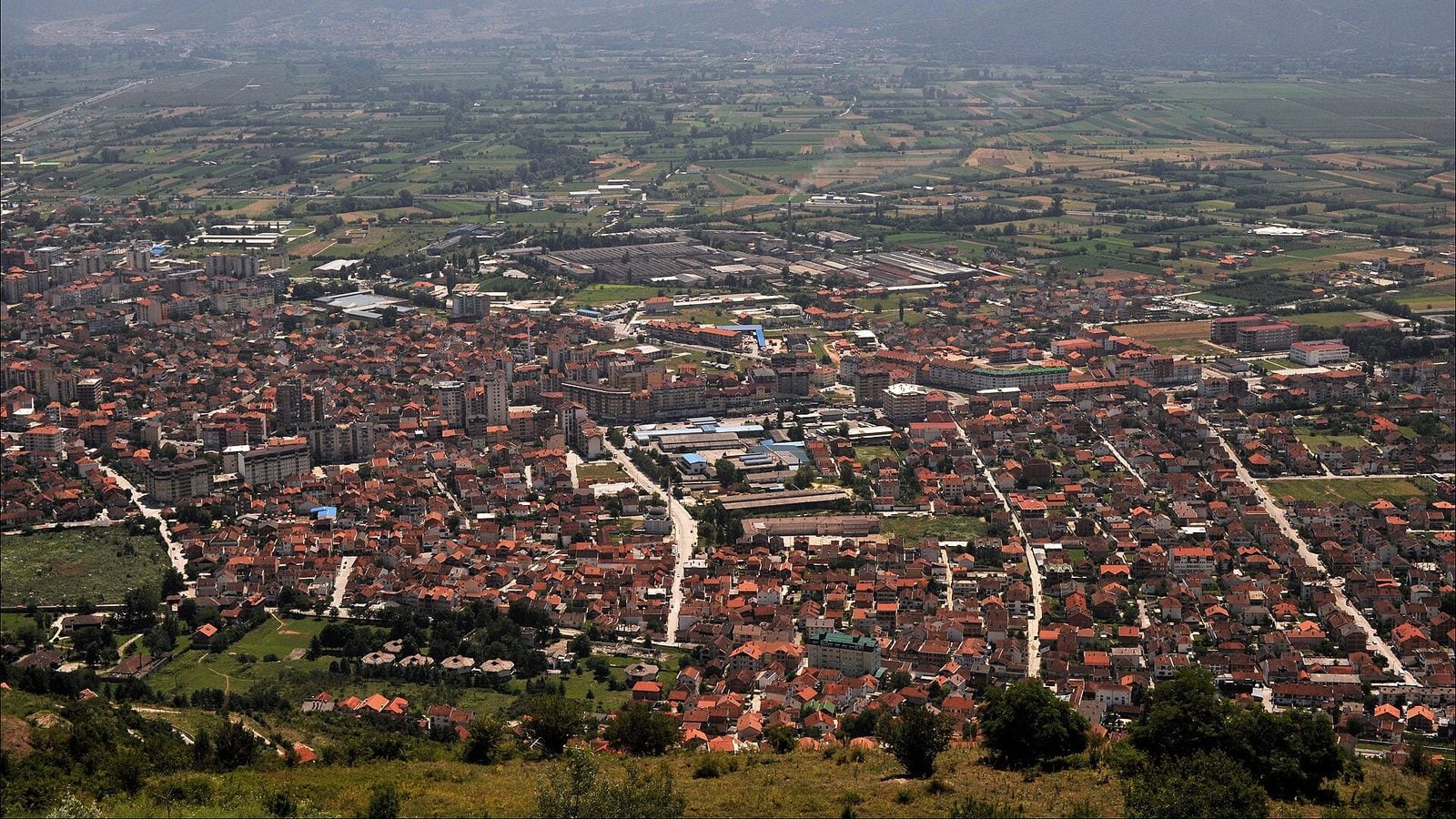
The geographic concentration is sharp. In Tetovo municipality, 70.3 percent of residents are Albanian. In Gostivar, the figure is 66.7 percent. Debar, Kičevo, and Struga all have Albanian pluralities or majorities. Several municipalities in western Skopje — Čair, Saraj, Šuto Orizari — are majority Albanian. East of a rough line running through central Skopje, the population is overwhelmingly ethnic Macedonian.
This is not a recent settlement pattern. It reflects centuries of continuous habitation that predates the modern state.
How the border drew itself around them
During Ottoman rule, the territory that is now western North Macedonia was part of the Kosovo Vilayet, an administrative unit whose population was substantially Albanian. The Albanian communities in Tetovo, Gostivar, and the Polog valley were part of the same cultural and economic fabric as Albanians in Pristina and Prizren.
The Balkan Wars of 1912–1913 dismantled the Ottoman presence in Europe. The 1913 Treaty of Bucharest assigned the region to the Kingdom of Serbia, not to the newly independent Albania. The result: more than half of the Albanian-speaking population of the Ottoman Balkans ended up outside Albania’s borders. The western Macedonian Albanians were among them.
Through the Kingdom of Yugoslavia, wartime occupation, and socialist Yugoslavia, the community remained in place. Its legal status fluctuated — periods of cultural suppression alternated with periods of limited autonomy — but the demographic reality did not change. When North Macedonia declared independence from Yugoslavia on September 8, 1991, the Albanian minority was already a quarter of the population.
The 2001 conflict
By the late 1990s, ethnic Albanians in North Macedonia had concrete grievances. Albanian was not an official language at the state level. Albanians were underrepresented in public administration, the police, and the judiciary. The University of Tetovo, founded in 1994 as an Albanian-language institution, was not recognized by the government and had faced police raids in which one person was killed.
The Kosovo War of 1998–1999 and NATO’s intervention next door sharpened these tensions. In January 2001, the National Liberation Army (NLA), an ethnic Albanian armed group led by Ali Ahmeti, launched an insurgency in the northwest. The NLA’s stated aims were greater rights for Albanians within North Macedonia — not secession and not union with Albania or Kosovo.
Fighting lasted from January to August 2001. It was concentrated in the Tetovo and Kumanovo areas and displaced roughly 170,000 people. The conflict ended not with a military victory by either side but with a negotiated settlement: the Ohrid Framework Agreement, signed on August 13, 2001.
The Ohrid Framework Agreement
The Ohrid Framework Agreement is the foundational document of post-2001 North Macedonia. Brokered by the European Union and the United States, it kept the country as a unitary state while expanding minority rights in three areas:
Language. Any language spoken by at least 20 percent of the population in a given municipality became co-official there. In practice, this meant Albanian became the working language of local government, courts, and public services in Tetovo, Gostivar, Debar, Struga, Kičevo, and parts of Skopje. A 2019 law later extended Albanian-language rights at the national level.
Representation. The agreement required equitable representation of ethnic communities in public administration, the police, and the judiciary — proportional to their share of the population. This was a direct response to the pre-2001 reality in which Albanians held a small fraction of state jobs despite being a quarter of the country.
Decentralization. Municipalities gained greater authority over local services, education, and culture. This gave Albanian-majority municipalities meaningful control over their own affairs without creating a formal autonomous region.
The agreement worked in the narrow sense that the fighting stopped and did not resume. Its broader implementation has been uneven — Albanian representation in state institutions has improved but remains below proportional levels in some sectors, and interethnic tensions surface periodically — but the framework itself has held for twenty-five years.
Language and education
The language question has been central to Albanian life in North Macedonia for decades. Two institutions illustrate how it has played out.
The University of Tetovo was founded on December 17, 1994, as a private Albanian-language university. The Macedonian government declared it illegal. In 1995, police raided the campus; one person, Abdylselam Emini, was killed. The university continued operating without state recognition until January 2004, when it was finally recognized as a public institution. Today it enrolls roughly 7,000 students and offers instruction in Albanian, Macedonian, and English.
The South East European University in Tetovo, founded in 2001 with international backing, was designed from the start as a multilingual institution. It teaches in Albanian, Macedonian, and English and has served as a model for interethnic higher education in the region.
As of 2026, a live issue is the right to take professional licensing exams — bar exams and judicial qualification tests — in Albanian. Albanian law students have staged protests demanding this right, arguing that the Ohrid Agreement’s language provisions should extend to professional certification.
Political representation
The political landscape of North Macedonia’s Albanians has been dominated since 2002 by the Democratic Union for Integration (DUI), founded on June 5, 2002, by Ali Ahmeti — the same figure who led the NLA during the 2001 conflict. The transition from armed resistance leader to democratic party chief was a deliberate choice, and DUI became the primary Albanian coalition partner in successive governments for two decades.
Other Albanian parties — the Democratic Party of Albanians (DPA), the Alliance for Albanians, and Alternativa — have competed for the Albanian vote, sometimes in coalition and sometimes in opposition. The competition among Albanian parties has been a consistent feature of North Macedonian politics; no election since independence has been decided without an Albanian coalition partner.
The most famous Albanian from Skopje
The single most internationally recognized person of Albanian heritage from North Macedonia is Mother Teresa — born Anjezë Gonxhe Bojaxhiu in Skopje in 1910, when the city was part of the Ottoman Empire. Her family was Albanian and Catholic. She won the 1979 Nobel Peace Prize and was canonized as Saint Teresa of Calcutta in 2016. Albania, Kosovo, and North Macedonia all claim her as a national figure.
Her story is covered in full in our dedicated article. What matters here is the context: Skopje’s Albanian Catholic minority — the community Mother Teresa came from — is part of the same long-standing Albanian presence in the region that this article describes.
The US diaspora connection
Albanian emigration from the territory of present-day North Macedonia to the United States began in the early 1900s, when men from the Tetovo and Gostivar regions traveled to find industrial work. That first wave settled in cities like Detroit, Chicago, and New York and founded some of the earliest Albanian community organizations in America.
Post-2001 emigration has added a newer layer. Albanians from North Macedonia have settled in existing Albanian-American communities across the country, particularly in the New York metro area and Michigan. They share language and cultural ties with Albanians from Albania and Kosovo, but they carry a distinct civic experience — one shaped by life as a constitutional minority in a Slavic-majority state, by the 2001 conflict, and by the Ohrid framework.
For a broader look at how Albanian-American communities have formed in different waves and from different source countries, see our article on the five Albanian Americas.
Where things stand
Twenty-five years after the Ohrid Agreement, the Albanian community in North Macedonia occupies an unusual position. It is large enough — a quarter of the country — to be a permanent fixture of the state’s political structure, but it is a minority in a country whose ethnic Macedonian majority controls most national institutions.
The concrete gains since 2001 are real: Albanian-language education at every level, Albanian as a working language in local government and increasingly at the national level, improved (if still incomplete) representation in public administration, and a functioning multiparty Albanian political scene.
The unresolved issues are also real: professional licensing in Albanian remains contested, economic development in the western Albanian-majority municipalities lags behind the rest of the country, and interethnic trust, while functional, is not deep.
The Šarena Džamija — Tetovo’s Painted Mosque, built in 1438 and reconstructed in 1833 with its distinctive exterior frescoes — still stands at the center of the old town. It is one of the most photographed buildings in North Macedonia, and it is Albanian. So is roughly a quarter of everything else in the country.