
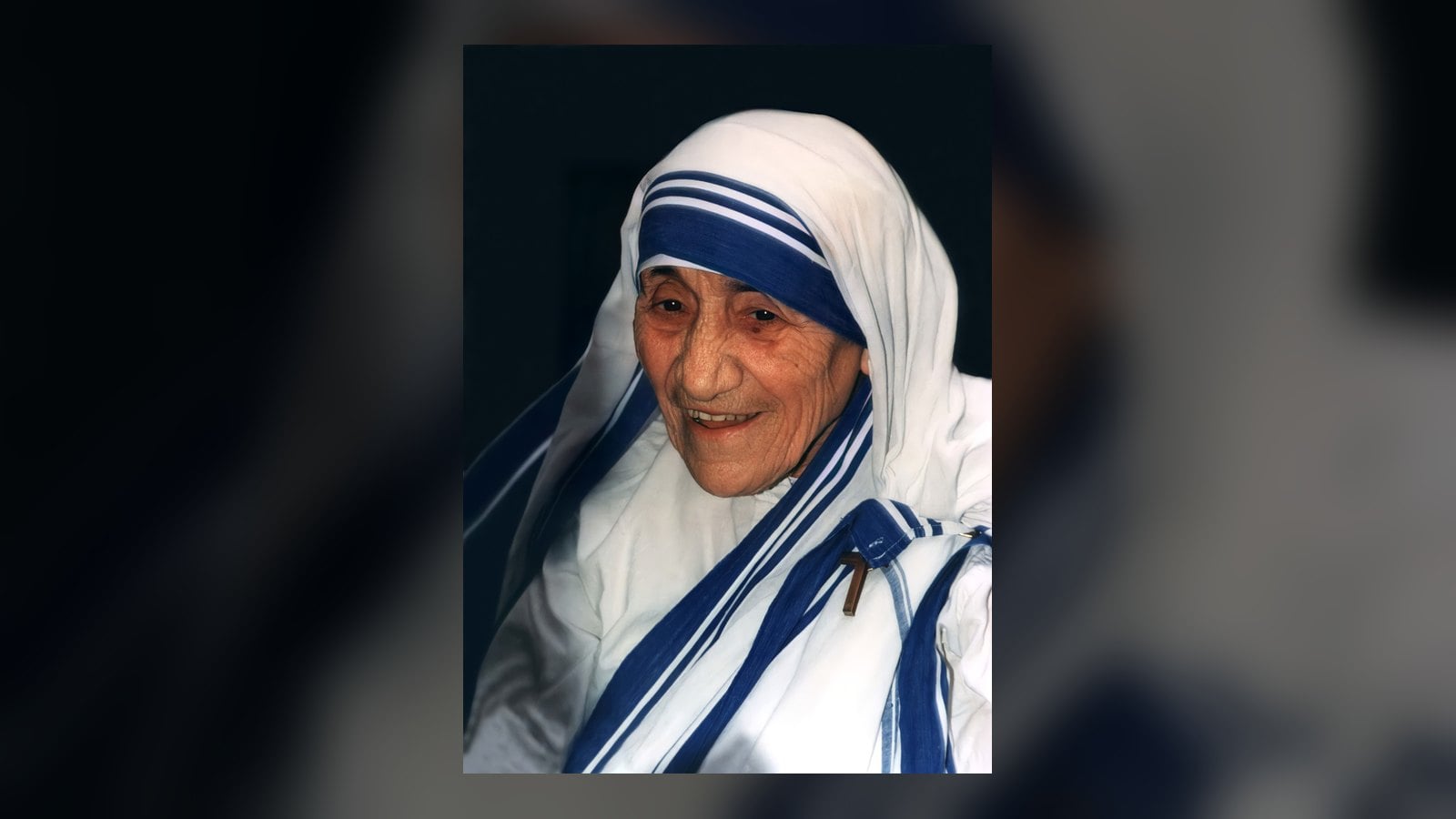
Mother Teresa — born Anjezë Gonxhe Bojaxhiu on August 26, 1910 — was the Albanian Catholic nun who founded the Missionaries of Charity, won the 1979 Nobel Peace Prize, and was canonized as Saint Teresa of Calcutta by Pope Francis on September 4, 2016. She is one of two Albanian Nobel laureates. The other is the Albanian-American pharmacologist Ferid Murad, who shared the 1998 Nobel Prize in Medicine.
Albanians on three continents claim her, and the claim is unusually well-grounded. She was born in Skopje — then in the Ottoman Empire, today the capital of North Macedonia — to an Albanian Catholic family that spoke Albanian at home. She identified as Albanian her entire adult life. Albania, Kosovo, and North Macedonia each treat her as a national figure, and the Albanian-American diaspora invokes her name in nearly every speech, school presentation, and heritage-month observance about who Albanians are and what the community has produced.
This piece is her life, her work, her legacy, and her place in Albanian-American memory. We cite Wikipedia inline as the canonical reference for dates and biographical detail. The criticisms of her work are mentioned briefly and in context — they are documented, the reader can find them, and they don’t change the larger story.
An Albanian Catholic family in Skopje
Anjezë Gonxhe Bojaxhiu was born on August 26, 1910, in Skopje, then part of the Ottoman Empire’s Kosovo Vilayet, today the capital of North Macedonia.
Her father, Nikollë Bojaxhiu, was an Albanian Catholic merchant and a nationalist activist involved in the Albanian community’s politics in the years leading up to and immediately after Albanian independence in 1912. He was, by the standards of the time and place, a prominent figure — a small-business man with a hand in trade and construction across the Balkans, and a public-facing partisan of the Albanian cause. In 1919, when Anjezë was eight years old, he died suddenly. The family understood at the time, and the historical record has continued to suggest, that he was likely poisoned for his political activities — possibly by Serbian agents during the period of Yugoslav consolidation in Macedonia (Wikipedia: Mother Teresa).
Her mother, Dranafile “Drane” Bernai Bojaxhiu, was also Albanian. Widowed at a young age with three children, she ran the household and supported the family through embroidery and small trade. The three children were:
- Lazar, the oldest, who later served as an officer in the army of King Zog of Albania and lived most of his adult life in Italy
- Aga, the middle daughter
- Anjezë, the youngest, the future Mother Teresa
The family belonged to the Albanian Catholic minority of Macedonia — a small, tightly knit community within a city that was itself a patchwork of Ottoman-era ethnicities and faiths (Albanian Muslim, Albanian Catholic, Macedonian Slav Orthodox, Sephardic Jewish, Turkish, Vlach). Anjezë attended the Sacred Heart parish school, the local Albanian-language Catholic primary school in Skopje. She spoke Albanian at home, Serbian at school in the early years, and learned English later through her religious education (Wikipedia: Mother Teresa).
By her own account, she resolved at age 12 that she wanted to commit to a religious life. The decision was firm enough that, six years later, she acted on it without apparent hesitation.
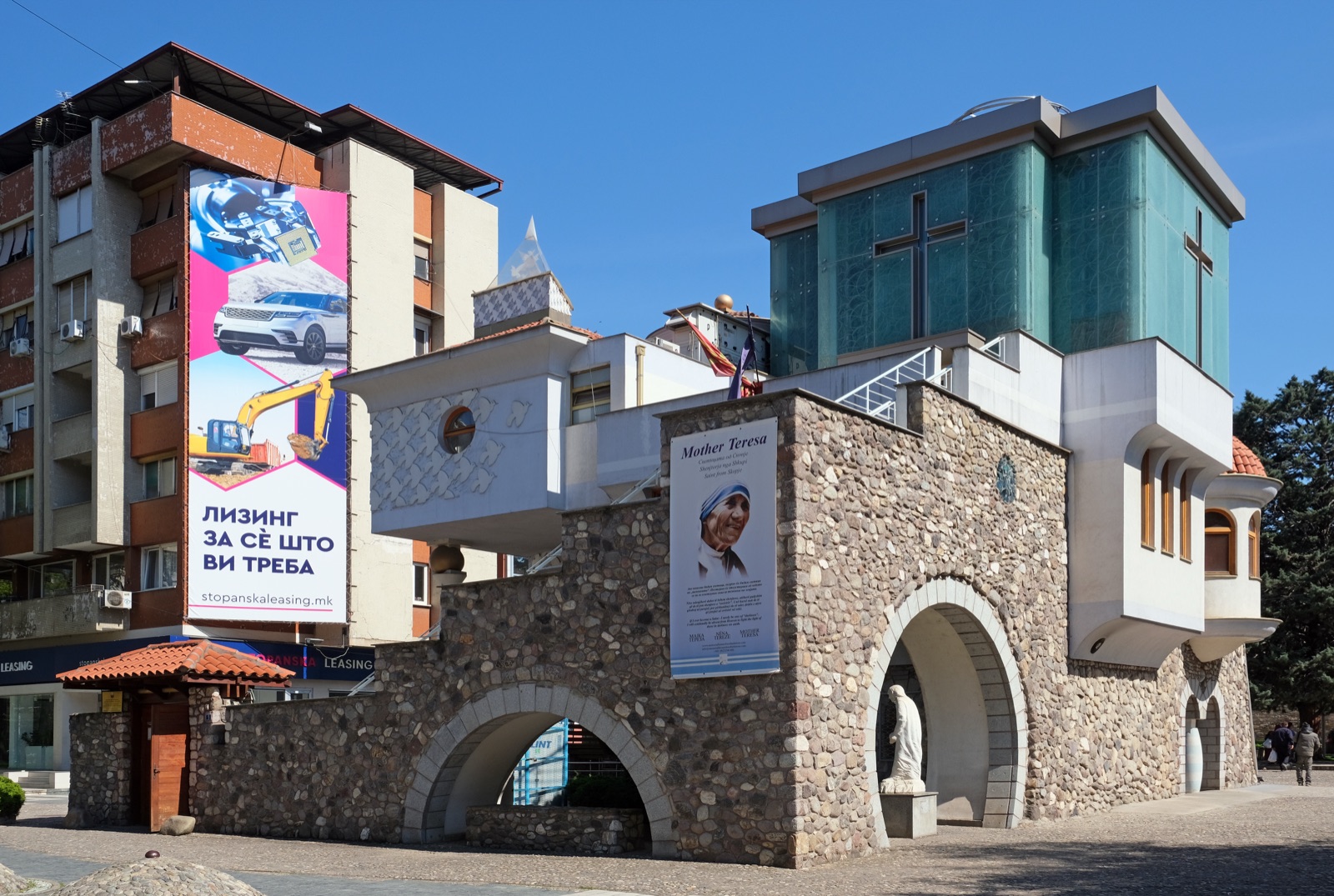 Photo: Wikimedia Commons / CC BY-SA 4.0
This is the cultural and family inheritance she carried for the rest of her life: an Albanian Catholic upbringing in a Balkan city, a politically engaged father lost early, a strong mother running a household on embroidery income, and an early, unwavering sense of vocation. None of those facts ever fell away. Late in life, in interviews and private correspondence, she returned to Skopje and to her Albanian family of origin as the formative ground of who she was.
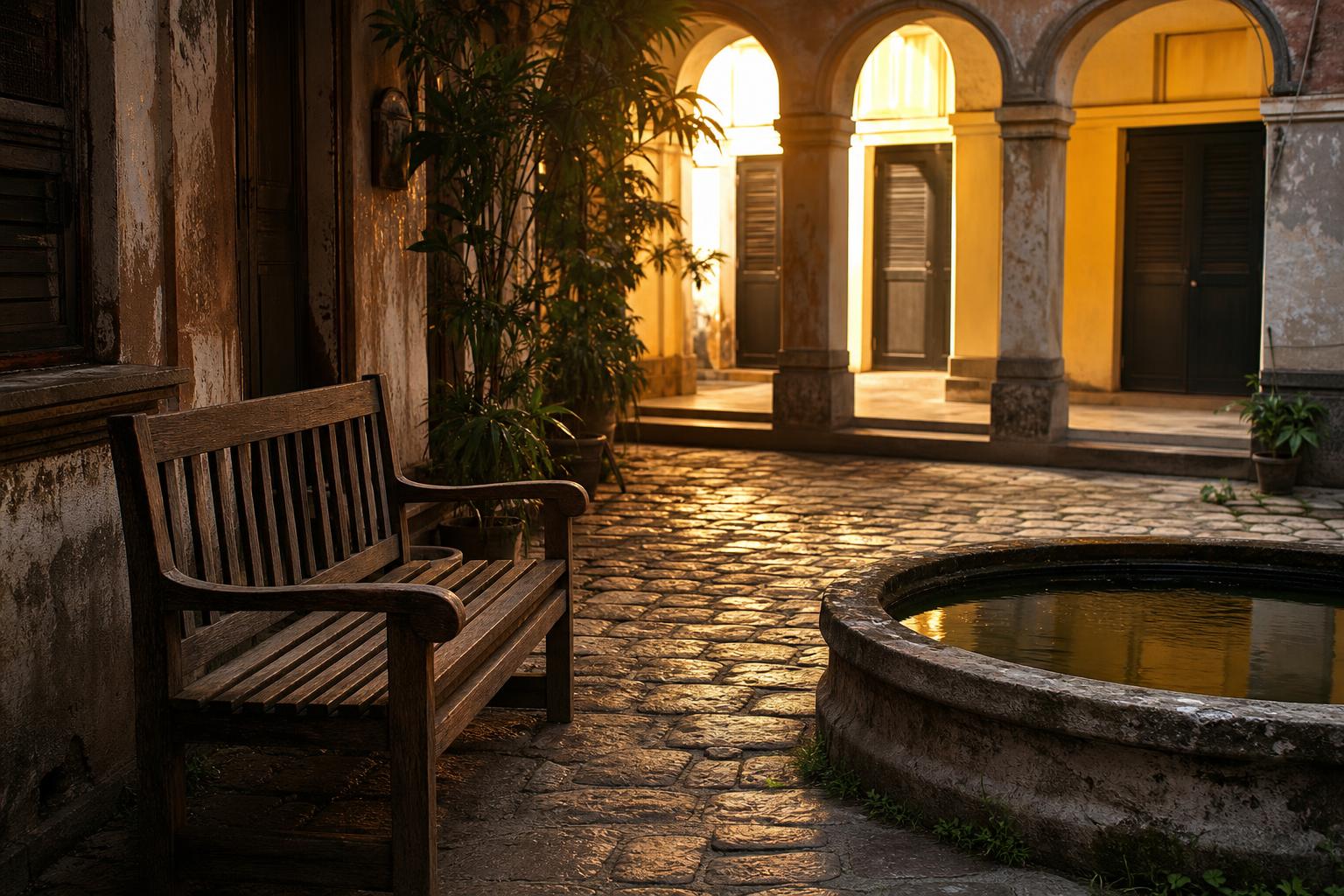 Calcutta-style courtyard evoking the Loreto convent grounds in India where Anjezë Bojaxhiu arrived in 1929 and took the religious name Teresa.
Graphic by NAR
Calcutta-style courtyard evoking the Loreto convent grounds in India where Anjezë Bojaxhiu arrived in 1929 and took the religious name Teresa.
Graphic by NAR
Joining the Sisters of Loreto (1928)
In 1928, at age 18, Anjezë left Skopje and traveled to Ireland to join the Sisters of Loreto, an Irish congregation of Catholic nuns active in missionary education across the British Empire. She arrived at Loreto Abbey in Rathfarnham, Dublin, in late 1928, where she spent roughly six weeks learning English — the working language of the order — before being sent onward to India (Wikipedia: Mother Teresa).
It is at the Sisters of Loreto that she took the religious name Teresa — the Spanish form, after Saint Thérèse of Lisieux, the late-19th-century French Carmelite known as the “Little Flower” and the patron saint of missionaries.
She arrived in India in 1929 and was sent to Darjeeling, in the foothills of the Himalayas, for her novitiate — the formation period during which a candidate trains for full vows.
She took her first religious vows on May 24, 1931, and her solemn (final) vows on May 14, 1937, at age 27. From that point on, she was Sister — and later Mother — Teresa (Wikipedia: Mother Teresa).
The trajectory she had set for herself was, by the standards of mid-20th-century Catholic religious life, conventional. She had joined a teaching order. She would teach. The Sisters of Loreto ran convent schools across British India, and she was sent to one of them.
Teaching at St. Mary’s School (1929-1948)
For roughly two decades, Mother Teresa taught at the Loreto convent school in Calcutta — most often associated with St. Mary’s School in the Entally neighborhood. She taught geography and history to girls in the upper grades, and she rose through the ranks of the school staff. By 1944, she had been promoted to headmistress (Wikipedia: Mother Teresa).
The Loreto convent was a walled compound. Inside the walls were classrooms, a chapel, a garden, and the day-to-day routine of a girls’ boarding and day school for the daughters of relatively well-off Calcutta families — Catholic, Anglo-Indian, Bengali, and otherwise. Outside the walls was the Calcutta of the 1930s and 1940s: a colonial port city of enormous wealth and enormous, conspicuous poverty, where the Bengal famine of 1943 killed an estimated two to three million people in the surrounding countryside, and the Calcutta riots of 1946 during the run-up to Partition produced thousands more dead and tens of thousands of displaced people in the streets.
She had been observing the slums of Calcutta from inside the convent walls for nearly twenty years.
She had, by all accounts, been a popular and capable teacher and a steady administrator. There is no indication in the record that anyone — including Mother Teresa herself — expected what came next.
The “call within a call” (1946)
On September 10, 1946, on a train from Calcutta to Darjeeling for her annual retreat, Mother Teresa experienced what she would later describe as a direct divine call to leave the convent and live among the poorest of Calcutta. The Missionaries of Charity have observed September 10 as “Inspiration Day” ever since (Wikipedia: Mother Teresa).
She did not leave that week, or that month, or that year. The Catholic Church — particularly inside an established religious order — does not allow a sister to walk away from her vows on personal conviction. The path forward had to go through Rome.
She petitioned her superiors at the Sisters of Loreto, who in turn petitioned the Archbishop of Calcutta, who in turn petitioned the Vatican. The case was for what canon law calls exclaustration — formal permission for a vowed religious to live outside her cloister while remaining bound to her vows. The review took roughly two years.
In 1948, permission was granted. Mother Teresa left the Loreto convent, took a brief course in basic medicine and nursing with the Medical Mission Sisters in Patna, and returned to Calcutta. She set aside the European-style nun’s habit she had worn for two decades and put on a simple white cotton sari with three blue stripes along the border — meant to look like the saris worn by Indian women, not like a Western religious habit. The choice was deliberate. She did not want to enter the slums dressed as a colonial figure (Wikipedia: Mother Teresa).
She was 38 years old, alone, and starting from zero.
Founding the Missionaries of Charity (1950)
On October 7, 1950, Pope Pius XII formally established the Missionaries of Charity as a religious congregation under the Archdiocese of Calcutta. The founding statement of mission was direct in a way that Vatican documents rarely are. The order existed to care for, in Mother Teresa’s words, “the hungry, the naked, the homeless, the crippled, the blind, the lepers, all those people who feel unwanted, unloved, uncared for throughout society — people that have become a burden to the society and are shunned by everyone” (Wikipedia: Mother Teresa).
The first home was a small rented building in Calcutta. The first sisters — twelve at the start — included some of her former students from St. Mary’s. The work, in its earliest years, was running a small open-air school for slum children, then a dispensary, then a home for the dying poor at the Kalighat temple complex that became known as Nirmal Hriday (“Pure Heart”) — the model for what would, in time, become the Missionaries of Charity’s most distinctive institution.
Growth was rapid in a way that surprised the order itself.
By the early 1960s the Missionaries of Charity had spread beyond Calcutta to other Indian cities. In 1965, the Vatican granted the order the right to operate internationally, and Mother Teresa opened the first house outside India — in Cocorote, Venezuela. By the 1970s, the order had houses in dozens of countries. By the time of Mother Teresa’s death in 1997, the order operated over 4,000 sisters running 610 missions in 123 countries (Wikipedia: Mother Teresa). Today, that footprint is larger still — the order also includes a brothers’ branch (the Missionaries of Charity Brothers, founded 1963) and a contemplative branch.
The work has remained, throughout, organized around a small set of concrete tasks: hospices for the dying, homes for the abandoned and the disabled, leprosy clinics, soup kitchens, orphanages, AIDS hospices added in the 1980s, schools, mobile clinics. The sisters take a distinctive fourth vow in addition to the standard three of poverty, chastity, and obedience: a vow of wholehearted free service to the poorest of the poor.
The Nobel Peace Prize (1979)
On October 17, 1979, the Norwegian Nobel Committee announced that the Nobel Peace Prize would be awarded to Mother Teresa “for her work for bringing help to suffering humanity” (Wikipedia: Mother Teresa).
She accepted the prize in Oslo on December 10, 1979.
She made one public request in connection with the award that has been remembered, in Albanian-American homes and elsewhere, ever since: she asked the Nobel committee to skip the customary ceremonial banquet and to donate the cost — approximately $192,000 — directly to the poor of India. The committee complied.
Her Nobel lecture is short by Stockholm/Oslo standards and almost entirely free of the procedural rhetoric that the genre invites. In it, she argued that the poverty of the West — the loneliness and the feeling of being unwanted — could be harder to remedy than the physical poverty she encountered in Calcutta. (The often-quoted line that “the most terrible disease is not leprosy or tuberculosis, but the feeling of being unwanted” is frequently misattributed to this lecture; it actually comes from Malcolm Muggeridge’s 1971 book Something Beautiful for God.) When asked what ordinary people could do to promote world peace, she gave one of the more durable answers in the history of the prize: “Go home and love your family.”
The Nobel Peace Prize confirmed a public stature she already had, but it also expanded it. From 1979 forward, Mother Teresa was a globally recognized public figure, and the Missionaries of Charity opened houses on a different scale.
Health, death, and canonization
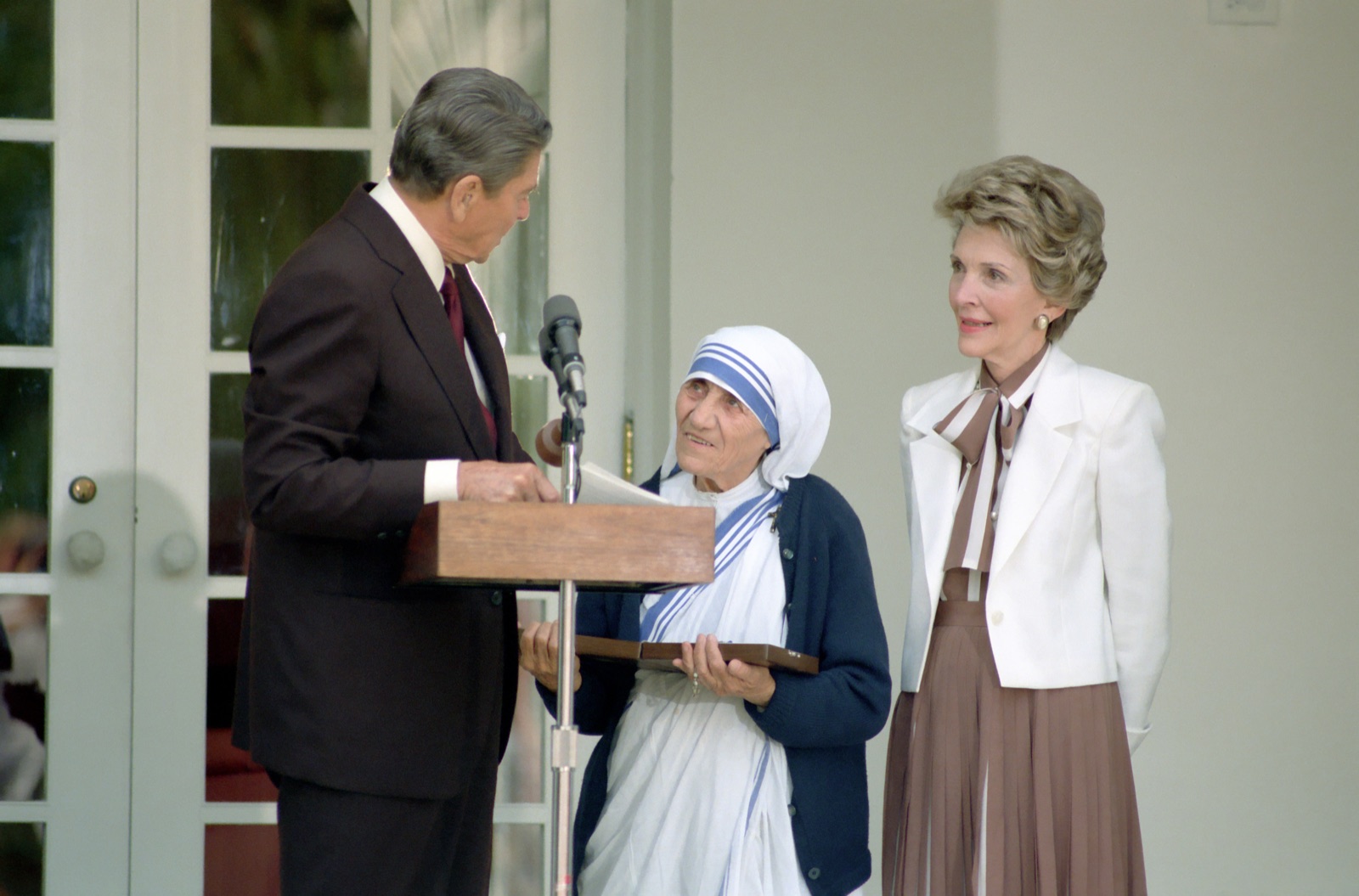 Mother Teresa accepting the Presidential Medal of Freedom from President Ronald Reagan, with First Lady Nancy Reagan, June 20, 1985 — she told the Rose Garden audience she was accepting the honor in the name of the world’s poor.
Photo: White House Photographic Office / Wikimedia Commons / public domain (US federal government work)
Mother Teresa accepting the Presidential Medal of Freedom from President Ronald Reagan, with First Lady Nancy Reagan, June 20, 1985 — she told the Rose Garden audience she was accepting the honor in the name of the world’s poor.
Photo: White House Photographic Office / Wikimedia Commons / public domain (US federal government work)
Mother Teresa’s health began to fail in the 1980s. She suffered a heart attack in Rome in 1983, then a second heart attack in 1989 — after which she received a pacemaker (Wikipedia: Mother Teresa). She continued to run the Missionaries of Charity through declining health into the 1990s, traveling, opening new houses, and — controversially, by 1990s-Catholic standards — speaking publicly on a wide range of moral questions she considered to fall within the order’s mission.
In 1996, she broke her collarbone, contracted malaria, and went into heart failure. She resigned as superior general of the Missionaries of Charity on March 13, 1997.
She died at the order’s motherhouse in Calcutta on September 5, 1997, at age 87.
The Indian government held a state funeral — the highest civic honor India confers — and the casket was borne through Calcutta on the same gun carriage that had carried Mahatma Gandhi and Jawaharlal Nehru, draped in India’s national flag. Heads of state and religious leaders from around the world attended.
Pope John Paul II beatified her on October 19, 2003 — the formal first step toward sainthood, granting the title “Blessed.”
Pope Francis canonized her on September 4, 2016, at St. Peter’s Square in Rome, declaring her Saint Teresa of Calcutta. The canonization Mass drew an estimated 120,000 people. The Albanian-American Catholic dioceses of New York, Boston, Detroit, and elsewhere held companion observances on the same day.
The United Nations General Assembly had already, in 2013, designated September 5 — the anniversary of her death — as the International Day of Charity in her honor.
Albanian heritage and identity
Mother Teresa never publicly distanced herself from her Albanian roots, and she returned to them whenever circumstances allowed.
For most of her adult life, those circumstances did not allow much. Communist Albania under Enver Hoxha (1944-1985) was the most closed country in Europe, a self-declared atheist state that had banned all religion in 1967 and persecuted clergy of every faith. Mother Teresa’s mother and sister, who had remained in Albania, lived out their final years there under the Hoxha regime; she was never permitted to visit them, and they were never permitted to leave to see her. Drane Bojaxhiu died in Tirana in 1972; her sister Aga died there in 1973. Mother Teresa was barred from the funerals of both.
Albania began to open under Ramiz Alia, Hoxha’s successor, in the late 1980s. In 1991, Mother Teresa made her first visit to Albania — initially, characteristically, to lay flowers at her mother’s and sister’s graves. She returned multiple times over the next several years. The Missionaries of Charity opened houses in Tirana and elsewhere in Albania once permitted.
She also visited her birthplace, Skopje, several times despite the political tensions of the late Yugoslav and post-Yugoslav era.
She insisted, in interviews and in private correspondence, that her ancestral language was Albanian and her culture was Albanian Catholic. “By blood, I am Albanian. By citizenship, an Indian. By faith, I am a Catholic nun. As to my calling, I belong to the world,” she said, in a formulation that Albanian-American speakers have quoted for thirty years.
The memorial infrastructure that has accumulated around her since her death reflects all three of the Albanian-majority territories that claim her. Tirana International Airport is named “Mother Teresa International Airport” (renamed 2001). The Cathedral of Saint Mother Teresa in Pristina, Kosovo — consecrated in 2017 — is one of the largest Catholic cathedrals in the Balkans. The Memorial House of Mother Teresa in Skopje, North Macedonia opened in 2009 on the site of the parish where she was baptized. Mother Teresa Day — observed on September 5 in Albania, August 26 elsewhere in the diaspora — is a fixture of the Albanian-American civic calendar.
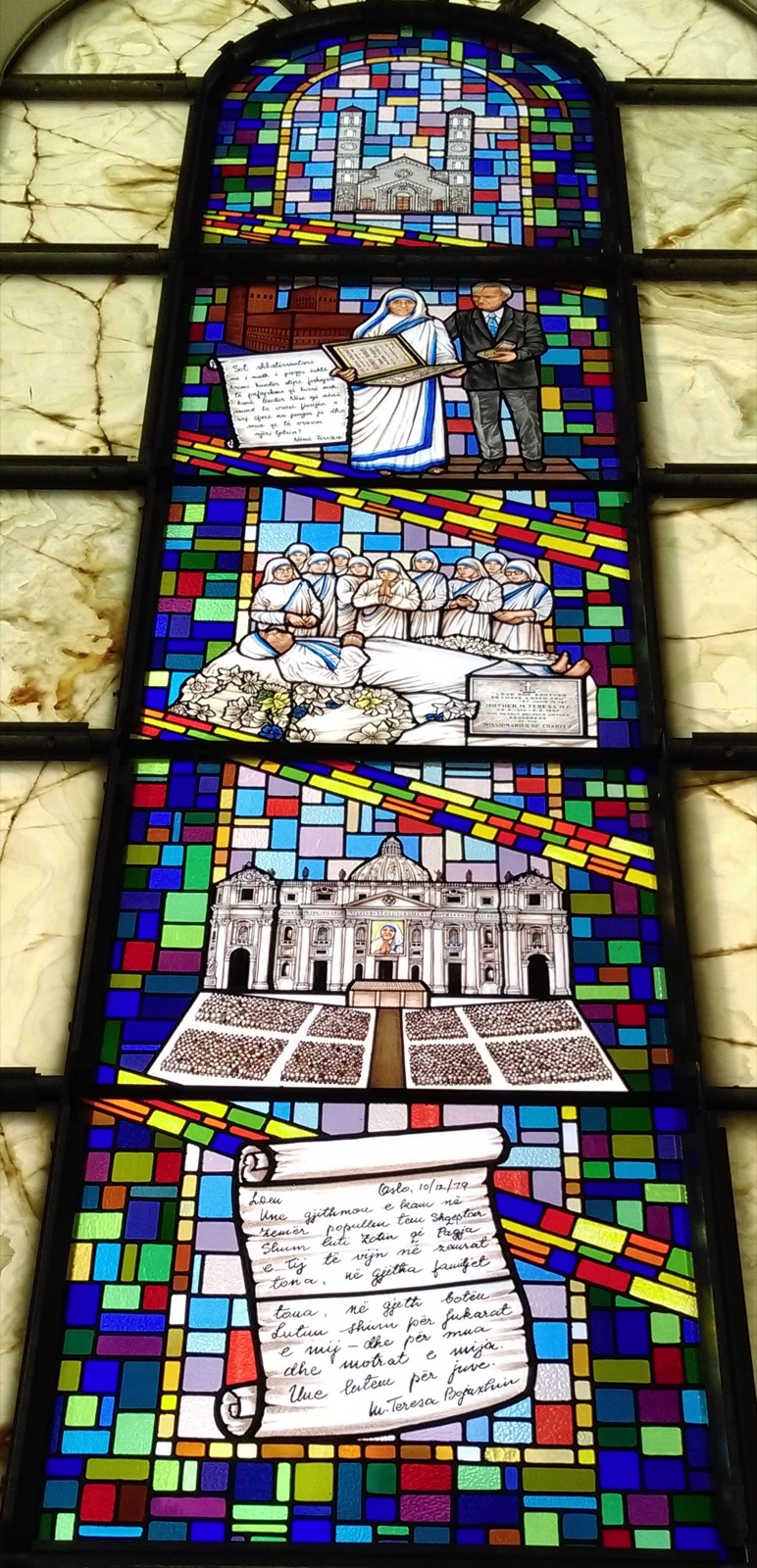 Photo: Resnjari / Wikimedia Commons / CC BY-SA 4.0
For Albanian-American families teaching children about heritage, Mother Teresa is, with the medieval national hero Skanderbeg, one of the two most-cited figures. NAR registrants, in their open-text comments and in community group threads, invoke her name more often than any other.
Public criticism and complicated legacy
Mother Teresa’s legacy is not without critics, and we mention this for completeness.
The most widely circulated critical work is Christopher Hitchens’s 1995 book The Missionary Position: Mother Teresa in Theory and Practice, which followed his 1994 documentary Hell’s Angel for British television (Wikipedia: Mother Teresa). Hitchens questioned, among other things, the medical quality of care at Missionaries of Charity facilities, the financial transparency of the order, the theological framing of suffering as redemptive, and Mother Teresa’s public associations with various political figures during her lifetime. A smaller medical literature — including a 2013 review by University of Montreal researchers — has raised similar questions about clinical practices in the Missionaries of Charity’s homes for the dying.
Defenders have responded with their own substantial body of work, including detailed accounts from sisters and physicians who worked in the homes, and have noted that the order was always primarily a religious congregation rather than a medical one — its mission was companionship and dignity in dying, not advanced clinical care.
NAR’s view, stated plainly: she is one of the two Albanian Nobel laureates and a defining global figure of Albanian heritage. The criticisms are documented and the user can read them. The achievement is the larger story.
What this means for the Albanian-American diaspora
Diaspora visibility is downstream of who claims their heritage publicly, and how clearly.
Mother Teresa’s case is unusually clear. She was Albanian Catholic by birth and family. She spoke Albanian at home. She identified as Albanian throughout her life. She is recognized as Albanian by Albania, by Kosovo, by North Macedonia, by the Vatican, and by the global Catholic Church. The story of who Albanians are — what we have produced, where the community sits in the world’s memory — is, in part, her story.
For Albanian Americans, that matters in a concrete way. When the US Census tries to count Albanian Americans, what it captures is who wrote “Albanian” in the ancestry box. The most recent ACS estimate is roughly 230,000 — almost certainly an undercount, with community estimates closer to a million. The gap exists because some Albanian Americans, especially second- and third-generation, never identify themselves as Albanian on a federal form. They were never asked. They never thought to volunteer it.
Figures like Mother Teresa widen the field of “Albanians you can name.” Every time an Albanian-American grandchild learns that the nun in the saint card on a parish wall was Anjezë Gonxhe Bojaxhiu, born in Skopje to an Albanian Catholic family that spoke Albanian at home, the cost of claiming Albanian heritage falls a little.
You don’t need a Nobel Peace Prize to be part of the count. You need 2 minutes.
Get counted at /register — the National Albanian Registry’s free, encrypted, community-led roster. We mint a recognition certificate. We don’t sell anything. We never share data.
The community-led count of Albanian Americans starts with you adding your name.