
Albanian-American families teach their kids one line about where they come from before any other: we are descended from the Illyrians. The line is short, it carries weight, and it is also — in the full scholarly version — more careful than the bumper-sticker rendering. The Illyrians were a real ancient people, with kings and coins and ruined cities you can still walk through; the thread from them to modern Albanians is widely accepted by mainstream scholarship, and it is also still partly contested in the specifics.
This guide gives the long version. It walks through who the Illyrians were, where they lived, the tribes you hear named most often, the kingdom that briefly went toe-to-toe with Rome, the three Illyrian Wars that ended that kingdom, what we know of the language, the religion and the art, the slide into Christianity and the Byzantine world, and the modern debate over Illyrian-Albanian continuity. We close on why any of this matters to a third-generation kid in Worcester or a recent arrival in Detroit.
We move chronologically where we can and we name what’s contested rather than papering over it. The point is not to assert a national myth — it is to give the diaspora reader a real, sourced account they can actually use.
Who were the Illyrians?
The Illyrians were a family of Indo-European peoples who lived in the western Balkans from roughly the second millennium BCE through late antiquity (Wilkes, The Illyrians, 1992). They were not a single state, a single language, or a single culture in any tight modern sense. The label “Illyrian” — Illyrii in Latin, Illyrioí in Greek — was used by classical authors as a catch-all for the non-Greek, non-Italic, non-Thracian peoples of the eastern Adriatic coast and its inland highlands.
Their material presence in the region is visible from the early Bronze Age, with archaeological cultures (the Cetina, the Glasinac-Mati, the Donja Dolina-Sanski Most) showing continuous development through the Iron Age into the historical period. By the time Greek colonists began planting trading posts on the eastern Adriatic in the seventh and sixth centuries BCE — Epidamnos (later Dyrrhachium, modern Durrës), Apollonia, Issa, and Pharos among them — the Illyrians were a recognizable, named neighbor with whom the Greeks traded, fought, and intermarried.
The Greeks, and later the Romans, organized the Illyrians in their writing as a confederation of tribes. Modern archaeology and linguistics treat the Illyrian world as a cultural sphere rather than a single ethnicity: closely related dialects, shared fortification styles, recurring burial customs (tumulus burial above all), shared deities, shared jewelry types. Inside that sphere, individual tribes had their own kings, their own coinage, and their own foreign policies.
The Illyrian story as classical history runs about a thousand years, from the first secure mentions in Greek sources around the sixth century BCE through the fall of the last independent Illyrian kingdom in 168 BCE, and on into the Roman provincial era. The cultural continuity — language, settlement, custom — runs longer on both ends.
Where did they live?
The Illyrian zone covered most of the western Balkans. At its widest classical extent, it stretched from the Istrian peninsula in the northwest, down the Dalmatian coast through modern Croatia, across Bosnia and Herzegovina, through Montenegro, the whole of modern Albania, Kosovo, parts of western Serbia, the western parts of North Macedonia, and into northwestern Greece (Epirus, where the line between Illyrian and Greek populations was always blurred).
The geography shaped everything. The Adriatic coast gave the southern Illyrians maritime trade, piracy, and pressure from Greek city-states. The interior is mountains, with the Dinaric Alps running parallel to the coast and the Albanian Alps anchoring the south. Hilltop fortresses, perched above narrow valleys, are the signature Illyrian settlement form. River valleys — the Neretva, the Drin, the Vjosa, the Mat — carried inland trade and the occasional invading army.
The core of the later Illyrian kingdom sat in what is today southern Montenegro and northern Albania, roughly between the Neretva and the Drin. The royal capital was Scodra (modern Shkodër), commanding the lake of the same name and the Bojana river outlet to the Adriatic. Coastal cities like Lissus (modern Lezhë) and Rhizon served as ports. Inland strongholds at Meteon, Ulcinj, and Doclea anchored the highland network.
To the east and north sat tribes whose Illyrian classification is debated — the Dardanians of modern Kosovo and northern North Macedonia, sometimes counted as Illyrian, sometimes as a related but distinct group with Thracian connections (Hammond, A History of Macedonia, 1972). To the south, the Epirote tribes (Chaonians, Molossians, Thesprotians) sat on the Greek-Illyrian boundary, sometimes counted Greek, sometimes Illyrian-adjacent, depending on the author and the century.
This is the territory that, two millennia later, would substantially overlap with the lands where the Albanian language continues to be spoken — and that geographic overlap is one of the main pieces of evidence in the modern continuity debate.
The tribes
Classical sources name dozens of Illyrian tribes; a handful matter most for the historical narrative.
- Dardanians — Centered on what is now Kosovo and northern North Macedonia, with their main center at Damastion. The Dardanians were a major regional power from the fourth century BCE onward, repeatedly clashing with Macedon and later allying with Rome. King Bardyllis (early fourth century BCE) is often counted Dardanian; classification of his people as Illyrian, Thraco-Illyrian, or a distinct Paleo-Balkan group is unsettled.
- Taulantii — A central-coastal Illyrian kingdom anchored around Epidamnos/Dyrrhachium (Durrës). Their late-fourth-century BCE king Glaucias intervened in Epirote dynastic politics and famously sheltered the young Pyrrhus of Epirus after a coup against his family.
- Ardiaeans — The dominant Illyrian power of the third century BCE, with a heartland near the Neretva valley that expanded south to absorb most of the coastal Illyrian zone. The kingdom of Agron, Teuta, and (after the Roman intervention) Pleuratus and Gentius is essentially the Ardiaean polity in its imperial phase.
- Labeates — A tribe of the Scodra basin, the Labeates supplied the core territory of the late Illyrian kingdom; the royal seat at Scodra is in Labeatean ground, and the Lake Scodra fortress system was their work.
- Enchelei — One of the oldest documented Illyrian groups, recorded by Greek authors as inhabiting the area around Lake Ohrid. They feature in Greek myth (the Cadmus and Harmonia migration legend) and in early conflict accounts with Macedon.
- Daorsi, Autariatae, Liburni, Iapodes, Delmatae, Pannonii — Additional named groups across Dalmatia, Bosnia, and the Pannonian plain, each with their own kings, fortresses, and coin issues. The Liburni were famous Adriatic sailors; the Delmatae of central Dalmatia gave the region its long-lasting name.
A useful way to picture it: the Illyrian world was structured something like the Celtic world a few hundred years later — a cultural-linguistic continuum with shared customs and shifting alliances, organized into kingdoms that occasionally federated under a single dominant ruler and otherwise operated independently.
Kings and the Illyrian kingdom
The first Illyrian ruler to enter Greek historiography as a major power is Bardyllis (c. 448–358 BCE), a king of the Dardanians (or a related southern Illyrian group, depending on the source). Bardyllis defeated the Molossians and the Macedonians in turn, holding the upper hand over both kingdoms for decades. In 358 BCE, the young Macedonian king Philip II — father of Alexander the Great — defeated and killed the by-then 90-year-old Bardyllis at the Battle of the Erigon Valley, ending Illyrian dominance over Macedon and beginning Macedon’s own rise.
Illyrian power did not vanish with Bardyllis. Glaucias, king of the Taulantii (reigned c. 335–c. 295 BCE), fought Alexander the Great’s forces early in Alexander’s reign, later sheltered the infant Pyrrhus of Epirus, and intervened in the wars between Cassander and the Antigonids. Through the third century, the Illyrian coastal kingdoms grew steadily wealthier on Adriatic trade — and increasingly on piracy.
The Illyrian kingdom’s imperial moment came under the Ardiaeans. King Agron (reigned c. 250–231 BCE) built a powerful navy, defeated an Aetolian army sent to support the Greek city of Medion in 231 BCE, and reportedly died of celebratory drinking shortly afterward. His widow Teuta assumed the regency for Agron’s young son Pinnes and pushed the kingdom to its furthest reach, with Illyrian raiders operating from the Albanian coast as far south as the Peloponnese and as far west as the Italian shore.
Roman commercial shipping in the Adriatic suffered. Rome demanded restraint. Teuta refused — and, according to Polybius, had one of the Roman envoys killed on his way home. The First Illyrian War followed in 229–228 BCE (more on the wars below). Teuta was forced to terms; the kingdom contracted but survived.
The last Illyrian king of consequence was Gentius (reigned c. 181–168 BCE), an Ardiaean ruler based at Scodra who made the fatal choice of allying with King Perseus of Macedon against Rome during the Third Macedonian War. Gentius was defeated, captured, and paraded through Rome in a triumph. With his fall in 168 BCE, the independent Illyrian kingdom ended, and the territory was reorganized into Roman client states and, later, the formal province of Illyricum.
The Illyrian Wars and Roman conquest
The Illyrian Wars are three distinct Roman campaigns fought between 229 and 168 BCE.
First Illyrian War (229–228 BCE). The proximate cause was Queen Teuta’s Adriatic raiding and the killing of Roman envoy Coruncanius. Rome dispatched a fleet of 200 ships under consuls Gnaeus Fulvius Centumalus and Lucius Postumius Albinus. Roman forces took Corcyra, Apollonia, and Epidamnos, then reduced Illyrian coastal strongholds. Teuta sued for peace in 228 BCE; the terms required tribute, a ban on Illyrian warships sailing south of Lissus, and the surrender of much of the southern coast. Demetrius of Pharos, an Illyrian noble who had defected to Rome, was installed as a client ruler over a large slice of the coast. The war was significant beyond its scale — it was Rome’s first major military operation east of the Adriatic, and it brought Rome formally into Greek-world politics for the first time.
Second Illyrian War (220–219 BCE). Demetrius of Pharos proved a poor client. He resumed piracy, allied himself with the anti-Roman Macedonian king Philip V, and attacked cities under Roman protection. Rome — busy preparing for the Second Punic War against Hannibal — moved quickly. Consul Lucius Aemilius Paullus took Pharos and drove Demetrius into exile at the Macedonian court (where he would later advise King Philip V to challenge Rome, contributing to the First Macedonian War). The campaign was brief but reset the Adriatic balance of power.
Third Illyrian War (168 BCE). This war was a side theater of the larger Third Macedonian War between Rome and King Perseus of Macedon. King Gentius of Illyria, persuaded by Macedonian diplomacy (and reportedly a Macedonian bribe of 300 talents that never arrived), declared for Perseus. Roman praetor Lucius Anicius Gallus invaded Illyria with two legions, reached Scodra in approximately 30 days, and accepted Gentius’s surrender. Gentius, his family, and his court were shipped to Rome and displayed in Anicius’s triumph. The Illyrian kingdom was abolished and its territory partitioned into three Roman-administered districts (Polybius, Histories, 28–30; Livy, books 44–45). Full Roman conquest of the wider western Balkans took another century and a half of intermittent campaigning, but the Illyrian kingdom as an independent state ended at Scodra in 168 BCE.
The legacy on the ground was permanent: roads, cities, Latin loanwords absorbed into the proto-Albanian language, and the slow Romanization of the Illyrian aristocracy. The legacy in memory was the founding episode for Roman expansion into the Greek world.
Language and inscriptions
Illyrian was an Indo-European language — or, more cautiously, a group of related Indo-European languages — spoken across the western Balkans before Roman conquest. Beyond that careful sentence, almost everything is debated.
No long Illyrian inscriptions survive. There is no Illyrian literature, no Illyrian historiography, no preserved religious text. What we have is onomastic evidence: personal names, place names, tribal names, and a small number of glosses preserved in Greek and Latin sources. Modern reconstruction of Illyrian phonology and morphology rests almost entirely on this material — names like Teuta (related to an Indo-European root for “people”), Gentius, Bardyllis, place names like Scodra and Dyrrhachium, river names like Drin and Mat.
The closest documented relative is Messapic, an Indo-European language spoken in southeastern Italy (modern Apulia and the Salento peninsula) until roughly the first century BCE. Messapic is attested in inscriptions — hundreds of them — and its grammar and vocabulary show clear Indo-European structure with features that align it with Illyrian. The Messapic-speaking population is generally believed to have crossed the Adriatic from the Illyrian zone in the early Iron Age, which is why their language matters for reconstructing what Illyrian itself looked like.
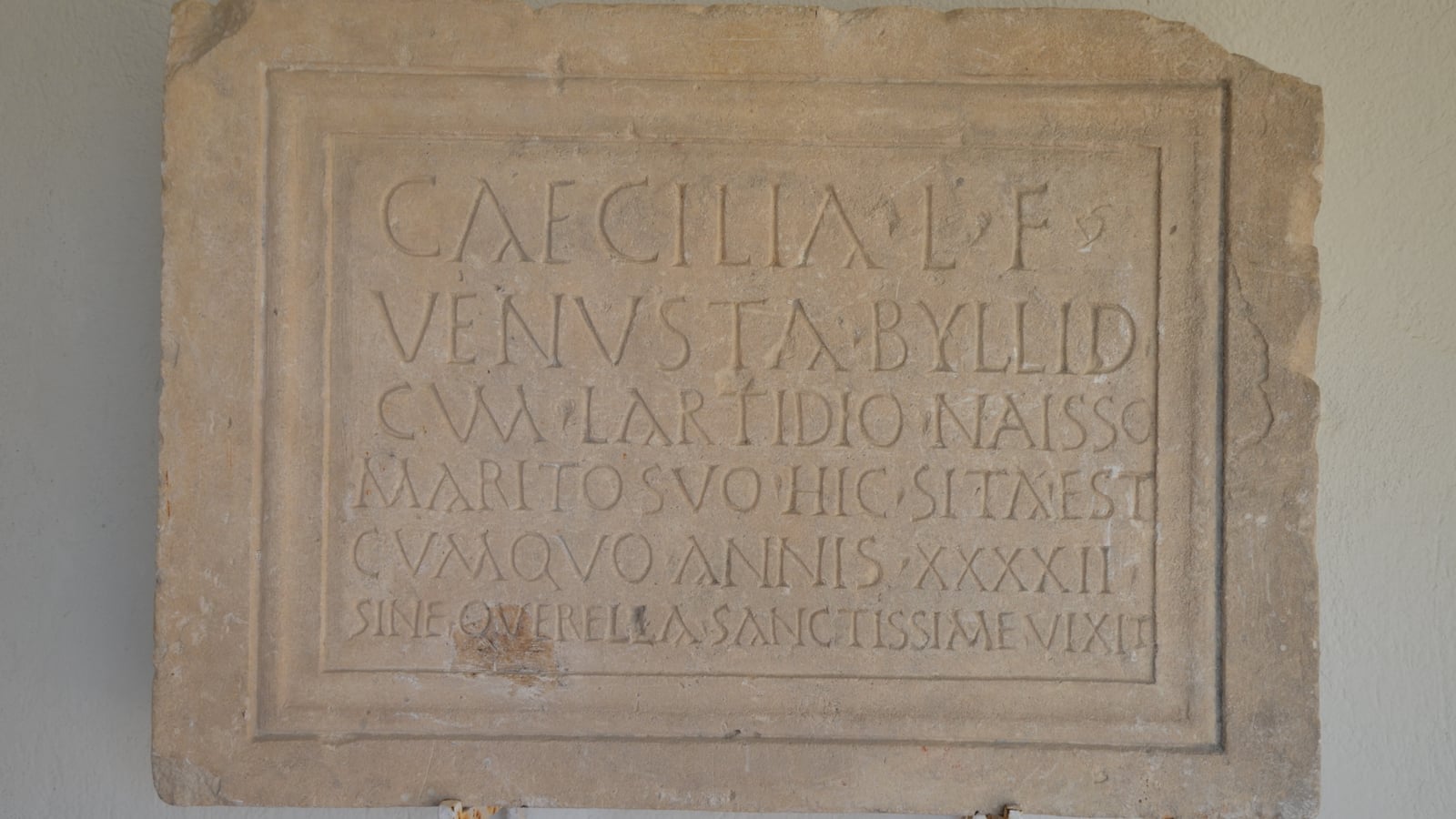
Several Roman-era inscriptions from the Balkans contain Illyrian names embedded in otherwise Latin or Greek text, allowing partial reconstruction of an Illyrian name-stock and a small lexicon. Scholars like Hans Krahe and Anton Mayer in the twentieth century, and Eric Hamp later, built much of the modern picture from this material.
What we do not have is enough connected text to do for Illyrian what we can do for, say, Etruscan: read sentences, parse grammar, translate documents. Illyrian remains a substantially reconstructed language. This is one reason the Illyrian-Albanian linguistic question is so hard to settle definitively — we cannot directly compare Illyrian and Albanian sentences because the Illyrian sentences are not there.
Religion, art, and material culture
Illyrian religion was polytheistic and, like most Indo-European religious systems, shows both inherited Indo-European elements and distinctive regional features. Greek and Roman sources record a number of Illyrian deities, though most are known only by name.
Major deities and figures. Medaurus, a war god, was the patron of Risinium (modern Risan, Montenegro) and was depicted on horseback with a lance. Redon was a sea god associated with the port city of Lissus, his name appearing on coins. Bindus, identified with Roman Neptune, was venerated by the Japodes at a spring near modern Bihać. The Thracian-Illyrian rider deity, sometimes called the Thracian Horseman, appears widely on funeral stelae across the eastern Illyrian zone.
Snake symbolism. The serpent was a recurring sacred figure in Illyrian art and ritual, appearing on jewelry, bronze fibulae, and ceramic vessels. The Cadmus and Harmonia myth, which has the couple transformed into serpents at the end of their lives in Illyrian territory, may reflect a real cultural emphasis on snake veneration. Serpent imagery persists in Balkan folk tradition — and in modern Albanian symbolism — well into the historical period.
Burial customs. The most distinctive Illyrian archaeological feature is tumulus burial — earthen mounds, sometimes capped with stone, raised over single burials or family groups. Tumuli are found across the Illyrian zone from the early Bronze Age into the Roman period, with the largest concentrations at sites like Glasinac in eastern Bosnia (where excavations have catalogued thousands), Mati in central Albania, and Kosovo. Grave goods — weapons, fibulae, jewelry, imported Greek pottery — give the clearest window into Illyrian social structure and trade networks.
Jewelry and metalwork. Illyrian craftsmanship in bronze and silver is unusually distinctive: elaborate fibulae (cloak pins), torcs, spiral bracelets, amber and glass-bead necklaces. The “Illyrian-type” bronze helmet, an open-faced design with a flared neck guard, was produced from the seventh century BCE into the Hellenistic period and is found in graves across the Balkans and as far as southern Italy.
Fortifications. Cyclopean masonry — large irregular stone blocks set without mortar — characterizes Illyrian hilltop fortresses across modern Albania and Kosovo. Sites like Lissus, Antigonea, Byllis, and Amantia preserve sections of these walls; many were reused and modernized in Hellenistic and Roman periods.
Christianity and late antiquity
Christianization came to Illyrian-speaking territory gradually, beginning in coastal cities in the second and third centuries CE and reaching the highland interior over the next several centuries. By the late Roman Empire, the western Balkans hosted some of the most important bishoprics of the early Church.
Apollonia, Dyrrhachium, Scodra, Naissus, Sirmium, and Salona were all major Christian centers by the fourth century CE. Justiniana Prima (near modern Niš), founded by the emperor Justinian in the sixth century, was briefly raised to a metropolitan see covering much of the central Balkans. The Butrint baptistery on the southern Albanian coast, dated to the early sixth century, is one of the largest surviving paleo-Christian buildings of its type.
The provinces drawn from old Illyrian territory — Dalmatia, Praevalitana, Epirus Nova, Dardania, Moesia Superior — produced a remarkable cluster of Roman emperors in the third and fourth centuries. Claudius II Gothicus, Aurelian, Diocletian, Constantine the Great, and several lesser figures all came from the Illyrian provinces, in what historians sometimes call the “Illyrian emperors” period. Constantine in particular was born around 272 CE at Naissus (modern Niš), in the eastern reaches of the historically Illyrian zone. The label “Illyrian” by this point was regional and provincial more than strictly ethnic — but the geographic continuity with earlier Illyrian populations is real, and the cultural legacy lingered.
The permanent division of the Roman Empire in 395 CE placed Illyrian-speaking territory on the Eastern (Byzantine) side. Slavic migrations in the sixth and seventh centuries restructured the demographic map across the lowlands, pushing the surviving Latin- and Illyrian-derived populations into the highland refugia of the central western Balkans. The archaeological assemblage known as the Komani-Kruja culture (fourth–ninth centuries CE), spread across central and northern Albania, southern Montenegro, and western North Macedonia, is widely interpreted as the bridge between late-antique Illyrian-Roman provincial society and the medieval Albanian population — an organized regional society maintaining continuity through the upheaval (Curta, The Making of the Slavs, 2001).
By the time Byzantine sources begin using the name “Albanoi” or “Arbanitai” for a distinct people in the eleventh century, the cultural and linguistic descendants of the Illyrian zone are visibly there.
Are modern Albanians descended from Illyrians?
This is the contested question. The honest version is more interesting than the bumper sticker.
The mainstream position. Most contemporary scholarship — Albanian, Balkan, and Western — accepts that modern Albanians are descended at least partially from a Paleo-Balkan population, most likely Illyrian or closely related to it. The key planks of the argument are: (1) geographic continuity — Albanians have been documented in roughly the same territory the southern Illyrians occupied; (2) the Albanian language is a unique branch of Indo-European, the so-called “Albanoid” branch, with no surviving close relatives outside Albanian itself and the extinct Messapic — implying long isolation in or near the western Balkans; (3) place-name continuity — rivers (Drin, Mat), settlements (Shkodër from Scodra, Durrës from Dyrrhachium, Ulqin from Olcinium) preserve pre-Roman forms through Albanian sound changes; and (4) archaeological continuity — the Komani-Kruja culture is broadly read as a transitional bridge.
The Thracian alternative. A minority position, associated with scholars including Gottfried Schramm and elements of the older Bulgarian and Romanian historiography, argues that Albanians descend instead from a Thracian or Daco-Moesian population that migrated west into the historically Illyrian zone in late antiquity. Proponents point to certain features of Albanian vocabulary, some place-name parallels in the eastern Balkans, and the relatively late appearance of the Albanian ethnonym in Byzantine sources. The Thracian hypothesis is a minority view in current scholarship but not a fringe one; it remains under active debate. A separate claim that circulates online — that Albanians trace back to the Caucasus — is weaker still; we weigh it against the evidence separately.
What linguists agree on. Albanian is Indo-European. Albanian is a unique branch with no surviving close relatives. The closest known relative is extinct Messapic. The Albanian sound system shows shifts that took centuries of continuous in-region development. Latin loanwords absorbed early into Albanian preserve features that suggest contact with Latin in or near the western Balkans, not the eastern.
What linguists do not agree on. Whether the underlying Paleo-Balkan substrate that became Albanian was specifically Illyrian, specifically Thracian, specifically a Daco-Moesian variant, or some related Paleo-Balkan group whose name we no longer have. The direct linguistic evidence — being able to compare Illyrian sentences to Albanian sentences — is not available, because Illyrian sentences are not preserved.
Why the question is politically charged. Origin questions in the Balkans are never just academic. The Illyrian-Albanian link supports modern Albanian territorial and identity claims; rival origin narratives have been used to challenge them. The Albanian state under the Hoxha regime made Illyrian descent a pillar of official historiography; neighboring states have at various times pushed alternative readings for their own reasons. Per the synthesis at the Origin of the Albanians article and elsewhere, the right posture for a careful reader is to hold the mainstream Illyrian-continuity view as the most likely working hypothesis, to take seriously the partial nature of the evidence, and to be skeptical of both nationalist overreach and politically motivated revision.
The National Albanian Registry’s position is that posture exactly: continuity is widely accepted and reasonable; the details remain a live scholarly debate; the bumper sticker is not wrong, but the long version is more honest.
Why this history matters to the diaspora today
For US-based Albanian Americans, the Illyrian story does a specific kind of work that nothing else in the national history quite replaces.
It is the answer to where do we come from, originally? Skanderbeg, Vlora, the Rilindja, the bunker years, the post-1991 emigration — those are recent enough to feel like family history. The Illyrian thread is what makes the family history feel rooted instead of arriving. A second-generation kid in Westchester whose grandparents came from Korçë can point to a 2,500-year continuity in the same patch of land. That continuity is the closest thing the community has to a creation story.
It also explains why certain symbols carry the weight they do. The double-headed eagle now flying on the Albanian flag is tied by long tradition to Skanderbeg’s 15th-century revolt — though historians note the specific “raised in 1444” flag story is more legend than documented record — and traces its imagery back to Byzantine adoption of late-Roman Illyrian iconography. Place names — Shkodër, Durrës, Vlorë, Berat — carry pre-Roman roots in Albanian sound clothing. The very word shqiptar (the Albanian self-name for “Albanian,” in use since roughly the late Middle Ages, distinct from the older arbëresh / arbëror family of self-names) sits inside an unbroken naming tradition for a people who have called the same mountains home for a very long time.
For Albanian-American families teaching kids the basics, this is the history to anchor with. Museum holdings to visit when the question comes up: the Metropolitan Museum of Art in New York has Greek and Roman material from the Adriatic that contextualizes the Illyrian trade world; the University of Pennsylvania Museum in Philadelphia and the Field Museum in Chicago hold Balkan archaeological collections; the Detroit Institute of Arts has rotating ancient-Mediterranean material that occasionally features Illyrian-zone objects. The Albanian community in the US has not yet built a dedicated Illyrian-Albanian exhibit on the scale of, say, the Hellenic museums — that is a project waiting for someone to take it on.
The thread runs from a hilltop fortress above the Drin to a registration form on a website. It is the same community, recorded across a very long time. Add yourself to that count — get counted — and you are part of how the next chapter gets written down.