

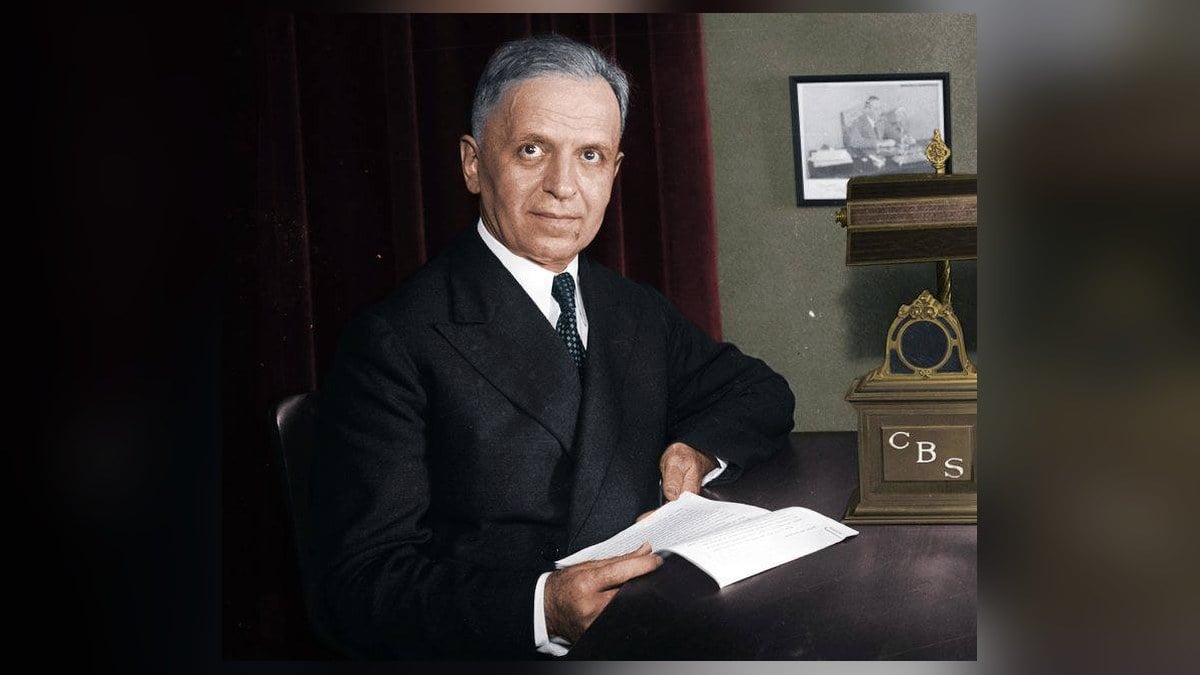
Picture a factory recreation room in Southbridge, Massachusetts, on a Sunday afternoon in late 1937. Rows of chairs, working men in their good suits, families who had come in from the mill villages of North Grosvenordale, Charlton, and Webster. At the front, a radio set. When the moment came, the room went quiet, and out of the speaker, carried across the Atlantic from Albania itself, came the voice of King Zog, addressing his people, including the ones who had left.
This actually happened, and a small Connecticut newspaper recorded it. Twenty-five years earlier, on November 28, 1912, Albania had declared its independence from the Ottoman Empire. The Albanians of industrial New England were not going to let the anniversary pass unmarked.
A celebration in a factory hall
The Windham County Observer of Putnam, Connecticut, ran the notice in its December 1, 1937 edition, under the plain heading “Albanian Celebration Planned”:
“Albanian residents of North Grosvenordale will join other members of that race from Southbridge, Charlton and Webster, Mass., in a celebration of the twenty-fifth anniversary of Albanian independence. The observance will be held at 2 p.m. Sunday in the recreation room of the American Optical Company at Southbridge, Mass. One of the features of the program will be an address by King Zog of Albania which will be broadcast over the radio from that country.”
Read past the dry wording and look at what it describes. A cluster of small immigrant communities, spread across a state line, coordinating a single event. A borrowed hall inside the plant that employed many of them, the American Optical Company. And a live radio link to the homeland, in an era when that was a genuine feat, so that a king’s voice could reach a factory town in New England on the same afternoon it left Tirana.
These were not wealthy people. They were textile and optical workers, the kind of first-generation immigrants who show up in census records as “operative” or “laborer.” What they had was organization and memory, and they put both to use.
The same season, the Minister chose Boston
While the mill towns gathered in Southbridge, a very different celebration was taking shape ninety miles away in Boston, and the man at the center of it was Albania’s top diplomat in America.
The Evening Star of Washington, D.C., reported on November 21, 1937:
“The Albanian Minister, Mr. Faik Konitza, will go to Boston the first of next week to attend the banquet which the Albanian colony in that city has arranged to celebrate the 25th anniversary of Albanian independence. The Minister will be the principal speaker at the banquet and will stay at the Ritz-Carlton while in Boston. The Minister, who has been at Washington since October, 1926, has made a wide circle of personal friends as well as friends for his native land.”
Notice the choice buried in that paragraph. Konitza was the Albanian government’s official representative in the United States, based in the capital. For the silver jubilee of the nation he served, he did not stay in Washington. He went to Boston, to the Albanian colony, to be the principal speaker at the community’s own banquet. The diplomat traveled to the diaspora, not the other way around, because Boston is where the living heart of Albanian America beat.
Who Faik Konitza was
That the Minister was Faik Konitza (also written Konica) makes the choice even more fitting.
Long before he was a diplomat, Konitza was one of the founders of Albanian America itself. Born in 1875 in Konitsa, then Ottoman territory, he arrived in the United States in 1909, settled in Boston, and within three years had helped found the Vatra federation, taken over editing of Dielli, the Albanian newspaper, and earned a master’s degree from Harvard. He was, in a real sense, one of the architects of the very community he came back to celebrate with in 1937.
In the summer of 1926, King Zog’s government appointed him Albania’s Minister to the United States, the senior diplomatic post, which he held until the Italian invasion of 1939. He never went home. He died in Washington in 1942, and his remains were returned to Tirana only in 1995, after the fall of the communist regime.
So when Konitza stood up as principal speaker at the Boston banquet in 1937, he was not a stranger sent from a foreign capital. He was a founding figure of the diaspora, standing in the city where he had built it, marking twenty-five years of the country he had spent his life defending in print and in person.
Two rooms, one anniversary
Put the two scenes side by side and you have a portrait of Albanian America in a single season.
In one room, a factory hall in a Connecticut-Massachusetts mill district, working families gathered around a radio to hear their king. In the other, a Ritz-Carlton banquet in Boston, the nation’s Minister at the podium. Different means, different social registers, the exact same instinct: we are twenty-five years a nation, we are here, and we will mark it together.
This is what a diaspora looks like when it is healthy. It spans the factory floor and the diplomatic corps, and it treats a homeland anniversary as a reason for both to show up. The 1937 celebrations sit directly alongside the earlier chapters of the same New England story, the Albanian-American parade at Grosvenordale in 1921 and the 1919 cable to the Paris Peace Conference that helped keep Albania on the map in the first place.
Why this belongs in the count
The people in that Southbridge recreation room are exactly who the recorded numbers miss. They were immigrants and their children, in small mill towns, showing up under a company roof to honor a country an ocean away. No census category captures the meaning of that afternoon. The only record that survives is a two-inch newspaper notice and, now, this.
That is what a registry is for: to make sure the next gathering, and the people in it, are counted while they are here, not reconstructed from a clipping decades later.
The U.S. Census counts about 230,000 Albanian Americans. The real number is close to a million. The Albanians of 1937 New England understood that being organized and on the record was how a small community made itself impossible to ignore. It still is.
Get counted at /register: free, encrypted, community-led. We mint a recognition certificate. We do not sell anything. We never share your data.
The 1937 celebrations are quoted from The Windham County Observer (Putnam, CT), December 1, 1937, and The Evening Star (Washington, DC), November 21, 1937, both via the Library of Congress, Chronicling America. Biographical details on Faik Konitza are drawn from published histories and linked where used.