

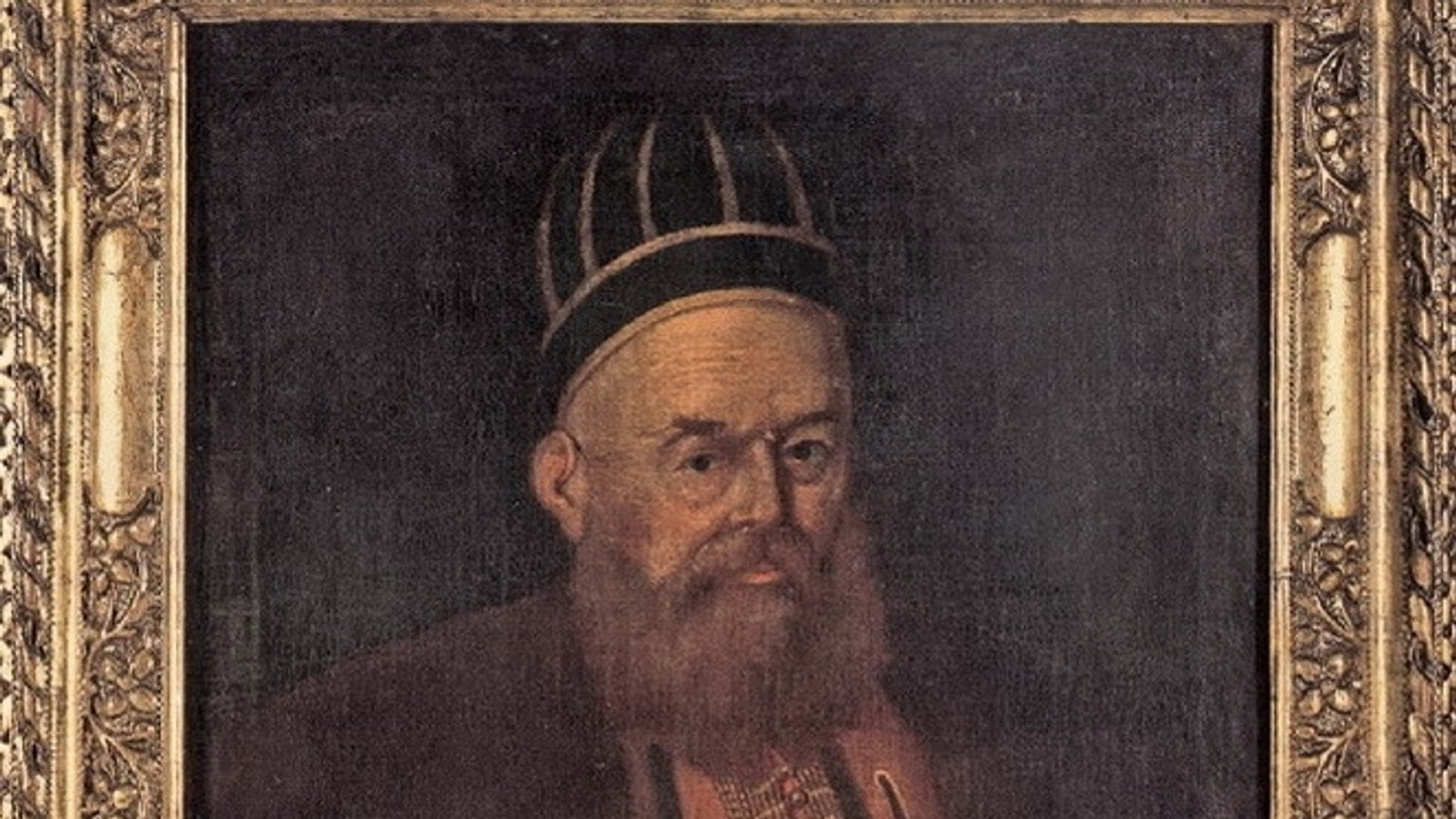
Ali Pasha of Tepelena governed more territory than some European monarchs of his era, and he did it from inside an empire that never quite decided whether he was its most useful servant or its most dangerous subject. From the 1780s until his death in 1822, this Albanian Muslim strongman ruled from Ioannina — a lakeside city in what is now northwestern Greece — over a domain that stretched from the Albanian highlands to the Gulf of Corinth.
He kept his own army. He taxed his own subjects. He sent his own envoys to Paris and London. Napoleon wrote him letters. Lord Byron drank coffee with him. The Ottoman Sultan, whose nominal vassal he remained throughout, spent the last two years of Ali’s life trying to kill him.
He was born in a small town on the Vjosa River. He died on an island in a lake, shot by agents of the sultan he had served and defied for half a century. Between those two points, he built one of the most consequential Albanian pashaliks — the semi-independent domains that Albanian strongmen carved within the Ottoman system — and left a mark on Albanian, Greek, and European history that outlasted the empire itself.
Tepelena: the starting point
Ali was born around 1740 in Tepelena (Tepelenë), a town on the Vjosa River in what is now southern Albania. His father, Veli Bey, was Tepelena’s local ruler — a minor feudal lord with a garrison and enough men to hold his valley. His mother, Hanko, came from a respected family in the region. The clan was Muslim, Albanian-speaking, and anchored in the tribal politics of the southern highlands.
When Veli died, Ali was still a teenager. The family lost its lands and its position — rival clans moved in, and Ali’s mother and sister were captured and held for a time. The dispossession marked him. He spent the next two decades clawing his way back, through a combination of brigandage, marriage alliances, and service to the Ottoman governor of Rumelia. He fought for whoever would pay or arm him, and he fought against anyone who had taken what he considered his.
By his mid-forties, he had assembled enough armed followers and enough Ottoman patronage to receive official appointments. The route from Tepelena to Ioannina was not a career path. It was a campaign.
Pasha of Ioannina (1788–1822)
In 1788, the Ottoman Porte appointed Ali as the Pasha of Janina (Ioannina). The appointment was partly reward and partly a bet: Ali had military capacity, he knew the terrain, and the Porte needed someone who could hold the western Balkans while the empire fought wars on other fronts. Ali accepted the title and then spent the next 33 years turning it into something the Porte had not intended.
He expanded systematically. By the mid-1790s he had absorbed the surrounding sanjaks. By 1800 he held Epirus, much of Thessaly, and was pushing into Aetolia-Acarnania and parts of the Peloponnese. He took Preveza from the French after the Battle of Nicopolis in 1798. He pressed north into Albanian territory, bringing Berat and parts of central Albania under his influence. At his peak, his domain covered roughly 25,000 square miles and somewhere between 1.5 and 2 million subjects — Christians and Muslims, Greeks and Albanians, governed from a lakeside fortress in Ioannina.
His administration was not gentle. Ali taxed ruthlessly, punished dissent with public executions, and used hostage-taking as standard political practice. He massacred the population of Gardiki in 1812 to settle an old vendetta from his youth — the town had been involved in the captivity of his mother and sister decades earlier. He drowned women in the lake. He burned villages that resisted.
But he also built roads, established a postal system, encouraged trade, and maintained a degree of public order that travelers noted as unusual for the region. The contradiction was the man: Ali governed with both commerce and terror, and he did not distinguish between the two.
The court: Byron, Pouqueville, and the European gaze
Ioannina under Ali Pasha was one of the most visited courts in the eastern Mediterranean. European diplomats, adventurers, spies, and writers passed through — and most of them wrote about it.
The most famous visitor was Lord Byron, who reached Ioannina in October 1809 during his first tour of the Mediterranean — only to learn that Ali was away on a military campaign. Byron and his travel companion, John Cam Hobhouse, pushed on to Ali’s fortified palace at Tepelena, where the actual audience took place. Ali received him warmly — sweets, coffee, compliments about his ancestry. Byron was 21; Ali was about 69. Byron described the encounter in his letters and later in Childe Harold’s Pilgrimage (Canto II, 1812), where Ali appears as a charismatic and terrifying figure, an “old man” with “a fire in his eye” who commanded loyalty and fear in equal proportion.
Byron wrote to his mother from Albania: “He is a remorseless tyrant, guilty of the most horrible cruelties, very brave, and so good a general that they call him the Mahometan Buonaparte.” The visit lasted several days. Byron left with impressions that shaped his view of the Balkans for the rest of his short life.
François Pouqueville, the French consul in Ioannina from 1805 to 1816, left a more sustained account. Pouqueville spent over a decade at Ali’s court and published a detailed (if often hostile) history of Ali’s rule. His Voyage de la Grèce is one of the primary European sources on early 19th-century Albania and Epirus.
Other visitors included William Martin Leake, a British military surveyor who mapped the region, and Henry Holland, who traveled through in 1812. The common thread in their accounts is the same: Ali’s court felt like a capital, not a provincial outpost. He conducted himself like a sovereign, and the Europeans who dealt with him found it easier to treat him as one.
Between empires: France, Britain, and the Porte
Ali Pasha’s political survival depended on playing European powers against the Ottoman center — and against each other. He managed this for decades.
When Napoleon’s armies arrived in the Ionian Islands in 1797 (after the fall of Venice), Ali opened negotiations with the French. He saw an opportunity: the French controlled the coastline opposite his territory, and an alliance could give him access to European arms and diplomatic cover. When the French were driven from the islands by a Russo-Ottoman force in 1799, Ali pivoted to the British, who now held the Ionian Islands as a protectorate.
He corresponded with both London and Paris, offering intelligence, port access, and military cooperation in exchange for recognition of his autonomy. Napoleon took him seriously enough to send agents and letters. The British maintained consuls at his court. Ali played both sides not because he was fickle but because he was small — a regional power between two global ones, buying space by being useful to each.
With the Sublime Porte, the relationship was older and more complex. Ali held his position legally as an Ottoman official — he was the sultan’s appointed pasha. In practice, he paid tribute when pressed, ignored orders when he could, and fought the sultan’s enemies when it aligned with his interests. The Porte tolerated him because he held the western flank, kept order in a difficult region, and was expensive to replace.
The arrangement worked as long as both sides needed it. By the 1810s, the balance was shifting. Sultan Mahmud II had begun a systematic campaign to break the power of provincial strongmen across the empire. The Albanian pashaliks — Ali’s in the south and the Bushati family’s in Shkodra — were among the most obvious targets.
The siege and the death (1820–1822)
In 1820, Mahmud II declared Ali Pasha a rebel and ordered him stripped of all titles. An Ottoman expeditionary force — estimates range from 20,000 to 50,000 troops under the command of Hurshid Pasha — marched on Ioannina.
Ali fought back. He had about 20,000 men of his own, and he had spent decades fortifying his positions. The siege of Ioannina lasted over a year. Ali lost territory piece by piece — his allies defected, his garrisons fell, and the Ottoman noose tightened. In a final irony, the Greek War of Independence broke out in March 1821, partly because Ali’s rebellion had drawn Ottoman forces away from the Peloponnese and created an opening. The revolt he had not planned helped trigger a revolution he did not live to see.
By late 1821, Ali had retreated to the small island in Lake Pamvotis, inside the monastery of St. Panteleimon. He was roughly 82 years old, cornered, and still negotiating.
On 5 February 1822, Ottoman agents came to the island under a flag of truce, ostensibly to discuss terms. They shot him. Some accounts say Ali fired back and killed one of the attackers before he fell. His head was cut off and sent to Constantinople, where it was displayed publicly. His body was buried on the island.
The monastery still stands. So does the bullet hole in the floor — or what the guides point to as one.
What Ali Pasha means for Albanian memory
Ali Pasha was not a national figure in the modern sense. He did not fight for Albania, invoke Albanian nationhood, or aim to build an Albanian state. He fought for himself, governed for power, and died because the empire he had served decided he was more dangerous alive than dead.
But his career demonstrated something that mattered to the generation that came after him: that an Albanian-born ruler could hold a major territory, command a standing army, deal with European great powers as a near-equal, and govern a diverse population across ethnic and religious lines — all within the Ottoman framework, and all because he was too strong to remove easily.
The Albanian Rilindja intellectuals of the late 19th century did not celebrate Ali Pasha as a hero. He was too violent, too personal in his ambitions, too willing to govern non-Albanians by terror. But they could not ignore him either. His pashalik was proof of concept: Albanian political autonomy was not hypothetical. It had existed, in Ali’s domain, for a generation.
For Albanian Americans tracing the roots of Albanian political identity, Ali Pasha sits in a specific place in the story. He is not Skanderbeg — the Christian knight who fought the Ottomans for Albanian freedom. He is the Muslim strongman who worked inside the Ottoman system until the system came to destroy him. Both figures — the rebel and the insider — are part of the Albanian political tradition. Both matter.
The town of Tepelena still stands on the Vjosa, smaller and quieter than in Ali’s time. The fortress at Ioannina — his capital for 33 years — sits beside the lake where he died. Between those two places, a story that lasted 82 years and covered half the Balkans.