

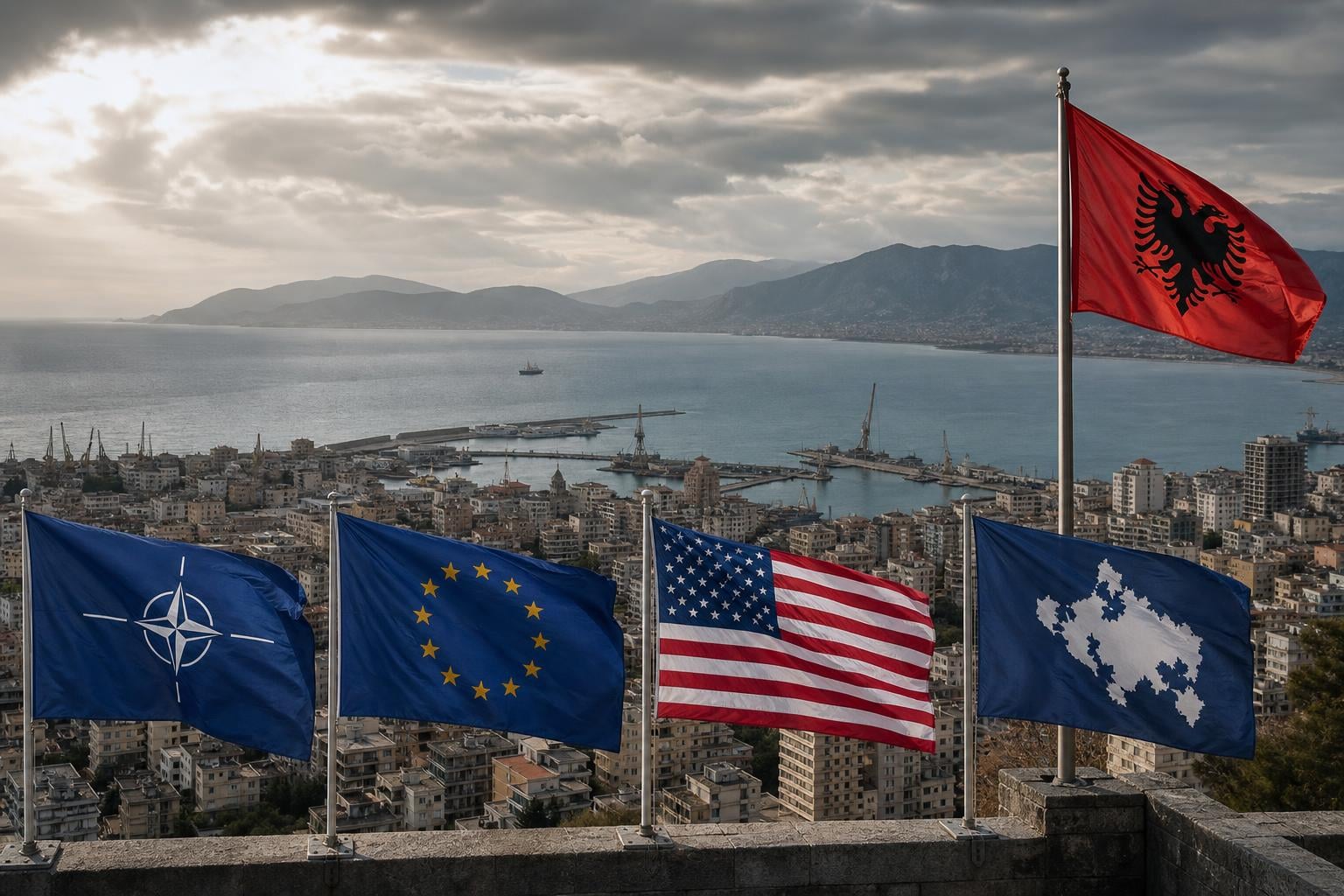
By 2026 Albania holds more formal alliances than at any point in its history. It is a treaty member of NATO, an active candidate to the European Union, a strategic-dialogue partner of the United States, and a working partner with Italy, Kosovo, Israel, Turkey, the United Kingdom, Germany, and others across defense, trade, energy, and diaspora policy.
The architecture is also recent. Most of it was built after 1991. Albania spent the Cold War in deep isolation, breaking with Yugoslavia in 1948, the Soviet Union in 1961, and China in 1978, and ended that period with no functioning Western alliances at all. The current alliance map is the result of three decades of post-communist foreign-policy work, much of it concentrated in two clusters: the 1999-2009 NATO track and the 2014-2025 EU track.
This article is the diaspora-side reading of who Albania is aligned with today and how each relationship took shape. It is not advocacy. Where bilateral history is complicated, especially with Greece and Serbia, the article sticks to dated facts. For broader context on the bilateral history with Washington, see our companion piece on Albania-US relations. For the parallel Kosovo question, see Kosovo vs Albania.
A note on the word “ally.” It carries different weight in different contexts. NATO membership is a binding treaty obligation under Article 5. EU candidacy is a structured accession process, not a defense pact. Bilateral partnerships vary by domain. Where a partnership is treaty-grade, the article says so.
NATO membership, the formal alliance
NATO is the only treaty-binding military alliance Albania belongs to, and it is the load-bearing element of the country’s external security.
Albania joined NATO on 1 April 2009, alongside Croatia. The two countries became the 27th and 28th members of the Alliance when their ambassadors deposited the ratified instruments of accession at the US State Department. That made Albania the first Western Balkans state, together with Croatia, to enter the Alliance, ahead of Montenegro (2017) and North Macedonia (2020).
The accession path took fifteen years.
- 1994: Albania joined NATO’s Partnership for Peace program.
- 2 May 2003: Albania, Croatia, and the Republic of Macedonia (now North Macedonia) signed the Adriatic Charter in Tirana, with the United States as the lead external partner. The framework coordinated the three countries’ candidacies for membership, deliberately patterned on the earlier US-Baltic Charter.
- 2008: NATO issued the membership invitation at the Bucharest Summit (2-4 April 2008). Foreign ministers signed accession protocols on 9 July 2008.
- 1 April 2009: Full accession.
NATO membership obligates Albania to the collective-defense clause of Article 5 of the North Atlantic Treaty and to the Alliance’s standard force-readiness, interoperability, and budget commitments. Operationally, that has meant Albanian deployments to ISAF in Afghanistan, contributions to the Kosovo Force (KFOR), and an upgrade of Kuçovë Air Base in central Albania under NATO Security Investment Programme funding as a regional support facility.
NATO is also the umbrella under which most of Albania’s bilateral defense ties run. Joint exercises with US forces, training cooperation with the United Kingdom, and the German contingent in KFOR all sit inside the NATO framework even when they appear in news coverage as bilateral events.
The European Union accession track
EU candidacy is the second pillar of Albania’s external alignment, structurally distinct from NATO. NATO is a defense treaty; the EU process is an accession negotiation that resolves only at full membership.
Key dates:
- 2009: Albania applied for EU membership.
- June 2014: The European Council granted Albania candidate country status.
- 2020: The Council of the EU approved opening accession negotiations.
- 19 July 2022: The first accession conference with Albania opened formal negotiations, on the same day as the parallel conference with North Macedonia.
Once negotiations opened, Albania moved through the EU’s revised methodology of six negotiating clusters covering all 33 chapters. Cluster 1 (Fundamentals) opened on 15 October 2024; Cluster 6 (External relations) on 17 December 2024; Cluster 2 (Internal market) on 14 April 2025; Cluster 3 (Competitiveness and inclusive growth) on 22 May 2025; Cluster 4 (Green agenda and sustainable connectivity) on 16 September 2025; and Cluster 5 (Resources, agriculture and cohesion) on 17 November 2025. By late 2025, all clusters had opened. The government has stated a goal of membership by 2030, although the European Council has not endorsed a specific accession date.
The accession process runs through the European Commission’s enlargement directorate and the Council of the EU. Each chapter requires Albania to align domestic law with the relevant section of the EU acquis communautaire and to demonstrate institutional capacity to implement it. Justice-sector reform, particularly the vetting of judges and prosecutors that began in 2016, is treated as foundational by both Brussels and Washington.
Albania’s EU track is twinned with North Macedonia’s in timing but not in substance. The two countries opened negotiations on the same day in 2022 after the EU lifted Bulgaria’s veto on North Macedonia; subsequent progress has run separately.
The United States strategic partnership
The United States is not an EU member and is not part of Albania’s accession process, but it is one of the two countries (with Italy) most consequential to Albania’s external posture. The relationship is grounded in NATO membership and runs alongside it through a dedicated bilateral framework.
The arc of the US-Albania relationship is covered in detail in our Albania-US relations piece. The shorthand version:
- 1922: First US diplomatic recognition of Albania.
- 1939-1991: Diplomatic relations severed during the Italian occupation and the communist period.
- 15 March 1991: Relations restored.
- 2003: Adriatic Charter signed in Tirana; US-led NATO candidacy framework.
- 10 June 2007: President George W. Bush visited Tirana, the first sitting US president to do so.
- 1 April 2009: Albania joined NATO.
- 25 October 2022: First US-Albania Strategic Dialogue session held in Washington, in the centennial year of US-Albania diplomatic relations. The Joint Declaration on Strategic Partnership was signed earlier, in 2015.
The Strategic Dialogue is the standing annual framework for bilateral coordination on defense, regional security, rule of law, energy, and economic cooperation. It operates in addition to the NATO obligations, not as a substitute for them. The US Embassy in Tirana, the US State Department country page, and USAID’s Albania mission are the working channels.
The Kosovo war of 1998-1999 is the inflection point that converted the post-1991 thaw into a durable security alignment. Camp Bondsteel in southeastern Kosovo, built in 1999 as the US contingent’s KFOR headquarters, anchored a continuing US military presence in the region. While Bondsteel sits in Kosovo rather than Albania, its existence reshaped how the US treats Western Balkans security, and Albania has been a continuous partner in that posture.
US engagement in Albania also includes USAID programs running continuously since 1992, Peace Corps placement since 1992, Fulbright scholarships in both directions, and Foreign Military Financing and International Military Education and Training programs for the Albanian Armed Forces.
Italy, the closest Western European partner
Italy is Albania’s largest trading partner, the largest destination for Albanian emigration, and one of the principal investors in Albanian infrastructure. The relationship is structurally deeper than the NATO-ally pairing alone would suggest, and it sits alongside the US partnership rather than competing with it.
The trade figure: bilateral trade between Italy and Albania exceeds €3 billion annually and accounts for roughly 20% of Albania’s foreign trade share, the largest of any single partner.
The migration figure: Italy hosts the largest Albanian emigrant community in Western Europe. Mass migration began after the collapse of communism in 1991 and continued through the 1997 pyramid-scheme crisis (see 1997 pyramid-scheme collapse) and the early 2000s economic transition. The Italian-language fluency among that generation has become a structural asset for bilateral business and tourism.
The strategic-partnership figure: Italy and Albania held their first formal intergovernmental summit at Villa Doria Pamphilj in Rome, signing 15 agreements covering defense, energy, infrastructure, and migration. The package outlined a “strategic and operational partnership” and includes naval cooperation, renewable-energy development, and shared migration management.
The energy figure: In January 2025, Italy, Albania, and the United Arab Emirates signed a €1 billion agreement to build a 1,000 MW undersea power interconnector between Vlora (on Albania’s southern coast) and Puglia (Italian heel). The project pairs with the development of approximately 3 GW of new renewable-energy capacity inside Albania, much of it intended for export to Italy through the cable. Completion is targeted within three years of signing.
The defense figure: An Italian-led shipbuilding venture between Fincantieri and Albania’s KAYO is rebuilding the Pashaliman facility in the Bay of Vlora into a modern naval shipyard. The deal is projected to generate annual revenue of €400 million by 2031, with an initial focus on seven new patrol vessels for the Albanian Navy.
The migration-policy figure: Under a separate 2023 protocol, Italy operates two migrant-processing facilities inside Albania, funded and managed under Italian jurisdiction. The protocol is politically contested in Rome and in Brussels; institutionally, it sits inside the broader bilateral partnership.
The Italy-Albania relationship is not without complicated history. Italy invaded Albania on 7 April 1939, annexed it under Mussolini’s regime, and occupied the country until Italian forces collapsed in September 1943. That occupation, and the earlier Treaty of London concessions Italy sought at Versailles, sit in the historical record. The post-1991 partnership has been built on a different basis: large-scale population links, regional NATO alignment, and direct economic integration.
Kosovo, the Albanian-Albanian alignment
Kosovo is the closest partner Albania has, and the relationship is structurally different from every other entry in this article. The two states share a language, a flag (Kosovo’s institutional flag is distinct, but the Albanian double-headed eagle is used widely in both), and an integrated diaspora.
Foundational dates:
- 17 February 2008: Kosovo declared independence from Serbia. Albania recognized Kosovo on the same day. The United States, the United Kingdom, France, and Germany followed within days.
- 2008-present: Free movement of people between the two states.
- November 2018: Albania and Kosovo signed nine agreements, including a Protocol on Joint Customs Control Activities at the Common Border Crossing Point and an agreement removing roaming-services tariffs.
- March 2019: The two countries signed an agreement to unify and coordinate foreign policy, including joint diplomatic missions and shared staff.
- 2019-present: A Kosovo customs office operates inside the Port of Durrës, simplifying the import flow into Kosovo and relieving the Vërmica/Morina land crossing.
The two states are gradually harmonizing their customs systems and have stated a long-term goal of a customs union. Joint cultural and education initiatives run through ministries on both sides. The diaspora in the United States, organized largely around Albanian-language and Catholic, Orthodox, Muslim, and Bektashi institutions, treats the two populations as a single community for most civic purposes, including the National Albanian Registry’s count.
The political question of unification between the Republic of Albania and the Republic of Kosovo periodically appears in public discussion. The institutional position of both governments is that EU integration is the primary track and that any change to the state structure would have to run through both populations and through the EU accession framework. The National Albanian Registry takes no position on that question. The day-to-day reality is that the two countries operate as the closest possible partners short of political union.
Turkey, the UK, and Germany
Three additional partners deserve sectioned treatment because they carry distinct roles inside the broader alliance structure.
Turkey. Albania and Turkey signed an initial military-cooperation agreement on 29 July 1992 covering training, joint exercises, weapons-production cooperation, and access to Albania’s Pasha Liman naval base in the Bay of Vlora. The relationship has been periodically rebuilt: a Military Framework Agreement was signed at the first meeting of the Turkey-Albania High-Level Cooperation Council in February 2024, formalizing the defense partnership. Both states are NATO members. Turkey is a significant investor in Albanian infrastructure, including airports, roads, and religious-heritage sites, and the two countries share Ottoman-era cultural and religious ties that are particularly visible in mosque construction and restoration. Both are members of the Organisation of Islamic Cooperation, although Albania’s domestic confessional balance includes substantial Catholic, Orthodox, and Bektashi populations alongside the Muslim majority.
United Kingdom. The UK is a long-running supporter of Albanian EU integration and a partner inside NATO. British forces deployed alongside Albanian counterparts in KFOR and continue to engage on regional-security and rule-of-law programs. The UK-Albania relationship has been politically active around migration issues since 2022, including a 2022 Joint Communiqué between Tirana and London on migration cooperation. UK development programs and education exchanges run through the British Council and the Foreign, Commonwealth and Development Office.
Germany. Germany is one of the largest bilateral donors to Albania’s reform agenda, particularly through GIZ (Deutsche Gesellschaft für Internationale Zusammenarbeit) on justice-sector and public-administration reform. The German contingent in KFOR has been a continuous presence since 1999. Germany has been the principal European driver of the Berlin Process (see below). The Albanian-German diaspora in Bavaria, Baden-Württemberg, and North Rhine-Westphalia is one of the largest Albanian communities in Western Europe and a significant remittance source.
Israel and the besa legacy
Albania and Israel established diplomatic relations on 19 August 1991, four months after Albania’s communist regime ended its long break with Western states. An Israeli embassy opened in Tirana in 2012.
The historical anchor of the relationship is the World War II rescue of Jewish refugees in Albania. Albania is the only country in Nazi-occupied Europe whose Jewish population grew during the war: an estimated 200 Jews lived in the country before the war, and more than 2,000 (some estimates run higher) were sheltered there by war’s end. The sheltering was organized across confessional lines through the customary code of besa (the binding word; the Albanian obligation of hospitality to a guest). We’ve written about that code in more detail at Albanian besa.
Dozens of Albanians have been recognized by Yad Vashem as Righteous Among the Nations, an unusually high per-capita figure. The story has become a fixed reference point in Israeli-Albanian public diplomacy and is regularly cited in both Tirana and Jerusalem.
Bilateral cooperation today covers technology, defense, agriculture, and tourism. Albania has consistently aligned with Israeli positions on regional-security questions in international forums, while supporting two-state solutions in the United Nations framework. The relationship has been described in Israeli media as a structurally pro-Israel posture, distinct in the broader Muslim-majority world.
Saudi Arabia and the UAE
The Gulf states are a smaller but growing element in Albania’s external relationships, concentrated in investment and religious diplomacy.
The United Arab Emirates is the third party in the January 2025 €1 billion undersea energy cable agreement with Italy and Albania, contributing the strategic-partner role on financing and renewable-energy development. UAE state energy company Masdar has signed agreements to develop solar capacity inside Albania for export to Italy through the planned cable.
Saudi Arabia and the UAE both fund religious-heritage and education projects inside Albania, primarily through their respective embassies and through Albania’s Muslim Community. The investment profile is real but small relative to the EU, US, and Italian flows.
Regional initiatives: Open Balkan, Berlin Process, Western Balkans Six
Three multilateral frameworks shape Albania’s regional integration.
Open Balkan (since 2019). A trilateral initiative among Albania, Serbia, and North Macedonia to enable free movement of people, goods, services, and capital. Plans were declared on 10 October 2019 in Novi Sad. The Ohrid summit on 11 November 2019 formalized the agreement among Edi Rama (Albania), Aleksandar Vučić (Serbia), and Zoran Zaev (North Macedonia). The initiative was initially called “Mini-Schengen” and renamed “Open Balkan” in 2021. Kosovo, Montenegro, and Bosnia and Herzegovina have not joined; Kosovo in particular has objected on grounds related to its disputes with Serbia. The institutional position in Tirana is that Open Balkan complements rather than replaces EU integration.
Berlin Process (since 2014). An EU-led framework launched by Germany covering the Western Balkans Six: Albania, Bosnia and Herzegovina, Kosovo, Montenegro, North Macedonia, and Serbia. The process runs annual summits at heads-of-government level alongside the EU enlargement track. Berlin Process initiatives cover regional infrastructure, youth mobility, mutual recognition of academic credentials, and a Common Regional Market roadmap.
Western Balkans Six (informal). The grouping of the six EU candidates and potential candidates in the region. The label is used in EU enlargement policy and in regional cooperation documents.
The three frameworks overlap rather than conflict. Open Balkan covers three states inside the Western Balkans Six; the Berlin Process covers all six. Albania is a participant in both.
What’s complicated: Greece, Serbia, Russia
Three relationships sit in a different category and deserve careful framing.
Greece. Both states are NATO allies, both are members or candidates of the EU framework, and Greece is the second-largest destination for Albanian emigration after Italy. The bilateral history is complicated by several outstanding issues: the state-of-war declaration that technically remained on Greek law from 1940 was effectively suspended in August 1987, when the Greek government declared that the characterization of Albania as an enemy state had ceased, although the law’s formal publication status has been contested in the years since; the maritime border in the Ionian Sea, where a 2009 delimitation agreement was annulled by the Albanian Constitutional Court in January 2010 and is still pending renegotiation; the status of the Greek minority inside Albania and the Albanian and Cham communities historically associated with northwestern Greece; and ongoing diaspora-property questions. The institutional position of both governments is that these issues are to be handled through bilateral negotiation and within the EU framework. Day-to-day economic and people-to-people ties between Greece and Albania remain dense and functional.
Serbia. Diplomatic relations exist. Both states are Berlin Process participants, and Albania and Serbia (together with North Macedonia) are the founding partners of Open Balkan. The principal complicating factor is Kosovo: Serbia does not recognize Kosovo’s 2008 declaration of independence, and Albania does, fully and immediately. The Tirana-Pristina dialogue, mediated by the EU since 2011, has produced incremental agreements on freedom of movement, civil registration, and license-plate recognition; full normalization between Belgrade and Pristina remains unresolved. Albania’s position is that Kosovo recognition is settled. See Serbs and Albanians for a longer treatment of the bilateral history.
Russia. Albania broke with the Soviet Union in 1961, formally exited the Warsaw Pact in 1968, and entered the post-1991 period with no operational ties to Moscow. As a NATO member since 2009 and an EU candidate since 2014, Albania aligns with Euro-Atlantic positions on Russia, including the sanctions regime adopted after Russia’s February 2022 invasion of Ukraine. The bilateral relationship today is functional but minimal.
What this means for the Albanian-American diaspora
If you are reading this from the United States, the alliance map matters in three concrete ways.
Citizenship and travel. Albanian citizens hold a passport that grants visa-free or visa-on-arrival access to the EU’s Schengen area for short stays, to the United Kingdom under post-Brexit visa rules, and to most of the broader Euro-Atlantic space. Under Albanian Law 113/2020, Albanian-Americans whose ancestors emigrated up to three generations ago can claim Albanian citizenship by descent without renouncing US citizenship (see our citizenship-law explainer). The alliance infrastructure is what makes that citizenship operationally useful.
Investment and business. Italy’s €3 billion bilateral trade with Albania, the Italy-Albania-UAE energy partnership, and the US-Albania Bilateral Investment Treaty (in force since 1998) shape the channels available to diaspora investors. AmCham Albania, the Italian-Albanian Chamber of Commerce, and the Albanian-American Development Foundation (the successor to the SEED Act-capitalized AAEF) are the standing institutions.
Policy voice. Albanian-Americans concentrated in New York, Michigan, Massachusetts, New Jersey, and Florida are a recognized constituency on Western Balkans policy in Washington. The community’s stated priorities — Kosovo recognition, sustained NATO engagement, EU accession support — align with the bipartisan US baseline. The institutional channels include the Albanian-American Civic League, the National Albanian American Council, and partner organizations covering specific issues.
Cultural and educational ties. The Fulbright Program, the Peace Corps in Albania, German DAAD scholarships, Italian Erasmus exchanges, and UK Chevening fellowships all operate as live programs for Albanian and Albanian-American students. The next generation inherits a multilateral framework where movement between Albania, Kosovo, and the principal Western partners is structurally easier than it has been in any prior decade.
Sources and further reading
The institutional positions cited in this article are sourced from the Albanian Ministry for Europe and Foreign Affairs, the European Council, the NATO official portal, the US State Department country page, and the Wikipedia foreign-relations-of-Albania entry as a layperson reference. Dated facts on NATO accession, EU candidacy, and bilateral agreements are drawn from the primary documents released by each institution.
The National Albanian Registry counts Albanian-Americans across the diaspora, including ethnic Albanians from Albania, Kosovo, North Macedonia, Montenegro, and the broader community. Adding your name takes about 2 minutes. The certificate of recognition is free; it is a community-issued recognition document, not a government ID and not citizenship. Get counted at /register.