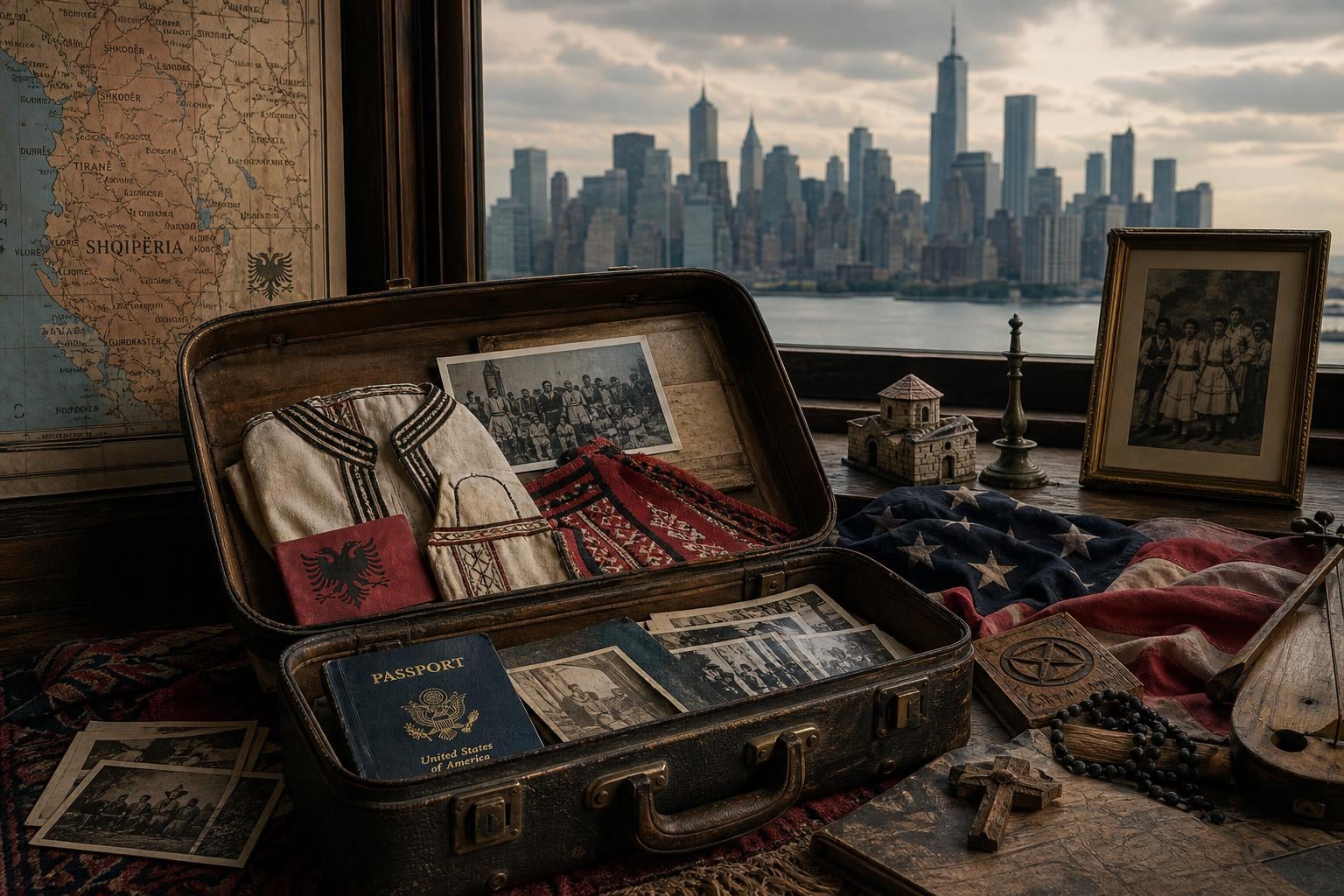
A wedding in Yonkers runs eight hours. Three generations on the dance floor, the older men in a slow shoulder-locked valle, the cousins laughing through it, a teenager filming on her phone. The bride’s grandmother speaks no English and the groom’s nephew speaks no Albanian, and somehow they get through dinner.
Across the country, a kid in suburban Detroit asks his grandmother who Skanderbeg was. In a Bronx apartment building, a family unpacks bread, salt, and a small flag for an Easter visit. In a Massachusetts church basement, a woman who left Korçë in 1995 teaches a five-year-old how to say mirëdita (good day).
These are heritage scenes, and they happen every week in the United States. They are also the central question this guide tries to answer. What does Albanian heritage actually mean if you are from here, not there — a 2nd or 3rd-generation descendant who may not speak the language, may have never set foot in Albania, and is still, unmistakably, Albanian?
Heritage is not a passport. It is not a fluency test. It is the inherited piece of a tradition that survives the trip across an ocean and the gap between generations. For Albanian Americans, that piece includes language, faith, food, names, regional ties, and a quiet sense of besa — the Albanian code of honor — that shows up in how families treat guests. This guide walks through what that heritage is made of, how it travels through generations in the US, and the practical ways descendants stay connected to it.
What Albanian heritage actually means
Albanian heritage is ethnic, linguistic, and cultural at once. Ethnically, it traces back to the shqiptarë — the Albanian self-name, from a root often glossed as “speakers of a clear language.” The community spans the modern Republic of Albania, Kosovo, parts of North Macedonia and Montenegro, the historic Arbëresh villages of southern Italy, and a global diaspora that includes the United States.
Linguistically, heritage centers on the Albanian language, an independent branch of the Indo-European family with two major dialect groups: Gheg in the north and Tosk in the south. The modern literary standard, set in 1972, is based largely on Tosk. Most US-based families speak some version of one or the other at home, and many use a hybrid shaped by the village or city of origin.
Religiously, Albanian heritage is unusually pluralistic. Albania’s population today is split among Sunni Muslims, Bektashis, Orthodox Christians, and Catholics, with significant numbers of secular and atheist Albanians. Kosovo is predominantly Muslim. The Arbëresh of Italy are mostly Byzantine Catholic. National identity historically has been treated as larger than any single faith — a posture worth understanding for descendants who grew up assuming “Albanian” implied one religion.
Heritage is also regional. A family from Shkodër in the north carries a different set of foods, dialect cues, and saints’ days than a family from Korçë in the southeast or from Gjakova in Kosovo. In the US, these differences fade across generations but rarely disappear entirely. The recipes, the songs at weddings, and the cadence of the spoken language all keep little signatures of where the family came from.
A practical note for descendants: there is no single test for being Albanian enough. The community in the US has always included people who left as adults, people born here, people whose grandparents arrived a century ago, and recent arrivals from Kosovo and North Macedonia. They speak different dialects, follow different faiths, and sometimes argue about food. All of them count as part of the same heritage.
The Albanian American story in numbers
The US Census Bureau’s American Community Survey put the documented Albanian-ancestry population at roughly 230,000 in its 2024 release (ACS table B04006). That is the official count, and it is almost certainly low.
Community organizations, demographers, and the National Albanian Registry consistently put the real figure closer to one million when you include 2nd and 3rd-generation descendants, ethnic Albanians from Kosovo and North Macedonia who do not self-identify the same way on Census forms, and households the Census systematically undercounts. The gap is structural, not anecdotal — the ACS ancestry question is voluntary, single-write-in, and not designed to capture multi-generational identification.
The geographic concentration is striking. New York leads with roughly 52,000 documented Albanian Americans, followed by Michigan with about 30,000 and Massachusetts with about 21,000. Smaller but meaningful concentrations exist in New Jersey, Pennsylvania, Connecticut, Illinois, and Texas. Within those states, the community clusters tightly — the Bronx and Westchester in New York, Sterling Heights and surrounding Macomb County in Michigan, Worcester and the Boston area in Massachusetts.
The waves of arrival explain the geography. The first significant wave came between roughly 1900 and 1920, mostly Orthodox men from southern Albania heading for industrial jobs in New England and the Midwest. Later flows brought political refugees through the early Cold War, a slow trickle through the communist period, and then a much larger movement after 1990 when the regime collapsed. Kosovars arrived in large numbers during and after the 1998-99 war. The community in the US today is a layered record of those decades.
How heritage gets transmitted across generations
In any immigrant community, the first generation arrives carrying the full set of cultural defaults. The second generation absorbs most of it but starts editing for the American context. The third generation receives a curated version — fewer words, fewer recipes, a thinner connection to the old country — and decides how much to reclaim. Albanian American families follow this pattern with their own specifics.
Language is the first thing to thin out. A first-generation parent typically speaks Albanian at home; a second-generation child grows up bilingual but English-dominant; a third-generation grandchild often understands fragments and speaks little. The drop is sharper for families without nearby Albanian-speaking grandparents or community institutions. Sunday phone calls to relatives in Tirana or Pristina slow the loss but rarely reverse it.
Food travels better than language. Byrek (savory filo pie), tavë kosi (baked lamb with yogurt), fërgesë (a peppers-and-cheese dish), qofte (meatballs), and raki (the grape or fruit brandy used for toasts) all survive into the third generation in recognizable form. Recipes pass through grandmothers and aunts; specific brands of feta and ajvar appear in suburban Albanian American kitchens far from any Balkan neighborhood. Holiday foods — Easter breads, baklava at weddings, lamb at Bajram — anchor the calendar.
Music and dance survive in more compressed form. Many third-generation kids cannot name a single Albanian polyphonic singer but will get up for a valle at a family wedding without thinking. Wedding rituals — the bride’s procession, the bowl-breaking, the traditional speeches — show similar patterns. The form persists even when the underlying knowledge fades.
Religion is the most variable line. Some families pass on the practice intact, attending Albanian-language services at Orthodox parishes in Boston or Catholic parishes in the Bronx or mosques and Bektashi tekkes in Michigan. Others let practice lapse but retain identity — “we’re Catholic Albanian” or “we’re Bektashi” as ethnic-religious markers rather than weekly attendance. Both patterns are common.
Religious heritage in the US
The four major religious traditions of the Albanian community all have institutional homes in the United States. Each is worth knowing if you want to understand the community or trace a family’s specific lineage.
The Albanian Orthodox Archdiocese in America was founded in 1908 by Fan S. Noli, a Harvard-educated priest who later served briefly as Albania’s prime minister. Its mother parish is St. George Cathedral in Boston. Other Albanian Orthodox parishes operate in Worcester, New York, Philadelphia, Chicago, and Las Vegas, among others. These churches are often community anchors in addition to religious ones.
Albanian Catholic communities are concentrated in the New York metro area and Michigan, often tied to specific northern Albanian or Kosovar villages. Parishes serving Albanian Catholics include Our Lady of Shkodra in Hartsdale, New York, and several in the Detroit area.
Sunni Muslim Albanian Americans have substantial communities in Michigan, the Bronx, and Connecticut. The Albanian American Islamic Center in Harper Woods, Michigan is one of the older institutions. Many of these mosques serve both Albanian and broader Muslim communities.
The Bektashi order — a Sufi-rooted tradition with deep ties to Albania — maintains its World Headquarters near Tirana, but it also has a US presence, most prominently the First Albanian Bektashi Tekke in Taylor, Michigan, founded in 1954. Bektashism is sometimes described as a distinct religious community rather than a branch of Sunni Islam.
Across these traditions, a long-running Albanian tendency holds: the national community is treated as bigger than any single faith. That pluralism is itself part of the heritage worth passing on.
Cultural pillars that travel
Some pieces of Albanian culture survive in the US almost intact because they are durable, portable, and easy to teach. These are the pillars worth knowing.
Besa (the Albanian code of honor) is the first. Codified historically in the customary law tradition known as the Kanun, besa is the obligation to keep your word and to protect a guest. The most cited modern example is the rescue of Jewish refugees in Albania during World War II, when Albanian families hid neighbors and strangers under besa. In the US diaspora, besa rarely gets named explicitly, but it shows up in how families show up for each other — funerals attended, weddings supported, new arrivals housed.
Mikpritja (hospitality) is the everyday expression of besa. A guest in an Albanian American home gets coffee, then food, then more food, then is asked to stay longer. Refusing the third cup is awkward. Hosts measure themselves by how well a visitor is fed.
Family structure remains tight across generations, even when household size shrinks. Cousins remain close. Weddings and funerals draw large extended families across state lines. Many Albanian American adults still consult parents on major life decisions well into their thirties.
Music and dance are the audible pillars. Iso-polyphony from southern Albania, a UNESCO-recognized vocal tradition, is the deep root. The lahuta (a one-stringed bowed instrument used to accompany northern epic songs) is the northern counterpart. In the diaspora, contemporary Albanian pop and Albanian-language rap travel further than the old forms, but at weddings, the valle — the line and circle dances — remains universal.
Food, as covered above, is the daily pillar. Coffee is its own ritual. The small filxhan (cup) of espresso-style coffee is a unit of social time.
Tracing your Albanian lineage
If you want to map your family back to a specific place and time, the work is more manageable than it looks for most US-based descendants. A few practical notes.
Start with names. Albanian surnames often end in -aj, -i, -u, -aj, -ani, -iqi, -ari, or a place-derived suffix. Names ending in -i are common across Albania; -aj clusters in the north and Kosovo. Some families anglicized their names at Ellis Island or in later naturalization records — a “Gjokaj” might appear as “Gjoka” or “Gloka,” a “Hoxha” as “Hodja” or “Hoja.” The original form is usually recoverable from immigration records.
Regional origin is often encoded in family memory. “We’re from Korçë” or “we’re from the Mat region” is the starting clue. Albanian Catholic families almost always come from the north or from Kosovo. Albanian Orthodox families almost always come from the south, often the Korçë or Gjirokastër regions. Bektashi families have historic concentrations around Krujë and southern Albania.
Records exist on both sides of the Atlantic. US records (Census, naturalization, ship manifests) are searchable through NARA and family-research databases. Albanian state records — civil registers (regjistri i gjendjes civile), church baptismal records, and Ottoman-era population registers — are increasingly accessible, often requiring an in-country contact or attorney to pull. Kosovar records sit with Kosovo authorities and parishes.
For more practical guidance on naming patterns and how they encode origin, see our piece on Albanian names.
A short note on DNA tests. Commercial ancestry services report Albanian ethnicity in a “Balkans” or “Southeastern Europe” bucket that overlaps with Greek, Macedonian, and South Slavic populations. The results can confirm a broad regional origin but rarely pinpoint a specific village or even country. Document research and family conversation are still the more reliable path to a real lineage map.
Albanian citizenship by descent
Albania’s Law 113/2020 on citizenship is the most consequential recent change for the US diaspora. It allows citizenship by descent through a parent, grandparent, or great-grandparent who held or holds Albanian citizenship. The law is generous compared to peer countries.
The headline features: no residence requirement in Albania, dual citizenship is allowed, no renunciation of US citizenship is required, and the descent chain extends three generations back. You can be the 3rd-generation US-born descendant of an Albanian great-grandparent and qualify.
The documentation work is the real cost. Each generation in the chain needs certified records — birth, marriage, and where relevant death certificates — linking back to the Albanian ancestor. US documents must typically be apostilled for use abroad. Albanian-side documents may need certified translations. Names spelled differently across documents are the most common obstacle and usually require an affidavit of identity.
The application goes through a ministry review and then a presidential decree before the oath step, and typically takes many months — often the better part of a year or more — with real-world cases running longer depending on document quality and the consulate handling the case. Outcomes are decided by Albanian authorities, not by any community organization or law firm. Anyone who promises a guaranteed outcome is selling something.
NAR does not file citizenship cases. For a deeper read on the law itself, see the standalone explainer on 2020 Albanian citizenship law.
Connecting locally — organizations and the count
Heritage is easier to sustain when it has institutional homes. The US Albanian community has several layers of them, and most are within reach of any descendant willing to look.
National organizations include Vatra (the Pan-Albanian Federation of America), founded in 1912 in Boston and one of the oldest Albanian institutions outside the homeland. Vatra’s newspaper Dielli has been published since the early 20th century. The Albanian American National Organization (AANO) and the Albanian American Civic League (AACL) operate at the national level on civic and policy questions.
State and regional organizations are usually the best entry point for a descendant trying to reconnect. Most concentrations have at least one cultural center, parish, or community association — the Albanian American Cultural Center in suburban New York, parish-based community groups in Worcester and Boston, the Albanian American Islamic Center and cultural organizations across Macomb County in Michigan, and similar institutions in Philadelphia, Hartford, Chicago, and the DFW area in Texas.
Then there is the count itself. The National Albanian Registry is a 501(c)(3) nonprofit producing a community-led count of Albanian Americans, built to make the diaspora’s full size and reach visible. The point of the count is partly statistical — closing the gap between the ACS 230,000 and the real-world ~1,000,000 — and partly practical. A community that knows its own size, geography, and composition can advocate, organize, and pass on its heritage more effectively.
Heritage often gets framed as memory. It is also data. A family that shows up in the count is harder to lose track of over time, easier to reach during community moments, and easier to include when resources or representation get allocated. Being counted is one of the most concrete ways heritage shows up as data, not just memory. If that fits, register here — it takes a few minutes, and it is free.