
The short version: Albania is building a museum in Vlorë about the history of Jews in the country and the Albanians who sheltered them during World War II. Since early September 2026, residents have protested against it, saying it is being built in the historic complex where the Labëria Club was founded in 1908, on the one intact historic square in the city. The culture ministry and the 2024 municipal council records say the museum goes into the house next door, not into the Labëria building itself. Protesters reject that account. Either way, the design adds a glass rooftop volume and new pavilions to a listed 19th-century house that stands against the building tied to Albania’s independence. On October 16, a court froze the works until it decides the residents’ lawsuit. The protest’s organizers say they honor the World War II rescue and object to the site, not the history.
What is being built
The Albanian Jewish Museum is meant to tell the history of Jews in Albania and of Albanian-Jewish relations, including the protection of Jews during World War II, according to Balkanweb. The same report says the Albanian-American Development Foundation (AADF) committed $6.5 million to the project. JNS describes it as a joint venture of AADF and Albania’s Ministry of Culture, working with the local Jewish community.
The architect is Kimmel Eshkolot, a Tel Aviv studio that was commissioned in August 2022 after an international competition. The original plan was to open in 2025, according to e-architect. A construction permit for the museum, with the culture ministry as the applicant, was on the agenda of Albania’s National Territory Council on May 29, 2024, according to the council’s published agenda.
The design keeps the historic house as the core of the museum, with the permanent exhibition in its original rooms. It adds a glass volume on the roof, two stone entrance pavilions on the square, and an underground hall for temporary exhibitions beneath the square, according to the architect’s description on e-architect. JNS reported that the complex will roughly double the size of the existing building.
Where it sits, and the Labëria Club question
The protest’s main slogan was “Jewish Museum no, Labëria Museum yes.” Many protesters said the museum is being built in the building where the Labëria Patriotic Club was founded in 1908, a club tied to the work that led to Albania’s declaration of independence in Vlorë in 1912. That building now houses Vlorë’s Ethnographic Museum.
The government’s account is that these are two buildings. At a Vlorë municipal council session in March 2024, the Ethnographic Museum was identified as heritage file no. 158 and the new museum’s site as file no. 162, a separate house registered as “the house next to the Labëria Club,” Balkanweb reported. Euronews Albania reported that council decisions include an underground floor for the new museum and reinforcing the Ethnographic Museum’s foundations during the works, and that local officials describe the museum site as an 1850s house a few meters east of the Ethnographic Museum. Culture Minister Blendi Gonxhja said the historic Labëria building “will not be turned into a Jewish Museum,” that it will not be altered, and that it will be restored. Prime Minister Edi Rama said AADF had also granted $200,000 to design the restoration of the Labëria building, which he described as badly degraded, according to Lexo.al.
The protesters’ account is different. They say the construction is taking place on the Labëria Club site, and Euronews Albania reported that as their position. Gëzim Zilja, a former mayor of Vlorë, said on the Albanian television program Opinion that the plans he holds show three buildings: a two-story glass addition on the existing house that faces the square, and two new buildings of four floors each. In his account, the Labëria building would disappear from view behind them. Those details come from him and have not been matched against the permit drawings, which have not been published. The architect’s own description shows the glass rooftop volume, two stone pavilions and an underground hall.
NAR cannot settle from public records which account of the footprint is right. The court that froze the works is now the place where it will be tested.
Why people are protesting
The protesters’ strongest case is about the setting. In their account, the Labëria Patriotic Club, founded in 1908, is where the documents and the organizing for the declaration of independence, proclaimed in Vlorë under Ismail Qemali in 1912, were prepared. The square around it is, in their words, the one living historic square left in the city. They argue that a large new museum, with modern glass and new buildings, does not belong beside that building, whatever it is about, and that the square should first tell the story of Vlorë and of Albanian independence. They want the Labëria building restored and strengthened, and the museum on Albanian-Jewish history built somewhere it does not overshadow it. Zilja made that case on Opinion and said his group would take it to court. Some claims made on the same broadcast, including that the foundations were dug a few centimeters from the Labëria building and cracked its walls, are his and have not been independently confirmed.
Some protesters go further. Riselda Balliu, an activist interviewed at one of the protests, said she counts the wartime rescue of Jews as a proud part of Albanian history. She argued that the museum should be folded into Albania’s national museum system elsewhere, or built in Israel instead.
Others object to how the decision was made. Marjana Koçeku, an independent member of parliament, called for transparency and consultation on the location, Truth Times reported. Historian Pëllumb Xhufi proposed giving the history a room inside an existing museum, or a single-story house that would not stand out, Balkanweb reported.
The protests have been tense. On September 12, protesters tried to enter the construction site and police stopped them. Rama called the group delinquents and singled out Democratic Party MP Bujar Leskaj with an insulting nickname, Balkanweb reported. Leskaj replied that he attended as a citizen, not an organizer, and stepped in as an MP to calm a clash with police. On October 17, some protesters tried to force their way into the building, there were clashes with police, and some protesters were taken into custody, according to Bold News. Protests have also been held in Tirana, including outside the culture ministry, according to an opinion piece in Middle East Eye by six Albanian and diaspora academics and activists who oppose the museum.
The court order
On October 16, 2026, the Administrative Court of First Instance in Lushnjë accepted a request to secure the residents’ lawsuit and ordered the works suspended immediately until the case is decided, RTSH and Shqiptarja reported. Ilir Zoto, a lawyer for the residents, said they are seeking to have the acts behind the construction declared absolutely invalid.
The group behind the lawsuit said 1,034 residents signed its petition. In NAR’s translation, it said the effort “is not a battle against anyone, but an effort to protect cultural heritage and respect the law,” and it acknowledged Vlorë’s Jewish history and the local families who sheltered Jews during the war.
A suspension is not a final ruling. The court has not yet decided whether the permits were lawful.
The history the museum is meant to tell
Historians describe a sizable Jewish community in Vlorë in the 1500s. Historian Pëllumb Xhufi, citing Ferit Duka’s study of the Ottoman tax register of 1519 to 1520, writes that the register lists 528 Jewish households out of 1,558 in the town, about a third. The Encyclopaedia Judaica gives the same figure of 528 Jewish families for 1520. These are tax records as historians read them, and they count households, not people. At an assumed five people per household, that would be roughly 2,600 people, an estimate rather than a count.
The community was mixed. Exiles from Apulia in southern Italy, Sephardic Jews from Spain and Portuguese Jews settled there after the expulsions of the 1490s, alongside an older Greek-speaking Romaniote community. A rabbi of the time, David ben Judah Messer Leon, wrote that the Apulians were the largest group, according to a 2025 study by Nadia Zeldes and David Ben Zazon. Other, higher figures also circulate, including claims of a Jewish majority.
During World War II, Albania sheltered Jews from across Europe. It ended the war with more Jews than it had before, the only country in occupied Europe where that happened. We cover the numbers in How Many Jews Are in Albania?. Yad Vashem, Israel’s Holocaust memorial, had recognized 75 Albanians as Righteous Among the Nations as of January 2019, according to Albania’s foreign ministry.
The record has one exception that belongs in any honest account. In May 1944, the SS Skanderbeg division arrested 281 Jews in Pristina, then annexed to Albania, and handed them over to the Germans, who deported them to the Bergen-Belsen concentration camp, according to the summary on Wikipedia.
Anna Kohen, who grew up in a Romaniote Jewish family in Vlorë, wrote about that life in Flower of Vlora: Growing up Jewish in Communist Albania, which she presented at Harvard’s Center for Jewish Studies in 2024.
Why the heritage case deserves a hearing
The organized protest, the lawsuit and the officials involved talk about location, scale, monument protection and a decision made from the top. They say they respect the World War II rescue. A heritage argument about a glass addition in a historic square is a fair argument to have, and a court has taken it seriously enough to stop the works while it decides.
Much of the anger could have been avoided with more openness. Months into the dispute, the two sides still disagree about something as basic as which building the museum occupies, and the permit drawings have not been published. Releasing the full permit file and site plans, and holding a public hearing in Vlorë, would let residents check the footprint for themselves.
Where NAR stands
NAR’s view is that this museum belongs elsewhere: in another part of Vlorë, or inside Albania’s national museum system, but not beside the building where the Labëria Club was founded in 1908. Two things deserve respect here, and this site forces them to compete. The story of Albanians who sheltered Jews during World War II is one of the best things in Albanian history and deserves a proper museum. The building tied to the independence movement deserves its setting protected, not overshadowed by new construction.
NAR is not a party to the lawsuit, and the court will decide whether the permits were lawful. Albanian Americans have family in Vlorë, and many grew up on the story of the families who hid Jews during the war. Our board’s October 18 statement says peaceful protest belongs to no party. Arguing over where a museum should stand is part of that.
What to watch next
- The lawsuit in Lushnjë. The court still has to decide whether the permits were lawful. An appeal of the suspension is possible.
- The design documents. The permit drawings would settle disputed claims about the number of new floors and the effect on the Labëria building.
- The Labëria restoration. Rama said AADF funded a design to restore the building. Whether that work starts will matter to the people protesting.
- Statements from the backers. AADF, the culture ministry and the Jewish Community of Albania have not commented publicly on the court order, as far as we found, and we found no statement from Israel on the protests.
This article will be updated when the court rules.
Sources
- Balkanweb, “The Jewish Museum and the Labëria Club: what do the facts show after the debate in Vlora,” September 11, 2026. balkanweb.com
- Euronews Albania, report on the September protest and the institutions’ response, September 12, 2026. euronews.al
- Lexo.al, report on the September 12 protest and Rama’s response, September 12, 2026. lexo.al
- Balkanweb, report on Rama’s statement about the protesters and MP Bujar Leskaj, September 12, 2026. balkanweb.com
- Balkanweb, Bujar Leskaj’s reply to Rama, September 12, 2026. balkanweb.com
- Truth Times, interview with MP Marjana Koçeku, September 27, 2026. truthtimes.com
- Balkanweb, “Pëllumb Xhufi’s proposal for the Jewish museum in Vlora,” October 10, 2026. balkanweb.com
- Bold News, report on the October protest and clashes with police, October 17, 2026. boldnews.al
- RTSH, report on the court suspension, October 17, 2026. rtsh.al
- Shqiptarja, report on the court suspension, October 16, 2026. shqiptarja.com
- National Territory Council of Albania, meeting agenda, May 29, 2024. azht.gov.al
- e-architect, “Albania Jewish Museum Vlorë building,” 2022. e-architect.com
- JNS, “New museum to provide comprehensive look at Albanian Jewish life.” jns.org
- Encyclopaedia Judaica, “Valona.” encyclopedia.com
- Pëllumb Xhufi, “Gjurmë të pranisë së hebrejve në Shqipëri gjatë mesjetës,” Studime historike, no. 3-4, 2008, citing Ferit Duka’s 1991 study of the 1520 Ottoman register. ih-revista.edu.al
- Nadia Zeldes and David Ben Zazon, “Pugliesi, Sephardim, and Portuguese, Jewish Exiles in Ottoman Valona (1492-1550),” Sefer yuḥasin 13, 2025. unina.it
- Video interview with activist Riselda Balliu at a protest in Vlorë, YouTube, 2026. youtube.com
- Wikipedia, “The Holocaust in Albania.” wikipedia.org
- Middle East Eye, opinion by Klodiana Millona, Diana Malaj, Brunilda Pali, Kristina Millona, Drivalda Delia and Vjosa Musliu, October 21, 2026. middleeasteye.net
- Harvard University Center for Jewish Studies, “Anna Kohen, Flower of Vlora: Growing up Jewish in Communist Albania,” March 2024. harvard.edu
- National Albanian Registry, “A statement from the NAR board on the protests in Albania,” October 18, 2026. albanianregistry.org
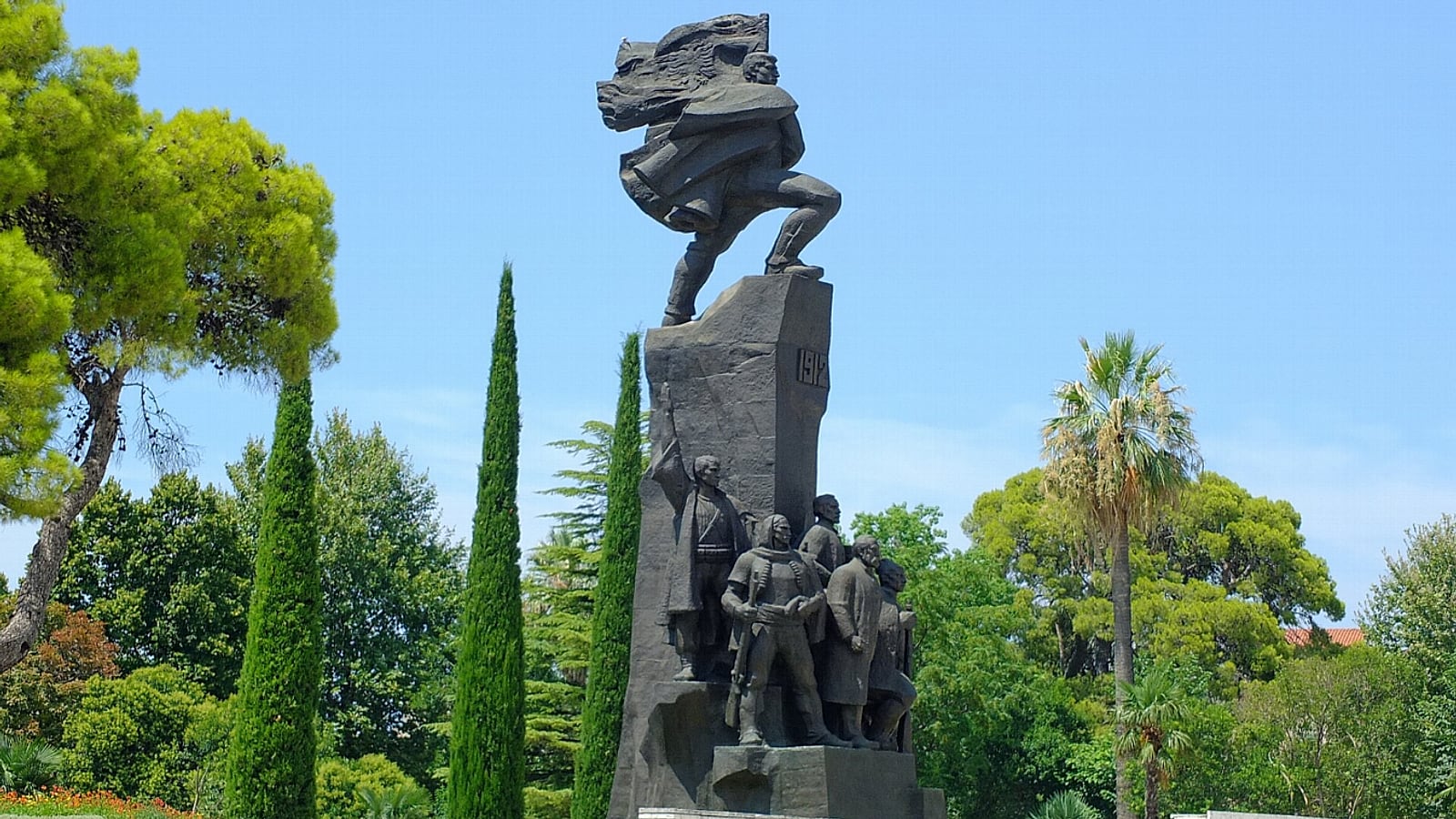
- Hero photo: “The monument of Independence in Vlorë (Vlora)” by Constantine H., Wikimedia Commons, CC BY 2.0. commons.wikimedia.org
