
The number that matters first: Albania began the Second World War with about 200 Jews and ended it with roughly 1,800 to 2,000 (Wikipedia: History of the Jews in Albania). It is the only country in Nazi-occupied Europe whose Jewish population was larger at the end of the war than at the start. The Nazis themselves, at the 1942 Wannsee Conference, recorded an estimate of 200 Albanian Jews — a number that turned out to be hopelessly low because the country was, by then, hiding thousands of refugees from Greece, Yugoslavia, Austria, and Germany inside Albanian homes.
The mechanism was not a resistance army. It was besa — shqiptar (the Albanian self-name) for the code of honor that obligates a host to protect any guest who has crossed the threshold, even at the cost of the host’s own life. When Yad Vashem asked rescuers, decades later, why they had taken on the risk, the answers were not political. They were domestic. The refugees were guests; the guests had asked for refuge; the rule was the rule.
This piece covers the numbers: how many Jews were in Albania before 1939, how many were sheltered between 1939 and 1944, how many Albanians have been recognized as Righteous Among the Nations, how many remain in Albania today, and what the story has meant for the shqiptar diaspora in the United States. It is a companion to our longer explainer on besa — that piece is about the concept; this one is about what the concept did in the 20th century.
The short answer: Jews in Albania today and in history
Today, the resident Jewish community in Albania is small — roughly 40 to 50 people, almost all of them in Tirana, served by the Hechal Shlomo synagogue that opened in December 2010 (World Jewish Congress: Albania). The community shrank dramatically after 1991, when nearly the entire population emigrated to Israel.
Before the war, the registered community was also small. The 1930 Albanian census counted 204 Jews. Official state recognition came on April 2, 1937, when the community totaled about 300 members (Wikipedia: History of the Jews in Albania).
The wartime figure is the one that broke the trend. By 1945, the Jewish population on Albanian territory was roughly nine to ten times larger than in 1939, with most of the increase coming from refugees taken in during the Italian occupation (1939-1943) and protected through the German occupation (1943-1944). The Albanian-proper figure cited most often by historians is about 1,800, with broader estimates ranging from 1,800 to 2,000 depending on whether refugees in Kosovo and the territories briefly attached to Albania are counted.
Those three numbers — 200 before, 2,000 during, 50 today — are the spine of this article.
The pre-war community
Jewish presence in the territory of modern Albania is documented going back to Roman-era Durrës (Dyrrhachium), where a Romaniote (Greek-speaking) Jewish community is attested in the 1st century CE. A second, larger wave came after 1492, when Jews expelled from Spain and Portugal under the Alhambra Decree settled along the Adriatic coast. The Ottoman administration that controlled the region accepted them, and Sephardic communities took root in Vlorë (still called Avlonya in some Ottoman sources), Berat, Elbasan, and later Korçë and Tirana (Wikipedia: History of the Jews in Albania).
By the 16th century, Vlorë was the most significant Jewish town in the region, with documented synagogues, a Hebrew-language printing press, and Mediterranean trade ties. The community declined over the following centuries as Sephardic families dispersed to Salonika, Istanbul, and Italy.
The community that the 1930 census found — 204 people — was a remnant of those waves, joined by a small number of Ashkenazi families from Austria-Hungary and Germany. Most lived in Vlorë, Korçë, Tirana, and Berat. They were merchants and craftspeople with a community organization but no national synagogue building; religious life happened in private homes.
The Albanian state granted formal recognition to the Jewish community on April 2, 1937, under King Zog. That document is one reason the legal status of Jewish residents was relatively clear when refugees began arriving from elsewhere in Europe two years later.
The 1939-1944 rescue
The Italian occupation of Albania began on April 7, 1939, when Mussolini’s forces landed at Durrës and King Zog fled into exile. From that point until the September 1943 Italian armistice, Albania was under Italian administrative control — and, paradoxically, that made it safer for Jewish refugees than most other corners of southern Europe.
Italian occupation policy in Albania did not generally deport Jews. Many Italian officials ignored, slow-walked, or quietly subverted orders to register or hand over Jewish residents. Several historians have called the Italian zone in Albania the most permeable border in occupied Europe for Jews fleeing the Nazi-controlled Balkans (Wikipedia: The Holocaust in Albania).
Refugees came from three directions. Yugoslav Jews — from Kosovo, Macedonia, and Bosnia — crossed in over the eastern mountains. Greek Jews fled north from Ioannina, Salonika, and Corfu. A smaller group of Austrian and German Jews had arrived earlier via Italy or by sea. Many were initially placed in Italian-run internment in towns such as Berat and Kavajë, where surveillance was thin and the local population was already moving people into private homes.
The German occupation began in September 1943, after Italy switched sides. From then until the liberation of Albania in late 1944, the country was under direct Wehrmacht and SS control. The danger jumped sharply. In early 1944, German authorities demanded a list of the country’s Jews. Two Jewish community leaders raised the demand with former prime minister Mehdi Frashëri, who referred the matter to Interior Minister Xhafer Deva. Deva refused to hand over the list, calling the German request interference in Albanian affairs, and Albanian officials refused again when Germany repeated the demand in June 1944 (Wikipedia: The Holocaust in Albania).
The mechanics of hiding were domestic. Refugees were taken into the homes of villagers and townspeople — sometimes for weeks, often for months, in some cases for the full year of German occupation. Some were registered as servants, some as cousins, some as Muslim or Christian by the simple device of new identity papers with Albanian names. In Berat alone, documented accounts describe Jewish families hidden across roughly 60 Muslim, Catholic, and Orthodox households in a single small city.
The country also produced almost no deportations. Nearly the entire Jewish population on Albanian soil, refugees included, survived the war.
Besa and what it actually meant in 1943
The word that comes up in every survivor and rescuer account is besa — usually translated as “the given word” or “the pledge of honor.” It is the Albanian code that obligates a host to feed, shelter, and defend any guest who has crossed the threshold, even when the cost is the host’s own life. We cover the concept and its place in the Kanun (Albanian customary law) in detail in our piece on besa.
What matters for this article is what besa did in 1943, not what it is in the abstract.
Refik Veseli, the 16-year-old Muslim photography apprentice from Krujë who brought the Mandil family up the mountain on mules at night and hid them above his family’s barn from November 1943 until the liberation in late 1944, used that word when Yad Vashem asked him decades later why he had done it.
The point that comes through in every account: rescuers did not describe what they were doing as resistance, as charity, or as a moral exception to a national norm. They described it as the norm. A guest is in the house; the host’s job is to protect the guest. The fact that the guests in 1943 were Jews fleeing Nazis was, in this telling, the kind of historical accident that besa was built to handle. That is not a romantic gloss. It is what the source material says.
Named rescuers and survivors
The story is best understood through specific families rather than aggregate counts. A few of the documented cases:
The Veseli family of Krujë. Vesel and Fatime Veseli sent their teenage son Refik to Tirana in 1943 to apprentice at the photography studio of Neshad Prizerini, where he met a Yugoslav-Jewish refugee photographer working there, Moshe Mandil. When the Germans entered Albania in 1943, Refik secured his parents’ permission to bring Mandil, his wife Ela, and their children Gavra and Irena up to Krujë. They moved at night, hid in caves by day, and crossed the mountains by mule. From November 1943 to the liberation in late 1944, the Mandils lived in a small room above the family’s barn while the Veseli children mingled openly with the Mandil children in the village. After the war Refik followed the family to Yugoslavia to finish his photography training and continued the relationship until the Mandils emigrated to Israel in 1948. On December 23, 1987, Yad Vashem recognized Vesel, Fatime, and Refik Veseli as Righteous Among the Nations — the first Albanian family to be honored.
The wider Krujë network. Refik Veseli was not the only rescuer in his town. The Krujë region sheltered multiple Jewish families across the war, often coordinated informally between households. These are two among dozens of named cases in the Yad Vashem files — typical of the Albanian rescue record, not exceptional within it.
Albanian Righteous Among the Nations
Yad Vashem, the World Holocaust Remembrance Center in Jerusalem, awards the title Righteous Among the Nations to non-Jews who risked their lives to save Jews during the Holocaust. As of January 1, 2024, the institution had recognized 75 Albanians (Yad Vashem: Names of Righteous by Country).
That count is by individual rescuer. By family, the number of households is significantly higher, because most rescue operations were collective and multiple members of one home were named together. The first Albanian recognition came in December 1987 to the Veselis; awards have continued in waves through the 1990s and 2000s as testimonies, family records, and survivor accounts were assembled.
Two patterns make the Albanian record distinct from other national rescues.
The first is the multi-confessional pattern. Albanian rescuers came from Muslim, Catholic, Orthodox, and Bektashi households in roughly the proportions of the broader population. The Veselis were Muslim. Other named rescuers — the Vrioni, Toptani, and Bicaku families among them — included Catholics and Orthodox. The cross-confessional shape of the rescue is one of the reasons historians describe it as a national act rather than a religious one. Albania has been a multi-confessional country for at least 500 years; besa belongs to all four communities.
The second is the majority pattern. In every other Nazi-occupied country, Righteous rescuers are by definition exceptional — a minority of citizens who acted against the prevailing collaboration or indifference. In Albania, by the historical record, rescue was the prevailing response. The 75 individual recognitions undercount the actual scope, because so many of the rescues were performed by ordinary villagers and townspeople who never came to Yad Vashem’s attention and whose names were not preserved.
The photographer Norman H. Gershman documented several dozen of the rescuers, then alive or recently deceased, in his 2008 book Besa: Muslims Who Saved Jews in World War II. The 2012 documentary Besa: The Promise covered the same ground. Both projects are now anchor references for the academic and museum literature.
After the war: the exodus to Israel
The post-war story is shaped by Albania’s communist regime under Enver Hoxha, which governed from 1944 to 1985, and by its successor government, which collapsed in 1991-1992.
For most of the communist period, Albania’s Jewish community lived under the same constraints as the rest of the country: a closed border, no diplomatic relations with Israel, and — after 1967 — an outright state ban on religion. In February 1967, Hoxha’s regime declared Albania the first officially atheist state in the world, closing mosques, churches, and the private prayer rooms that had served the small Jewish community. Religious practice of any kind became a criminal offense (Wikipedia: History of the Jews in Albania).
The community survived this period largely by going silent — religious observance moved indoors, Hebrew was not taught, and intermarriage with non-Jewish Albanians became common. The community was not specifically targeted; the regime’s atheism applied across all faiths.
When communism collapsed in 1990-1991, the community was free to emigrate. Israel and Albania had no diplomatic relations at the time — they were established only in August 1991 — and most of the community left for Israel in the years that followed.
When communism fell in 1991, nearly the entire Jewish community — several hundred people — left the country, most airlifted to Israel and others settling in the United States (World Jewish Congress: Albania). The reasons given by emigrants in interviews at the time were primarily economic — Albania in 1991 was the poorest country in Europe — rather than a response to antisemitism, which historians of the period describe as essentially absent.
By the mid-1990s, the resident Jewish population was a small fraction of what it had been in 1945.
The Jewish community in Albania today
The community that remains is small and concentrated in Tirana. Estimates in 2023 put the number of Jews resident in Albania at roughly 40 to 50, in a country of fewer than 3 million people (World Jewish Congress: Albania).
The institutional anchor is the Hechal Shlomo synagogue in Tirana, which began holding services in December 2010 — the first regular synagogue in the country since the Second World War. The synagogue was established with support from the Brussels-based Rabbinical Centre of Europe and named for Shlomo Amar, the Sephardic Chief Rabbi of Israel at the time, who attended the opening. Rabbi Joel Kaplan was inaugurated as the first Chief Rabbi of Albania at the same ceremony, attended by Chief Rabbi Amar and a representative of then-Prime Minister Sali Berisha, who was kept away by flooding and sent his greetings with the representative.
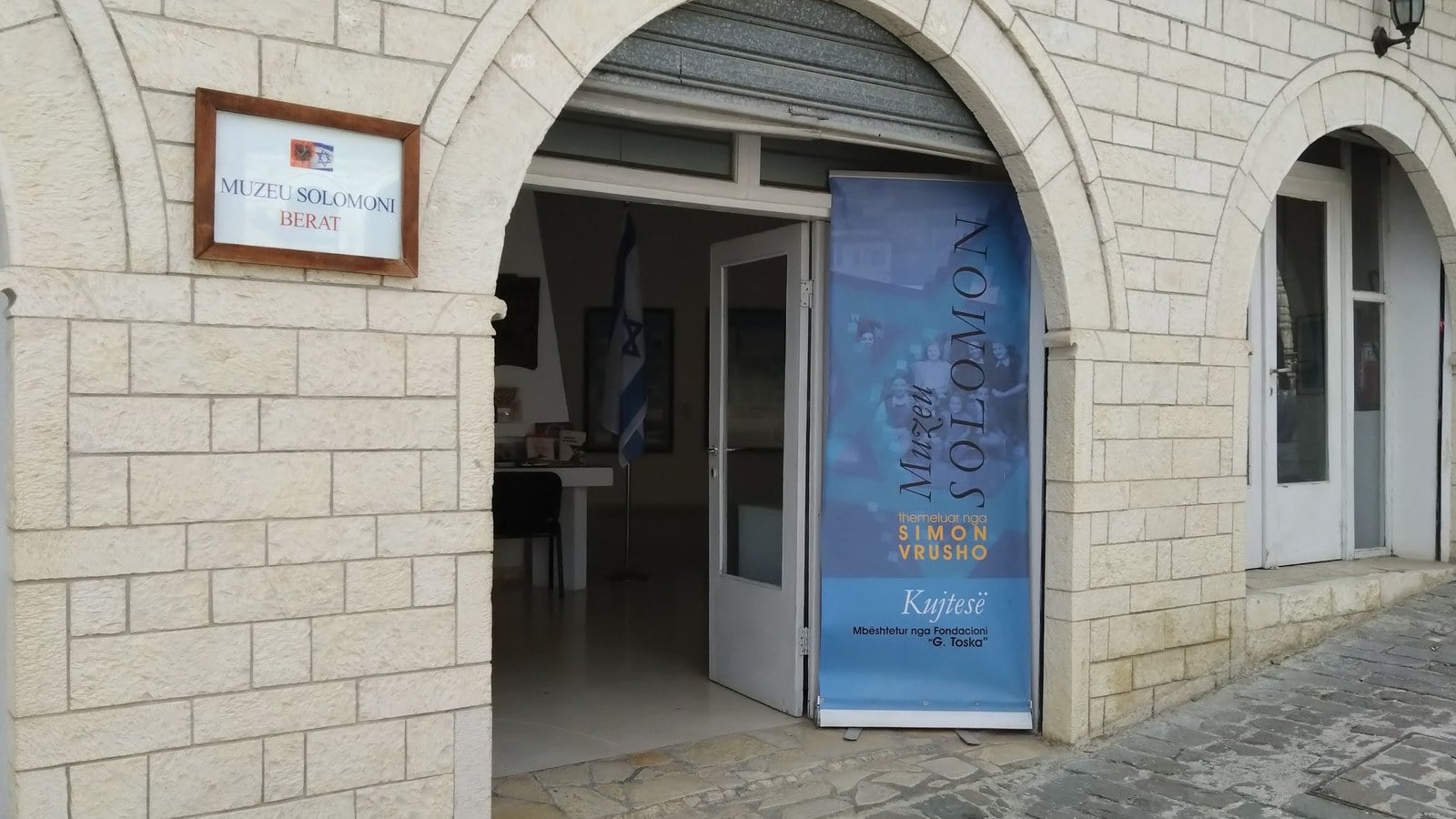
A small Jewish community center has operated in Tirana in recent years, supported by a mix of community donations, diaspora support, and Albanian state cooperation. Albania’s Jewish history museum, the Solomon Museum, is in Berat — it opened in 2018 and covers the WWII rescue and the community’s Sephardic roots (Wikipedia: Solomon Museum). The community in Tirana is served by a Chabad rabbi based in Greece who travels in periodically.
Albania has also maintained warm institutional relations with Israel since 1991 and is one of the small group of countries that openly highlight the wartime rescue in its public diplomacy. The country’s 2023 announcement of plans to honor the wartime rescuers with a state-funded monument and museum is one example.
The community will not return to its mid-century scale. What it does maintain is a continuous presence, a religious infrastructure, and a documentary anchor for the larger Albanian-Jewish story that has now mostly moved to Israel and the United States.
What the story means for the diaspora
For Albanian Americans, the rescue is part of how the family story gets told. It is not the only story — the diaspora’s identity is also built on Skanderbeg, on Mother Teresa, on independence in 1912, on the post-1990 migrations, on the food and the language and the music. But the rescue sits in a specific load-bearing position in the way shqiptar identity is explained to non-Albanian neighbors, in-laws, and children.
A few reasons it matters.
It is multi-confessional. Albania has been Muslim, Catholic, Orthodox, and Bektashi simultaneously for five hundred years, and the rescue is one of the cleanest pieces of evidence that the national identity has historically sat above the confessional one. A Catholic Albanian in the Bronx and a Muslim Albanian in Sterling Heights can both point to the besa rescue as part of the same inheritance. That cross-confessional shared-table quality is hard to manufacture and easy to lose; the rescue is one of the things that has kept it intact.
It is documented. Diaspora communities often work with family histories that are hard to verify in the formal historical record. The rescue is the opposite: 75 individual Yad Vashem recognitions, a documentary film, a photography book, museum collections in Jerusalem and Washington, named survivors who lived into the 2000s and gave video testimony. For a 2nd- or 3rd-generation Albanian American teaching a child what besa means, the rescue provides verifiable narrative material that a Wikipedia summary alone can’t.
It is portable. The honor-side of besa survived the trans-Atlantic crossing in a way that the feud-side mostly did not. Albanian Americans use the language of besa in business introductions, in family obligations, in community endorsements. The rescue is the largest-scale example in modern history of what that language obligates someone to do. It is the reason the word still has weight in diaspora life rather than nostalgia.
It is also sober. The community has lost many of its people to emigration over the last century, has watched the resident Jewish population shrink from thousands to dozens, and has watched the wartime rescuers themselves pass on. The rescue is something to mark and remember, not to celebrate. The rescuers who gave testimony to Yad Vashem, decades later, described what they did in the plainest terms — not as heroism, but as an obligation kept. That is offered as a description, not as a slogan.
If your family’s story includes any of this — a grandparent in a village that took in refugees, an aunt whose name appears in the Yad Vashem files, a great-uncle who carried Jewish papers across a mountain — that is exactly the kind of inheritance the National Albanian Registry exists to count. Get added at /register. It takes a minute.