
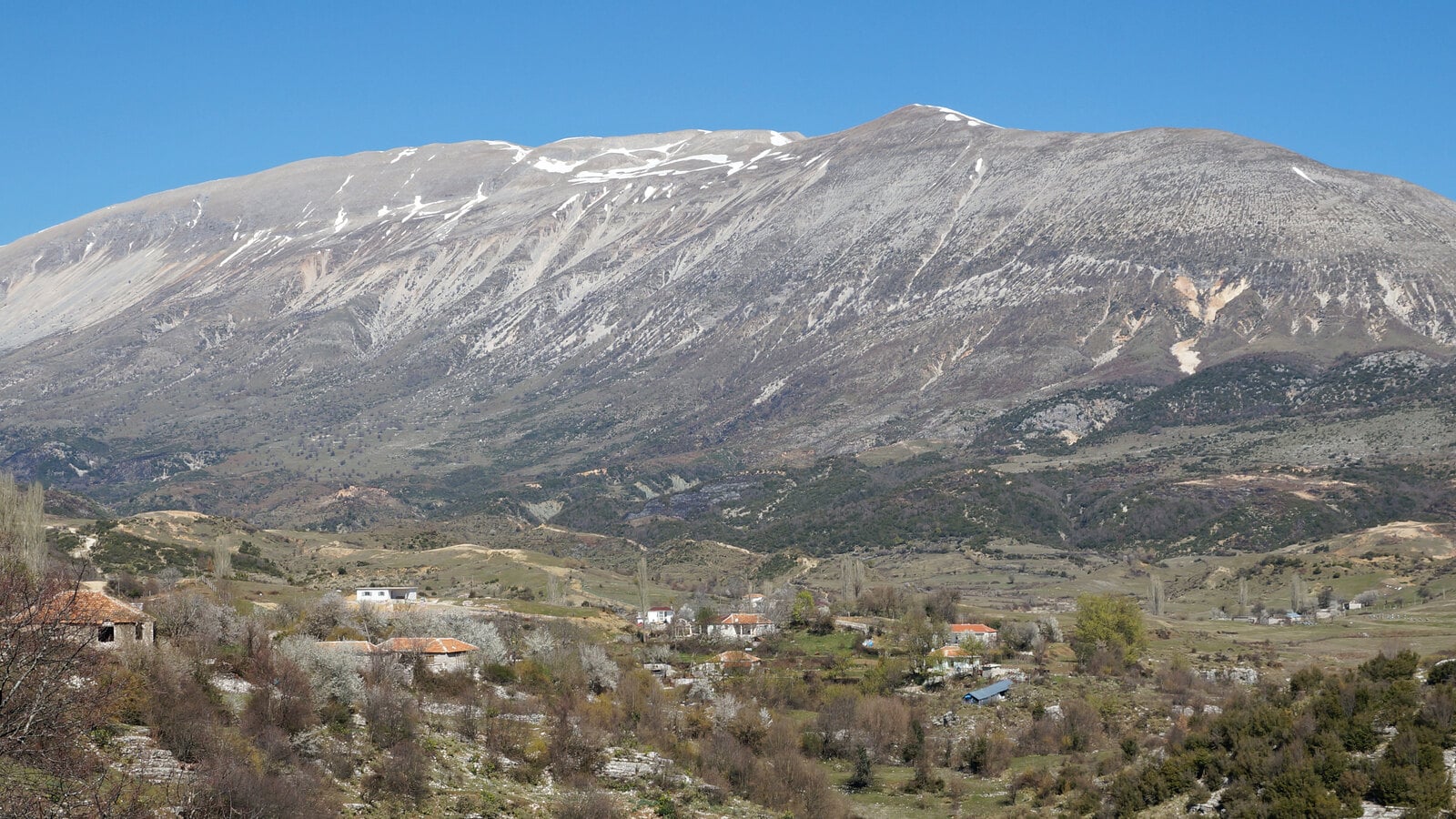
Labëria is not on most maps of Albania. It is not a prefecture, not a municipality, not an administrative region. It is the name the people of southwestern Albania give to the territory they have occupied since before the Ottoman arrival — a belt of limestone mountains, gorges, and Ionian coastline running from the outskirts of Vlorë south to the Greek border, and east into the Kurvelesh highlands above Tepelenë.
The people who live there call themselves Lab. They speak a Lab dialect of Tosk Albanian. They follow a customary law code — the Kanun of Papa Zhuli — that developed independently from the better-known Kanun of Lekë Dukagjini in the north. And they carry a form of polyphonic singing that UNESCO recognized in 2005 as one of the masterpieces of world intangible heritage. What makes Labëria worth knowing is not any one of these things, but the fact that they all persisted — across Ottoman centuries, across a half-century of communist isolation, and into a present where the region’s young people are leaving for Tirana and Athens.
Geography: what the land looks like
Labëria’s boundaries are customary, not political. The Lab themselves define them by dialect, kinship, and the reach of the Kanun of Papa Zhuli. Most observers draw the region roughly as follows:
- North: the city of Vlorë and its bay, where Lab territory meets the Myzeqe lowland
- West: the Ionian coast from Dhërmi and Palasë south through Himarë and Borsh to Lukova
- South: the vicinity of Sarandë and the Butrint lowlands near the Greek border, adjacent to the historical territory of Chameria
- East: the Kurvelesh mountains, the Shushicë river valley, and the district of Tepelenë
The terrain is steep, rocky, and water-scarce in summer. Villages sit on ridges or at the heads of narrow valleys, positioned for defense rather than agriculture. Roads arrived late — many Lab villages were accessible only by mule track until the mid-20th century. This isolation preserved customs and dialect but also meant poverty. The land supports goats, sheep, and olives more readily than grain.
The Lab people
Travelers from the 17th century onward described the Lab in remarkably consistent terms. The English landscape painter and writer Edward Lear, crossing Labëria in 1848 and 1849, recorded their hospitality and their readiness for violence in the same paragraphs. Ottoman administrators classified them as difficult subjects. Greek observers noted them as Albanian-speaking and (by the 19th century) predominantly Muslim, though earlier centuries had been largely Orthodox.
The Lab are a subgroup of the Tosk Albanians — southern Albanian speakers, as distinct from the Gheg-speaking northerners. Within the Tosk world, Lab identity is its own thing: the dialect is recognizable, the singing style is distinct, and the regional pride is fierce. A Lab family in Vlorë or Sarandë will still identify the ancestral village and the fis (patrilineal clan) it belongs to.
The population shift from Orthodox to Muslim happened gradually, largely during the 17th and 18th centuries. The conversion was driven less by conviction than by famine, taxation, and the practical advantages Ottoman rule extended to Muslims. Some villages converted collectively; others resisted. The religious divide never mapped neatly onto clan boundaries, and Lab identity has always sat above it — a Lab is a Lab whether the family prays in a mosque or a church.
The Kanun of Papa Zhuli
Northern Albania’s customary law — the Kanun of Lekë Dukagjini — is well documented, codified in writing by the Franciscan priest Shtjefën Gjeçovi in the early 20th century, and widely studied. Labëria had its own parallel legal system, less well preserved but no less real.
The Kanun of Papa Zhuli is attributed to a Catholic priest named Papa Zhuli, traditionally associated with the village of Zhulat in the Kurvelesh highlands. The dating is uncertain — oral tradition places him during the period of Norman incursions into the Balkans, roughly the 11th or 12th century. Whether he was a single historical figure or a name that accumulated a body of customary rulings over centuries is debated.
What the code governed is clearer than who authored it. The Kanun of Papa Zhuli regulated:
- Family and inheritance: patrilineal succession, bride-price, the rights and obligations of household heads
- Hospitality: the obligation to shelter and feed any guest, including an enemy under truce — the same besa principle found in northern customary law
- Conflict resolution: mediation procedures, blood-feud regulations (though less elaborately codified than the northern system), and the authority of village elders as arbiters
- Property: grazing rights, water access, boundary disputes between clans
The code was reformed and partially updated by Idriz Sulli, a prominent Lab figure of the 18th century. Unlike the northern Kanun, the Kanun of Papa Zhuli was never systematically written down and published. What survives comes from oral transmission, ethnographic fieldwork conducted in the early 20th century, and the legal memory of Lab families. The communist period (1944–1991) suppressed customary law statewide, and the Kanun of Papa Zhuli’s oral-only status made it more vulnerable to that suppression than its northern counterpart.
Ali Pasha of Tepelenë
The most famous Lab figure in European history is Ali Pasha (1744–1822), born in Tepelenë to a prominent Lab Muslim family. He rose through violence, alliance, and political skill to become the semi-independent ruler of a domain stretching from southern Albania through Epirus into Thessaly. At his peak he governed from Ioannina (now in Greece), maintained his own army and navy, conducted foreign policy independently of Istanbul, and corresponded with Napoleon and the British.
Ali Pasha was not a national hero in the modern Albanian sense — he was a warlord and an Ottoman governor who pursued his own power. But his career illustrates the Lab pattern: a peripheral, mountainous people producing fighters and political figures whose influence exceeded what the region’s poverty would predict. Byron visited Ali Pasha’s court in 1809 and wrote about it in Childe Harold’s Pilgrimage. The encounter helped fix “Albania” in the English literary imagination at a time when few Western Europeans could locate the country on a map.
Polyphony: the Lab sound
The Lab singing tradition is the four-voice branch of Albanian iso-polyphony. Where Tosk polyphony uses two or three voices over a smooth continuous drone, Lab polyphony stacks four: the marrës (lead), the kthyes (answering voice), the hedhës (a high ornamental voice), and the iso (the communal drone). The result is a denser, more dissonant sound — harsher to untrained ears, structurally more complex.
Villages along the Ionian coast — Dhërmi, Palasë, Pilur, Himara — are the heartland of Lab polyphonic practice. Each village has its own repertoire and its own local variations on the form. The songs are performed a cappella, without instruments, typically by groups of men standing in a half-circle. Women’s polyphonic singing exists in Labëria but follows somewhat different forms and repertoires.
UNESCO inscribed Albanian iso-polyphony on its Representative List in 2005 (initially as a Masterpiece, reclassified in 2008), and the full tradition encompasses both Lab and Tosk styles. The safeguarding concern is real: the villages where the tradition lives are losing population, and oral transmission from elder to younger singer is breaking down as families move to cities.
Labëria today
The region’s story in the post-communist period is a story of depopulation. The collapse of the state-farm system after 1991 removed the economic base that had kept people in Lab villages, and the 1997 pyramid-scheme crisis accelerated emigration. Young Lab families moved to Tirana, Vlorë, or abroad — to Greece, Italy, the United Kingdom, and the United States. Many villages that had populations in the hundreds during the communist period now have a few dozen permanent residents, most of them elderly.
The Ionian coast — the Riviera segment from Dhërmi to Borsh — has seen a different trajectory. Tourism development, particularly since the mid-2010s, has brought construction, seasonal employment, and rising land values. The coastal villages are no longer emptying the way the interior highlands are. But tourism brings its own pressures: the same development that creates jobs also changes the character of the villages. A beachfront guesthouse in Dhërmi is a different economy than a goatherd on the Kurvelesh ridge.
What persists is identity. Lab families in Tirana still marry within Lab networks, still sing polyphony at weddings and funerals, still tell their children which village the family came from and which fis they belong to. The diaspora carries the same markers. Labëria-as-place may be thinning out; Lab-as-identity shows no sign of doing so.
Why it matters for the diaspora
For Albanian Americans, Labëria is one of several regional identities that crossed the Atlantic with the immigration waves. Lab families settled in concentrations in the northeastern United States, often clustering by village of origin in the pattern common to Albanian-American settlement. The Lab dialect, the polyphonic tradition, the family structures — all of these traveled.
Understanding Labëria matters because Albanian identity is not monolithic. The north has its highland codes, its Gheg dialect, its Catholic and Muslim communities. The south has its Tosk speech, its own customary law, and a history shaped by proximity to Greece and the Ionian Sea. Labëria is the most distinctive subregion within that southern world — the place where the terrain was steepest, the isolation deepest, and the resulting culture most stubbornly its own.