
A teqe — pronounced teh-keh, also spelled tekke in Turkish-language sources — is the lodge of the Bektashi Sufi order. It is a place of worship, a residence for clergy, the burial site of the community’s founders, and a community hall where families gather for the great observances of the Bektashi calendar. For most Albanian-Americans the word is familiar from grandparents in Gjirokastër, Korçë, or Tetovo, even when the household itself is not Bektashi. The teqe is one of the visible institutions of an Albanian religious landscape that has, for centuries, balanced four traditions in close proximity.
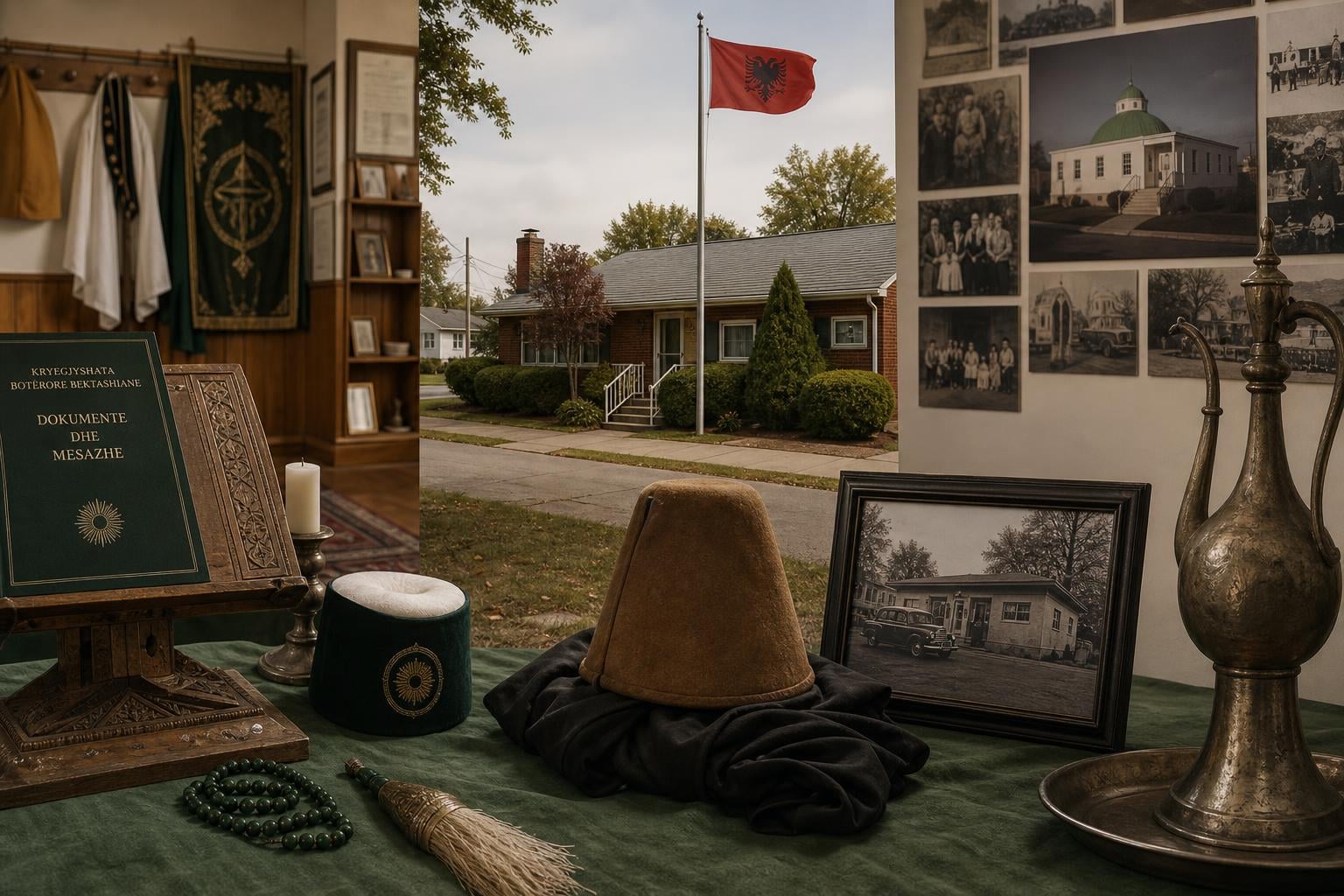
The most consequential teqe in the United States sits on a side street in Taylor, Michigan, a Detroit-metro suburb. The First Albanian-American Bektashi Tekke — Teqeja Bektashiane Shqiptaro-Amerikane — was founded there in 1954 by Baba Rexheb Beqiri, a refugee cleric from Gjirokastër who had reached the United States in the early 1950s. It was the first Bektashi sanctuary ever built on American soil, and more than seventy years later it remains the principal Bektashi institution in North America. Baba Rexheb is buried in the türbe (mausoleum) on the grounds; families still visit.
This piece does three things. It explains what a teqe is and what a visitor would actually see inside one. It walks through the history of Albanian Bektashism — from thirteenth-century Anatolia to the Janissary corps, from Atatürk’s 1925 ban to the move of the world headquarters to Tirana in 1930, through Enver Hoxha’s atheist suppression and the post-1990 revival, to Edi Rama’s 2024 announcement of a sovereign Bektashi microstate. And it tells the diaspora story: how Baba Rexheb’s Michigan teqe came to be, and how Bektashism fits into the broader Albanian-American faith landscape alongside the Sunni, Orthodox, and Catholic communities.
NAR counts the Albanian-American community across all four traditional faiths and the secular majority that sits alongside them. This article is one of several explainers on those institutions.
What a teqe actually is
The simplest description: a teqe is a Sufi lodge. The Bektashi order is a tariqa — a Sufi brotherhood with its own clerical hierarchy, liturgy, and theology — and its physical home, wherever it sits, is the teqe. The Albanian word teqe and the Turkish tekke are the same institution; Albanian Bektashis tend to use teqe in spoken Albanian and tekke in English-language writing.
A typical Albanian Bektashi teqe contains several elements. The semahane is the central prayer and ceremonial hall — the room where the community gathers for the muhabbet (the Bektashi religious meeting), recitations, and seasonal observances. The türbe is the mausoleum of the teqe’s founding baba or another sanctified figure of the order; in many Albanian teqes the türbe is the spiritual anchor of the site, and visitors come specifically to pray there.
Around those two rooms sit the practical functions of the community. There are residential quarters for the baba (the head of a teqe, addressed as a father) and the dervish (the initiated member who has taken vows). There is a kitchen and a dining hall, because Bektashi observances are deeply tied to shared meals. Larger teqes have a courtyard, a garden, a cemetery for community members, and sometimes a meydan — an open-air assembly space.
The clerical structure is its own ladder. The kryegjysh (literally “head grandfather”) is the world leader of the order. A gjysh (grandfather) leads a regional grouping of teqes. A baba leads an individual teqe. A dervish is an initiated member of the order who has not yet been ordained as a baba. Muhibs are lay adherents — the broader community of Bektashi-affiliated families. The whole structure has more in common with a monastic order than with a parish system; a teqe is closer to a Catholic monastery than to a Sunni mosque.
That distinction matters when you walk in. A Sunni Albanian xhami (mosque) is organized around the five daily prayers and the Friday xhumaja. A Bektashi teqe is organized around the baba’s spiritual authority, the founder’s tomb, and the calendar of seasonal observances. Both are houses of worship; they are not the same kind of building.
Bektashism from Hajji Bektash Veli to the Janissaries
The Bektashi order traces itself to Hajji Bektash Veli, a thirteenth-century Sufi saint who lived in Anatolia and is buried at Hacıbektaş, in today’s Nevşehir Province in central Turkey. His tomb complex there remains a pilgrimage site for Bektashis worldwide, including Albanian Bektashis who travel to it from the United States.
From its Anatolian center the order spread west across the Ottoman Balkans over the fourteenth, fifteenth, and sixteenth centuries. Albanian-inhabited territory — particularly the south of what is now Albania, parts of present-day North Macedonia and Kosovo, and the Çamëri region — became one of its strongest concentrations. Teqes were established at Krujë, Korçë, Gjirokastër, Përmet, Tepelenë, Vlorë, Berat, Frashër, Tetovo, and dozens of villages between them. The Frashër Tekke, founded in 1781 in the southern village that produced the Frashëri brothers, was one of the most influential of these southern centers.
For roughly four centuries the order was closely tied to the Janissary corps — the elite infantry of the Ottoman Empire, recruited as boys from Christian families across the Balkans under the devshirme system, converted to Islam, and trained as professional soldiers. The Janissaries adopted Bektashism as their unofficial religious order; Bektashi babas served as their chaplains; the corps and the order grew politically and economically together. That alliance is part of why Bektashism became so deeply rooted in Albanian-inhabited Ottoman territory: many Albanian boys passed through the Janissaries, and many returned to their villages with Bektashi affiliations.
The alliance ended sharply in 1826, when Sultan Mahmud II destroyed the Janissary corps in what Ottoman historians call the Auspicious Incident — a deliberate massacre and abolition of the corps in Istanbul. The Bektashi order was suppressed alongside it. Teqes across the empire were closed, babas were exiled or executed, and the order went underground. It survived best, by some margin, in Albanian-inhabited regions, where local power-holders and the relative weakness of central Ottoman authority allowed teqes to continue operating in modified form.
By the late nineteenth century the order had partially recovered. Albanian Bektashi teqes were openly active, and the order was deeply intertwined with the Albanian National Renaissance — the Rilindja Kombëtare. Naim Frashëri’s Fletore e Bektashinjve (Bektashi Notebook, circa 1895-96) was the first major Bektashi devotional text in the Albanian language and framed Albanian identity in spiritually inclusive terms compatible with all four of the country’s traditional religious communities.
The 1925 ban and the move to Tirana
The hinge moment for the modern history of the order came in 1925. The new Republic of Turkey under Mustafa Kemal Atatürk abolished all Sufi tariqas, closed every tekke in the country, and dissolved the orders’ legal status. The Bektashi headquarters at Hacıbektaş was shut down and converted into a museum. For an order whose spiritual center had been in Anatolia for seven centuries, this was an institutional emergency.
The response, formalized at a 1929 Bektashi congress, was to move the world headquarters of the order to the new Kingdom of Albania, which had emerged from the Balkan Wars and World War I as an independent state with a substantial Bektashi population and no comparable suppression. In 1930 the Kryegjyshata Botërore Bektashiane — the World Bektashi Headquarters — was established in Tirana. Baba Salih Niyazi (also rendered Sali Nijazi) became the first Albanian-based World Leader of the order; he was assassinated in Tirana in 1941 during the Italian occupation, and the leadership has continued in Tirana through every Albanian regime since.
That move is a small fact with large consequences. Since 1930, Albania has been the global center of Bektashism. Every world-level decision about the order is made in Tirana. The current Kryegjyshata complex on the outskirts of the city houses the spiritual leadership, archives, training facilities, and the central teqe of the order. For Bektashi Albanian-Americans, Tirana is what Rome is for Catholic Albanian-Americans or Constantinople is for Orthodox Albanian-Americans — the institutional home of the faith.
Hoxha’s atheist state, 1967 to 1990
The communist regime that took power in Albania after World War II was, from the start, hostile to organized religion. The hostility hardened into something unprecedented in 1967, when Enver Hoxha declared Albania the world’s first officially atheist state. All religious institutions — Catholic, Orthodox, Sunni, and Bektashi — were dissolved. Religious buildings were closed, repurposed, or destroyed. Clergy were imprisoned, sent to forced-labor camps, or executed. Public religious observance was criminalized; private observance carried serious risk.
For the Bektashi order specifically, the 1967 ban was a near-extinction event. Teqes across the country were shuttered. The Tirana Kryegjyshata was repurposed. Babas and dervishes who survived continued teaching in whispers; many did not survive. The community’s living memory of its own liturgy thinned out across a generation.
The thaw began with the regime’s collapse in 1990-1991. Religious freedom was restored, the Kryegjyshata was returned to Bektashi control, and a slow rebuilding began. Teqes were repaired or rebuilt. Survivors of the older generation of clergy trained new babas. The order re-established its public calendar of observances. By the 2010s, Bektashism had recovered to roughly the institutional footprint of a recognized minority faith in Albania, though the demographic share of self-identified Bektashis in the country has shifted considerably across the century.
The Albanian-American diaspora — which had built the first Bektashi tekke abroad in 1954, far from any threat the Albanian state could pose — played a quiet preservation role through the entire suppression period. The Michigan teqe operated continuously while the homeland was closed. Some of the most thorough Bektashi religious texts written in Albanian during the communist decades were produced by Baba Rexheb in Taylor.
The four traditional faiths of Albania
Albanian religious life is conventionally described as having four traditional communities: Sunni Islam, Bektashism, Albanian Orthodox Christianity, and Albanian Catholicism. The exact demographic shares have been debated and re-debated for a century — the most-cited Albanian census figures of the late Ottoman and inter-war period put Sunni Muslims at the largest share, with Bektashis at perhaps a quarter of the Muslim population, Orthodox concentrated in the south, and Catholics concentrated in the north around Shkodër.
What matters here is the framing. Albanian identity has, for most of the modern period, been understood as something that crossed religious lines rather than something defined by them. The well-known nineteenth-century formula attributed to the Albanian writer Pashko Vasa — Feja e shqiptarit është shqiptaria, “the religion of the Albanian is Albanianism” — is not anti-religious; it is a statement that the four communities are bound together by a common national identity that none of them gets to claim exclusively.
In the United States that pluralism is institutionally visible. Sunni Albanian-Americans worship at the Albanian-American Islamic Center network anchored by Imam Vehbi Ismail’s Harper Woods, Michigan flagship. Bektashi Albanian-Americans gather at the Taylor teqe and at smaller Bektashi sites in the New York metro and elsewhere. Albanian Orthodox families belong to the Albanian Orthodox Church in America parishes founded by Fan Noli. Albanian Catholic families worship at the Albanian Catholic Church communities concentrated in Michigan, New York, and the Bronx.
At Albanian-American civic events — Flag Day on 28 November, Independence Day commemorations, scholarship banquets, the New York Albanian Parade — clergy from all four traditions sit at the same head table. That is not a polite fiction; it is how the community actually functions.
The Taylor, Michigan teqe: Baba Rexheb’s story
The story of the First Albanian-American Bektashi Tekke begins in Gjirokastër, in southern Albania, where Baba Rexheb Beqiri was born in 1901. He came from a Bektashi family with deep roots in the region. He took religious training in his teens, entered the Bektashi order as a dervish, and served for some twenty-five years at the Zall Tekke near Gjirokastër under his uncle, Baba Selim, and was active in Albanian religious and patriotic affairs through the inter-war period.
When the communist takeover of Albania moved into its final phase in 1944, Baba Rexheb fled. He spent four years in a displaced-persons camp in Italy, then four more years at a Bektashi tekke in Cairo, joining the wave of Albanian clergy and intellectuals who left rather than accept what was coming. He reached the United States in the early 1950s — a few years after Imam Vehbi Ismail’s parallel arrival in Detroit on a Sunni track from Shkodër in 1949.
The Albanian Bektashi families of metropolitan Detroit — many from the same southern Albanian districts Baba Rexheb came from, working in the auto industry and the small-business economy that grew up around it — invited him to establish a teqe. Land was acquired in Taylor, Michigan, a working-class Detroit suburb southwest of the city. Construction of the first building began in the early 1950s. The teqe was formally established in 1954, and Baba Rexheb served as its head baba from then until his death in 1995.
The Taylor site has grown over the decades. Today it includes a semahane prayer hall, a türbe containing Baba Rexheb’s tomb, a community hall used for the major observances and family events, residential quarters, a cemetery, and grounds maintained for gatherings on the great feast days. The complex sits on a roughly residential lot — a low brick building most passers-by would not identify as a religious site without knowing what they were looking at — and that quietness is part of its character.
Baba Rexheb’s own contribution went beyond the building. His scholarly work — particularly Misticizma Islame dhe Bektashizma (Islamic Mysticism and Bektashism), published in Albanian in 1970 — is one of the more thorough modern expositions of Bektashi theology in any language. He wrote, taught, corresponded with Bektashi communities in Albania and the Balkans, and held the institutional thread of the order during the decades the homeland was closed. When he died in 1995, several thousand mourners attended his funeral; he was buried on the grounds of the teqe he had built, and his türbe remains the site’s spiritual anchor today.
Leadership of the Michigan teqe has passed to successor babas since 1995. The community it serves — Albanian-American families across Macomb and Wayne counties, with visitors and members from other states — is intergenerational. Second- and third-generation Albanian-Americans return for Sultan Nevruz, family memorials, and weddings, even when they live a thousand miles away.
The 2024 Sovereign Bektashi State announcement
In September 2024, Albanian Prime Minister Edi Rama announced a proposal to grant the Bektashi World Headquarters a form of sovereign status on a roughly 10-hectare plot of the Kryegjyshata grounds in Tirana. The announced framework draws on the Vatican City model — a small enclave within a host country, with its own internal administration, recognized as the global seat of a religious tradition. Rama presented the proposal as a way to give Bektashism, with its world center in Albania, an analogous institutional status to that the Catholic Church enjoys with the Holy See.
As of mid-2026, the proposed Sovereign State of the Bektashi Order was still being developed as a domestic legal arrangement; the precise legal mechanism, the constitutional questions involved, and the international-recognition picture had not been fully resolved. Press coverage was extensive and the reaction in Albania and the diaspora was mixed — some welcomed it as an elevation of a long-rooted Albanian religious tradition; others raised practical and constitutional questions. NAR reports the announcement as factually made and does not take a position on its political dimension.
For Albanian-American Bektashi communities, the practical consequences are likely modest in the short term. The Michigan teqe will continue to function as it has since 1954. Whatever institutional status the Kryegjyshata acquires in Tirana, the day-to-day life of a teqe in Taylor — Sultan Nevruz in March, Ashura in Muharrem, weddings on summer Saturdays, the slow turn of the seasonal calendar — is its own thing.
Visiting a teqe: what to expect
Most Albanian Bektashi teqes — including the Taylor, Michigan site — welcome respectful visitors, particularly at public observances. The major dates on the Bektashi calendar are worth knowing if you intend to visit:
Sultan Nevruz falls on 22 March. It is the Bektashi spring festival, observed as the birth of Imam Ali — the Prophet Muhammad’s cousin and son-in-law, the central figure of Shia and Bektashi devotion — and as the new year. It is the largest annual gathering at most Albanian teqes, and the Taylor teqe hosts a substantial community observance each year. Families come from across the Midwest.
Ashura falls on the tenth day of the Islamic month of Muharrem and is the principal Bektashi commemoration of the Battle of Karbala and the martyrdom of Hussein, Ali’s son. Albanian Bektashi tradition observes Ashura with a community fast and the preparation of ashure — a sweet grain pudding shared at the teqe. The date moves through the Western calendar each year because the Islamic calendar is lunar.
Other observances — Matem (the ten-day mourning period leading up to Ashura), the spring and autumn equinox-aligned days, individual babas’ commemoration days, weddings, and forty-day memorials for the deceased — fill out the year.
A few practical notes for visitors. Dress modestly: long sleeves, long pants or a long skirt, a head covering for women if you have one (in many Albanian teqes it is not strictly required for visitors, but bringing a light scarf is the thoughtful move). Remove your shoes where indicated. If you are visiting for a service, contact the teqe ahead of time — phone or email — so the community knows you’re coming. Photography inside the semahane and the türbe is generally not appropriate without permission.
If you are simply curious about Albanian Bektashism and want to see a teqe, the Taylor site is the right first stop for anyone in the United States. The community there is used to visitors and has hosted scholars, journalists, and Albanian-American families across the country for decades.
Bektashism in the broader Albanian-American faith landscape
The Bektashi presence in the United States is one part of a larger Albanian-American religious infrastructure built across the twentieth century. The first organized Albanian-American institutions were Orthodox — Fan Noli’s parish work in Boston dates to 1908, and the Albanian Orthodox Diocese of America was formally organized in 1949. Sunni institutions followed: Imam Vehbi Ismail founded the Albanian American Moslem Society in Detroit in 1949 and consecrated the Harper Woods mosque in 1963. The Albanian Catholic community organized parishes in the Bronx, Hartford, Detroit, and elsewhere across the same decades. And the Bektashi community built the Taylor teqe in 1954.
Each of those four communities has its own clergy, its own institutions, its own publications, and its own internal life. They are not interchangeable, and Albanian-American families generally know which tradition they belong to — even when religious observance has thinned across generations.
What they share is the broader Albanian-American civic infrastructure: Vatra (the Pan-Albanian Federation of America, founded in 1912), the Albanian American National Organization, the regional chambers of commerce, the cultural centers, Flag Day, Independence Day, the scholarship galas, the parades. The religious institutions are the venues for family life; the civic institutions are the venues for community life; and they overlap constantly.
For the small Bektashi share specifically, the Michigan teqe is the anchor and the Tirana Kryegjyshata is the world headquarters. The community is small enough that most Albanian-American Bektashi families know one another by name across state lines. It is also old enough — by US-diaspora standards — to have produced three generations of American-born members and to have buried its founder on American soil. Both of those are significant institutional facts.
Get counted, regardless of faith
NAR counts the Albanian-American community across all four traditional religious traditions — Sunni, Bektashi, Orthodox, Catholic — and the substantial secular share that sits alongside them. The official US Census records about 230,000 Albanian Americans in the most recent ACS estimate; the community estimate is closer to one million. Closing that gap is what the registry exists to do. Religion is not on the form. Telling us you exist is what adds you to the count.
Sources: Wikipedia — Bektashi Order; Wikipedia — Bektashism in Albania; Wikipedia — First Albanian Bektashi Tekke in America; Wikipedia — Baba Rexheb; Kryegjyshata Botërore Bektashiane (Tirana). Where dates or community sizes are approximate, we’ve said so plainly.