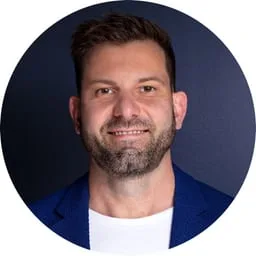
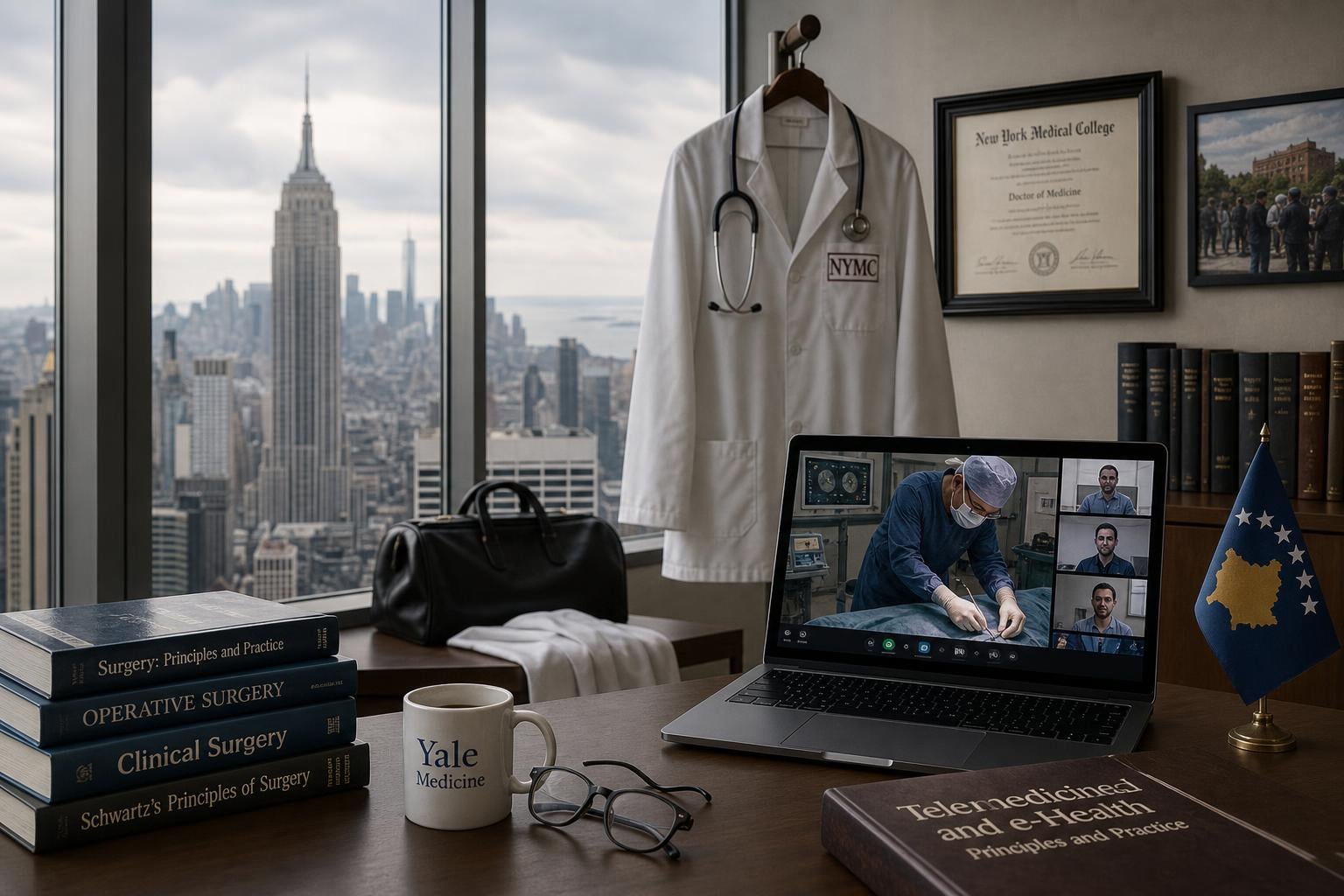
Rifat Latifi is the Kosovo-born Albanian-American trauma surgeon, academic, and former Minister of Health of the Republic of Kosovo whose career sits at an unusual intersection: a working surgeon in US level-one trauma centers, a tenured department chair at a major American medical school, and the founder of a nonprofit that has stood up national telemedicine programs in three countries. He is one of the most-cited Albanian-American physicians in the trauma and telemedicine literature, with more than 450 peer-reviewed papers and 20 edited books to his name.
He is also one of the cleanest examples of a pattern this registry exists to count. The Albanian-American diaspora has produced an outsized concentration of physicians, surgeons, and biomedical researchers — a vector for the community that sits alongside small business, construction, and food service in the conventional accounting, but is less often named explicitly. Latifi is at the very top of that vector. So is the late Ferid Murad, the Indiana-born Albanian-American who shared the 1998 Nobel Prize in Medicine.
What follows is an account of Latifi’s training, his surgical career, the telemedicine work that made him known internationally, his year as Kosovo’s Minister of Health, and the academic record that anchors all of it.
Origins in Kosovo and the path out
Latifi was born in 1955 in Kosovo, then part of the Socialist Federal Republic of Yugoslavia. He came of age in a Kosovo where Albanians were the demographic majority and a political minority, and where access to professional training in Albanian was uneven and frequently contested.
He entered medical school at the Faculty of Medicine of the University of Pristina — Universiteti i Prishtinës, the Albanian-language university whose medical faculty has trained most of Kosovo’s physicians since its founding. The university opened a path into medicine that did not require leaving the country, but the post-graduate training infrastructure for advanced surgical specialties was thin. For surgeons who wanted formal subspecialty training in trauma, critical care, or transplantation, the United States, Western Europe, and to a lesser extent Yugoslavia’s larger Belgrade and Zagreb hospitals were the realistic options.
Latifi earned his MD from the University of Pristina in 1982 and, after several years of clinical work in Kosovo, left for the United States in 1985 — a few years before Slobodan Milošević’s 1989 revocation of Kosovo’s autonomy and the crackdown on Albanian-language institutions that followed. He initially worked as a researcher in Houston, Texas, before beginning his formal US surgical training several years later, at the Cleveland Clinic in 1993–94.
It is worth pausing on this transition: an immigrant physician in his late thirties, trained in a system the US does not directly recognize, restarting at the level of a categorical surgical intern. That is the formal entry-level position of a first-year resident. Most surgeons spend that year in their late twenties.
Surgical training in the US: Cleveland, Yale, the Bronx
Latifi completed a categorical internship in general surgery at the Cleveland Clinic Foundation in 1993-1994. From Cleveland he moved to Yale University School of Medicine in New Haven, where he completed a five-year general surgery residency from 1994 to 1999.
He then took a Surgical Critical Care Fellowship at Lincoln Hospital, the level-one trauma center in the South Bronx affiliated with New York Medical College, training under the trauma surgeon and educator Rao Ivatury. Ivatury’s name carries weight in US trauma circles; an Ivatury fellowship signals that the trainee handled penetrating-trauma volumes most US surgeons see only in textbooks. Lincoln, in the South Bronx of the 1990s, was one of the highest-acuity trauma services in the country.
That fellowship is what produced the trauma surgeon Latifi would be for the next two decades. The combination is also what shaped his telemedicine instincts: Lincoln-style trauma care depends on protocols that compress complex decision-making into the first ten minutes after a patient arrives, and Latifi began to think about how those protocols could be transmitted electronically to clinicians 5,000 miles away who would never see Lincoln-grade volumes.
After fellowship he was appointed to the faculty at the University of Arizona College of Medicine in Tucson, where in January 2003 he took the role of Associate Professor of Surgery and Director of Surgical Critical Care. He was promoted to full professor of surgery shortly after — an unusually fast climb for a foreign medical graduate who had restarted as an intern less than a decade earlier.
The International Virtual e-Hospital and the Balkans telemedicine programs
Latifi is best known internationally for telemedicine — and specifically for one institution: the International Virtual e-Hospital (IVeH), the US-based nonprofit he founded after presenting the concept at the G8 meeting in Berlin in 2000.
IVeH’s stated mission is to assist post-conflict and low-resource countries in rebuilding their public health systems by introducing telemedicine, telehealth, and continuing-medical-education networks at the national level. The organization’s design rule, in Latifi’s own framing, is that the country runs the program after the build-out, not the foreign team.
Three national programs anchor the record:
Kosovo. IVeH stood up the first national telemedicine network in post-war Kosovo in the early 2000s, linking the University Clinical Center of Kosovo in Pristina to regional hospitals in Peja, Gjakova, Prizren, Mitrovica, Gjilan, and Ferizaj. The network combined real-time consultation, store-and-forward radiology and pathology, and continuing-medical-education delivery to clinicians who, in the post-1999 period, had been substantially cut off from international medical literature for a decade.
Albania. The Integrated Telemedicine and e-Health Program of Albania (ITeHP-Albania) was built by IVeH in cooperation with USAID/Albania, the US Army Corps of Engineers, and the Albanian Ministry of Health. As of the program’s published evaluations, the network covered the entire country through roughly 36 active telemedicine centers and clinical portals, and a 2020 study Latifi co-authored in Telemedicine and e-Health analyzed 2,724 patient consultations delivered through it.
Cabo Verde. The third national program, in the West African archipelago of Cabo Verde — a country with roughly half a million people spread across ten islands — used the same IVeH playbook to connect the islands’ regional hospitals into a single specialty-consultation network anchored in Praia. For this body of work, Latifi received the American College of Surgeons / Pfizer Award for International Surgical Volunteerism in 2015.
The cross-cutting argument in Latifi’s telemedicine writing is that telemedicine is not a luxury layer for rich health systems — it is, on the contrary, the most cost-effective way for small and post-conflict countries to compensate for the specialty depth they cannot afford to staff in person. North Macedonia and Bosnia and Herzegovina have appeared as additional partner geographies in IVeH’s published work over the years, generally on a project basis rather than the fully nationalized model used in Kosovo and Albania.
Trauma surgery at Westchester Medical Center and the chair at NYMC
In January 2016, Latifi moved from Arizona to New York to take the role of Director of the Department of Surgery at Westchester Medical Center (WMC), the level-one trauma and academic medical center in Valhalla, NY, and Vice-Chairman and tenured Professor of Surgery at New York Medical College (NYMC), WMC’s affiliated medical school.
In 2018 he was elevated to Chairman of the Department of Surgery at New York Medical College — the senior surgical role across the WMC Health Network — a position he held until 2021. Across those years he ran a clinical service that handles the trauma volume of Westchester County and the lower Hudson Valley, supervised the surgical residency program, and continued to run IVeH and to publish heavily in trauma and surgical critical care.
That period coincided with the COVID-19 pandemic, during which Latifi co-authored some of the most widely-circulated commentaries arguing that COVID had finally pushed US telemedicine into mainstream clinical care after twenty years of policy and reimbursement friction. The 2020 Telemedicine Journal and e-Health perspective he wrote with Charles Doarn — Perspective on COVID-19: Finally, Telemedicine at Center Stage — is one of the more frequently cited US telemedicine commentaries of the pandemic year.
He held the NYMC chair until November 2021, when he left for Pristina.
Service as Minister of Health of the Republic of Kosovo
On November 16, 2021, Prime Minister Albin Kurti named Latifi Minister of Health of the Republic of Kosovo. He stepped down from the chair of surgery at NYMC and from his clinical role at Westchester Medical Center to take the post.
The ministerial appointment was Latifi’s second formal Kosovo government role. Earlier — in 2009 — he had been appointed Health Adviser to then-Prime Minister Hashim Thaçi, an unpaid advisory role that gave him a working relationship with the country’s health bureaucracy more than a decade before he came back to lead it.
His ministerial agenda emphasized two themes: building out a functional national health information system and stabilizing the country’s mandatory health insurance scheme, both of which Kosovo had been attempting to implement, with mixed success, since independence (Kosovo declared independence in 2008). Both are unglamorous infrastructure problems. Both are also the kind of problems where a minister with a working knowledge of US-style integrated health systems, telemedicine networks, and academic-medical-center governance has more to contribute than a more conventional political appointee.
Latifi’s tenure ended in October 2022, less than a year after it began. Reporting at the time identified mounting political criticism around the ministry; Latifi himself has spoken about the experience in interviews and op-eds since, including a 2023 piece in Illyria, the New York Albanian-American newspaper, framing the year as a deliberate decision to spend the political capital of a US academic surgeon on a system that needed it. He returned to clinical practice in the United States after stepping down.
Academic record: books, journal editorships, and Kosova College of Surgeons
Latifi’s academic output is unusual in volume even by the standards of senior US surgical chairs.
By his most recent published count he is the author or co-author of more than 450 peer-reviewed scientific articles and book chapters and has authored or edited 20 books, the bulk of them in trauma surgery, surgical critical care, telemedicine, and global surgery. The titles include multi-edition reference texts on telemedicine (Establishing Telemedicine in Developing Countries; The Modern Hospital) and on the operative management of complex abdominal-wall problems and trauma.
He serves on the editorial boards of several international surgical journals, including Surgical Technology International (as editor) and the Journal of Telemedicine and e-Health. He is the founding Editor-in-Chief of the Kosova Journal of Surgery, the English-language peer-reviewed journal of the Kosova College of Surgeons (Kolegji i Kirurgëve të Kosovës), the professional society he founded and continues to lead as Founding President. KOSCS is, in effect, the institutional home for an Albanian-language surgical academic community that did not previously have one — a parallel to the role that Vatra and the Federation of Albanian American Catholic Clergy played in earlier generations of diaspora institution-building, but in the surgical academic register.
He has also served as Vice-President of the US Chapter of the International College of Surgeons.
The mentorship record is harder to count from the outside, but in the published acknowledgments and co-authorships of two decades of trauma fellows and surgical residents trained at Arizona, Westchester, and Pristina, the pattern is consistent: Latifi co-publishes with his trainees, brings them into the IVeH network, and the IVeH network exports them — back to Kosovo, into the broader Balkans, and into US academic surgery.
Why this story matters to the Albanian-American diaspora
The Albanian-American community is, demographically, small. The 2024 American Community Survey count of self-reported Albanian ancestry sits at roughly 230,000; community estimates including ethnic Albanians from Kosovo, North Macedonia, Montenegro, and Italian Arbëresh populations push that number above one million. Either way, it is a small share of the US population.
Inside that small share, medicine is a disproportionately represented profession. Walk through the staff directory of a major academic medical center in the New York metro, Detroit metro, or Boston metro area, and Albanian and Kosovar names show up at a rate that would surprise an observer working from the headline census number alone. There are reasons. Albanian higher education has produced strong basic-science training for decades; the post-1990 Albanian and post-1999 Kosovar emigrations brought working physicians and physicians-in-training who restarted in the US system; the community’s intergenerational expectation around academic professions, especially medicine, is high.
Latifi sits at the very top of that pattern. He is the rare member of the diaspora who built a senior US academic surgical career, a parallel academic infrastructure in the home country, a multinational nonprofit, and a national health-ministry role — and did all four sequentially rather than as alternatives.
For a US-based Albanian American reading this and wondering whether the diaspora has produced consequence in medicine, the honest answer is that it has produced more consequence than the headline numbers suggest, and Latifi is one of the names by which that fact is made legible. The other obvious one, in a different scientific register, is Ferid Murad. They are not the only two — but they are the two who are easiest to point at.
This is also the reason a registry of Albanian Americans matters. A community whose physicians, scientists, and senior professionals are not formally counted is a community whose contribution is easy to underestimate from outside, and easy to lose track of from inside. Adding your name to the count is a ninety-second action with a long downstream consequence.
Get counted at /register — free, encrypted, community-led, no payment, no data sales. The community-led count of Albanian Americans starts with you.