
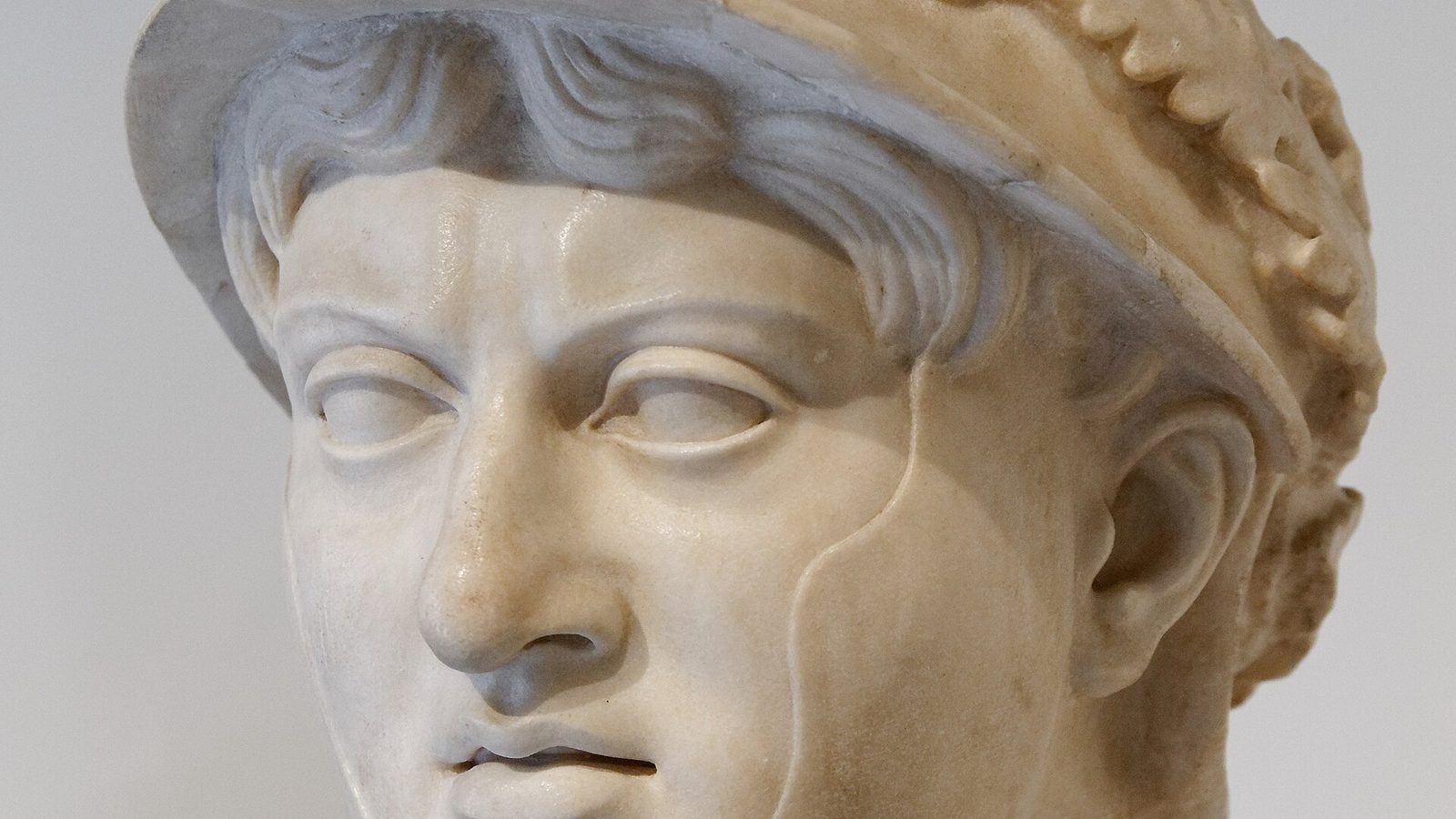
Pyrrhus of Epirus gave the English language a phrase that has outlasted every kingdom he built and every army he led. A Pyrrhic victory — a win that costs so much it might as well be a defeat — is one of the few concepts from the ancient world that a person with no classical education can define. The phrase is 2,300 years old. It still works because the pattern keeps happening.
The man behind it was a Molossian king born in 319 BC in the ancient kingdom of Epirus, a territory that covered what is now northwestern Greece and southern Albania. He was raised from infancy by an Illyrian king. He married an Illyrian princess. He fought Rome’s legions in southern Italy and won — twice — at a cost that destroyed his own army. He fought in Sicily, in the Peloponnese, and died at 47 when an old woman on a rooftop threw a tile at his head during street fighting in Argos.
Hannibal, according to Plutarch, considered Pyrrhus the second-greatest general who ever lived. The modern reader is more likely to know him from the phrase than the man. This article covers both: the life, the wars, the Epirote-Illyrian world he came from, and the careful case for how Pyrrhus sits in Albanian ancestral memory — and where that claim runs ahead of the sources.
For the broader Illyrian world that Pyrrhus’s Epirus bordered and overlapped with, our guide to Illyrian civilization covers the tribes, kings, and the Illyrian-Albanian continuity debate in full.
The Aeacid dynasty and the kingdom of Epirus
Epirus was not a city-state like Athens or Sparta. It was a tribal kingdom in the northwestern corner of the Greek world, organized around three main peoples: the Molossians in the center, the Chaonians in the north, and the Thesprotians in the south. The Molossian royal house — the Aeacids — claimed descent from Neoptolemus, son of Achilles, which placed them in the Homeric genealogy of Greek heroes. Alexander the Great’s mother, Olympias, was a Molossian Aeacid princess. Pyrrhus was her second cousin, once removed.
That Homeric lineage carried political weight in the Greek world — it was a ticket to the Olympics, to alliances with Macedon, and to recognition by Delphi. But the relationship between Epirus and the wider Greek world was more complicated than the genealogy suggests. Thucydides, writing in the fifth century BC, classified the Epirotes alongside the Illyrians as barbaroi — non-Greek peoples. Whether he meant linguistically non-Greek or merely politically and culturally un-urbanized has been debated for centuries, but the label stuck. The Epirotes sat at a border: Greek enough to compete at Olympia, northern enough that the core Greek states sometimes grouped them with their Illyrian neighbors.
The Molossian kingdom occupied a territory that maps directly onto the modern Albanian-Greek borderland. Its northern frontier touched the lands of Illyrian peoples — the Taulantii, the Dassaretii, the Enchelei — and political, marital, and military alliances between the Molossian court and Illyrian rulers were routine. This is the world Pyrrhus was born into.
A childhood in Illyria (317–306 BC)
Pyrrhus was born around 319 BC, the son of King Aeacides of Epirus and Phthia, daughter of Menon of Pharsalus. He was born into instability. His father, Aeacides, was overthrown by an internal revolt in 317 BC when Pyrrhus was roughly two years old. The child’s life was in immediate danger — the faction that had deposed his father had reason to kill the heir.
According to Plutarch, Pyrrhus’s attendants fled with the infant through the mountains. They reached the court of Glaucias, king of the Taulantii — an Illyrian people whose territory roughly corresponded to central Albania. The story is one of the most cited episodes in ancient Albanian historical memory: Plutarch writes that the attendants placed the child at Glaucias’s feet, and that the Illyrian king, moved by the gesture, took Pyrrhus under his protection despite Macedonian threats to hand the boy over.
Glaucias raised Pyrrhus for the next decade. The Taulantian court was not a minor outpost — the Taulantii had fought Alexander the Great’s father, Philip II, and maintained a military force sufficient to challenge Macedon. In 306 BC, when Pyrrhus was twelve or thirteen, Glaucias invaded Epirus, expelled the rulers who had displaced the Aeacids, and placed Pyrrhus back on the Molossian throne with a regency to govern until he came of age.
This is the first and most concrete link between Pyrrhus and the Illyrian world. He did not merely pass through Illyria. He was raised there, protected there, and restored to power by an Illyrian king’s army.
The young king, exile, and the road to power (306–281 BC)
The restoration did not hold. In 302 BC, while Pyrrhus was away fighting in a dynastic war alongside his brother-in-law Demetrius Poliorcetes, Cassander of Macedon seized Epirus and installed Pyrrhus’s cousin Neoptolemus II on the throne. Pyrrhus was exiled again at roughly seventeen.
What followed was a decade of high-stakes Hellenistic politics. Pyrrhus fought alongside Demetrius at the Battle of Ipsus (301 BC), one of the largest battles of the successor wars. He was sent as a hostage to Ptolemy I in Egypt — a move that turned into an opportunity. Ptolemy married his stepdaughter Antigone to Pyrrhus and provided the money and soldiers for a return to Epirus.
Around 297 BC, Pyrrhus returned, deposed Neoptolemus II (and killed him at a banquet, according to some sources), and consolidated control over Epirus. Over the next fifteen years he expanded the kingdom, defeated a Macedonian invasion, and built alliances through a series of politically calculated marriages:
- Antigone — stepdaughter of Ptolemy I of Egypt. His first and reportedly most-loved wife; she died young.
- Lanassa — daughter of Agathocles, tyrant of Syracuse. She brought the island of Corcyra (modern Corfu) as dowry. She later left Pyrrhus, reportedly offended by his polygamy, and offered Corcyra to Demetrius Poliorcetes.
- Bircenna — daughter of Bardylis II, an Illyrian king. This marriage, around 292 BC, was a military alliance: Pyrrhus secured his northern frontier by marrying into the Illyrian royal house that controlled the territory above his kingdom. Their son, Helenus, carried both Molossian and Illyrian royal blood.
- A daughter of Audoleon, king of the Paeonians, extending his network into the central Balkans.
By 281 BC, Pyrrhus had built Epirus into the strongest state on the western edge of the Hellenistic world. He controlled territory from southern Illyria to the Gulf of Ambracia. And then Tarentum called.
The wars against Rome (280–275 BC)
The Greek colony of Tarentum, in the heel of the Italian peninsula, was under pressure from Rome’s expanding republic. The Tarentines appealed to Pyrrhus — a king with the military reputation and the Hellenistic pedigree to stand against a rising western power.
In 280 BC, Pyrrhus crossed the Adriatic with approximately 25,000 infantry, 3,000 cavalry, and 20 war elephants. It was the first time a Hellenistic army had fought a Roman one. The encounter was a collision between two military systems: the Macedonian-style phalanx against the Roman legion, professional Hellenistic cavalry against Roman citizen-soldiers, and war elephants against troops who had never seen one.
Heraclea (280 BC)
The first battle, at Heraclea in Lucania, was a Pyrrhic success. Pyrrhus won, but the cost was steep. The Romans lost roughly 7,000 men; Pyrrhus lost approximately 4,000, including several of his best officers and men who had fought with him since Epirus. The Romans could draw on a vast pool of Italian manpower to replace their losses. Pyrrhus could not. Every dead Epirote or Thessalian veteran was irreplaceable at that distance from home.
Asculum (279 BC)
The second battle, at Asculum in Apulia, produced the line that gave the English language its phrase. Pyrrhus won again — but at an even higher cost. Plutarch records the moment: when congratulated on his victory, Pyrrhus said, “If we are victorious in one more battle with the Romans, we shall be utterly ruined.”
The arithmetic was brutal. Pyrrhus could beat a Roman army in the field. But the Romans could raise another army, and another, and another. Pyrrhus could not. He was fighting thousands of miles from his recruiting base, and every battle — won or lost — ground down the army he had brought with him.
Sicily and the retreat (278–275 BC)
Rather than fight a third Italian battle immediately, Pyrrhus accepted an invitation from the Greek cities of Sicily to help them against Carthage. He spent nearly three years in Sicily, achieved initial successes, but antagonized his Greek allies and failed to take the Carthaginian fortress of Lilybaeum. He returned to Italy diminished.
In 275 BC, at Beneventum (modern Benevento), the Romans finally beat Pyrrhus in the field. His elephants panicked and stampeded through his own lines. Pyrrhus withdrew to Epirus with roughly a third of the army he had brought to Italy. The western adventure was over.
The last campaigns and death in Argos (272 BC)
Pyrrhus was not finished. He invaded Macedon in 274 BC and briefly seized the throne from Antigonus II Gonatas, only to lose it again. In 272 BC he marched south into the Peloponnese to support a claimant to the Spartan throne, Cleonymus, and attacked Sparta itself. The Spartans held — women and old men joined the defense of the unwalled city — and Pyrrhus withdrew.
He then moved to Argos, where Antigonus was encamped nearby. Fighting spilled into the streets of the city. According to Plutarch, Pyrrhus engaged an Argive soldier and was about to kill him when the soldier’s mother — an old woman watching from a rooftop — hurled a roof tile that struck Pyrrhus on the head and knocked him from his horse. A Macedonian soldier named Zopyrus finished him off on the ground.
He was 47 years old. He had ruled Epirus for most of his adult life, fought wars on three fronts, and given the world a phrase that would outlast all of it.
The Albanian claim: what the sources support and where they stop
Pyrrhus occupies a contested place in the Albanian national story. Albanian schools, popular history, and diaspora culture often present him alongside Skanderbeg and Queen Teuta as a figure from Albanian antiquity — a kind of proto-Albanian hero. The claim is worth examining honestly, because the real connections are substantial and don’t need embellishment.
What the sources support:
-
Geography. Epirus covered territory that is partly modern southern Albania. The Molossian heartland sat in what is now the Albanian-Greek border region. Pyrrhus ruled land that Albanians live on today.
-
The Illyrian childhood. Pyrrhus was raised for a decade by King Glaucias of the Taulantii, an Illyrian people centered in what is now central Albania. This was not a brief diplomatic visit — Glaucias was effectively his foster father, and the Taulantian army restored him to power.
-
The Illyrian marriage. Pyrrhus married Bircenna, daughter of Bardylis II, an Illyrian king. Their son Helenus carried both Molossian and Illyrian royal blood. The marriage was a political alliance, but it was also a family — it tied the Epirote and Illyrian royal houses together by blood.
-
The border zone. Epirus was not clearly “Greek” or “Illyrian” in the way that Athens was Greek or the Ardiaean kingdom was Illyrian. It was a borderland, and Thucydides’s classification of the Epirotes as barbaroi — whatever he meant by it — places them outside the core Greek cultural sphere.
-
Medieval continuity claims. The Muzaka family, one of the most prominent Albanian noble houses of the medieval period, traced their ancestry explicitly to the Molossians. Gjon Muzaka’s 15th-century chronicle makes the connection by name.
Where the claim overreaches:
-
Language. The Molossians, as far as the evidence shows, spoke a form of Northwest Greek. Their royal decrees, their dedications at Dodona, and their diplomatic correspondence were in Greek. There is no surviving evidence that they spoke an Illyrian language or an ancestor of Albanian.
-
The Aeacid genealogy. The royal house of Epirus claimed descent from Neoptolemus, son of Achilles — a Greek genealogy accepted by the Greek world and validated by Delphi and Olympia. Whether that genealogy was historical or political is debatable, but Pyrrhus and his dynasty presented themselves as Greek and were received as such by other Greek states.
-
The ethnic label problem. “Albanian” is a medieval and modern identity. There were no “Albanians” in 319 BC in the way there are today. The Illyrians were the Illyrians; the Molossians were the Molossians. The connection between these ancient peoples and modern Albanians runs through 2,000 years of continuity that mainstream scholarship broadly accepts for the Illyrians and still debates for the Epirotes. Calling Pyrrhus “Albanian” collapses that distance in a way the sources don’t support.
-
Scholarly consensus. Most academic treatments of Pyrrhus place him in the Greek world — specifically in its northwestern, less urbanized, tribal periphery. The overlap with the Illyrian world is acknowledged, but the Molossians are not classified as Illyrian by most historians. The connection is one of neighborhood, intermarriage, and shared border — not identity.
The honest position is that Pyrrhus belonged to a world that was both near the Illyrian peoples and entangled with them by family, fosterage, and geography. He is not straightforwardly “Albanian” in the way Skanderbeg is, but he is not simply “Greek and nothing else” either. He is a figure from the Epirote-Illyrian borderland — which is exactly the territory modern Albanians and Greeks share.
Why it matters
For Albanian Americans looking to understand the deep roots of the Albanian presence in the western Balkans, Pyrrhus is useful not as a nationalist trophy but as an illustration of a genuine historical pattern: the Illyrian and Epirote worlds were not sealed compartments. They traded, fought, married into each other’s ruling houses, and shared a landscape. The baby smuggled across the mountains to Glaucias’s court is a story about the real political connections between these peoples — connections that the modern border between Albania and Greece cuts across but does not erase.
The phrase “Pyrrhic victory” has survived because it names something true about power: that winning and losing are not always opposites. Pyrrhus knew this. He won battles against the most formidable military machine of his era and walked away weaker each time. The arithmetic mattered more than the outcome on the field.
That kind of unsentimental clarity about costs — what a fight actually takes, what a victory actually leaves you with — is the thing worth keeping from his story. The ethnic label matters less than the history.