
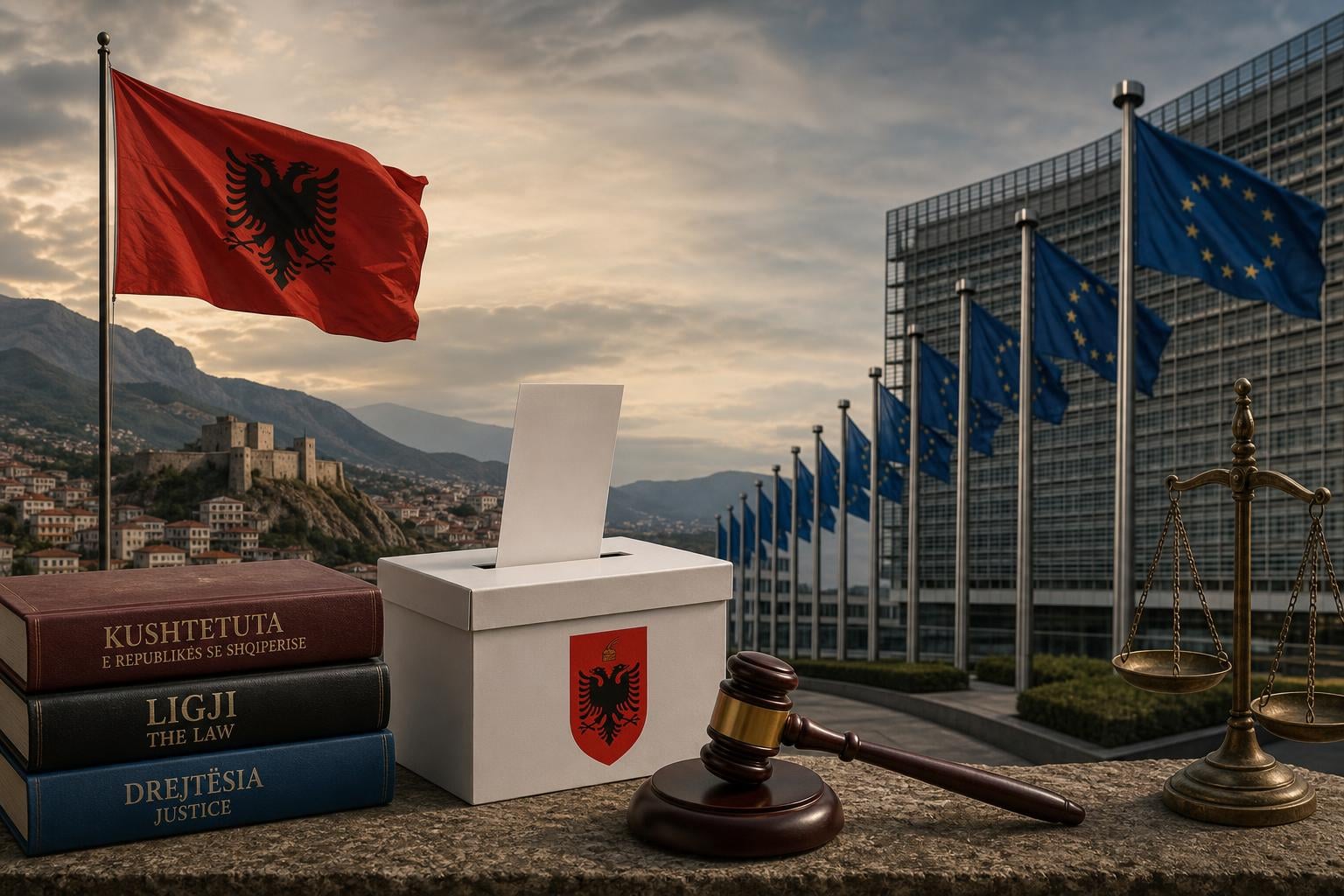
The short answer is yes. The Republic of Albania (Republika e Shqipërisë) is a parliamentary democracy under a written constitution adopted in 1998, with multi-party elections held continuously since 1991, an independent judiciary undergoing the most thorough re-evaluation in Europe, and active candidacy for membership in the European Union. International democracy monitors place Albania in the middle band of European democracies — not authoritarian, not consolidated, with the rule-of-law gap as the active argument.
The longer answer is what this article is for. For an Albanian-American reader in 2026 — first generation, second, third — the question “is the country my family came from a democracy?” usually carries two unspoken follow-ups: is it stable enough to visit, to invest, to retire to? and do my relatives there get the same political rights as I do here? Both questions have institutional answers that can be checked against named sources rather than guessed at.
What follows is a diaspora-side reading of Albanian democracy as it stands in 2026: the constitutional framework, the institutions that run day to day, what the monitors say, what the European Union is conditioning, and what is still openly broken. The piece companions our overviews of Albanian history and Albania-US relations — those are the long arcs; this is the present.
The short answer: parliamentary democracy since 1991
Albania is a parliamentary republic. Sovereign power belongs to the populli (the people), exercised through a directly elected unicameral parliament, the Kuvendi (the Albanian Parliament). The Prime Minister leads the executive and is drawn from the parliamentary majority. The President is head of state with mostly ceremonial powers. Civil and political rights — speech, assembly, association, religion, free press, due process — are guaranteed by the 1998 constitution and a long list of European human-rights instruments to which Albania is a party.
That is the institutional answer. The empirical answer, drawn from the standard democracy monitors, is more textured.
- Freedom House rates Albania Partly Free in its annual Freedom in the World country report. Political-rights scores are higher; civil-liberties and rule-of-law scores are lower. (See the Freedom House Albania country page.)
- V-Dem (Varieties of Democracy, University of Gothenburg) classifies Albania as an electoral democracy with mid-range scores on its Liberal Democracy Index — competitive elections, with weaknesses on judicial constraints and media plurality.
- The Economist Intelligence Unit’s Democracy Index classifies Albania as a flawed democracy — the second of four bands (full democracy, flawed democracy, hybrid regime, authoritarian regime).
- Bertelsmann’s Transformation Index (BTI) places Albania among “defective democracies” with ongoing transformation pressure, particularly on rule of law and stateness.
None of these institutions calls Albania an autocracy. None calls it a consolidated liberal democracy either. The reading is consistent across methodologies: a functioning electoral democracy with rule-of-law weaknesses that the country is in the middle of trying to fix.
From single-party state to multi-party (1990–1992)
Until late 1990, Albania was a one-party communist state under the Party of Labour (Partia e Punës e Shqipërisë). The party had ruled without competition since November 1944 — first under Enver Hoxha (1944–1985) and then under his successor Ramiz Alia (1985–1992). The 1976 constitution explicitly enshrined the party’s leading role and banned religion. There were no opposition parties, no free press, no independent judiciary, and no contested elections. For background on the communist period, see our Albanian history overview.
The transition came fast. Mass student-led demonstrations in late 1990 forced the Alia government to legalize opposition parties on 11 December 1990. The Democratic Party of Albania (Partia Demokratike e Shqipërisë, PD) was founded the next day, on 12 December 1990, by a group of academics and reform-minded former communists, with the cardiologist Sali Berisha as its public face. Other parties followed within weeks.
The first multi-party elections were held on 31 March 1991. The Party of Labour, running under the residual advantages of incumbency and rural reach, won that vote. The new Kuvendi adopted an interim constitutional document (the Major Constitutional Provisions) in April 1991, formally ended the People’s Republic, and renamed the country the Republic of Albania.
A second election in March 1992, after a year of economic collapse and the failure of the communists’ last reform attempts, produced a Democratic Party landslide. Berisha became the first non-communist President of Albania. The transition was complete in the procedural sense: power had changed hands at the ballot box for the first time in 47 years.
What followed was harder than the headline suggests. Albanian democracy in the 1990s was buffeted by weak institutions, weak rule of law, and the 1997 pyramid-scheme collapse — a household-balance-sheet catastrophe that briefly broke state authority across the southern third of the country and forced an Italian-led multinational intervention. The PD government fell. The Socialists returned to power. The country stayed inside the multi-party framework, but only barely, and the institutional rebuild from 1997 forward is the actual story of Albanian democratization.
The 1998 constitution and the architecture of government
The current constitution of Albania was approved by referendum on 22 November 1998, with around 93% of valid votes in favor (turnout was relatively low and the result was disputed by the opposition at the time). It replaced the interim 1991 Major Constitutional Provisions and put the country on a written, modern constitutional footing for the first time since the inter-war monarchy.
The 1998 document — drafted with technical input from the Council of Europe’s Venice Commission — sets out the architecture that is still in place today:
- A unicameral Parliament, the Kuvendi, with 140 seats elected for four-year terms.
- A President as head of state, elected by the Kuvendi (not by direct popular vote), with limited powers — promulgating laws, calling elections, commanding the armed forces in a ceremonial sense, and making certain judicial and diplomatic appointments on the Prime Minister’s nomination.
- A Prime Minister as head of government, nominated by the President from the party or coalition holding a parliamentary majority and confirmed by a vote of the Kuvendi.
- An independent judiciary, comprising the Gjykata Kushtetuese (Constitutional Court), the Gjykata e Lartë (High Court / Supreme Court), the courts of appeal, and the courts of first instance.
- A Prosecutor General as head of the prosecution service.
- Protected civil and political rights in Part Two — speech, press, assembly, association, religion, due process, equal protection — backed by the European Convention on Human Rights, which Albania ratified in 1996.
The constitution has been amended several times since 1998. The most consequential amendments came in July 2016, when Parliament unanimously passed a comprehensive justice-reform package rewriting the judicial provisions and creating the constitutional basis for the Vettingu (the judicial vetting process) and the new prosecutorial bodies that came online from 2016 onward.
The full constitutional text, in English and Albanian, is published on the Kuvendi’s website and summarized at Constitution of Albania on Wikipedia.
Today’s institutions: President, PM, Parliament, courts
In practical terms, Albanian government in 2026 looks like this.
The Kuvendi (Parliament). 140 seats, four-year terms, elected by regional proportional representation across the 12 qarqe (regions). The Kuvendi sits in Tirana, passes laws by simple majority, ratifies treaties, approves the budget, elects the President, confirms the Prime Minister and Cabinet, and can dismiss the government on a vote of no confidence.
The Prime Minister. Since the 2013 general election, the Kryeministër has been Edi Rama, leader of the Socialist Party of Albania (Partia Socialiste e Shqipërisë, PS), re-elected in 2017, 2021, and 2025 — the first Albanian PM to win four consecutive terms. The Cabinet is appointed by the PM, with ministers confirmed by the Kuvendi.
The President. A largely ceremonial head of state, elected by the Kuvendi for a five-year term, eligible for one re-election. The role is closer to the Italian or German presidency — a constitutional referee with appointment and promulgation powers, expected to stand above day-to-day politics.
The judiciary. Reorganized by the 2016 amendments. The Gjykata Kushtetuese (Constitutional Court) rules on the constitutionality of laws. The Gjykata e Lartë (High Court) is the court of cassation. A specialized Anti-Corruption and Organized Crime Court system handles senior corruption cases and is the most-watched institutional innovation of the post-2016 reforms.
The prosecution. The Prokurori i Përgjithshëm (Prosecutor General) leads the general prosecution service. The Special Prosecution Office Against Corruption and Organized Crime (SPAK), created by the 2016 amendments and operational since 2019, has jurisdiction over high-level corruption and organized-crime cases and operates independently. SPAK indictments of sitting and former officials have driven much of the political news cycle since 2019.
Local government. Albania is divided into 61 municipalities (bashki) under the 2014 territorial reform, each with a directly elected mayor and council.
The Vetting process since 2016
The single most consequential reform of post-1998 Albanian democracy is the Vettingu — the constitutional re-evaluation of every sitting judge and prosecutor on three independent grounds: assets (do their declared wealth and income match their lifestyle?), background and integrity (any ties to organized crime?), and professional competence.
The Vettingu was created by:
- The July 2016 constitutional amendments, which gave the process its basis in the constitution itself.
- Law No. 84/2016 (“On the Transitional Re-evaluation of Judges and Prosecutors in the Republic of Albania”), the implementing statute.
- The two new bodies that run it:
- The Komisioni i Pavarur i Kualifikimit (KPK, Independent Qualification Commission) — first-instance evaluation.
- The Kolegji i Posaçëm i Apelimit (KPA, Special Appeals Chamber) — appellate review.
- An International Monitoring Operation (ONM) of European and US judicial experts, embedded as observers in every case.
The numbers from the process are striking. By the time the bulk of evaluations had been completed, roughly half or more of the country’s sitting judges and prosecutors had either been dismissed by the KPK/KPA or had resigned rather than face evaluation. The Constitutional Court and High Court were left without a quorum for extended periods while replacements were trained and vetted. Specific case totals shift as appeals close; the Komisioni i Pavarur i Kualifikimit publishes running statistics.
The reform has been costly and contentious. Supporters argue it has cleaned out the worst of the unreformed post-communist judiciary and made SPAK indictments possible. Critics argue it has concentrated too much power in the Prime Minister’s office during the rebuild and left the courts under-staffed. Both readings are defensible from the institutional record.
International monitors have treated the Vettingu as net-positive but unfinished. The European Commission’s annual country reports on Albania consistently identify the reform as the most ambitious in the region and a precondition for the rule-of-law cluster of EU accession negotiations. Freedom House and V-Dem have flagged the slow recovery of court capacity as a continuing concern.
What international monitors say
Albanian democracy has been measured by four standard institutional indices for a decade. Findings cluster:
Freedom House — Freedom in the World. Albania is rated Partly Free. Political-rights scores sit in the upper-middle band; civil-liberties scores have been pulled down by rule-of-law, corruption, and media-independence concerns. See freedomhouse.org/country/albania.
V-Dem — Varieties of Democracy. Albania is classified as an electoral democracy. The Liberal Democracy Index places it in the middle band of European democracies; the narrower Electoral Democracy Index scores higher.
Economist Intelligence Unit — Democracy Index. Classified as a flawed democracy, the second of four categories. Scores on electoral process and civil liberties are higher; scores on functioning of government and political culture are lower.
Bertelsmann Transformation Index (BTI). Places Albania among “defective democracies” with continuing transformation pressure on rule of law and stateness.
OSCE/ODIHR election observation. The OSCE’s election-monitoring arm has observed every Albanian parliamentary election since 1991. The standard finding has been “competitive but flawed” — vote-day mechanics generally clean, with concerns on campaign finance, media balance, and vote-buying allegations in specific regions. Reports are published at osce.org/odihr/elections/albania.
The point is not that any one of these indices is the final word. The point is that four independent methodologies converge on the same reading: Albania is a democracy, not a dictatorship; an electoral democracy, not a consolidated liberal democracy; partly free, flawed, defective — the vocabulary varies, the diagnosis does not.
EU accession and what conditionality has done
Albania applied for EU membership in April 2009, was granted candidate status in June 2014, and saw formal accession negotiations open on 19 July 2022, alongside North Macedonia, after years of blockage related to internal EU disputes and the resolution of Bulgaria’s veto on the North Macedonia file.
EU accession negotiations are organized into six thematic clusters of 33 chapters. Cluster 1 — Fundamentals covers rule of law, democratic institutions, public administration, judiciary, fight against corruption, and fight against organized crime. Under the EU’s revised methodology, Cluster 1 is opened first and closed last, with measurable progress required throughout the process.
The conditionality matters in practice. A non-trivial share of post-2016 Albanian reform — the Vettingu, SPAK, asset-declaration regimes, anti-money-laundering enforcement, public-administration modernization — has been driven, at least in part, by EU accession requirements. The European Commission’s annual country report on Albania, published every autumn, is the closest thing to an objective scorecard of where the institutional reform stands. The 2024 and 2025 reports flagged continued progress on Cluster 1 alongside persistent concerns on media freedom, anti-corruption enforcement at the highest levels, and the operational capacity of the rebuilt judiciary.
Accession has no fixed end date. The European Council reviews progress annually; individual member states retain a veto on opening and closing each chapter. The political conditions inside the EU itself — enlargement fatigue, the war in Ukraine, the broader Western Balkans agenda — shape the timeline as much as the conditions inside Albania.
Albania has been a NATO member since 1 April 2009, alongside Croatia. NATO accession is a separate institutional track and is already complete.
What is still broken
A fair NPOV reading of Albanian democracy in 2026 has to name what is not working. The standard list:
- Corruption. Transparency International’s annual Corruption Perceptions Index has put Albania in the bottom third of European countries for the last decade, though scores have improved modestly since the launch of SPAK. The European Commission’s country reports flag corruption at senior levels and in public procurement as the largest unresolved governance issue.
- Judicial reform throughput. The Vettingu has dismissed or vacated a substantial share of the judiciary, but training and vetting replacement judges has been slow. Caseload backlogs in commercial and administrative courts have grown.
- Media freedom. Reporters Without Borders’ annual World Press Freedom Index ranks Albania in the mid-band of European countries, with concerns about ownership concentration, the financial dependence of outlets on government advertising, and the use of defamation suits against journalists. The 2019 “anti-defamation package” of media-regulation amendments was returned by the President and modified after pushback from the Council of Europe.
- Political polarization. The PS-PD rivalry has produced repeated parliamentary boycotts by the opposition and disputed processes for constitutional appointments. The 2019 opposition boycott of Parliament — the PD vacated its seats over disputes about electoral reform — is the high-water mark.
- Electoral integrity. OSCE/ODIHR reports name misuse of state resources, vote-buying allegations in specific regions, and campaign-finance opacity as recurring issues across the 2017, 2021, and 2025 cycles. Vote-day mechanics, by contrast, have generally been clean.
- Emigration. A democracy that loses population at the rate Albania has lost it since 1991 (and especially in the 2010s and 2020s) has a structural problem that no constitutional reform can fix on its own. EU accession is partly an attempt to slow that outflow by raising the floor of governance at home.
None of these are fatal to democratic classification. All of them are real, named in the European Commission’s country reports, and tracked in the academic indices.
Albania in regional context
The Western Balkans are not a homogeneous democratic bloc. Brief comparisons:
- Albania: parliamentary democracy, EU candidate (2014), NATO member (2009), Vettingu underway. Partly Free / flawed democracy.
- North Macedonia: EU candidate (2005), NATO member (2020), accession negotiations opened with Albania in July 2022.
- Montenegro: EU candidate (2010), NATO member (2017), accession negotiations underway since 2012 and currently the most advanced in the region.
- Serbia: EU candidate (2012), accession negotiations underway since 2014 but slowed by rule-of-law and Kosovo-normalization issues.
- Bosnia and Herzegovina: complex consociational system under the Dayton Accords, EU candidate since December 2022.
Among Western Balkan states, Albania is roughly mid-pack: more institutionally consolidated than Bosnia, less so than Montenegro, comparable to North Macedonia, with the Vettingu as its distinguishing reform.
Why this matters for the diaspora
For Albanian-Americans, the institutional answer has practical edges.
Citizenship by descent. Albania’s Law No. 113/2020 on citizenship extends Albanian citizenship to descendants up to the great-grandparent generation, with no residence requirement and no obligation to renounce US citizenship. The law is administered by the Albanian state under its democratic institutions — the Ministry of Interior, the consular network, the courts. Whether a diaspora reader cares about Albanian democracy abstractly, the practical processing of a citizenship application runs through these institutions.
Voting from abroad. Albanian citizens abroad gained the right to vote in Albanian elections in the 2025 parliamentary election under amendments adopted in 2020 and operationalized in 2024–2025. The implementation has been contested at the margins — registration deadlines, ballot delivery — but the principle is now embedded.
Return and investment. Property rights, contract enforcement, and tax administration are the institutions a diaspora investor or returning retiree actually meets. The judicial reform and anti-corruption work since 2016 is the part of the reform agenda most directly relevant to that experience.
Family in Albania. Relatives in Albania live under the same constitution, the same electoral system, the same courts as the institutional reading above. Their political rights are protected on paper and exercised in practice; the rule-of-law gap that the indices flag is the gap they live with too.
The National Albanian Registry’s role is to count Albanian Americans, not to take positions on Albanian domestic politics. We report institutional findings rather than partisan readings. PS and PD will trade power again — that is what democracies do. The longer story is the institutional one.