

The Illyrians who lived in the western Balkans from the Bronze Age through late antiquity left behind more than tribal names and contested borders. They left weapons. Graves, riverbeds, and fortified hilltops across modern Albania, Kosovo, Bosnia, and the Dalmatian coast have yielded curved blades, bronze helmets, iron spearheads, and shield bosses — the material record of how a people fought before anyone wrote their history down.
The warrior reputation and the broader Illyrian cultural world are covered in depth elsewhere on this site. This article stays with the objects and the tactics — what the archaeology and the classical sources tell us about the physical kit an Illyrian fighter carried and the way Illyrian forces operated on land and sea.
The Illyrian-type helmet
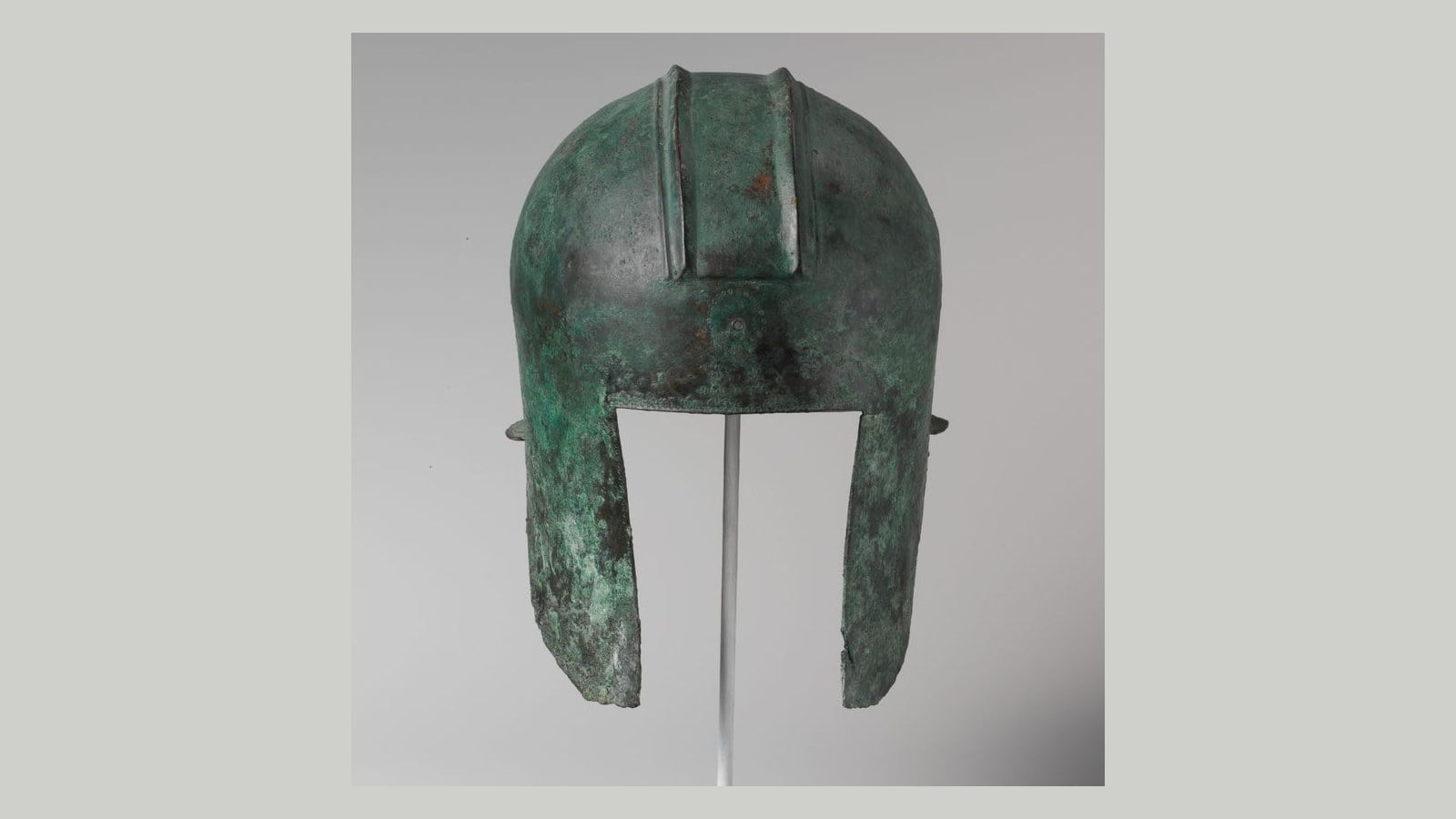
The most recognizable Illyrian artifact in the world’s museums is a helmet.
The Illyrian-type helmet is a bronze headpiece, open-faced, with a rectangular face opening, triangular or elongated cheek guards, a protective neck flare, and two parallel ridges across the crown where a horsehair or feather crest attached. It first appears in the archaeological record in the 8th–7th centuries BCE, with early forms originating in the Peloponnese. By the 6th century BCE, it had spread across the Illyrian world — Albania, Kosovo, Bosnia, coastal Croatia, and western Macedonia — and become the signature piece of warrior burial goods.
These were not mass-produced army issue. The helmets recovered from elite tumulus graves — such as the finds at the Trebenishte necropolis near Lake Ohrid, which yielded multiple bronze helmets alongside gold funerary masks, bronze kraters, and Corinthian helmets — mark their owners as men of rank.
The British Museum holds a helmet found in the River Alpheios, made around 550–525 BC, with silver decorations including horsemen appliques on the cheek-pieces. The Metropolitan Museum of Art holds additional examples. The National History Museum in Tirana has several. Sites at Sindos and Archontiko in Macedonia produced helmets with exceptional decorations including lion iconography and ram’s-head cheek-pieces. For Albanian-American families, these helmets are physical objects in real museums, made by people who lived in the same geography 2,500 years ago.
The sica: a blade built to get behind a shield
The sica is a short curved sword — 30 to 45 centimeters long, with an inward-curving blade that narrows toward the point. It is the weapon most specifically associated with the Illyrians in Roman sources, though it was also used by the Thracians and Dacians across the wider Balkans.
The design is not decorative. A straight blade stopped by a round shield stays stopped. A curved blade can hook around the shield’s rim and reach the body behind it — back, neck, or shoulder. Roman writers described this quality with a mix of respect and unease. The Latin word sicarius, meaning assassin, derives from sica: to the Romans, the weapon carried an association with the covert and the dangerous.
Archaeological finds of sica blades dating from the 6th to 3rd centuries BCE have been recovered from burial sites across Albania, Serbia, Bosnia, and Dalmatia. Examples from central Dalmatia feature blades around 30 cm with a sharply hooked design. Earlier curved blades resembling proto-sica forms appear in Hallstatt-period contexts — roughly 8th to 6th centuries BCE — among communities in the central Balkans.
The sica later entered the Roman arena. Gladiators of the thraex class — named for the Thracians, who shared the weapon type with Illyrians — fought with curved blades modeled on the original Balkan design. On Trajan’s Column in Rome, the Dacian king Decebalus is depicted taking his own life with a sica. The weapon outlived the people who invented it.
Spear, javelin, and shield: the standard kit
Most Illyrian fighters were not sica-armed specialists. They were spearmen.
The primary weapons were the thrusting spear and the javelin. Classical sources also mention the sibyna, a form of boar spear with a broad blade — heavier than a standard javelin, designed for close-range stopping power against a charging opponent. The word sibyna is of Illyrian or Thraco-Phrygian origin, and the poet Ennius described it; the Roman lexicographer Festus preserved his account. The sibyna is commonly found across Illyrian burial sites, especially in the necropolises of Bosnia. Bronze and later iron spearheads have been found in tumulus burials across the Illyrian zone, some engraved with geometric patterns and featuring distinctive sockets that mark them as Illyrian manufacture rather than Greek imports.
Shields were circular, made of wood and leather. Because organic materials decompose, no complete Illyrian shield has survived, but the metal fittings have. Bronze shield covers and iron boss plates — the reinforced center that protects the handgrip — turn up in warrior graves from Glasinac in eastern Bosnia down through the Mat river valley in central Albania. The best-preserved example of an Illyrian circular shield with its bronze facing intact was excavated from a Liburnian necropolis at Nin on the Croatian coast, dated to the 4th century BCE.
The combination — spear, javelin, and light shield — tells a tactical story. This is a light-infantry kit, optimized for speed and rough terrain rather than the massed heavy formations of Greek hoplites or Roman legionaries. Illyrian fighters were mobile: throw at range, close to thrust, retreat uphill faster than any pursuer in column armor.
Armor beyond the helmet
Body armor existed but was not standard equipment. Bronze greaves — shaped shin guards — have been recovered from elite graves across the Illyrian zone, their form paralleling Greek models but with local variations in decoration and fit. Bronze breastplates of hammered sheet metal appear in burial contexts from the 6th and 5th centuries BCE, thin enough to be functional rather than ceremonial.
One distinctive piece is the belt-plate. Large decorated bronze plates worn at the waist served a dual purpose: they protected the lower torso and they signaled rank. The Gradistë belt-plate, an engraved bronze piece from the Albanian highlands, is among the most elaborate metalwork from the Illyrian world. The geometric and figural decoration on such pieces places them among the finest Bronze Age craftsmanship from the Balkans.
The overall picture is selective armoring. Helmets were the most common piece of metal protection. Greaves and breastplates appear in high-status graves. The ordinary Illyrian fighter — the farmer-soldier called up from his hillfort when a raid or invasion threatened — probably fought in a tunic, carrying a spear, a wooden shield, and a sica at his belt. The lightly equipped majority is consistent with what classical sources describe: fast, mobile fighters who avoided pitched battle on flat ground and preferred ambush, raid, and retreat into terrain where heavier armies could not follow.
On the water: the lembus and the liburna
Illyrian warfare was not fought only on land. The eastern Adriatic coast, with its deep harbors, island chains, and sheltered channels, produced a naval tradition that Rome took seriously enough to fight three wars over.
The signature Illyrian warship was the lembus. It was a light vessel roughly 12–18 meters long, with wider beams than typical Mediterranean warships and, in its Illyrian form, no ram — built for speed, boarding, and cargo rather than for sinking ships at range. Polybius describes fleets of 100 or more lembi, each carrying dozens of fighters in addition to its rowers. When they spotted a merchant vessel, the crew rowed hard alongside, grappled, boarded, and overwhelmed the crew by numbers. Philip V of Macedon recognized the design’s effectiveness: in 216 BC, he ordered 100 lembi built by Illyrian shipwrights for his own fleet — a direct adoption of Illyrian naval technology by one of the most powerful states in the Mediterranean.
Illyrian naval tactics were unconventional. Classical sources describe how Illyrian galleys sometimes lashed together in groups, presenting a stable broadside that invited a ramming attack. When the enemy ship committed its ram and embedded its prow, the Illyrian boarding parties poured across in overwhelming numbers. The tactic turned the enemy’s main weapon into an anchor that held the attacker in place.
The liburna, developed by the Liburni — an Illyrian people of the northern Adriatic coast in what is now Croatia — took a different path. The liburna was a two-banked galley (bireme), roughly 30 to 35 meters long, with 50 to 100 crew. It was fast, agile, shallow-drafted, and equipped with a ram. After Rome defeated the Illyrian naval powers, the Roman navy adopted the liburna design wholesale. By the time of the Battle of Actium in 31 BCE, liburnae formed the backbone of Octavian’s fleet. The Illyrian ship type that started as a coastal raider ended as a Roman warship class — a military technology transfer from the conquered to the conquerors.
Queen Teuta’s Adriatic campaigns of the 230s BCE, which provoked Rome into the First Illyrian War, were built on this naval tradition. The raiding that Roman senators denounced was, from the Ardiaean side, a state-backed economic model that predated Teuta and ran on lembus fleets crewed by men who had grown up on the water.
Mountain fighting: terrain as weapon
On land, the Illyrian military advantage was the mountain. The Dinaric Alps, the Albanian Alps, the highlands of Kosovo and central Bosnia — this is some of the most vertically layered terrain in Europe. Illyrian settlements were built into it: hilltop fortresses above narrow valleys, accessible by paths that one clan knew and an invading army did not.
But the Illyrians were not limited to guerrilla tactics. By the 4th century BC, Illyrian forces could field organized formations. Diodorus Siculus describes the army of King Bardyllis forming a square at the Battle of the Erigon Valley in 358 BC against Philip II of Macedon, with 10,000 infantry and 500 cavalry. The Illyrians held under heavy pressure before Philip’s cavalry broke their flanks, inflicting heavy casualties. The fact that Illyrian infantry could form and hold a tactical square against Macedonian forces indicates a level of military organization well beyond tribal raiding.
Against Rome, however, the Illyrians shifted to the tactics their geography favored: ambush on the march, harassment of foraging parties, retreat into positions that turned a pursuing column into a strung-out line on a mountain track. Strabo noted persistent inter-tribal fighting that kept Illyrian warriors trained. The Great Illyrian Revolt of AD 6–9 — Rome’s last major war in the region — demonstrated the pattern at full scale: insurgent forces that avoided pitched battle, struck at garrisons and supply lines, and forced Rome to commit 15 legions across years of mountain campaigning (AD 6–9).
The hill fort, the gradina, was the tactical anchor. These stone-walled enclosures sit on summits across the Illyrian zone, from Glasinac in Bosnia to the Mat and Drin valleys in Albania. Many were seasonal refuges, occupied when a threat materialized and abandoned when it passed. The Glasinac plateau in Bosnia alone has yielded hundreds of burial mounds and dozens of prehistoric forts, investigated since the 1880s — one of the largest concentrations of Illyrian martial remains anywhere. The forts gave defenders a vertical advantage that light infantry with javelins could exploit and heavy infantry in column formation could not answer.
What this means for Albanian-American families
The objects described here — a curved blade in a museum case in Tirana, a bronze helmet behind glass in Baltimore, an iron spearhead excavated from a tumulus at Glasinac — are the physical thread behind a story that Albanian-American families pass down in less specific form. When a grandparent says we come from fighters, the archaeology says: here is what they carried.
The significance is not martial. It is identity. These artifacts document continuous habitation and organized military culture in the western Balkans for at least 2,500 years before the modern Albanian state existed. For a diaspora community that fields “where are Albanians from?” more often than it would like, the answer is in the ground — spearheads, helmets, and the graves they were buried in, in the territory where Albanian is spoken today.
The warrior reputation is a cultural inheritance. The Illyrian world is its context. The weapons are its proof.