
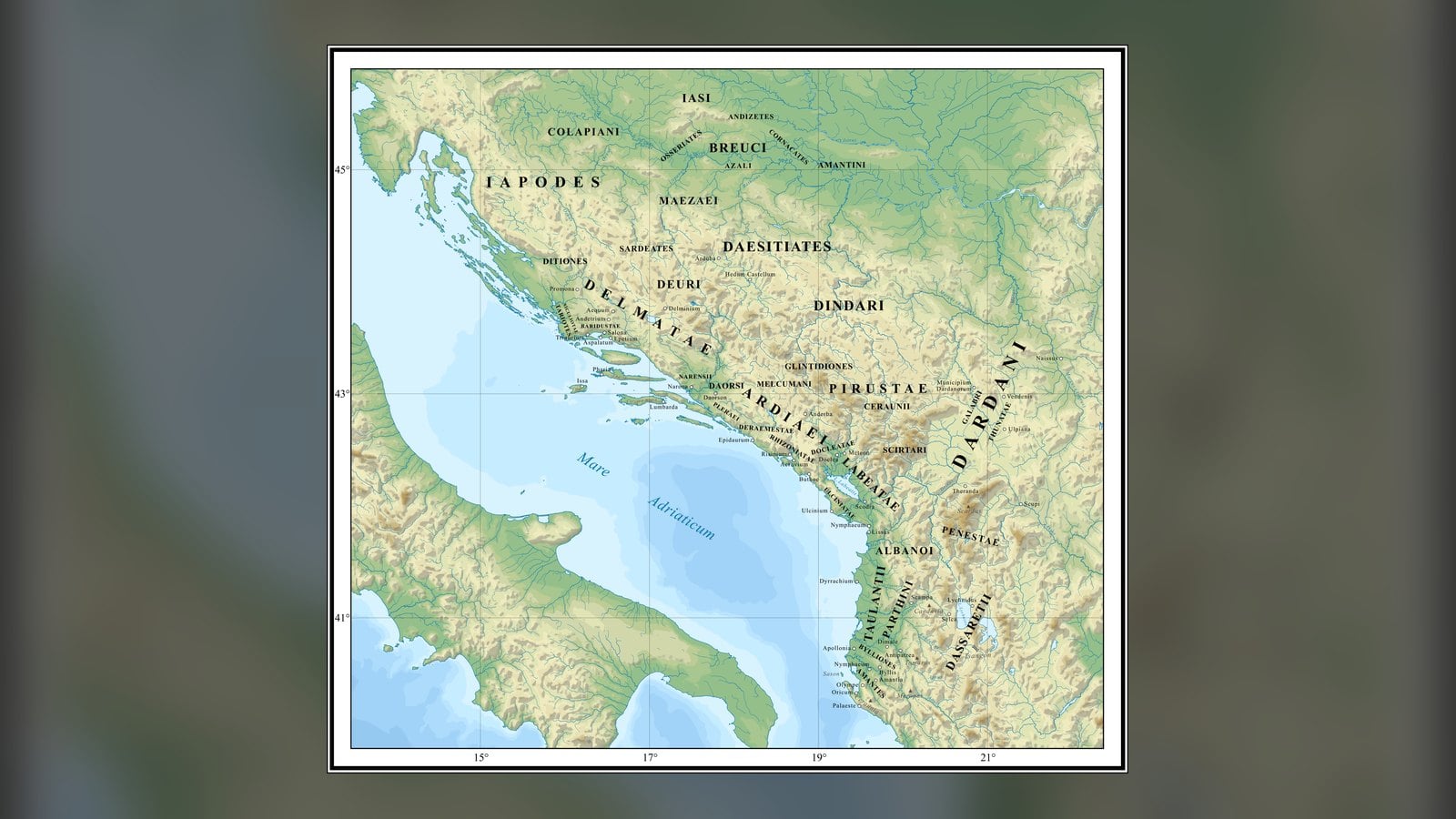
The Illyrians left behind fortified hilltops, bronze helmets, and the names of kings that classical writers recorded with varying accuracy. What they did not leave behind is a single sentence in their own language. No Illyrian poem, no law code, no religious text, no merchant’s receipt. Among the ancient peoples of the Mediterranean, this makes them an outlier: their neighbors — Greeks, Romans, Etruscans, even the Messapians of southeastern Italy — all produced written records. The Illyrians, as far as the archaeological record shows, did not.
What does survive is a scatter of evidence: personal names and place names embedded in Greek and Latin inscriptions, a handful of Illyrian words that ancient authors bothered to gloss, and — across the Adriatic — over six hundred inscriptions in Messapic, a language spoken by people who are generally believed to have migrated from the Illyrian zone to southern Italy in the early Iron Age. This is the raw material from which linguists have spent two centuries trying to answer a single question: is Albanian the descendant of Illyrian?
The broader case for Albanian origins in the Balkans, the Illyrian civilization itself, the modern Albanian language, and the etymology of the self-name shqip are covered elsewhere on this site. This article stays with the language evidence — what we have, what it says, and where certainty ends.
What the ancient sources preserved
The direct vocabulary of Illyrian amounts to roughly a dozen words. Ancient writers occasionally glossed an Illyrian term when describing the region:
- Rhinos — recorded as an Illyrian word for fog or mist. Albanian re means cloud, and the sound correspondence is regular enough to be more than coincidence.
- Sabaia (or sabaium) — described by ancient sources as a barley-based beer brewed by the Illyrians and Pannonians. No clean Albanian cognate survives, but the word enters Latin texts as a distinctly Illyrian contribution.
- Brisa — glossed as grape husks or skins left after pressing. Albanian bërsí means dregs or sediment, and the semantic range overlaps.
- Sica — the curved short blade described in Roman military sources. The word itself may be Illyrian or Thracian; the Romans used it broadly for Balkan-origin weapons of that shape.
This is not a vocabulary from which you can reconstruct a grammar or a sound system. It is a handful of words preserved by accident — because a Greek or Roman writer found them exotic enough to explain.
The real evidence: names
The bulk of what we know about Illyrian comes from onomastics — the study of names. Hundreds of Illyrian personal names, tribal names, and place names are recorded in Greek and Latin sources and in inscriptions from the western Balkans. This is where the Illyrian-Albanian argument gets its real traction.
Place names across the Albanian-speaking territory carry roots that can be explained through Albanian:
- Ulcinium (modern Ulcinj, Montenegro) — from a root ulk-, matching Albanian ujk (wolf). The name means wolf-town.
- Scodra (modern Shkodër) — the Illyrian royal capital, whose name some etymologists connect to an Illyrian root for a height or ridge.
- Lissus (modern Lezhë) — attested since the 4th century BCE, with a root that has proposed Albanian cognates.
- Dyrrhachium (modern Durrës) — the Greek colony name overlaid an older Illyrian settlement.
Tribal and personal names show similar patterns:
- Taulantii — the powerful coastal tribe, whose name has been linked to Albanian dallëndyshe (swallow), through a regular phonetic shift.
- Delmatae — connected to Albanian delme/dele (sheep), suggesting the tribe’s name meant “the shepherds.”
- Dardani — the people of the Kosovo–southern Serbia region, linked to Albanian dardhë (pear), possibly meaning “the pear-tree people.”
- Hyllus — an Illyrian royal name that some linguists connect to Albanian yll (star).
No single name proves descent. But the cumulative pattern — dozens of Illyrian names that are explicable through Albanian roots and difficult to explain through any other living language — is what makes the onomastic case persuasive.
Messapic: the closest relative across the water
The strongest external evidence for the Illyrian-Albanian link comes not from the Balkans but from the heel of Italy.
The Messapians lived in ancient Apulia (modern Puglia) and the Salento peninsula. Ancient sources described them as having crossed the Adriatic, and modern scholars generally classify them as an Illyrian or Illyrian-adjacent population. Unlike the Illyrians of the Balkans, the Messapians produced inscriptions — over six hundred of them, dating from roughly the 6th century BCE to the 1st century BCE, when the language was absorbed by Latin.
Messapic is fragmentary but far richer than anything we have for Illyrian proper. And several Messapic words have Albanian cognates that no other Indo-European language shares:
| Messapic | Meaning | Albanian | Meaning |
|---|---|---|---|
| aran | field | arë | field |
| biliā | daughter | bijë | daughter |
| biles | son | bir | son |
| menza | foal | mëz | foal |
These are not borrowings from a common third language. They are cognates — words inherited independently from a shared ancestor. The American linguist Eric Hamp grouped Messapic and Albanian together under the label “Adriatic Indo-European,” a proposed subfamily within the broader Indo-European family. Others use the term “Albanoid” or “Western Paleo-Balkan” for the same grouping.
The Messapic connection does not prove that Albanian descends from Illyrian. It proves that Albanian’s ancestor was spoken in the same linguistic zone as the language that crossed the Adriatic to become Messapic — and that zone is the western Balkans.
The scholarly case and its limits
The idea that Albanian descends from Illyrian was first proposed in 1854 by Johann Georg von Hahn, a German-Austrian diplomat and linguist, in his study Albanesische Studien. Over the next century and a half, the hypothesis was developed by a line of scholars whose work still shapes the field:
- Hans Krahe (1898–1965) — a German linguist who built the most comprehensive catalog of Illyrian onomastic material. Krahe’s early work treated Illyrian broadly; his later work narrowed the scope and acknowledged the limits of what names alone can prove.
- Norbert Jokl (1877–1942) — an Austrian linguist who studied Albanian etymology and its pre-Roman substrate before his death in the Holocaust.
- Eqrem Çabej (1908–1980) — Albania’s most influential historical linguist, who mounted the most systematic defense of the Illyrian thesis, drawing on onomastic, phonological, and lexical evidence.
- Shaban Demiraj (1920–2014) — whose Prejardhja e Shqiptarëve në dritën e dëshmive të gjuhës shqipe (The Origin of the Albanians in the Light of Linguistic Evidence, 1999) remains a standard reference in Albanian historical linguistics.
- Eric Hamp (1920–2019) — the American linguist who proposed the Adriatic Indo-European grouping and treated the Messapic-Albanian connection as a subfamily relationship.
The Illyrian hypothesis has never been overturned. But it has never been conclusively proved either, and serious scholars acknowledge the gap. The core problem is that the Illyrian evidence is too thin to test the hypothesis rigorously. With only a dozen glossed words and a stock of names, there is no grammar, no phonology, and no syntax to compare systematically against Albanian. The case rests on onomastic patterns, geographic continuity, and the Messapic parallel — strong circumstantial evidence, but circumstantial evidence all the same.
The alternative: Thracian or Daco-Moesian
A minority position in historical linguistics argues that Albanian may not descend from Illyrian at all, but from Thracian or a related Daco-Moesian language spoken further east in the Balkans.
The Bulgarian linguist Vladimir Georgiev was the most prominent advocate of this view. Georgiev argued that certain features of Albanian vocabulary and phonology were more consistent with Thracian than with Illyrian, and that the ancestors of the Albanians migrated westward into the historically Illyrian zone sometime in late antiquity.
The Thracian hypothesis has its own evidence problem. Thracian is even more poorly attested than Illyrian — a few inscriptions, a handful of glosses, and the same onomastic fragments. There is no Thracian Rosetta Stone that would allow a definitive comparison. The geographic argument works against the Thracian case: Albanians live in the western Balkans, not the eastern Balkans where Thracian was spoken, and the place names in Albanian-speaking territory trace to Illyrian rather than Thracian roots.
Most current scholarship treats the Illyrian hypothesis as the stronger position while acknowledging that “Illyrian” may have been a family of related languages rather than a single uniform tongue, and that Albanian’s ancestor may have been one variety within that family.
Albanian: the language that survived
Whatever its exact ancestor was called, Albanian is the language that survived where Illyrian was once spoken.
Albanian was first written down centuries after Illyrian vanished from the record. The earliest known sentence in Albanian is a baptismal formula embedded in a Latin text by Archbishop Pal Engjëlli in 1462. The first book in Albanian — the Meshari of Gjon Buzuku, a Catholic missal — appeared in 1555. By the time Albanian enters the written record, it has already absorbed hundreds of Latin loanwords from the Roman period, Greek loans from Byzantine contact, and Slavic and Turkish layers from later centuries.
Beneath those layers, the core of Albanian — its basic kinship terms, body parts, numbers, agricultural vocabulary, and grammatical structure — belongs to an Indo-European branch that stands alone. Albanian has no close living relatives. Its nearest documented cousin, Messapic, went extinct two thousand years ago. Its position in the Indo-European family tree is that of a sole survivor — a single branch with no sister languages, carrying the phonetic and grammatical imprint of a Paleo-Balkan ancestor that the written record never captured.
For Albanian Americans, that is the weight of the Illyrian language question. The language spoken at kitchen tables in the Bronx, in Dearborn, in Worcester — the language parents teach children on Saturdays at community schools — is not a dialect of Greek, not a Romance offshoot of Latin, not a Slavic language. It is its own thing, rooted in a western Balkan ancestry that predates the Roman conquest. The names of the rivers, the mountains, and the cities may carry the phonetic fingerprint of the people who named them before anyone in the Mediterranean was writing anything down.
The Illyrian evidence is thin. But the thread it traces — from the names in ancient inscriptions to the words Albanian speakers use today — is the strongest surviving connection between a modern language and the ancient Balkans. Where the evidence ends, the language itself begins.