
Albanians do not use the English word Albanian when they speak their own language. They use shqip (“the Albanian language”), shqiptar (“an Albanian person”), and Shqipëria (“Albania”). The English name and the Albanian self-name come from two different roots, and the Albanian set is younger than most people assume — younger, in fact, than the English name it sits next to.
For Albanian Americans, these four words show up everywhere: on the cover of an abetare (the first-grade reader), in the chorus of a wedding song, on a baseball cap at the New York parade, in a WhatsApp message from a cousin in Tirana. Many second- and third-generation diaspora readers learn the words as labels without ever learning where they came from or what they used to be.
This piece is a plain-English explainer for that question. We cover what shqip means and where the word probably comes from, what the older self-name Arbër was, when and roughly why the community switched from one to the other, what Shqipëria and “Land of the Eagles” actually mean today, and how the words land in 2026 American life — at the kitchen table, in the classroom, and in hashtags like #CountMeAlbanian.
The goal is the version of the answer a reader cannot get from a one-paragraph Wikipedia summary: not just etymology, but the lived shape of the words in the diaspora.
The four-word system: shqip, shqiptar, shqiptare, Shqipëria
Four Albanian words sit at the center of the story. They share a stem, and they each do a distinct grammatical job.
- shqip — the Albanian language. Also an adverb meaning “in Albanian” or, secondarily, “plainly.”
- shqiptar — an Albanian person (masculine, or generic). Plural shqiptarë.
- shqiptare — an Albanian woman.
- Shqipëria — the country, Albania.
The full noun phrase for the language is gjuha shqipe (“the Albanian language”), where gjuha is “tongue, language” and shqipe is the feminine adjective agreeing with it. On a university course catalog or a Tirana ministry letterhead, you will see gjuha shqipe. On a kitchen-table command from a grandmother to a grandchild — “fol shqip” — you will see shqip on its own.
In Albanian morphology, the suffix -tar attaches to a stem to form an agent noun, roughly English -er or -ist. Mësues is “teacher,” punëtor is “worker,” and shqiptar is the person who carries or does the shqip — the one who belongs to that speech. The country name Shqipëria is built off the same root with a geographical suffix.
This grammatical neatness matters because it is the most quietly powerful argument for the leading etymology. The four words are not unrelated lookalikes. They form a tight family that names a language, a man, a woman, and a country from a single verb stem. Whatever the original meaning of that stem turns out to be, the system is internally consistent — built from the inside out by Albanian speakers, not stitched together by foreign chroniclers.
“Land of the Eagles”: the eagle etymology
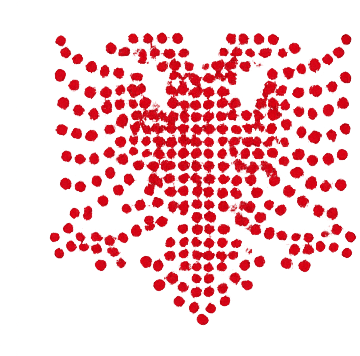
The story most Albanian-American children hear first is the eagle story. Shqiponjë (and the related form shqipe) is the Albanian word for eagle. The double-headed eagle is on the Albanian flag, the heraldic symbol of Skanderbeg’s 15th-century resistance, and the most recognizable visual marker of Albanian identity from the Adriatic to the Bronx.
The folk version is appealingly clean: Albanians are bijtë e shqipes (“the children of the eagle”), Shqipëria is “the Land of the Eagles,” and shqiptar is “eagle person.” It appears in patriotic poetry from the Rilindja, the 19th-century National Renaissance, and it gets repeated in tourist material, family lore, T-shirt slogans, and the marketing copy of more than one Albanian-American restaurant.
The linguistic case for the eagle reading is weaker than the case for the alternative. Shqipe (eagle) and shqip (language) share a consonant cluster, but the stem patterns and the historical record of attestations point in different directions. Most academic Albanologists treat the eagle reading as a secondary folk association — a poetic reinterpretation that grew up around the words during the National Renaissance, not the original source.
That said, the eagle association is now part of how Albanians actually use the word, even if it is not where the word came from. Shqipëria and shqiponjë sit close enough in the language that for many speakers the two have fused emotionally. Both threads — the literal language meaning and the poetic eagle meaning — live in modern usage. Linguists separate them carefully. Everyday speakers, including most of the diaspora, mostly do not, and that is fine. A word can come from one place and still belong to another.
The competing theory: “to speak clearly”
The mainstream linguistic view ties shqip and shqiptar to a native Albanian verb root meaning roughly “to speak clearly,” “to pronounce,” or “to understand the same speech.” The verb survives in modern Albanian as shqiptoj (“to pronounce, articulate”) and shqipoj (“to speak Albanian, to make oneself understood”). On this reading, a shqiptar is “one who speaks the same language clearly” — a member of the speech community.
Comparative evidence supports the verb-root reading. The semantic move from “speak clearly” to “the people who speak our language” is one of the most widely attested patterns in the world’s ethnonyms. The Slavic word Slověne (the medieval Slavic self-name) is built from slovo (“word”): the Slověne are the people of the word, the ones whose speech is intelligible. The opposite term, němci (“the mute ones”), became the Slavic name for Germans, who could not be understood. Greek barbaros worked the same way.
In the Albanian case, the survival of shqip as both a noun (“the language”) and an adverb (“clearly, plainly”) is a strong internal clue. When a grandmother in Worcester tells a grandchild to fol shqip, the grandchild hears two meanings layered together: “speak Albanian” and “speak so I can understand you.” That double meaning is exactly what the speak-clearly etymology would predict.
The verb-root reading is the one a serious Albanian linguist will give an American journalist asking the question. It is not as poetic as the eagle story, but it is the one supported by the comparative evidence (per the Albanian language entry on Wikipedia) and the one taught in Albanian university departments.
Before shqip: the Arbër name and its medieval life
For most of recorded Albanian history, the people did not call themselves shqiptar. They called themselves Arbër (Tosk variant), Arbën (Gheg variant), or Arbëresh / Arbërisht / Arbënuer (derived adjective and agent forms), and the land was Arbëria.
The older name traces back to Albanoi, a tribe recorded by the Greek geographer Ptolemy in the 2nd century AD as living near a town called Albanopolis in central Albania. The Byzantine writer Michael Attaleiates uses an Albanian ethnonym in the 11th century. Anna Komnene’s Alexiad, written in the mid-12th century, mentions a region called Arbanon in the western Balkans. Throughout the medieval period and into the Ottoman era, Western European chroniclers, Venetian merchants, Byzantine bureaucrats, and Albanians themselves used variations of the Arbën / Arbër root.
This is also the source of the English word Albanian. Medieval Latin Albanus and Italian Albanese descend from the same Greek-Latin family that sits behind Ptolemy’s Albanoi. When a 2026 reader in Detroit says Albanian, they are using a name that has been in continuous European circulation for almost two millennia. It happens to be a name the community itself stopped using as a primary self-designation about three hundred years ago, but the chain of foreign use never broke.
The Tosk-Gheg alternation between Arbër and Arbën is a textbook case of what linguists call rotacism — the regular shift of n between vowels into r in southern Albanian. The same rule gives Tosk rëra against Gheg rana for “sand,” or Tosk vëlla against Gheg vëllâ for “brother.” These are the kinds of sound rules that let scholars line up Albanian against its older Indo-European cousins (per the Names of the Albanians and Albania entry on Wikipedia).
When the switch happened: tracing the term in texts
The shift from Arbër / Arbëresh to shqiptar / shqip is one of the more interesting turns in Albanian self-naming. It happened relatively late by ethnonym standards — gradually across the late 17th and 18th centuries, deep into the Ottoman period — and it happened by adoption, not by decree.
The words shqip and shqiptar are attested in Albanian writing as far back as the 14th century, though for centuries they existed alongside the older Arbër terms rather than replacing them. The Catholic priest and writer Pjetër Bogdani (c. 1627–1689), author of the Counter-Reformation work Cuneus Prophetarum, worked during that long overlap period — Albanian intellectuals writing in Latin script were among the first to fix the newer name in print. It was only at the end of the 17th century and into the early 18th century that shqiptar and Shqipëria gradually overtook Arbëresh and Arbëria as the dominant self-designation across most of the Albanian-speaking world.
By the 19th-century National Renaissance, the Rilindja writers — Naim Frashëri, Sami Frashëri, Pashko Vasa — used shqiptar and Shqipëria almost exclusively. The older Arbër name had retreated to historical and literary registers, kept alive mostly in scholarship and song. Fan Noli, writing a generation later from the Albanian-American diaspora he helped organize, carried the same usage forward into the 20th century.
Why the change happened is not settled. The most plausible reading is that as Albanian-speaking communities became more conscious of themselves as a single linguistic community across confessional lines — Catholic in the north, Orthodox in the south, Muslim in the center and the cities, Bektashi in pockets — the word that emphasized shared speech became more useful as a unifying self-name than the older regional name. Shqiptar foregrounds language. Arbër foregrounds geography and lineage. Under a foreign empire, with no single church and no single political center, language was the most stable common thread.
The newer name did not erase the older one. It accumulated on top of it.
Arbëresh and Arvanites: why diaspora communities kept the older name
The strongest evidence that the Arbër root was the older self-name is who still uses it. Two large Albanian-descended communities that left the Balkans before the switch took hold kept the older name and have it to this day.
The Arbëreshë of southern Italy are descendants of Albanians who fled to the Kingdom of Naples in the 15th and early 16th centuries, mostly after Skanderbeg’s death in 1468 and the Ottoman consolidation that followed. They settled across Calabria, Sicily, Basilicata, Apulia, Molise, Campania, and Abruzzo — roughly fifty villages in seven regions, with around 100,000 people still speaking medieval Albanian as a heritage language. They call themselves Arbëreshë and their language Arbërisht. They never adopted shqiptar, because the switch happened in the homeland after they had already left.
The Arvanites of southern Greece are a parallel case. Albanian settlers’ migrations into central and southern Greece are first recorded around 1300, with the main waves running through the 14th century and ending around 1600 — all well before the shqiptar name took hold in the homeland. They call themselves Arvanites and their speech Arvanitika — a Greek phonological reshaping of the older Albanian Arbër / Arbërisht. They are heavily integrated into modern Greek identity, and the variety is endangered, but the name is the same medieval root.
This is the linguistic equivalent of a snapshot. The diaspora communities preserve the older self-name like a photograph from the day they left, while the homeland kept evolving. Both names are Albanian. Both are correct. The diaspora ones are older.
For Albanian Americans, the takeaway is that the question “what do you call yourselves?” has more than one true answer, and the answer depends partly on when your family last spoke the language at home and what they spoke it as. A first-generation immigrant from Tirana will say shqiptar. A fifth-generation Arbëreshë cousin in Cosenza will say arbëresh. They are members of the same diaspora, named in two layers.
“Shqipëria” in 2026 America: identity, hashtags, gjuha shqipe
In the United States in 2026, the four-word system is alive across a community of about 230,000 self-reported Albanian Americans by the 2024 American Community Survey, and roughly one million by community estimate when undercount is corrected for. The largest concentrations sit in New York (around 56,000), Michigan (around 27,000), and Massachusetts (around 21,000), with significant populations in Connecticut, Illinois, Pennsylvania, New Jersey, Texas, and Florida.
In daily life, the words sit side by side with English. Parents say shqiptar at home and Albanian at the parent-teacher conference. Children learn gjuha shqipe at shkolla shqipe — the Saturday-school programs run by churches, mosques, and community organizations from Brooklyn to Worcester to Sterling Heights. Teenagers tag their posts with #shqiptarë and #shqip and #CountMeAlbanian, often in the same caption. Restaurants in the Bronx call themselves Çeta e Shqipes (“the band of the eagle”). Soccer fans in Boston paint bijtë e shqipes on a banner for an Albanian national-team match.
The four words function on at least three levels at once for diaspora speakers. They are practical labels — what you call the language and the people. They are markers of identity — a way to signal heritage in a place that often hears only the English name. And they are emotional shorthand for the older eagle association, the flag, the history of resistance, and the cross-confessional unity of language that the Rilindja writers built the modern nation around.
That last layer is why the eagle story keeps living alongside the more accurate verb-root etymology. The linguistic record says shqip comes from “speak clearly.” The cultural record says shqip lives next to shqiponjë in the heart of the language and on the chest of every flag. Both are true at different levels.
How to use the words: a quick phrase reference
For diaspora readers who want to start using the words rather than only reading about them, the basics are short.
- Unë jam shqiptar. — “I am Albanian.” (a man speaking)
- Unë jam shqiptare. — “I am Albanian.” (a woman speaking)
- Ne jemi shqiptarë. — “We are Albanians.” (a group)
- Unë flas shqip. — “I speak Albanian.”
- A flet shqip? — “Do you speak Albanian?”
- Po, pak. — “Yes, a little.”
- Jam nga Shqipëria. — “I am from Albania.”
- Jam nga Kosova. — “I am from Kosovo.”
- Gjuha jonë është gjuha shqipe. — “Our language is the Albanian language.”
The pronunciation cue most English speakers need is that shq- is a single cluster: roughly the sh of “shop” rolling immediately into a ch-like consonant, no vowel in between. The 1908 Congress of Manastir fixed the Albanian alphabet at 36 letters and 9 digraphs, including sh as a single sound. Shq- is two letters but one motion. Heritage learners pick it up in a week of exposure.
A word on the slur question. The clipped Slavic-language form shiptar — without the q — was used pejoratively in former Yugoslavia and is widely treated as an insult by Albanians today. The standard Albanian self-name has the q and is pronounced shch-ip-tar. They are different words in modern usage. If a reader encounters the slurred form online, the response is to use the standard spelling.
Whatever name your family used in 1912, 1992, or 2026, the National Albanian Registry counts you. Add your name and your story at /register.