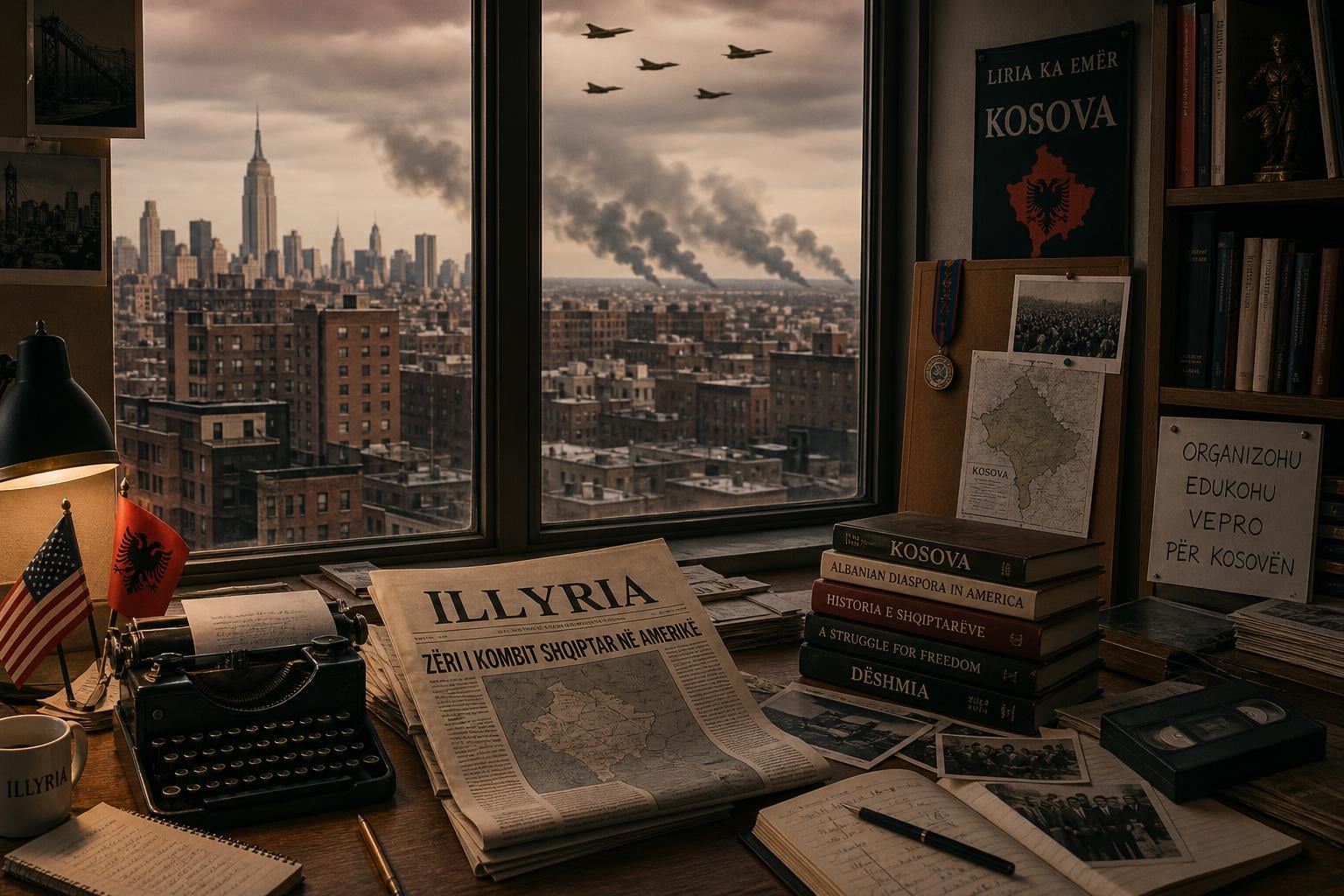
In June 1991, a young Bronx landlord named Harry Bajraktari mailed the first issue of Illyria from a small New York office. The paper was bilingual, weekly, and printed on cheap newsprint. Eight years later, NATO bombers were flying over Belgrade and the Albanian-American community was being credited, in serious Washington circles, with one of the more disciplined ethnic-lobbying efforts of the post-Cold War era.
The line from one to the other is not a coincidence. It runs through a real estate business in the Bronx, a circle of Albanian-American organizers from Westchester to the Bronx to Capitol Hill, and a publisher who treated his newspaper as both a community service and a political instrument.
This is the story of how a boy who arrived from a Kosovo village in 1969 became one of the most consequential Albanian-American figures of his generation, and what his work means for the diaspora that the National Albanian Registry is now counting.
Who Harry Bajraktari is
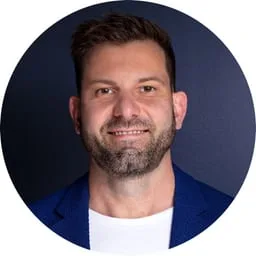
Harry Bajraktari is a Kosovar-American real estate developer, the founder and longtime publisher of Illyria — the Albanian-language newspaper in the United States — and one of the central pro-Kosovo lobbyists in the Albanian-American community from the early 1990s through the 2008 declaration of independence.
He is the co-owner, with his uncle Rrustem Gecaj, of Bajraktari Realty Management, a Bronx-based real estate operator. He is a founding board member and former vice chairman of the National Albanian American Council (NAAC) in Washington, DC, and a longtime supporter of the Albanian American Civic League (AACL), the Ossining-based lobby founded by former US Representative Joseph DioGuardi in 1989.
What makes him interesting is not any one of these roles in isolation. It is that he held all of them at once, and treated them as a single project: build the businesses, fund the press, organize the community, and walk Albanian-American demands into the offices of US senators and presidents.
From Vranoc to New York: arrival and early years
Bajraktari was born in 1957 in Vranoc, a village in the Lug of Baran area of the municipality of Peja in western Kosovo, then part of socialist Yugoslavia. The family belonged to a part of the Kosovo Albanian community that had spent generations under one foreign administration after another — Ottoman, Yugoslav royalist, then Yugoslav communist.
In 1969, when Harry was twelve, the family emigrated to the United States. They arrived in the post-1965 immigration wave that reshaped the demographics of the Albanian American community, mixing the older Tosk Orthodox families that had been arriving from southern Albania since the 1880s with a much larger flow of Gheg-speaking Catholics and Muslims from Kosovo, North Macedonia, and Montenegro.
The Bajraktari family settled in the New York metropolitan area. By his early twenties, Harry was working in real estate. He has spoken in interviews about the small-airplane view of the Manhattan skyline as the family approached JFK — the first picture of the country that would become his home and the staging ground for the rest of his career.
Building a New York real estate business
In October 1978, Harry Bajraktari and Rrustem Gecaj — his uncle and longtime business partner — bought their first building in the Bronx. From that single property, they built Bajraktari Realty Management into a multi-building portfolio across the Bronx, upper Manhattan, and Yonkers.
By the company’s own published count, the firm now owns and operates more than 70 buildings in the New York metro area, with hundreds of apartment units under management. That puts it among the larger Albanian-American-owned real estate operators in the city, in a community where small-scale ownership of multifamily buildings has been one of the most common paths to first-generation wealth.
The Bronx setting matters. The Belmont and Fordham sections of the borough — the area around Arthur Avenue, sometimes called “Little Italy in the Bronx” — became, over the 1980s and 1990s, also a “Little Albania.” Bajraktari Realty’s buildings cluster in these neighborhoods. The company’s office on East 188th Street sits in the heart of one of the densest Albanian-American residential clusters in the United States.
This is not incidental to his lobbying career. Real estate cash flow funded the newspaper. The newspaper made him a publisher with a constituency. The constituency gave him standing to walk into a US senator’s office. The buildings come first.
Illyria and the Albanian-American press
Bajraktari founded Illyria in June 1991, naming it after the ancient Illyrian peoples that Albanian national history identifies as the community’s ancestors. The paper launched as a weekly, printed in both Albanian and English, with a starting circulation reported in trade press at roughly 4,000 copies in the United States and an additional 5,500 mailed to readers in Europe and elsewhere.
The timing was sharp. Yugoslavia was breaking apart. Slobodan Milošević had stripped Kosovo of the autonomy guaranteed under the 1974 federal constitution. Albanian-language schools were being shut down. Hundreds of thousands of Kosovo Albanians had been pushed out of state employment. There was no English-language paper of record covering any of this from an Albanian-American perspective. Illyria filled the gap.
Two things made the paper consequential beyond its modest circulation. First, it gave the Albanian-American community a single weekly news cycle that linked New York, Boston, Detroit, Chicago, and the metro Detroit Albanian Catholic neighborhoods around the Albanian American Islamic Center and the older Tosk parishes. Second, the bilingual format meant the paper could be quoted directly to non-Albanian-speaking US politicians and journalists — Illyria became a clip file for the Kosovo cause, not just a community paper.
That role placed Illyria in the same lineage as Dielli, the Boston-based Albanian-American newspaper founded in 1909 and later the organ of the Vatra federation, which had served the same diaspora-binding function during the First Republic period. Illyria was the post-1991 successor in a press tradition that stretches back more than a century.
Lobbying for Kosovo, 1989 to 1999
Bajraktari’s organized political work began before Illyria existed. According to his own account, he first walked into the Bronx district office of US Representative Eliot Engel in 1989, as conditions in Kosovo were sharply deteriorating. Engel’s district included the Albanian-American population in the north Bronx and southern Westchester; from that meeting forward, Engel became one of the most reliable congressional voices for Kosovo and remained so for thirty years.
That same year, former US Representative Joseph DioGuardi, who had served two terms representing Westchester before losing re-election, founded the Albanian American Civic League in Ossining, New York. The AACL became the principal Albanian-American lobby in Washington. Bajraktari was part of its early circle of supporters and a steady ally throughout the 1990s.
Through the AACL and through his own access, Bajraktari built relationships with the Senate’s most senior figures. Senate Majority Leader Bob Dole had visited Kosovo in 1990 and become a vocal advocate; a statue of Dole now stands in Pristina, and the Republic of Kosovo has formally honored him. Senators Alfonse D’Amato of New York and Larry Pressler of South Dakota, and Representative Tom Lantos of California, were among the others who took Albanian-American calls in this period.
When the Kosovo war escalated in 1998 and 1999, Bajraktari traveled repeatedly to Washington. He met with President Bill Clinton and, later, with President George W. Bush, pressing the case for US action. The 78-day NATO air campaign that began in March 1999 ended Serbian rule in Kosovo. Kosovo’s parliament declared independence on February 17, 2008. The United States recognized that independence the following day. The diplomatic record of those years is a complicated mix of US administration decision-making, NATO alliance politics, and on-the-ground Kosovo Liberation Army developments — but the steady pressure of Albanian-American organizing is part of the historical picture, and Bajraktari’s name appears throughout the documentary record of that pressure.
Philanthropy and rebuilding
When the war ended, the work shifted. Hundreds of villages in Kosovo had been burned. Tens of thousands of homes were destroyed. Bajraktari personally financed the construction or renovation of homes in his native Peja region — both for his extended family and for neighbors whose properties had been razed.
Beyond reconstruction, Bajraktari has been the largest Albanian-American sponsor of Gift of Life International, a Rotary-affiliated nonprofit that arranges life-saving heart surgery for children from regions where the procedures are not available. A family gift helped fund heart surgery for Kosovo children born with congenital heart defects. Smaller gifts have continued over the years.
The Bajraktari name also appears in the IRS public-charity database as the founder of Harry Bajraktari House Inc., a small US-registered nonprofit. His giving has clustered around healthcare, education in the Peja region, and Albanian-American cultural projects. The pattern is the one that economists who study immigrant philanthropy describe as “homeland investment from the diaspora”: first-generation success in the host country redirected back into specific, named projects in the country of origin, often along family and village lines.
Recognition and awards
President George W. Bush recognized Bajraktari for volunteer service to American civic life — part of the President’s Volunteer Service program established to honor Americans whose unpaid work contributes to national and community well-being.
The Republic of Kosovo awarded Bajraktari a state medal during the 100-year anniversary of Albanian independence in November 2012, an event marked at high ceremony in Tirana and Pristina. Albanian-American organizations and Albanian-language media have honored him repeatedly as one of the most consequential diaspora figures of the post-1990 generation.
The recognition is consistent across English- and Albanian-language sources, and across both US presidential administrations and Kosovo state authorities — a small data point about how unified the Albanian-American assessment of his work has been.
Why his story matters to today’s Albanian Americans
Bajraktari’s career is, in compressed form, a model of how a small immigrant community converts itself into a political constituency.
The order of operations is worth naming directly. He built businesses first. The businesses funded a newspaper. The newspaper organized the community into a single weekly readership and a quotable English-language clip file. The community gave him standing with US elected officials. Standing produced policy outcomes. Policy outcomes — most consequentially, US recognition of Kosovo’s independence in 2008 — then created new conditions for the community to operate in.
That model is not a museum piece. The roughly 230,000 Albanian Americans counted in the most recent US Census Bureau American Community Survey (2024 ACS B04006 Albanian-ancestry tables), plus a community estimate that runs to about one million when ethnic Albanians from Kosovo, North Macedonia, and Montenegro and second- and third-generation Americans are included, are still under-counted, under-organized, and under-represented relative to their actual numbers. The 1990s playbook — newspaper, civic league, congressional outreach — is still the playbook. The instruments need to be updated for an era in which most readers find news on their phones, but the underlying logic is the same.
Bajraktari’s generation built much of the infrastructure that today’s Albanian-American institutions, including this one, are working from. The next chapter of that work — counting the community accurately, mapping it across all 50 states, and connecting it to itself in real time — is what comes next.
If Bajraktari’s lifetime of building Albanian-American institutions speaks to what’s still ahead for the diaspora, the National Albanian Registry’s count is one part of it. Get counted →