
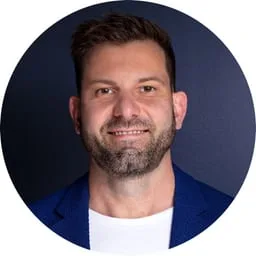
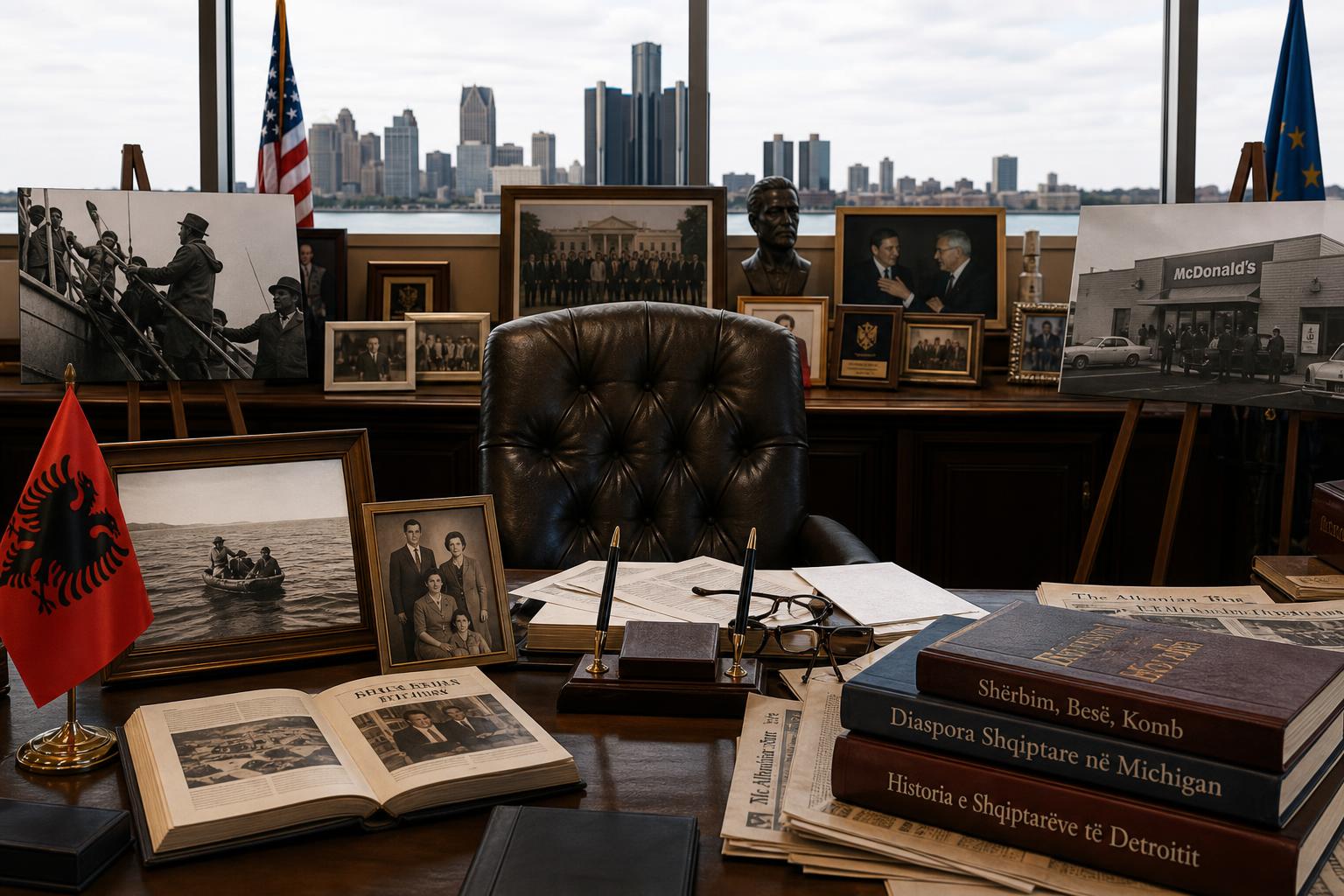
Ekrem Bardha is the Albanian-American businessman, restaurateur, and civic leader who, more than any other single figure, defined the public face of the Albanian-American community in metro Detroit through the second half of the twentieth century.
Born in 1933 in a village in southern Albania, he escaped the Communist regime in 1953 at age 20, made his way to the United States, settled in metro Detroit, and built a portfolio of McDonald’s franchises. He used the money and the platform that came with it to do something less common among first-generation immigrant entrepreneurs of his era — he turned outward.
He co-founded the National Albanian American Council (NAAC). He owned Illyria, the long-running Albanian-American newspaper. He worked alongside the Albanian American Civic League on Kosovo. He became Albania’s Honorary Consul in Michigan, a role he still holds. By the time he was in his eighties, he had built relationships with multiple US administrations, almost always on behalf of the same cause: the Albanian community of the Western Balkans and its diaspora.
This is the story of how that career was built, and why it still matters to Albanian-Americans today.
Who Ekrem Bardha is
Ekrem Bardha (born May 13, 1933) is an Albanian-American businessman, longtime restaurateur, and civic leader based in metro Detroit, Michigan. He is best known for three things, in roughly this order: his business success in the McDonald’s franchise system, his decades of advocacy for Kosovo and the broader Albanian community, and his role as Albania’s Honorary Consul in Michigan (Wikipedia: Ekrem Bardha).
He is also one of the small number of post-1953 Albanian arrivals to the United States who lived through the entire arc of the modern Albanian diaspora story — from the closed Albania of Enver Hoxha, through the wars of Yugoslav succession, through Kosovo’s 2008 declaration of independence, through the consolidation of metro Detroit as the second-largest US Albanian-American community — and remained publicly active for all of it.
Bardha is the author of two books. Far Yet Near Albania is a memoir of identity and exile written in the voice of an Albanian who has lived more of his life in the United States than in the country of his birth. The Albanian-American Diaspora and the Independence of Kosova (2023) is a participant-observer record of the lobbying and organizing campaign that helped move Kosovo from war to recognition.
He is one of the figures most often cited when Albanian-Americans of Detroit talk about who built the institutions they grew up inside.
From Albania to metro Detroit: arrival and early years
Bardha was born in Radanj, a village in the Kolonjë District of southern Albania, near the city of Ersekë. The region is mountainous, agricultural, and historically tied to the Albanian Orthodox tradition that produced Fan Noli and a substantial share of the first wave of Albanian immigration to the United States in the early twentieth century.
He came of age inside the Communist takeover. The Albanian Communist Party, led by Enver Hoxha, consolidated power in 1944 and quickly turned the country into one of the most isolated and repressive states in postwar Europe. Bardha was eleven years old when that began. By his late teens, the regime was in the middle of mass arrests and the construction of a labor-camp system that would, in time, imprison or banish a significant share of the country’s middle class.
In 1953, when Bardha was 20, one of his brothers was jailed for political reasons (Wikipedia: Ekrem Bardha). The arrest of a family member was, under Hoxha’s system, often the prelude to wider persecution of the household. Bardha escaped Albania that year. The route out — across closed borders, through refugee channels, eventually to the United States — was the route a generation of post-1953 Albanian arrivals would take.
He settled in the Detroit metropolitan area, joining a small but established Albanian community that had been there since the early twentieth century. Albanian Orthodox parishes had been organized in metro Detroit since 1929, when St. Thomas Albanian Orthodox Church was founded. By the 1950s the community was small enough that newcomers were quickly known by name and large enough to absorb them.
Bardha entered the restaurant business. That was the typical landing for Albanian arrivals in midcentury American cities — small lunch counters, diners, pizza shops, the working edge of the American food economy. He was good at it.
Building a restaurant and business career in Michigan
The restaurant work led, eventually, to a McDonald’s franchise. Then to another. Then to a portfolio.
By the time the business was at its peak, Bardha owned a portfolio of McDonald’s franchises in metro Detroit (Wikipedia: Ekrem Bardha). For context, that placed him among the larger McDonald’s operators in southeastern Michigan and made him one of the most commercially successful first-generation Albanian-Americans of his cohort.
The McDonald’s franchise model in the 1970s and 1980s was a particular kind of immigrant on-ramp. It required cash, credit, and the willingness to operate inside a corporate system whose standards were unforgiving — site selection, food safety, labor management, capital reinvestment. Operators who succeeded tended to compound their position, opening additional locations from the cash flow of the first.
That is the trajectory Bardha rode. By the 1990s, the McDonald’s portfolio was the financial base for a much wider set of activities: he became the owner of Illyria, the New York-based Albanian-American newspaper that served as the diaspora’s English-and-Albanian language paper of record from 1991 onward. He underwrote, donated to, and sat at the table of nearly every major Albanian-American civic initiative of the era.
The McDonald’s company has continued to recognize him decades after the original franchises were acquired — including a public milestone honor at one of his Michigan locations.
The Albanian-American community of metro Detroit
Bardha’s career sits inside one of the largest and longest-established Albanian-American communities in the country.
According to the US Census Bureau’s American Community Survey — table B04006, which tracks self-reported ancestry, as tabulated on Wikipedia’s Albanian Americans page — Michigan is home to roughly 30,000 people of Albanian ancestry, the second-largest state population, behind New York (~52,000) and ahead of Massachusetts (~21,300). Community estimates that include Albanians from Kosovo, North Macedonia, and Montenegro, and second- and third-generation Albanian-Americans whose ACS responses default to “American,” put the real number meaningfully higher. Michigan also has one of the highest percentages of Albanian-Americans of any state — roughly 0.4% of the state’s total population identifies Albanian ancestry, ahead of New York’s roughly 0.3%.
Within metro Detroit, the community is concentrated in a specific cluster of suburbs. Macomb County — Sterling Heights, Warren, St. Clair Shores, Roseville — holds the densest population, with several thousand Albanian-Americans living within a short drive of one another. Wayne County and Oakland County both have substantial communities. Farmington Hills, West Bloomfield, and Bloomfield Hills concentrate the more established business and professional class.
The institutional backbone is layered. The St. Thomas Albanian Orthodox Church has been continuously in operation since 1929. The Albanian-American Islamic Center serves the largest single share of the community, since most metro Detroit Albanians are Muslim by background. The Catholic minority has its own parish life. There are restaurants, banquet halls, soccer clubs, language schools, and cultural associations — many of them founded or supported by the same generation of immigrant business owners that Bardha came up through.
This is the community he became the public face of. When metro Detroit Albanians needed someone to host the Albanian Prime Minister, to speak at a US Senator’s fundraiser, to write the check for a community center, or to call a member of Congress on twelve hours’ notice, Bardha was on the short list.
Philanthropy and Albanian-American giving
Bardha’s philanthropy followed the shape of his civic life. He gave to Albanian-American institutions in Michigan, to Albanian-American media (he eventually owned Illyria outright), to scholarship and education funds for second-generation Albanian-Americans, and to the lobbying infrastructure that became the centerpiece of the Kosovo campaign in the 1990s.
A part of that giving moved through the National Albanian American Council, the Washington, DC-based 501(c)(3) advocacy and policy organization that Bardha co-founded with a group of other diaspora leaders. NAAC was, for the better part of two decades, the most visible Albanian-American policy presence in Washington — co-sponsoring conferences, briefing congressional staff, hosting visiting officials from Tirana and Pristina, and channeling diaspora attention toward US foreign policy on the Western Balkans.
Bardha’s contribution to NAAC was both financial and structural. He was one of the founding donors. He was on the rotation of community leaders whose calls were returned in Washington. And he kept showing up after most of the original cohort had stepped back.
He has separately donated to and worked through the broader Albanian-American civic ecosystem — the Albanian American Civic League, regional foundations and community-development efforts in metro Detroit, and Albanian cultural and educational institutions in Albania and Kosovo. The pattern, over fifty years, has been the same: small to mid-sized gifts, made consistently, to a wide range of Albanian-American institutions, with a strong preference for civic, educational, and media work over flashier projects.
The model — first-generation business owner converts commercial success into long-term institutional support of his diaspora community — is one of the recurring shapes of Albanian-American philanthropy, and Bardha is one of its clearest cases.
Civic engagement and Kosovo advocacy
The single most consequential strand of Bardha’s public life is his work on Kosovo.
The political context: Kosovo, a province with a roughly 90% ethnic Albanian population, was inside the Federal Republic of Yugoslavia through the 1980s. In 1989, Slobodan Milošević’s government revoked Kosovo’s autonomy. Through the 1990s the province was governed under conditions that the United Nations, the US State Department, and a wide range of human rights bodies documented as systematic repression of the Albanian majority. War followed in 1998-1999. NATO intervened. UN administration followed. Kosovo declared independence on February 17, 2008, and was recognized by the United States the next day.
The Albanian-American diaspora was an active participant in the US side of that arc — and Bardha was an active participant in the diaspora.
He worked alongside the Albanian American Civic League, the lobbying organization founded in 1989 by former Republican Congressman Joseph DioGuardi of New York. AACL is registered to lobby Congress and the executive branch on US foreign policy in the Balkans, and ran much of the front-line advocacy on Kosovo through the 1990s and 2000s (Albanian American Civic League).
He co-founded NAAC, which became the policy-and-conference counterpart to AACL’s lobbying work. He underwrote Illyria as the in-language newspaper that carried the campaign’s coverage to the diaspora itself. He hosted, traveled, and gave.
The exact number of presidents Bardha met over the decades isn’t reliably documented, and specific claims about which administrations and which meetings can’t be independently verified against primary sources.
Kosovo’s 2008 independence declaration, and the subsequent recognition by the United States and most of the European Union, did not happen because of any single diaspora effort. It was, in the end, a Kosovar political and military process supported by NATO. But the consistent pressure of Albanian-American civic organizations — across Republican and Democratic administrations, over twenty years — was part of the environment in which US policy moved. Bardha was one of the figures in the room.
Honorary Consul and recognition
Bardha currently serves as the Honorary Consul of the Republic of Albania in Michigan, headquartered in the Detroit metropolitan area (Honorary Consulate General of Albania in Detroit).
The Honorary Consul role is exactly what the title suggests: an unpaid representative of the sending state, formally accredited under the Vienna Convention on Consular Relations, with limited but real consular authority. In Bardha’s case, it makes him the senior official link between the government of Albania and the roughly 30,000-strong Albanian-American population of Michigan.
He has received a long list of honors from the Albanian and Kosovar states and from Albanian-American civic organizations over the years — community recognition events in Detroit and Pristina, ceremonial keys to cities, lifetime-achievement honors from diaspora groups, and acknowledgment from the Republic of Kosovo’s government for his role in the independence campaign. The mayor of Pristina has presented him with the city’s key. The McDonald’s corporation has publicly recognized his decades-long franchise tenure.
The list is long. The pattern is consistent. He is one of the figures the Albanian-speaking world reaches for when it wants to point to its diaspora’s institutional history.
Why his story matters to today’s Albanian-Americans
For an Albanian-American reader in 2026 — third-generation, first-generation, somewhere in between — the value of Bardha’s story is not the McDonald’s franchises and not the photo ops with presidents.
It is the demonstration, in one career, that Albanian-American civic life is something an Albanian-American can build.
He arrived with no money and no English in 1953. He ended up at the table for the most consequential foreign-policy moment in the modern Albanian story. He did it the unfashionable way: by running a working business for forty years, putting the cash flow into community institutions, and showing up to the same meetings for decades. The institutions he helped build — NAAC, Illyria, the metro Detroit civic infrastructure, the lobbying coalition that pushed for Kosovo — were not handed down. They were assembled by people like him, in the time they had after running their restaurants.
That is also the working theory behind a community-led count. The next generation of Albanian-American civic life will be built by the people who decide to be visible inside it. The first step, in concrete terms, is being recorded — by name, by state, by family — in a registry the community itself controls. The 2024 American Community Survey puts US Albanian-American population at roughly 230,000. Community estimates including ethnic Albanians from Kosovo, North Macedonia, and Montenegro, plus undercounted second- and third-generation Americans, put the real figure closer to one million. The gap between those two numbers is the work.
Bardha’s lifetime sits squarely inside that gap. Forty years of running a business, fifty years of running into rooms in Washington, eighty-plus years of being identifiably Albanian in a country that sometimes did not know what that meant.
If his story speaks to the Detroit diaspora’s resilience, NAR’s community count is one way the next generation gets recorded. Get counted →