

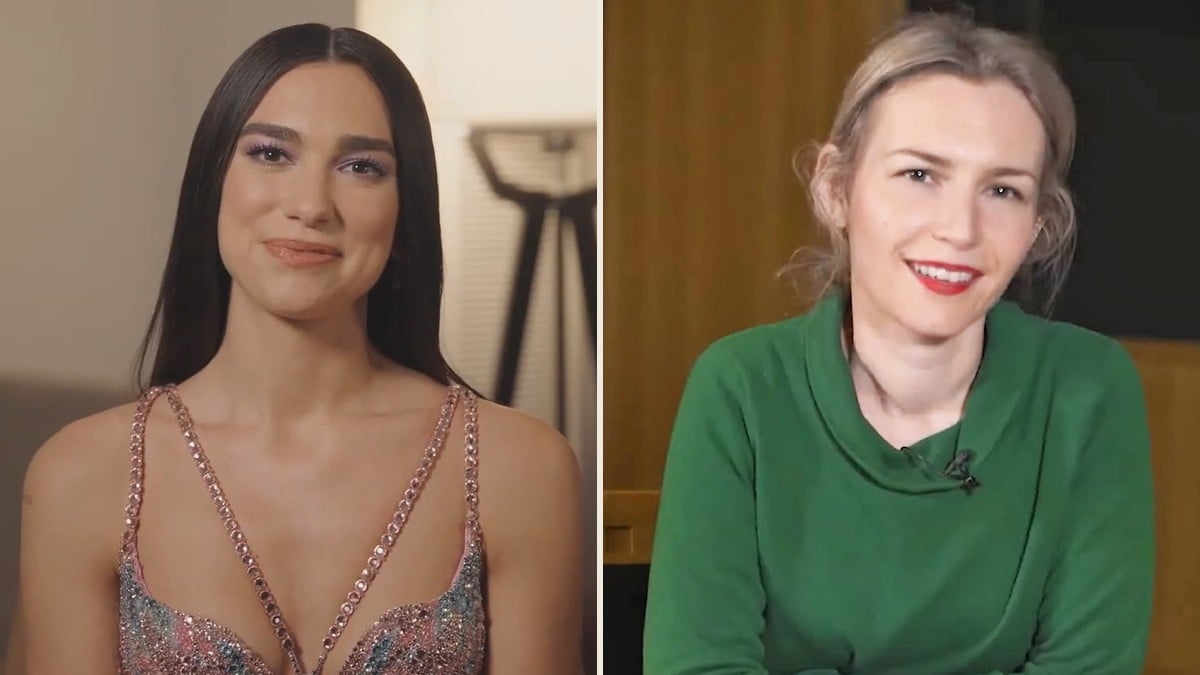
This article reports, with attribution to news organizations, what Dua Lipa and Lea Ypi said in a public interview about events in Albania. The National Albanian Registry is a 501(c)(3) that does not take positions on partisan politics in Albania or the United States. Nothing here is an endorsement of any party, government, or campaign.
In the summer of 2026, the Albanian singer Dua Lipa used her Service95 Book Club podcast to interview the Albanian author and London School of Economics professor Lea Ypi about Ypi’s memoir Free: Coming of Age at the End of History. The book is about growing up in communist Albania. The conversation did not stay in the past. The two of them turned to what is happening in Albania right now, and Dua Lipa’s comments were picked up by news outlets around the world (Service95: Dua & Lea Ypi).
This piece lays out what was said, and the events they were talking about, with sources. It is a report, not an argument.
Watch the conversation
The full Service95 Book Club episode. Most of it is about Lea Ypi’s memoir and childhood under communism; the exchange on Albania’s present, quoted below, comes near the end.
What Dua Lipa said
Late in the episode, Dua Lipa turned the conversation from history to the present. Her own words, from the podcast:
“We can’t talk about the history of Albania without talking a little bit about Albania today. I’m sure that a lot of people listening will have heard about all the protests that are happening right now, and I have to say I find it so inspiring to see how much people really care. Day after day they’re hitting the streets, because the government has opened up this part of a beautiful nature reserve to a high-end beachfront development. And of course this has been a huge story internationally because the company that’s invested in the project is part owned by Jared Kushner and Ivanka Trump. But what I actually find concerning is the principle that the government could just change the law to remove the environmental protection without any kind of public consultation.”
The Kushner and Trump reference is Dua Lipa’s own, from her own podcast, not a characterization added here. And her stated concern is about process, the removal of an environmental protection without public consultation, rather than an endorsement of any Albanian political party. Her comments were picked up by outlets including RTÉ and France 24.
Later, on the movement’s nickname, she added:
“I also love that it’s called the flamingo revolution. It is important to hold politicians accountable and to be like, okay, who does this really help in the grand scheme of things? Who does this benefit? How is this making our country better?”
The environmentalist Aleksandër Trajçe, who leads the Albanian conservation group PPNEA, told reporters that Dua Lipa’s words were “a very powerful statement” that had inspired many young Albanians (Middle East Eye).
What Lea Ypi said
Lea Ypi, whose memoir Free was the reason for the conversation, put the protests in the frame of her own subject: what freedom means in a country that spent most of the twentieth century under one of Europe’s most closed dictatorships. On the podcast, she called the demonstrations one of the most inspiring examples of civic activism she had seen since the fall of communism, and described the underlying problem as a capture of politics by economic interests:
“It’s a sort of interesting example of collusion between this economic elite and the political elite. We have technically democracy, and we technically have equal voice of all citizens, and technically we have these mechanisms of democratic legitimation, but actually you also have an oligarchic elite, whether it’s international or domestic, that just holds politicians in their grip.”
She also drew a contrast between this movement and earlier Albanian opposition protests, on the question of tactics:
“The previous opposition protests were all with fires in parliament and hurling Molotov cocktails to government buildings. And here at the beginning they were singing and dancing and handing flowers to the police.”
And she voiced a caution, that a leaderless, spontaneous protest without a unified program is both admirable and fragile, and has to move “from resistance to proposition” to change anything structural. For Ypi, that is the through-line from her book to the street: Free is about the promises made to Albanians at the end of the Cold War and the disappointments that followed, and she reads the protests as Albanians testing whether those promises still mean anything.
What the protests are about
Two overlapping sets of protests were running in Albania when the interview aired.
The Sazan Island resort. The immediate trigger for the environmental protests was a planned luxury tourism development on and around Sazan, a former military island at the mouth of the Bay of Vlorë that lies within the Karaburun-Sazan Marine Park. The neighboring Vjosa-Narta protected landscape, a coastal wetland known for its flamingos, is a separate zone that the wider development also reaches. News organizations including Al Jazeera, France 24, and Forbes have reported that the project, valued at roughly 1.4 billion euros, is backed by investors linked to Jared Kushner’s Affinity Partners fund, with Ivanka Trump also associated with it, and that the Albanian government granted the project “strategic investor” status, which speeds up permits (Al Jazeera; Forbes).
Critics, including more than forty environmental groups, have argued that a 2024 Albanian law opened protected natural areas to five-star hotel construction, and that the approvals lacked transparency. Albania’s special anti-corruption prosecution office, SPAK, opened an inquiry into decisions that changed the legal status of protected land along the southern coast (Balkan Insight). Because the affected wetlands are a habitat for flamingos, news outlets began calling the movement the “Flamingo Revolution” (Middle East Eye).
The wider opposition protests. Separately, a broader wave of anti-government demonstrations had been building since November 2025, driven by corruption allegations and disputes over the 2025 election, with protesters demanding the resignation of Prime Minister Edi Rama. By mid-2026, according to reporting compiled on Wikipedia, the environmental protests and the opposition protests had partly merged into a single anti-government current (Wikipedia: 2025-2026 Albanian opposition protests).
Why a diaspora registry is noting this
The National Albanian Registry counts Albanian Americans. We are not a party to Albanian domestic politics, and this article endorses no side in it. What we do track is how the Albanian world talks to itself across borders, and this interview is a clear example of it.
A Kosovo-Albanian pop star raised in London, interviewing an Albanian author who teaches in London, about a book set in communist Albania, and using the moment to discuss events in present-day Albania in front of a global audience: that is the diaspora functioning as a single conversation across four or five countries at once. You do not have to agree with a word either of them said to see the mechanism. Visibility for Albanian voices, in any direction, lowers the cost for the next Albanian who wants to be heard.
For the biography and the music, see our full profile of Dua Lipa. For the wider cohort, see Famous Albanians and Famous Kosovo People.
Get counted
The Albanian world is bigger, louder, and more connected than the recorded numbers suggest. In the United States, the Census counts about 230,000 Albanian Americans. The real number is close to a million.
Closing that gap starts with names on the record.
Get counted at /register: free, encrypted, community-led. We mint a recognition certificate. We do not sell anything. We never share your data.
Sources are linked inline. Quotations are reported as published by the outlets cited and are attributed to those reports.