

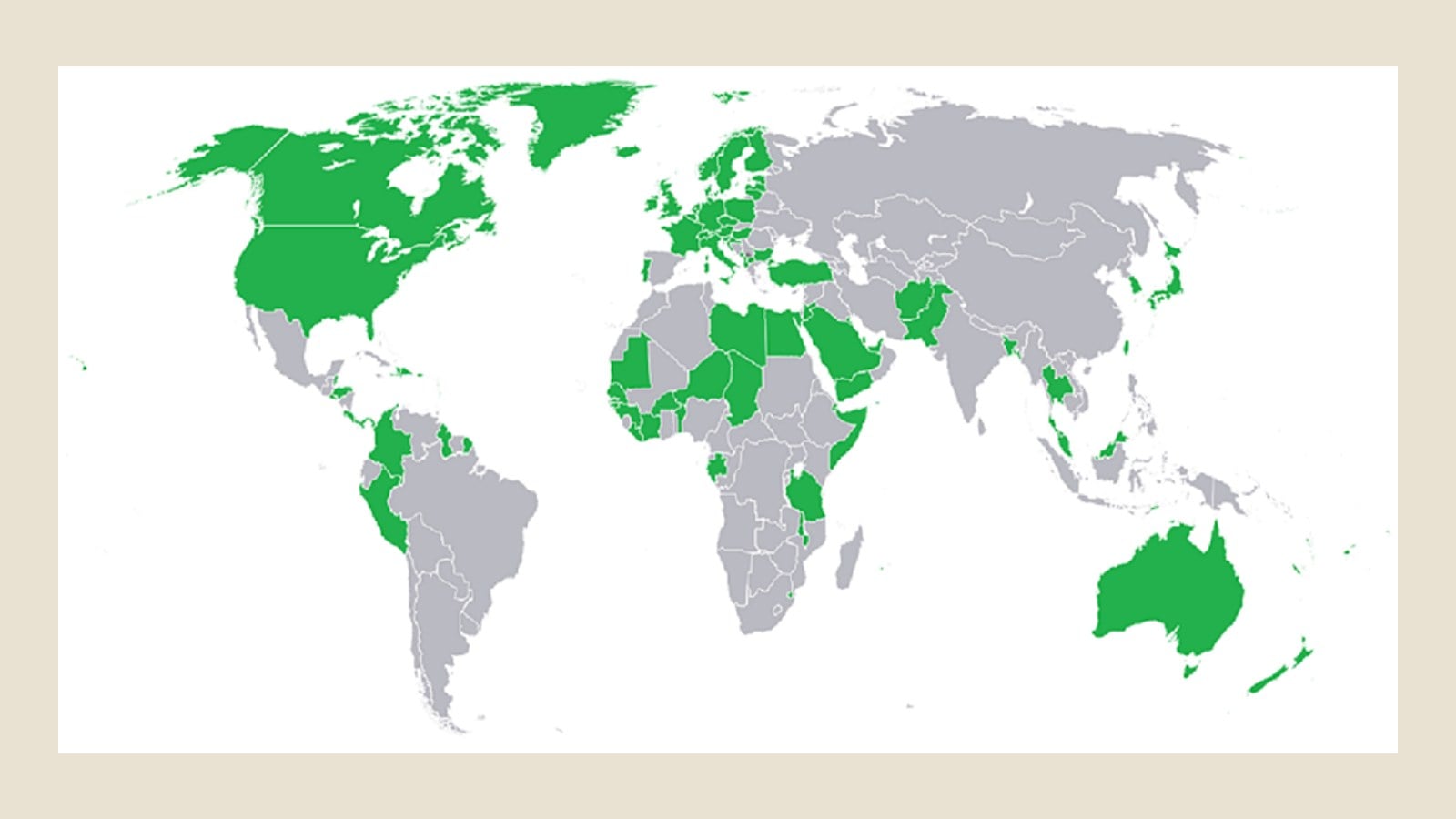
The short answer is no. The Russian Federation does not recognize the Republic of Kosovo as an independent state and has not done so since Pristina declared independence on 17 February 2008. That position has been continuous across the Putin and Medvedev presidencies and has been restated in United Nations Security Council sessions, in bilateral statements with Belgrade, and in Russian Ministry of Foreign Affairs communications for more than seventeen years.
The longer answer is the part most readers are actually looking for. Why does Russia hold that position? What does it mean at the UN, where Russia’s seat carries veto power? How does Russia’s stance interact with the recognition decisions of China, the five EU non-recognizers, and the roughly 110 states that have extended recognition since 2008? And what does any of it mean for Kosovar-American families whose passports, identity documents, and travel plans live downstream of all of this?
This piece walks through each of those questions in turn. NAR is a 501(c)(3) registry; we do not take positions on contested international questions. Where the Russian, Serbian, Kosovar, and US governments hold different views, we report what each says and what is a matter of record. For the broader sister context, we have written separately on Kosovo and the United States, on Kosovo vs Albania, and on Albania’s allies. This article is the Russia-specific piece of that picture.
A note on terminology. We use “recognition” in its standard international-law sense: a formal acknowledgement by one state that another entity is a state. Recognition is a political act, granted or withheld by individual governments, separate from membership in any international organization. A state can be widely recognized and still not sit in the UN. Kosovo is the working example.
The short answer, with dates
Russia rejected Kosovo’s declaration of independence within hours of its issuance. The Assembly of Kosovo adopted the declaration in Pristina on 17 February 2008. Russia called for an emergency meeting of the UN Security Council the same day. The session was held that evening in New York.
At that emergency session, the Russian representative argued that the declaration was a violation of UN Security Council Resolution 1244 (1999), the resolution that ended the 1999 NATO air campaign and placed Kosovo under UN administration while reaffirming Serbian sovereignty over the territory. That argument has not changed since.
Three additional Russian statements from February 2008 are worth recording because they have shaped the diplomatic record. Russian President Vladimir Putin described the recognition of Kosovo by major powers as a dangerous precedent that, in Russia’s stated view, would destabilize the entire system of international relations built up over centuries. Russian Foreign Minister Sergey Lavrov argued in February 2008 that recognizing Kosovo would set a precedent applicable well beyond the Balkans, not only to South Ossetia and Abkhazia but to other unresolved territorial disputes. Russian First Deputy Prime Minister Dmitry Medvedev — soon to be elected president — restated Russian support for Serbia’s position during a visit to Belgrade shortly after the declaration.
The Russian position has been restated in essentially identical terms at every Security Council session that has touched Kosovo since. As recently as December 2023, Russia blocked routine Council statements on the Kosovo file. Russia did not attend the General Assembly debate on the International Court of Justice advisory opinion in 2010 in any way that altered its stance.
The bottom line for this section: Russia has not recognized Kosovo, has never recognized Kosovo, and has used every available diplomatic channel to argue against recognition by others.
Why Russia opposes recognition: the stated reasons
Russia’s opposition rests on three publicly stated arguments. We present them as the Russian government has framed them, without endorsement.
The Resolution 1244 argument. Russia argues that UNSCR 1244, adopted on 10 June 1999, established UN administration over Kosovo while explicitly reaffirming “the sovereignty and territorial integrity of the Federal Republic of Yugoslavia” — Serbia’s predecessor state. In Russia’s reading, any change in Kosovo’s status required Security Council agreement; the 17 February 2008 declaration was a breach of that framework.
The Western counter-argument, articulated by US, UK, and most EU governments, is that the Ahtisaari Plan of 2007 had attempted a negotiated resolution under UN auspices, that Russia had signaled it would veto any Council resolution endorsing it, and that the impasse left supervised independence as the remaining viable path. The International Court of Justice advisory opinion of 22 July 2010 found that the declaration itself did not violate international law or Resolution 1244, though it did not adjudicate the deeper question of statehood.
The alignment with Serbia. Russia and Serbia have long-standing diplomatic, cultural, and religious ties that predate the Cold War. Both populations are predominantly Slavic and Orthodox Christian. Russia has positioned itself as Serbia’s senior partner on the Kosovo file in multilateral forums. The relationship is not unconditional — Belgrade and Moscow have visible disagreements on energy and sanctions, and Serbia pursues EU integration — but on Kosovo, the alignment has been consistent.
The precedent concern. This is the most-cited Russian rationale and the one with the most consequences elsewhere. Lavrov’s February 2008 framing — that recognition would set a precedent applicable well beyond the Balkans — reflected a Russian concern about secessionist precedents that could be invoked closer to home. The Russian Federation contains regions with secessionist histories (Chechnya most prominently), and the post-Soviet space contains contested entities (Transnistria, Nagorno-Karabakh until 2023, the Donbas) Moscow has interests in.
The precedent argument has had a complicated afterlife. In August 2008, Russia recognized South Ossetia and Abkhazia as independent states after the Russia-Georgia war, citing Kosovo as a precedent. In March 2014, after the annexation of Crimea, Russian officials again invoked the “Kosovo precedent.” Western governments have rejected these analogies on factual and legal grounds. Russia has continued to use the analogy regardless. For the recognition question, the operative point is that Russia’s stated rationale has not changed.
The UN Security Council bottleneck
The single most consequential effect of Russia’s non-recognition is procedural. UN membership requires a Security Council recommendation followed by a two-thirds vote in the General Assembly. The Security Council has fifteen members, of which five are permanent: China, France, the Russian Federation, the United Kingdom, and the United States. Each permanent member can veto a substantive resolution.
On Kosovo, three of the five permanent members — France, the UK, and the US — recognize the Republic. Two — Russia and China — do not. Either can veto a recommendation that Kosovo be admitted to the UN. Until at least one of those positions changes, Kosovo cannot become a UN member regardless of how many General Assembly votes it can muster. The General Assembly cannot admit a state without a Council recommendation.
This is why Kosovo’s diplomatic strategy has run on two parallel tracks since 2008. The first is bilateral: convincing individual states to extend recognition one at a time. The second is institutional: pursuing membership in international organizations that do not require Security Council approval. Kosovo is a member of the International Monetary Fund (since 2009), the World Bank (since 2009), FIFA and UEFA (since 2016), and the International Olympic Committee (since 2014). Kosovo applied for EU candidate status in December 2022 and gained Schengen visa-free entry on 1 January 2024.
What Kosovo cannot achieve through this strategy is a UN seat, a vote in the General Assembly, or membership in the specialized UN agencies that condition entry on UN status. Interpol has been a recurring obstacle: Kosovo’s applications to join Interpol have failed multiple times, with Serbian and Russian opposition cited as principal factors. The practical consequence — described in the diaspora section below — is that Kosovo cannot directly issue Red Notices or routinely participate in Interpol’s information-sharing systems.
The Security Council bottleneck is not unique to Kosovo. Taiwan, Palestine, and Western Sahara sit in adjacent positions, each blocked by a different combination of permanent-member opposition. The point for the Kosovo case is that the bottleneck is structural rather than political: it is the design of the UN Charter, written in 1945, operating as designed.
The global recognition map in 2026
Recognition is the running scoreboard, and the score is contested. The most commonly cited figure is that roughly 110 of the 193 UN member states recognize Kosovo, but published counts range from about 104 to 117 depending on how the source treats withdrawals and ambiguous cases.
The reason for the range: since 2017, several states have formally withdrawn or revoked their recognition of Kosovo. Suriname withdrew in 2017, the first state to do so. Subsequent withdrawals have been reported for Ghana, the Central African Republic, the Comoros, Madagascar, Palau, Vanuatu, and others. Kosovo’s Foreign Ministry and Serbia’s Foreign Ministry maintain different counts; in most cases a withdrawal letter was filed in one capital but the bilateral diplomatic relationship has not been formally rescinded everywhere. Non-governmental trackers like statusofkosovo.info update running tallies as new statements come in.
Recognition has also continued to grow. Israel recognized Kosovo in February 2021, a commitment made under the Washington Agreement signed at the White House on 4 September 2020. Barbados recognized in 2018. Kenya recognized in March 2025, the most recent African state to do so.
The roughly 83 UN member states that have not recognized Kosovo include several clusters: the five EU non-recognizers (covered in the next section); Russia, China, India, Brazil, and South Africa; most of Latin America outside the Caribbean; most of the Arab League (with significant exceptions including UAE, Saudi Arabia, Egypt, and Qatar); and roughly half of the African Union. Recognition correlates loosely with NATO and EU membership, with US bilateral influence, and with the absence of domestic secessionist concerns — but the correlation is weak enough that case-by-case explanations are usually more illuminating.
The five EU non-recognizers
Five EU member states do not recognize Kosovo. Each has a stated reason; we set them out without endorsement.
Spain is the most-cited example. Madrid’s stated concern is Catalonia, where independence movements have invoked secessionist arguments Spain does not want to legitimize. The position has been restated by successive Partido Popular and PSOE governments.
Greece has historical and religious affinities with Serbia rooted in shared Orthodox Christianity, joint experience of Ottoman rule, and Cold War-era alignments. The Greek minority question in Albania (Northern Epirus) is sometimes cited as a secondary factor. Athens describes the position as “non-recognition” rather than active opposition; it has not evolved.
Cyprus has its own contested-statehood case in the Turkish Republic of Northern Cyprus, recognized only by Turkey. Nicosia’s concern is symmetrical to Spain’s: a state that does not want to set a precedent that could be invoked against its own territorial integrity.
Romania cites concerns about precedent in Transnistria (the breakaway region of neighboring Moldova) and, less openly, about the Hungarian minority in Transylvania. Bucharest’s position has been consistent since 2008.
Slovakia cites the broader principle of territorial integrity and concerns about the Hungarian minority in southern Slovakia. The position has held across the political spectrum.
The practical effect is that the EU has not been able to take a unified position on Kosovo’s status. Brussels can speak of “engagement with Kosovo” but cannot speak of “EU recognition of Kosovo” because five members hold the contrary view. It is also why Kosovo cannot become an EU member through the standard process without the five non-recognizers either changing position or accepting an unusual workaround.
China’s position: parallel to Russia, distinct logic
The People’s Republic of China does not recognize Kosovo. The Chinese position has been continuous since 2008 and is one of the two locks on Kosovo’s UN membership.
China’s reasoning is closer to a precedent argument than to the Slavic-Orthodox solidarity narrative that informs Russia’s case. Beijing’s standing positions on Taiwan, Tibet, Xinjiang, and Hong Kong make it cautious about endorsing any unilateral declaration of independence by a sub-national entity. Recognizing Kosovo would, in China’s reading, weaken the principle that internal arrangements must be settled by negotiation between the parties involved rather than by unilateral action.
China’s bilateral relationship with Serbia has grown in the post-2008 period, particularly through Belt and Road infrastructure investment. Chinese-financed projects in Serbia include the Belgrade-Budapest railway upgrade, the Smederevo steelworks, and several power-sector deals. The relationship is not as historically deep as Russia’s, but it has become more visible since 2015.
Crucially, China’s veto on Kosovo would activate independently of Russia’s. Even if Russia changed its position tomorrow, a Kosovo UN bid would still require China to permit the recommendation. There is no public indication that the Chinese position is under review.
The combination of Russian and Chinese non-recognition is what makes the UN-membership question essentially closed under current Security Council composition. Either veto is sufficient. Both are operative.
What this means for Kosovar Americans
For families in the United States with roots in Kosovo, the recognition question intersects daily life in a few specific places. None are catastrophic; all are worth understanding before they come up.
US recognition is full and unchanged. The United States recognized Kosovo on 18 February 2008, the day after the declaration. President George W. Bush issued the recognition statement; Secretary of State Condoleezza Rice delivered the diplomatic note. The US Embassy in Pristina opened in 2008. The Republic of Kosovo passport is a fully valid travel document in the US, the Kosovo embassy in Washington is a recognized diplomatic mission, and Kosovar nationals are treated on the same legal basis as nationals of any other recognized state.
Passport acceptance globally. Kosovar passports are accepted in recognizing states — most of NATO, most of the EU, the US, UK, Canada, Australia, Japan, and most of Latin America. Schengen visa-free travel entered into force for Kosovar passport holders on 1 January 2024, removing one of the biggest practical barriers Kosovar Americans encountered when visiting family in Europe. Travel to non-recognizing states — Russia, China, India, Brazil, and the five EU non-recognizers among them — generally requires a visa. Some Kosovar Americans hold dual Kosovar–US, Kosovar–Albanian, or Albanian–US citizenship and travel on the most convenient passport for the destination.
Interpol non-membership. Kosovo is not a member of Interpol, and successive applications have been blocked. The practical effect is that Kosovo cannot directly issue Red Notices or sit on the standard Interpol information-sharing channels. Kosovar law enforcement coordinates through proxy channels via partner states; Kosovar Americans with ordinary US police-system interactions are unaffected. The friction shows up mostly in cross-border arrest-warrant enforcement and fugitive cases.
Citizenship and dual-national questions. Kosovo permits dual citizenship under its constitution. Albania’s 2020 citizenship law (Law 113/2020) allows Albanian-Americans to claim Albanian citizenship by descent without renouncing US citizenship. The two regimes are separate but compatible. This article is not a legal guide; for individual cases, consult the relevant consulate or a qualified immigration attorney.
Civil documents in non-recognizing states. Marriage, birth, and notarized documents issued by Kosovo are honored in recognizing states under standard legalization or apostille procedures. In non-recognizing states, recognition of those documents may require additional steps, sometimes through Serbian intermediation. Frequency depends on family geography.
The takeaway: for most Kosovar Americans, Russia’s non-recognition is geopolitically significant but operationally distant. The places where it bites are specific and identifiable. The places where it does not bite — daily life in the United States, travel to most of the world Kosovar Americans actually visit — are where most of the diaspora lives.
2022-2026: the Ukraine war and the diplomatic landscape
Russia’s February 2022 invasion of Ukraine has reshaped the diplomatic context around Kosovo without producing a binary shift in the recognition map.
The first effect has been to harden existing positions. Russia continues to refuse recognition and has used Security Council sessions on Kosovo more aggressively, including the December 2023 instance in which Russia blocked routine Council statements on the file. The Russian ambassador to Serbia stated in April 2022 that Russia’s Kosovo policy had not changed and would not.
The second effect has been a more open argument from Western governments that recognizing Kosovo is consistent with opposing Russia’s war on Ukraine. Some commentators have framed Ukrainian recognition of Kosovo as a logical step that would underline the parallel between Russia’s behavior in Crimea and its stated position on Kosovo. Ukraine has not recognized Kosovo as of 2026.
Serbia’s position has also held. Belgrade has resisted Western pressure to align with the EU sanctions regime against Russia, citing energy dependence and bilateral ties. Belgrade’s non-recognition of Kosovo remains official policy. The Belgrade-Pristina dialogue, mediated by the EU, has produced incremental agreements but no comprehensive normalization. The 2023 Ohrid framework — never formally signed — covers mutual recognition of state symbols and missing-persons resolution; implementation remains incomplete.
A fourth effect has been on the Kosovo Force (KFOR) posture. KFOR is the NATO-led peacekeeping force authorized by UNSCR 1244 in 1999, headquartered at Camp Film City in Pristina, with Camp Bondsteel near Ferizaj in southeastern Kosovo serving as the base for KFOR’s Regional Command-East. After the Banjska attack of 24 September 2023 in northern Kosovo, NATO members reinforced KFOR. NATO statements describe the reinforcement as defensive; Russian Foreign Ministry statements describe it as escalatory. Both characterizations are on the record.
What has not happened is equally worth noting. There has been no Russian recognition of Kosovo, no Chinese recognition, and no shift by any of the five EU non-recognizers. The recognition map of 2026 is recognizably the recognition map of 2022 — slightly larger on the recognizer side (Kenya, 2025), slightly smaller through continued withdrawals, and structurally identical at the Security Council.
A note on framing
This article uses third-person phrasing — “Russia does not recognize Kosovo,” “Serbia argues,” “the United States recognized” — throughout. That is deliberate. NAR is a 501(c)(3) registry, not a foreign-policy advocacy organization. Where states disagree, we report what each says and point to the sources. Where dates and texts are settled, we state them.
We do not characterize Russian foreign policy as right or wrong. We do not characterize Serbian non-recognition as right or wrong. The article is meant to be readable by a Kosovar-American reader, a Serbian-American reader, a journalist, a student, and a researcher — and to leave each of them with a clearer factual picture.
The Kosovar-American community is part of a broader Albanian-speaking diaspora that crosses every border the Balkans has drawn through it. The community in the United States — concentrated in the Bronx, Yonkers, Westchester, Staten Island, northern New Jersey, and the Detroit metropolitan area — exists in its current shape because of the 1999 NATO intervention, the Operation Provide Refuge resettlement of roughly 4,000 Kosovar refugees through Fort Dix, and the steady chain migration since. Their lives in the United States are not contingent on Russian recognition decisions.
If you are part of that community, the best thing you can do for the count is to be counted. Get counted at /register. The certificate is a recognition document, not a government ID and not citizenship — but the count it contributes to is real.
Sources and further reading
The institutional positions cited in this article are sourced from the Wikipedia entry on International recognition of Kosovo, the Wikipedia entry on Kosovo–Russia relations, the Wikipedia entry on the 2008 Kosovo declaration of independence, and the Wikipedia entry on Russia’s reaction to the 2008 Kosovo declaration as layperson references. Dated facts on UN Security Council resolutions, the ICJ advisory opinion, and bilateral recognition statements are drawn from the primary documents released by each institution. Running recognition counts are tracked at statusofkosovo.info and at the foreign ministries of Kosovo and Serbia, which maintain different totals.
For the parallel context on the United States, see our Kosovo and the United States explainer. For the broader Albanian-Kosovar relationship, see Kosovo vs Albania. For Albania’s alliance map, see Albania’s allies. For the Kosovar-American community’s place in the diaspora, see Kosovo America.