
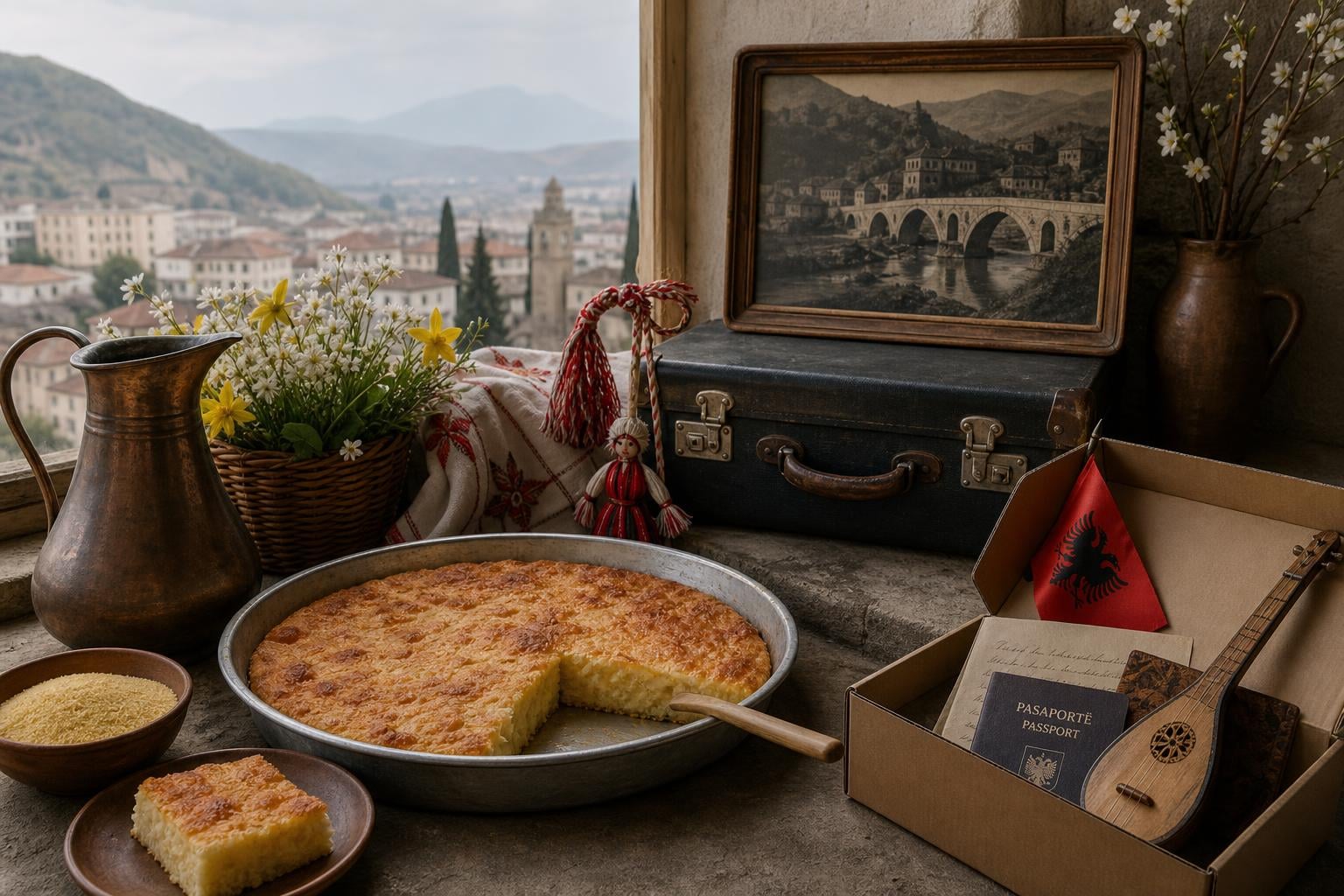
Every March 14, the city of Elbasan in central Albania fills with the smell of butter and toasted cornmeal. Home ovens and neighborhood bakeries run all morning, turning out trays of ballokume — a pale, crumbly cookie made from corn flour — by the dozen. The cookie is the unmistakable signal that Dita e Verës has arrived and that winter, at least by the old reckoning, is finished.
The name means Summer Day, though you will also see it rendered Spring Day or Summer’s Day in English. It is one of the oldest celebrations Albanians keep — a pre-Christian seasonal festival that has nothing to do with church or mosque and everything to do with the sun climbing back up the sky. Its roots reach into pagan rites that marked the end of the cold half of the year and the reawakening of nature, and its modern center of gravity sits in Elbasan, where the holiday and the cookie are practically synonymous (Summer Day, Albania — Wikipedia).
This piece is a heritage explainer, not a travel guide or an event listing. It covers what Dita e Verës is and why it falls on March 14, where its mythology comes from, why Elbasan became its heart, what ballokume is and the role it plays, how the date became an official national holiday in 2004, the spring-charm customs that travel with it, and — most important for our purposes — how Albanian-American families can and do mark the day from kitchens in New York, Michigan, and beyond. For the wider Albanian holiday calendar, see our overview of Albanian traditions; this is the deep dive on just one of them.
What Dita e Verës is and when it falls
Dita e Verës is Albanian for Summer Day. It is celebrated annually on March 14, and it marks the symbolic end of winter and the start of the warm, growing season (Wikipedia).
The first thing that confuses English speakers is the word summer. March 14 is nowhere near summer as most Americans count it — it lands just before the spring equinox. The explanation lies in an older, two-season way of dividing the year, common across the pre-modern Balkans and much of Europe: a cold half and a warm half. By that reckoning, the warm half — vera, the season of growth and sun — began in spring, not June. So Summer Day is really the day summer begins in the old sense, which is why some translators reach for Spring Day instead. Both labels point at the same thing: the turn of the year toward light and growth.
The holiday is secular in character. It predates Christianity and Islam in the region, and it carries no liturgy, no saint, and no required prayer. That is part of why it has survived and why it travels so easily across community lines — Catholic, Orthodox, Muslim, Bektashi, and secular Albanians can all keep it without contradiction.
The customs are simple and domestic at their core: baking and sharing seasonal sweets, gathering with family, going outside to greet the new season, and small good-luck rituals tied to renewal. The mood is celebratory and gentle rather than solemn. Where a holiday like 28 Nëntori carries the weight of nationhood and history, Dita e Verës carries the lighter, older weight of the seasons themselves — a reminder that the cold always ends.
The pagan origins and seasonal mythology
The deepest roots of Dita e Verës are pre-Christian. The festival belongs to a family of seasonal rites — found in various forms across the Balkans and beyond — that celebrate the death of winter and the rebirth of nature (Wikipedia).
At the center sits the sun. Across old Albanian folk belief, the sun was a force to be honored and welcomed back, and the lengthening days of March were read as the sun regaining its strength after the long darkness. Spring rituals across the Albanian-speaking world often involve fire, light, and the symbolic burning-away of winter — bonfires, the kindling of new flame, the casting-out of the old season. The underlying logic is the same everywhere: nature has been asleep, and the community gathers to wake it.
Scholars connect this seasonal turn to much older agrarian and pastoral cycles. For a farming and herding people, the end of winter was not an abstraction — it meant the difference between scarcity and plenty, the return of pasture, the first green on the hillsides. Marking that moment with ritual was a way of both celebrating survival and asking the new season to be generous. The customs of renewal — fresh sprigs of green, the first flowers, charms worn for health and luck — all read as gestures toward fertility and growth.
Albanian folk tradition is rich with figures and motifs tied to this turning of the year, and Dita e Verës sits inside that broader mythological world rather than standing alone. The honest scholarly picture is that the festival’s exact ancient lineage is reconstructed from folklore and comparison rather than documented in detail, so it is better to describe it as part of a pre-Christian seasonal complex than to claim a single, traceable origin myth. What is clear is the theme: the sun returns, winter dies, and the land comes back to life.
Why Elbasan is the heart of it
If Dita e Verës has a capital, it is Elbasan — a city in central Albania on the Shkumbin river, historically one of the country’s important inland towns (Elbasan — Wikipedia). The holiday is most concentrated, most elaborate, and best documented there, and Elbasan is widely described as the festival’s epicenter (Wikipedia).
The reasons are partly historical and partly culinary. Elbasan kept the celebration alive across generations as a distinctly local tradition, and it is the home of the cookie — ballokume — that has become the holiday’s edible signature. In Elbasan, Dita e Verës is not one festival among many; it is the day, woven into the city’s sense of itself. Families there treat March 14 the way other places treat a patron-saint feast or a founding day.
When Albania made Dita e Verës an official national holiday in 2004, it effectively raised an Elbasan tradition to a country-wide one. The celebration had already spread beyond the city over the preceding decades, but the formal recognition gave it a place on the national calendar and encouraged communities across Albania to keep it more visibly. Elbasan remains the reference point — the place the customs are measured against.
It is worth being precise here, because heritage writing tends to inflate. We are describing where a tradition is densest and where its signature food comes from. We are not telling anyone to plan a trip or attend a specific event; that is outside the point of this explainer. The relevant fact for a diaspora reader is simply this: when your grandmother or a Tirana cousin talks about Dita e Verës and ballokume, the cultural center they are pointing at is Elbasan.
Ballokume: the cookie at the center of the day
No food is more bound to Dita e Verës than ballokume — a butter-and-corn-flour cookie associated above all with Elbasan (Wikipedia).
Ballokume are pale, round, and crumbly, with a sandy, melt-in-the-mouth texture that comes from their corn-flour base rather than wheat. The core ingredients are simple: corn flour, butter, sugar, and egg. The traditional method is labor-intensive — the butter and sugar are beaten for a long time, often by hand, until the mixture is pale and airy, then the corn flour is folded in and the dough is spooned into rounds and baked until just set. The result is a cookie that is faintly sweet, rich with butter, and unmistakably grainy in a way that distinguishes it from any wheat-flour biscuit.
The ritual role matters as much as the recipe. In Elbasan, making ballokume for March 14 is a household event — a batch large enough to share, given to neighbors, set out for visitors, carried to family gatherings. The cookie is the way the holiday is tasted and passed along. To make ballokume is to keep Dita e Verës; to receive a plate of them is to be folded into someone’s celebration. That gift-and-share logic is exactly what makes the cookie portable across an ocean — more on that below.
Ballokume sits within the broader world of Albanian baked goods, alongside the syrup-soaked and nut-filled sweets the cuisine is better known for abroad. If you want the wider context — bakllava, trilece, gurabija, and the rest — our guide to Albanian pastries places ballokume among its cousins. But on March 14, ballokume stands alone. It is not a generic dessert that happens to appear on the day; it is the day, in edible form.
How it became a national holiday in 2004
For most of its life, Dita e Verës was a regional and folk celebration — strongest in Elbasan, kept by families and communities, observed without any official status. That changed in 2004, when it was declared an official national holiday in Albania (Wikipedia).
The recognition did two things. First, it gave the day a fixed place on the public calendar, which in practice means a non-working holiday and a country-wide acknowledgment rather than a purely local one. Second, it confirmed something about the festival’s character: a pre-Christian, secular, nature-based celebration was chosen as a shared national holiday precisely because it does not belong to any one religious community. In a country whose population includes Muslims, Bektashi, Orthodox, Catholics, and the non-religious, a holiday rooted in the seasons rather than a faith is something everyone can hold in common.
It also reflects a pattern worth naming. Across the twentieth century, Albanian folk traditions went through long stretches of suppression and neglect, and many were kept alive informally rather than officially. Bringing Dita e Verës onto the national calendar in 2004 was, in part, an act of reclaiming and formalizing folk heritage that had survived from below. The state did not invent the holiday; it ratified one the people had already kept.
For the diaspora, the 2004 status is useful context rather than a personal obligation. Albanian Americans are not bound by Albania’s public-holiday calendar — no one in Detroit gets March 14 off work. But knowing the date carries official weight in the homeland helps explain why it is worth keeping abroad, and why a cousin in Tirana might message Gëzuar Ditën e Verës — happy Summer Day — on the morning of the fourteenth.
The verore and other spring-charm customs
Alongside the food, Dita e Verës carries a small set of good-luck and renewal customs, the best known of which is the verore — a red-and-white charm or bracelet associated with the start of spring.
A quick gloss is in order, because the custom is easy to overstate or mislabel. The verore (sometimes also called by other regional names) is a twist of red-and-white thread worn at the turn of the season, traditionally tied on at the start of spring and kept for a stretch before being removed and, in some tellings, left out for nature to take. The red-and-white pairing reads as a charm for health, vitality, and protection through the new season — the colors of blood and milk, life and renewal. It belongs to the broader Balkan family of spring bracelets and shares features with similar customs in neighboring cultures, so it is most honest to describe it as a regional spring-renewal charm associated with this time of year rather than a custom unique to Albania alone.
Other customs cluster around the same theme of waking the year. Bringing the first green sprigs or flowers indoors, stepping outside to meet the new season, small acts meant to invite health and fertility for the months ahead — these are the kinds of gestures that travel with the holiday. None of them is a strict requirement, and practice varies by region and family. That variability is itself part of the tradition: Dita e Verës has always been a folk celebration, shaped locally, rather than a fixed liturgy.
For a diaspora family, the spring-charm customs are an easy, low-cost way to mark the day with children — a length of red-and-white thread, a sentence about why it is worn, a flower on the table. The point is not to perform a perfect reconstruction of an Elbasan ritual. The point is the gesture of renewal itself, which is the part that has always carried.
How the Albanian-American diaspora observes it
Here is the honest version: in Albania, and especially in Elbasan, Dita e Verës is a big, public, all-in celebration. In the United States, the diaspora observance is lighter — but it is real, and it is growing.
The center of diaspora practice is the kitchen. Albanian-American families who keep the day keep it mainly by making ballokume — sometimes from a grandmother’s method, sometimes from a recipe traded in a family WhatsApp thread or pulled off an Albanian cooking site. The corn flour and butter are easy to find in any US grocery store, which is part of why this particular tradition crosses the ocean so well. A batch baked on or near March 14, shared with family and a few neighbors, is the celebration for most diaspora households.
Around that center sit smaller gestures. Some families wear a verore or tie a red-and-white thread on the kids. Some gather for a meal and explain, plainly, why the day matters: winter is over, the sun is back, the year turns. Some post a Gëzuar Ditën e Verës greeting to family group chats and social media, often with a photo of the ballokume coming out of the oven. Albanian-American cultural associations and parishes sometimes fold the date into a March gathering, though it does not command the community-wide programming that 28 Nëntori does in the fall.
The most important diaspora function of the day is generational. For a second- or third-generation Albanian-American child, Dita e Verës is a small, repeatable, sensory anchor — flour on the counter, a warm cookie, a short story about a city called Elbasan and a season that always comes back. It asks almost nothing and gives a child a concrete handle on heritage that abstract talk cannot. That is the quiet work it does in US homes, and it is exactly the kind of low-stakes, high-meaning tradition that survives migration. Our guide to Albanian heritage makes the broader case for why these small, kept practices matter; Dita e Verës is one of the easiest places to start.
If your household never kept March 14, you have lost nothing by starting now. Bake a batch of ballokume, tell the kids what it marks, and the rest follows. The tradition has never been pass-or-fail.
Where Dita e Verës sits among Albanian holidays
It helps to place Dita e Verës against the other days the community keeps, because its character is genuinely different from most of them.
The big diaspora holidays are historical and national. 28 Nëntori — November 28 — commemorates the 1912 declaration of independence and doubles as Flag Day; it is the year’s civic anchor, the day parades and dinners fill the calendar from New York to Sterling Heights. Religious holidays — Christmas and Easter for Christian families, the Bajrams for Muslim families — anchor the faith communities. Then there are the personal-and-cultural rituals that recur all year: a long Albanian coffee with relatives, a wedding, a name-day.
Dita e Verës is none of these. It is older than the nation-state, older than the churches and mosques, tied to the turning of the seasons rather than to a battle, a saint, or a treaty. That makes it unusually inclusive — there is no religious or regional gatekeeping on a day that simply marks the end of winter — and unusually portable. It does not require a parish, a parade permit, or a quorum of relatives. It requires an oven and a willingness to mark the date.
For the diaspora, that portability is the whole point. The national holidays need community infrastructure; the religious holidays need a faith tradition; Dita e Verës needs only a family and a batch of cookies. It is the lightest lift on the Albanian-American calendar and, for that reason, one of the easiest to keep alive across generations. For the full calendar and how the pieces fit together, our overview of Albanian traditions is the place to go next.
Keeping March 14 across generations
A tradition that survives migration is usually a small one — a cookie, a thread, a sentence said to a child once a year. Dita e Verës is exactly that kind of tradition, and keeping it is one of the simplest ways an Albanian-American family stays connected to where it comes from. If that work matters to you, getting your family counted matters too: the National Albanian Registry is a free, community-led census of US Albanians run by a 501(c)(3) nonprofit — add your household at albanianregistry.org/register, so the people keeping these traditions are visible in the count.