
The short answer: No. Austria-Hungary and Italy backed an Albanian state and helped set its 1913 borders — mostly to keep Serbia off the Adriatic. But the Albanian nation is far older than 1912: the medieval Arbëreshë who fled to Italy in the 1400s, the League of Prizren of 1878, and the 19th-century Rilindja all predate the modern state by decades to centuries. Drawing a border is not inventing a people. This is part of our guide to where Albanians come from.
The claim is a favorite because it contains a grain of truth: the Great Powers really were in the room in 1912–13, and they really did shape Albania’s borders. From there it’s a short, dishonest step to “so they made you up.” Here’s where that step goes wrong.
What actually happened in 1912–13
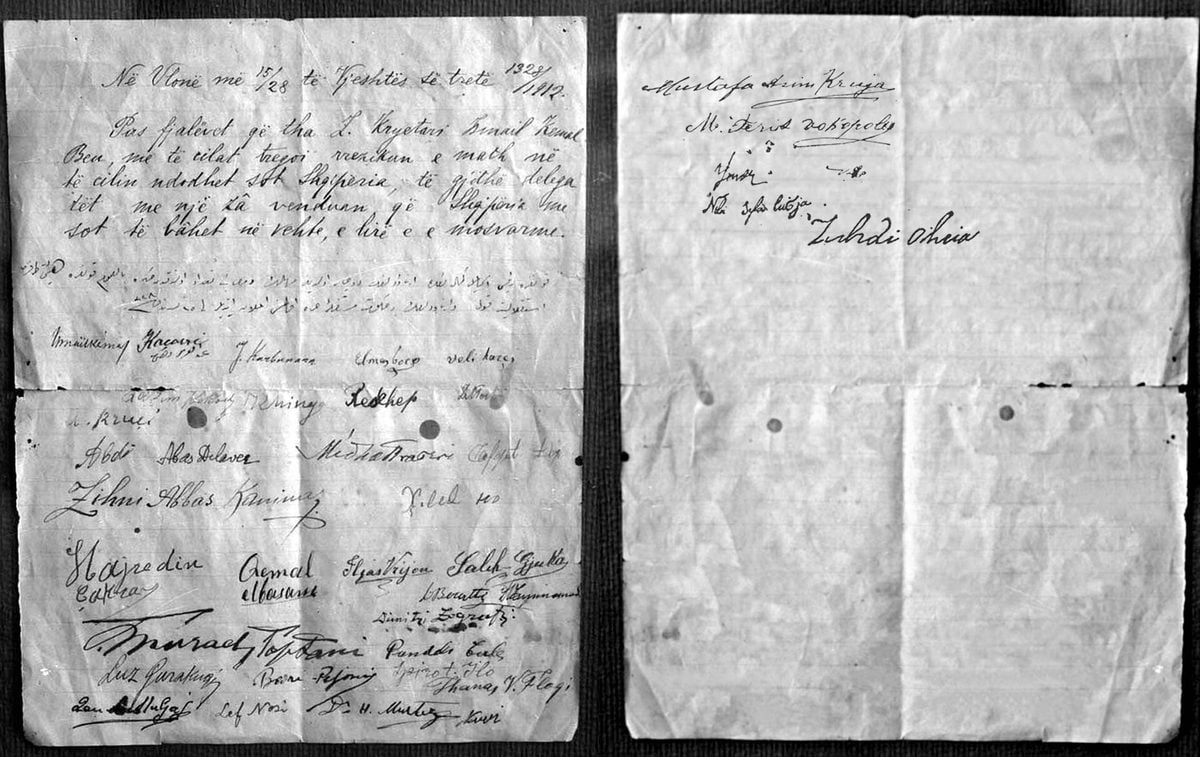
The modern Albanian state was declared on 28 November 1912, when Ismail Qemali proclaimed independence from the Ottoman Empire at Vlorë — raising the flag of Skanderbeg, the double-headed eagle that had flown four and a half centuries earlier.
The First Balkan War was underway, and Serbia, Montenegro, Greece, and Bulgaria were carving up the Ottomans’ European territory. That is what forced the question of Albania onto the table at the Conference of London (1912–13). The Great Powers — Austria-Hungary, Italy, Britain, France, Germany, Russia — recognized an independent Albania and set about drawing its borders, a process finished with the Protocol of Florence in December 1913.
Austria-Hungary and Italy were the strongest backers of an independent Albania, and their motive was cold geopolitics: an Albanian state on the Adriatic kept Serbia — and Serbia’s patron, Russia — from reaching the sea. That same power-politics is why the borders were drawn where they were, leaving roughly half of the Albanian-speaking population — in Kosovo, in western Macedonia, in Montenegro — outside the new state.
So yes: foreign empires shaped the map. Note what that means. They argued over where to draw the lines around a people who were already there. You do not need a boundary commission for a nation that doesn’t exist.
The nation was centuries old already
The Albanian people did not appear in 1912. The evidence runs back through the whole medieval and early-modern record.
- The ethnonym. Arbër / Arbëresh — the old self-name — is securely attested from the medieval period. (Some scholars also connect the earlier Albanoi tribe recorded by the geographer Ptolemy in the 2nd century, but that identification is contested — the medieval attestation is the solid ground, and it’s already centuries before 1912.)
- The Arbëreshë. After the Ottoman conquest in the 15th century, tens of thousands of Albanians fled across the Adriatic to southern Italy. Their descendants, the Arbëreshë, still live in some 50 villages, still speaking a 15th-century form of Albanian. A people invented in 1912 cannot have had a diaspora since the 1400s.
- Skanderbeg. In the 15th century, Gjergj Kastrioti unified the Albanian principalities at the League of Lezhë (1444) and held off the Ottoman Empire for 25 years. That is a collective Albanian political project four and a half centuries before independence.
- The League of Prizren (1878). When the Congress of Berlin threatened to hand Albanian-inhabited lands to neighboring states, Albanians organized the League of Prizren — a political and military body demanding autonomy and a unified Albanian territory. 1878. Thirty-four years before 1912.
- The Rilindja. The 19th-century National Awakening produced the standardized Albanian alphabet (Congress of Manastir, 1908), Albanian-language schools, newspapers, and a national literature — the ordinary machinery of a nation asserting itself, built by Albanians, before any empire “granted” a state.
Drawing a border is not making a nation
Every modern state has a founding date. France’s borders, Germany’s, Italy’s — all were drawn and redrawn by wars and conferences. Nobody argues the French were “invented” by the treaty that last moved their border. The founding of a state is an administrative event. The existence of a people is a much older, deeper fact.
Albania is no different. 1912 is the birthday of the state. The nation it enclosed had been speaking its own language, carrying its own name, and organizing its own resistance for centuries before the Great Powers ever picked up a pen.
Why the myth gets used
The “Austria-Hungary invented you” line does specific work: if the nation is a recent, artificial creation of foreign empires, then its claims — to Kosovo, to its own borders, to a place in the region’s history — look arbitrary and negotiable. That is the point of the argument. It is aimed at the present, dressed up as the past.
The honest history is less convenient for that purpose and better supported: a people old in the Balkans, whose state arrived late and partial precisely because foreign powers drew its borders to suit themselves.
For the full picture — Illyrian origins, the DNA evidence, and the other myths built to deny it — read Where Do Albanians Come From?. And if you’re Albanian American, the National Albanian Registry exists to count you — add your name, free and in about two minutes.