
The short answer: No. Caucasian Albania was a separate ancient kingdom in what is now Azerbaijan — its people spoke a Northeast Caucasian language with no relation to Albanian, and their only modern descendants are the small Udi community. Balkan Albanians descend from the Illyrians and speak an independent branch of Indo-European. The two share a name because ancient geographers reused the label — nothing more. This is part of our guide to where Albanians actually come from.
The claim shows up often enough that it’s worth answering in full: Albanians didn’t originate in the Balkans — they migrated from “Caucasian Albania,” near the Caspian Sea. It sounds plausible for exactly one reason. There really was a place called Albania in the Caucasus. Everything past the name falls apart.
Two places, one name
There were two “Albanias” in the ancient world, and they had nothing to do with each other.
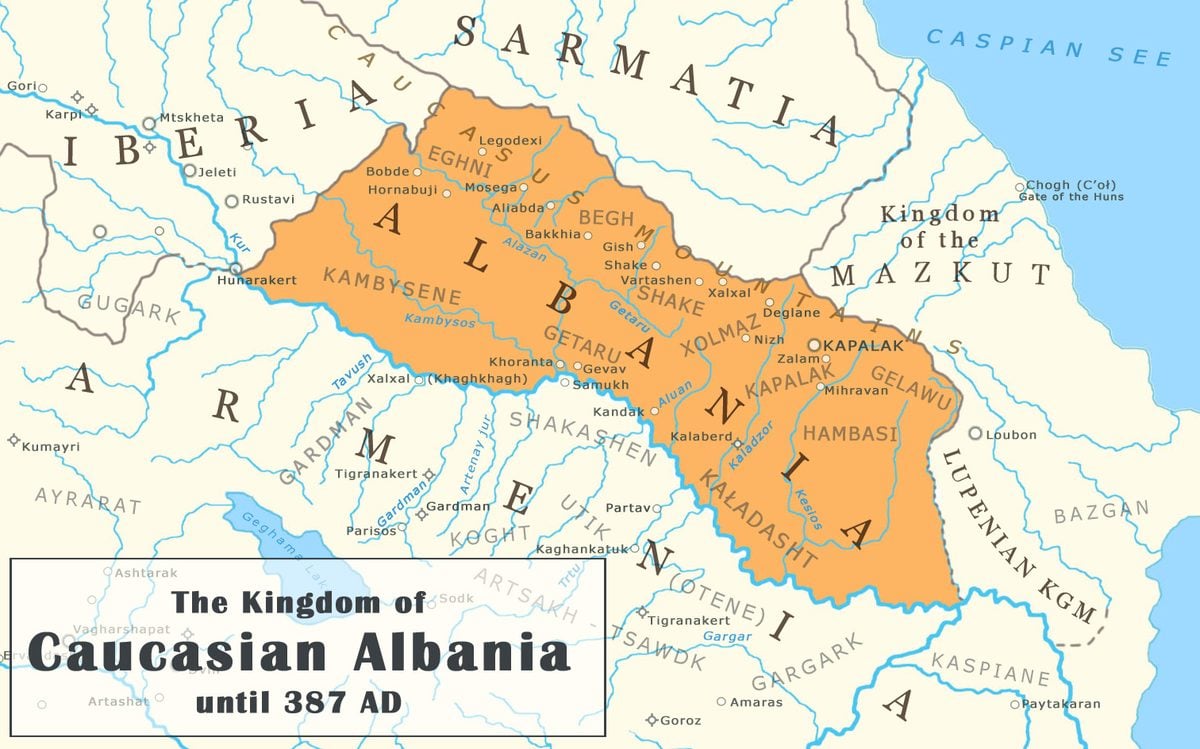
One is the Balkan Albania we know — the homeland of Albanian-speakers on the Adriatic. The other, Caucasian Albania, sat roughly 2,000 miles east, on the far side of the Black Sea, in territory that is now Azerbaijan and southern Dagestan. They are separated by the entire width of Anatolia and the Caucasus mountains.
The only thing they share is a label that ancient Greek and Roman writers handed out freely. The same root turns up in the Alps, in Albion (an old name for Britain), and in Alba (Scotland) — most likely a Proto-Indo-European element for “mountain” or “white.” Geographers slapped it on multiple places. Two of those places ended up called Albania. That is the whole of the coincidence.
What Caucasian Albania actually was
Caucasian Albania was a real and interesting kingdom — just not an Albanian one.
It existed from around the 2nd century BCE to the 8th century CE. The geographer Strabo described it as a confederation of about 26 tribes. Armenian sources called the land Aluank (or Aghwank); the people’s own name for it is not known. It was Christianized in the 4th century, developed its own alphabet and liturgical texts, and then, after the Arab conquests, gradually dissolved into the surrounding Azerbaijani, Armenian, and Georgian populations.
Its only clear modern descendants are the Udi people — roughly 10,000 today, concentrated in the village of Nij in Azerbaijan. If Balkan Albanians had “come from” Caucasian Albania, the Udi would be their closest relatives. They are not, by any measure that linguists or geneticists use.
The linguistic gulf
Language is where the claim dies for good.
Balkan Albanian is a member of the Indo-European family — its own independent branch, related at a deep level to Greek, Latin, Slavic, and the rest. The Caucasian Albanian language belonged to the Northeast Caucasian family (the Lezgic branch, the ancestor of modern Udi). Those two families are not related. They have different sound systems, different grammar — Northeast Caucasian languages use features like ergative-absolutive alignment and ejective consonants that Indo-European simply doesn’t have.
Languages don’t migrate without leaving traces. If a population had moved from the Caucasus to the Balkans, its speech would carry the fingerprints of a Northeast Caucasian origin. Albanian carries none. It carries, instead, the marks of a long history in the Balkans: an early layer of Doric Greek contact, a heavy stratum of Latin from Roman rule, later Slavic and Ottoman-Turkish loans.
What the scholars say
The specialists who actually study Caucasian Albania are blunt about this.
Jost Gippert — the linguist who deciphered the Caucasian Albanian palimpsests, the primary surviving texts in the language — put it in one sentence: “There are no historical facts supporting this, there is only the accidental similarity of the names.”
Balkanologist Svein Mønnesland reached the same conclusion, calling any connection “unlikely” precisely because of the linguistic distance between Albanians and the Udi.
When the people who can read the ancient language tell you there’s no relationship, that is as close to settled as this kind of question gets.
Why the myth gets used
If the connection is this weak, why does it keep circulating?
Because it isn’t really a historical claim — it’s a rhetorical move. Saying Albanians “came from the Caucasus” is a way of saying they are newcomers to the Balkans, and therefore have a weaker claim to the land they live on. It tends to surface in nationalist argument around Kosovo and the wider region, not in peer-reviewed linguistics or genetics, where Balkan continuity is the consensus. (For the naming-coincidence in even more detail, the heritage publication AlbaniaVisit has a dedicated breakdown.)
The honest version is simpler and older: Albanians are a Balkan people, descended from the region’s ancient inhabitants, who happen to share a place-name with a long-gone kingdom near the Caspian Sea. Same word. Different world.
This is one piece of the bigger picture. For the full account — Illyrian origins, the DNA evidence, and the other myths built to deny it — read Where Do Albanians Come From?. And if you’re Albanian American, the National Albanian Registry exists to count you — add your name, free and in about two minutes.