

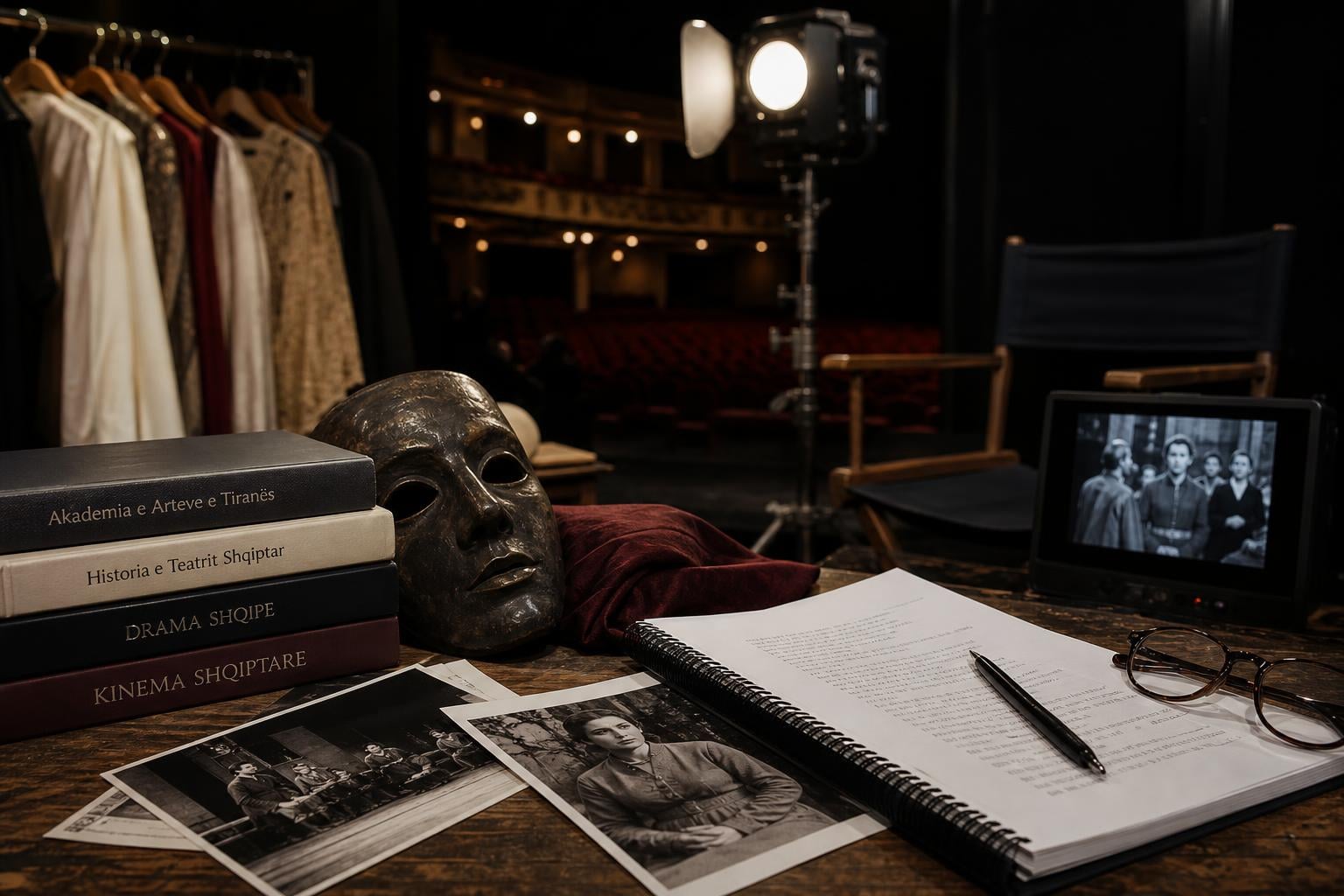
Besa Imami (1928–2014) was one of the notable stage and film actresses of Albania’s socialist era. Born in Gjakovë, Kosovo, she joined Tirana’s People’s Theater in 1946 and built a career that ran across more than four decades of Albanian stage and screen, closing with her retirement in 1988. She is best remembered for playing Donika Kastrioti in Skanderbeg, the 1953 historical film that remains one of the touchstones of early Albanian cinema. According to her Wikipedia biography, she died in Tirana in September 2014.
That sentence is enough to set the table. What follows is the longer version: where her career began, what she did on stage and on screen, why a mid-century Albanian actress’s biography matters for diaspora cultural memory in the United States, and where the canonical record sits when it comes to honors and personal life.
We have written this profile for diaspora readers — Albanian Americans who already know the names Vaçe Zela, Sandër Prosi, and Margarita Xhepa, and want a companion reference point from the same era; readers with roots in Gjakovë and the wider Kosovo diaspora, since that is where she was born; and the broader audience interested in the history of Albanian stage and screen. The aim is to be accurate, to avoid invention, and to point clearly at where the facts come from.
Who Besa Imami Was
Besa Imami was born on August 8, 1928, in Gjakovë, in what is now Kosovo. Her father, Ferid Imami, was an educator; her family moved to Tirana in 1937, when Besa was nine. In 1946, at eighteen, she entered the People’s Theater (Teatri Popullor) — the Tirana institution that would later be renamed the National Theater of Albania (Teatri Kombëtar). Rather than attending a separate conservatory beforehand, she trained through the theater’s own two-year in-house qualification course for new actors, a common path into the company in that era.
Her stage career ran from 1946 through leading roles in roughly 80 productions, ending with her retirement in 1988. Two roles stand out in the record: Gjinevra in Rrënjë të thella (“Deep Roots,” 1949) and Ermira in Mbi gërmadha (“Over the Ruins,” 1964).
On screen, she is best remembered for playing Donika Kastrioti — wife of the medieval Albanian hero Gjergj Kastrioti Skënderbeu — in the 1953 film Skanderbeg, a landmark production in the early history of Albanian cinema. She returned to film work later in life with roles in Gra pa krahë (“Women Without Wings,” 2002) and Eduart (2006).
She married the Albanian translator Petro Zheji; the marriage ended after about fifteen years. They had one son, Artur Zheji, born in 1961. The specifics — the full list of stage and film credits, the exact dates of honors — are best read directly from her Wikipedia entry, which we link to at the end of this piece.
Stage Work at the People’s Theater and the National Theater
Albania’s state theater in Tirana traces its modern institutional founding to 1945, when it was inaugurated as the Professional Theater of the State on May 24; the building itself had opened in 1939 under Italian administration, and the institution took the name National Theater (Teatri Kombëtar) in 1991. It is the country’s flagship state theater and the central institution of Albanian dramatic arts, and its predecessor, the People’s Theater, is where Imami spent her career.
Imami’s stage record — roughly 80 productions across more than four decades — is documented in her Wikipedia biography and in archival theater reviews from Albanian-language press, both of which can be uneven on older productions and which we therefore decline to paraphrase further here.
A point of context for diaspora readers: the National Theater’s physical home was at the center of a long public dispute in Tirana through the late 2010s, ending in the controversial demolition of the old building in 2020 — decades after Imami’s own retirement, but a landmark moment in the same institution’s history. The institution itself has continued to operate and has staged work in alternative venues and a new building.
For a US-based reader curious about the institution itself, the short version is this: Teatri Kombëtar is to Albanian drama roughly what the Royal Shakespeare Company is to English-language Shakespeare — the canonical state stage that produced the classical and contemporary Albanian repertoire across the socialist era and beyond. Imami’s four decades in that company’s predecessor institution is the load-bearing fact about her stage career.
On Screen: Skanderbeg and Her Other Film Work
Imami’s screen career is smaller than her stage record but more widely remembered, anchored by a single landmark role. Skanderbeg (1953) — a large-scale historical production about the 15th-century Albanian resistance leader Gjergj Kastrioti — cast her as Donika Kastrioti, Skanderbeg’s wife. The film remains one of the most widely referenced works of early Albanian cinema, and it is the role most associated with her name.
She returned to film decades later, with roles in Gra pa krahë (“Women Without Wings,” 2002) and Eduart (2006), both well after her 1988 stage retirement. Beyond these credits, we are not able to confirm a fuller filmography without direct access to production-level sources, and we decline to invent one.
Readers looking for a fuller filmography should consult her Wikipedia page and the production credits maintained by the Albanian Film Center (Qendra Kombëtare e Kinematografisë).
Albanian Stage and Screen History as a Cultural Bridge
A profile of a mid-century Albanian actress belongs on an Albanian-American site less because of her celebrity than because of what her career maps onto: the history of Albanian-language stage and screen that diaspora families carry pieces of, whether they trace their roots to Kosovo, where Imami was born, or to Albania proper, where she built her career.
Skanderbeg (1953) is a useful example of how this works in practice. It was one of the most ambitious films Albania produced in the mid-20th century, and it dramatizes a figure — Gjergj Kastrioti Skënderbeu — whose name and legacy diaspora families already know from family history and from Albanian national identity more broadly. A diaspora family that encounters archival or restored footage of the film today is encountering the same cultural touchstone Imami’s generation built, decades before satellite TV or streaming existed to carry it.
This isn’t unique to Albanians. Every diaspora community carries pieces of its home country’s mid-century stage and screen history forward this way — Greek-American families with classic Greek cinema, Italian-American families with RAI-era Italian film, Latino households with classic-era telenovelas and film. The mechanism is the same: a single well-remembered role becomes a fixed point that a culture’s history organizes around.
For NAR’s purposes, that is the relevance. A count of Albanian Americans is also an accounting of what gets carried forward — including pieces of cultural history, like a landmark film role, that families reference without necessarily having the biographical detail behind it.
Honors and Recognition
Albanian state honors for stage and screen artists are awarded by the President of the Republic and, for some categories, by the Council of Ministers, on the recommendation of the Ministry of Culture. The system includes the Honor of the Nation (Nderi i Kombit) and various Master and Grand Master of Work designations carried over from the post-war honors framework, alongside more recent presidential recognitions.
According to her Wikipedia biography, Imami was named an Artiste e Merituar (Merited Artist) in 1961, and she received the Nderi i skenës shqiptare (Honor of the Albanian Stage) from her native Gjakovë. Sources differ on whether she held Nderi i Kombit or another higher-tier national title, so we do not assert one here; readers seeking the fullest and most current list of her honors should consult her Wikipedia entry directly.
For diaspora readers unfamiliar with the Albanian honors system, the practical equivalent is this: the highest civilian honors recognize lifetime contribution to Albanian arts and culture, in roughly the same spirit as the Kennedy Center Honors or the National Medal of Arts in the United States. The audience for such recognition is national rather than commercial — it is the country’s way of marking artists whose work belongs to the public record.
Why She Matters to the Diaspora
A registry of Albanian Americans is, in part, an accounting of cultural connection. The 2024 American Community Survey counts roughly 230,000 Albanian Americans by ancestry; community estimates including ethnic Albanians from Kosovo, North Macedonia, and Montenegro and second- and third-generation Americans put the actual figure closer to one million. New York holds the largest concentration (~56,000), followed by Michigan (~27,000) and Massachusetts (~21,000).
Inside that population, family histories that cross the Kosovo–Albania line are common — and Imami’s own biography is one small example of that pattern: born in Gjakovë, she built her adult life and career about 115 miles away in Tirana. Diaspora families who trace roots to both sides of that border are tracing the same geography her life did.
The broader point: cultural memory across generations is one of the live questions in Albanian-American family life. Parents ask whether their children will speak Albanian. Grandparents ask whether anyone will remember the writers, the films, and the actors they grew up with. Communities ask whether the institutions — the church, the parade, the language Saturday school, the cultural society — will hold. None of those questions are answered by a single profile of a single actress from a previous generation. But pieces of cultural history like Imami’s are part of the answer, because they are part of the record the next generation inherits, whether or not anyone has explained where it comes from.
Famous Albanian-American names — Eliza Dushku, Bebe Rexha — are the part of the picture that English-language press already covers. Mid-century Albanian and Kosovar artists whose names surface in family stories and archival footage are the part the English-language record usually misses. NAR’s blog is one place to put both halves of the picture next to each other.
Public Profile and Legacy
Besa Imami died in Tirana in September 2014, at 86. Albanian-language press coverage of her death and of retrospectives on her career runs through the same channels that cover Albania’s cultural history generally: entertainment and culture sections of national outlets, broadcast retrospectives, and periodic references tied to anniversaries of Skanderbeg or of the National Theater’s own history.
For Albanian-American readers used to navigating English-language entertainment press, there is a real gap here: mid-century Albanian stage and screen figures like Imami have almost no English-language footprint outside a single Albanian Wikipedia entry, even when their best-known work — a film like Skanderbeg — is itself well documented as a landmark of Albanian cinema.
A practical note for readers wanting to follow up: the websites of the National Theater (teatrikombetar.al) and the Albanian Film Center carry institutional history and production records; Wikipedia’s Albanian-language entry (sq.wikipedia.org) is, as far as we can find, the only encyclopedia-level biography of Imami in any language. Albanian-American outlets — Illyria and Dielli in particular — periodically cover Albanian cultural history from the diaspora’s perspective.
We point readers at the institutions rather than at any specific article, because individual entertainment articles age out of currency quickly, while the institutions — the theater, the public broadcaster, the encyclopedia entry — are the durable record.
Sources and Further Reading
The canonical biographical reference for Besa Imami is the Albanian-language Wikipedia article; no English-language Wikipedia article exists for her as of this writing. Where this profile says “according to Wikipedia,” that is the source we are pointing at.
For the institutional context — the National Theater of Albania (Teatri Kombëtar) and its predecessor the People’s Theater, and the Albanian state honors system — the relevant institutional websites and the corresponding Wikipedia entries are the most reliable starting points. The Albanian Film Center (Qendra Kombëtare e Kinematografisë) maintains production credits for Albanian-funded films, including Skanderbeg.
For a broader frame on Albanian arts and the diaspora, NAR’s longer pieces on famous Albanians, Albanian music, and the Albanian American community sit alongside this profile, with the same evidentiary standards. We hedge where the record is uncertain and link out where the canonical source is better than our paraphrase.
The general principle we try to keep is this: a community-led count is also, implicitly, a community-led record. The point of writing about a historical Albanian stage and screen actress on a US-based 501(c)(3)‘s site is to make the cultural channel visible — to put the names that travel across kitchen tables and family histories into a public, English-language reference. We would rather have a short, accurate, hedged profile that points at better sources than a long one that invents specifics.
If readers spot inaccuracies — a missing role, an outdated fact, an honor that should be named — the right place to fix the underlying record is Wikipedia and the institutional sites. The right place to fix this profile is to email NAR; we update.
If you are Albanian American and this kind of cultural connection matters to you — kids who can still talk to grandparents in Albanian, a household that follows the work coming out of Tirana and Prishtina, a sense that the next generation will recognize the names — please get counted. The National Albanian Registry is a community-led count of Albanian Americans, and language and cultural transmission are on the list of things our data exists to surface.