
Albanian music is genuinely distinct. The traditional form is one of the few European singing practices listed by UNESCO as intangible cultural heritage. The modern form has produced three of the most-streamed pop artists of the 2020s, a Sanremo winner, and a soprano whose voice was used to score one of the most recognizable scenes in 1990s science fiction.
This guide spans roughly 1,000 years — from medieval epic poetry sung by torchlight in Gheg highland villages, through 1930s urban art songs recorded on shellac, through the communist-era Festivali i Këngës that filtered every working musician in Albania for nearly half a century, to the diaspora pop and hip-hop that now plays on global radio. The throughline is a small population producing musical forms that travel.
We’ve organized it the way we’d want to find it: traditional forms first (iso-polyphony, instruments, kângë kreshnikësh, sazi), then a gallery of 20th-century artists who shaped Albanian music as a recognizable national tradition, then the diaspora pop and hip-hop generation that put Albania on the global music map. We close with a section on Albanian-American wedding music — the place where most US Albanians first encounter their own musical tradition — and a guide to where to listen.
If you’re Albanian American and your relationship to this music is a parent’s cassette tape or a wedding playlist, this is the long version of what you’ve been hearing.
Albanian iso-polyphony — the UNESCO heritage form
Albanian iso-polyphony is the country’s most academically distinctive musical form, and the one most likely to surprise a first-time listener. It’s a four-voice unaccompanied singing tradition practiced in the southern Albanian regions of Toskëria, Labëria, and Çamëria — the Tosk dialect zone south of the Shkumbin river — and was proclaimed a UNESCO Masterpiece of the Oral and Intangible Heritage of Humanity in 2005, formally inscribed on UNESCO’s Representative List of the Intangible Cultural Heritage of Humanity in 2008.
The structure is precise and codified. A solo marrës (taker) begins the melodic line. A kthyes (turner) answers, weaving a second melodic line against the first. A hedhës (thrower) adds rhythmic, often falsetto, ornamentation on top. Underneath all of this, a group of singers holds the iso — a sustained drone bass note that gives the form its name and its weight. Four parts, no instruments, no conductor, traditionally performed by men in groups of four to six.
The Lab variant is more rhythmically complex and uses sharper falsetto cries. The Tosk variant is more lyrical and continuous. Both share the iso drone, both share the polyphonic architecture, and both are old — ethnomusicologists have argued for connections to Byzantine ecclesiastical singing and to even older Mediterranean traditions, though no firm date can be put on the form’s origin.
Iso-polyphony is still performed at weddings and funerals in southern Albanian villages, and is preserved through state-supported folk ensembles and the Gjirokastër National Folklore Festival, held every five years in the southern Albanian fortress city. For a first listen, the recordings of the Lab Polyphonic Group of Pilur and the field recordings made by Albert Lord and Milman Parry in the 1930s are both available online.
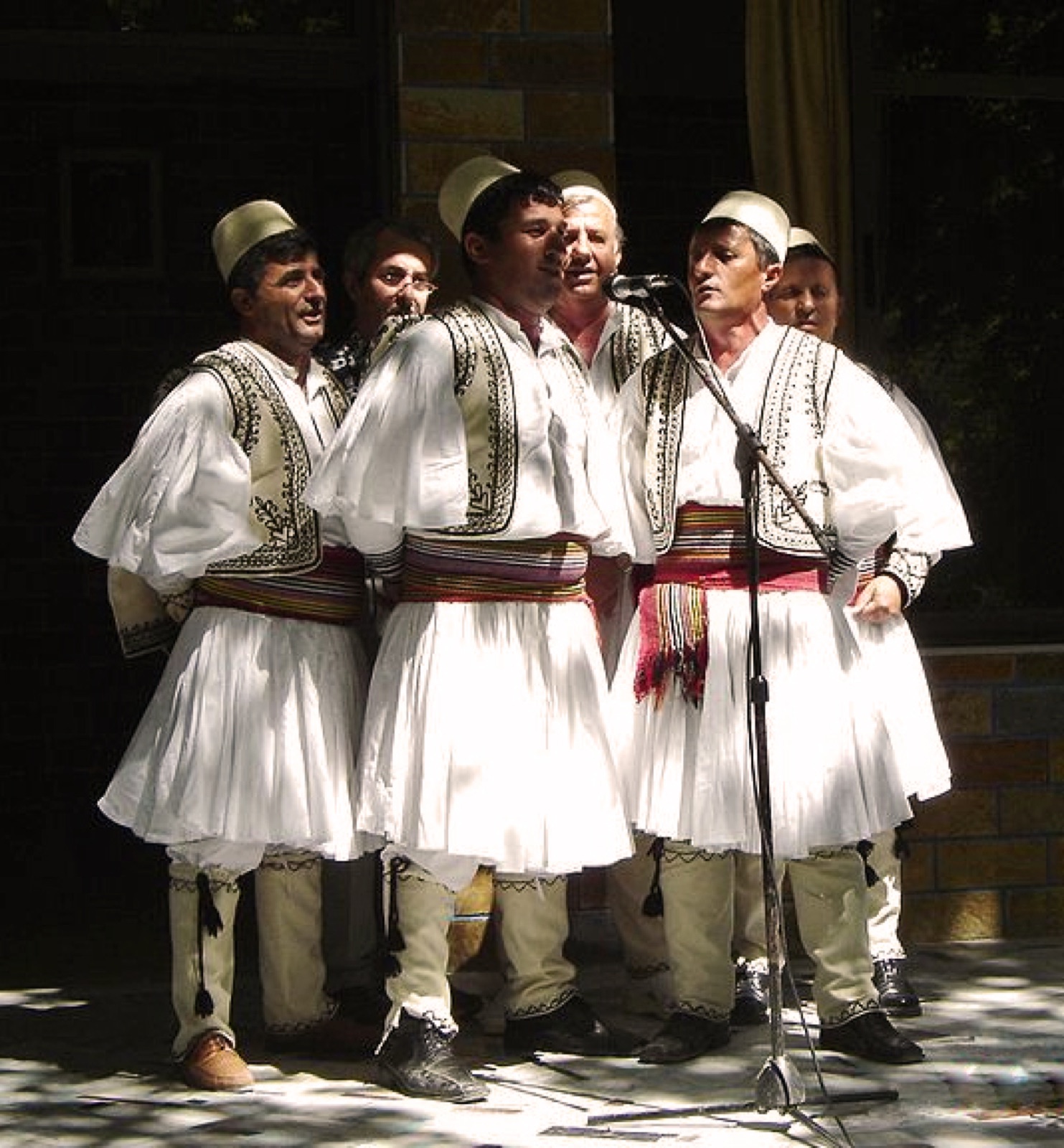 A southern Albanian folk group in fustanella — the four-voice iso-polyphony lineup UNESCO first proclaimed a Masterpiece in 2005 and formally inscribed on its heritage list in 2008. Photo: Wikimedia Commons, CC BY-SA.
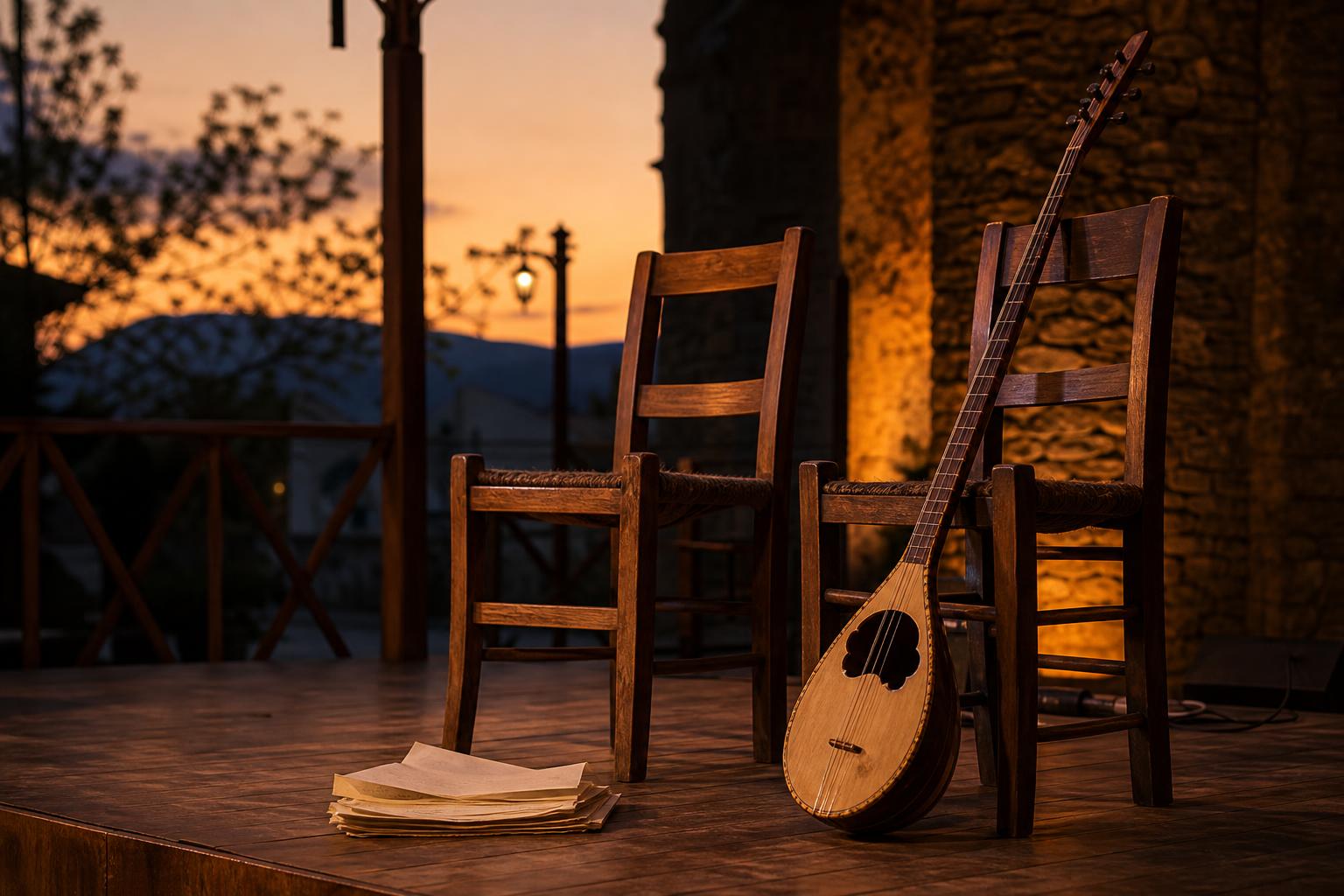 A çifteli leaning against a chair on an empty village stage — the working setup of an Albanian folk performance before the players arrive. — Graphic by NAR
Folk instruments
Albanian folk music is played on a small but distinctive instrumental palette. Recordings still common in folk ensembles, weddings, and the valle line dances:
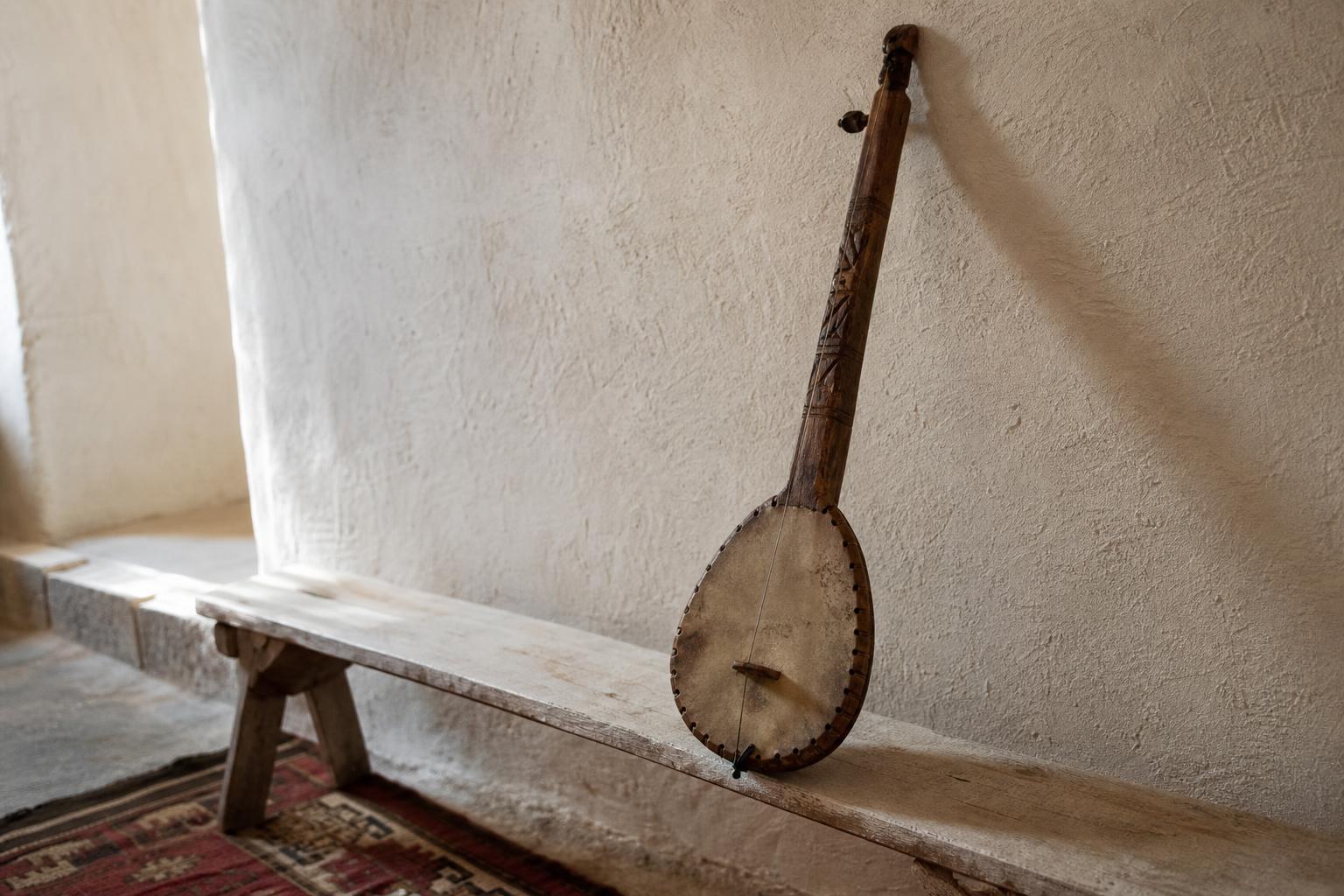
- Çifteli — a two-string fretted lute, plucked, used primarily by Gheg Albanians in the north and in Kosovo. One string holds a drone; the other carries the melody. The çifteli is the iconic instrument of northern Albanian song.
- Lahutë — a one-string bowed fiddle carved from maple, spruce, or oak, with a long fretless neck and a small bowl resonator. Played upright on the knee. It is the instrument of the kângë kreshnikësh tradition: a single voice singing epic poetry over a single bowed string.
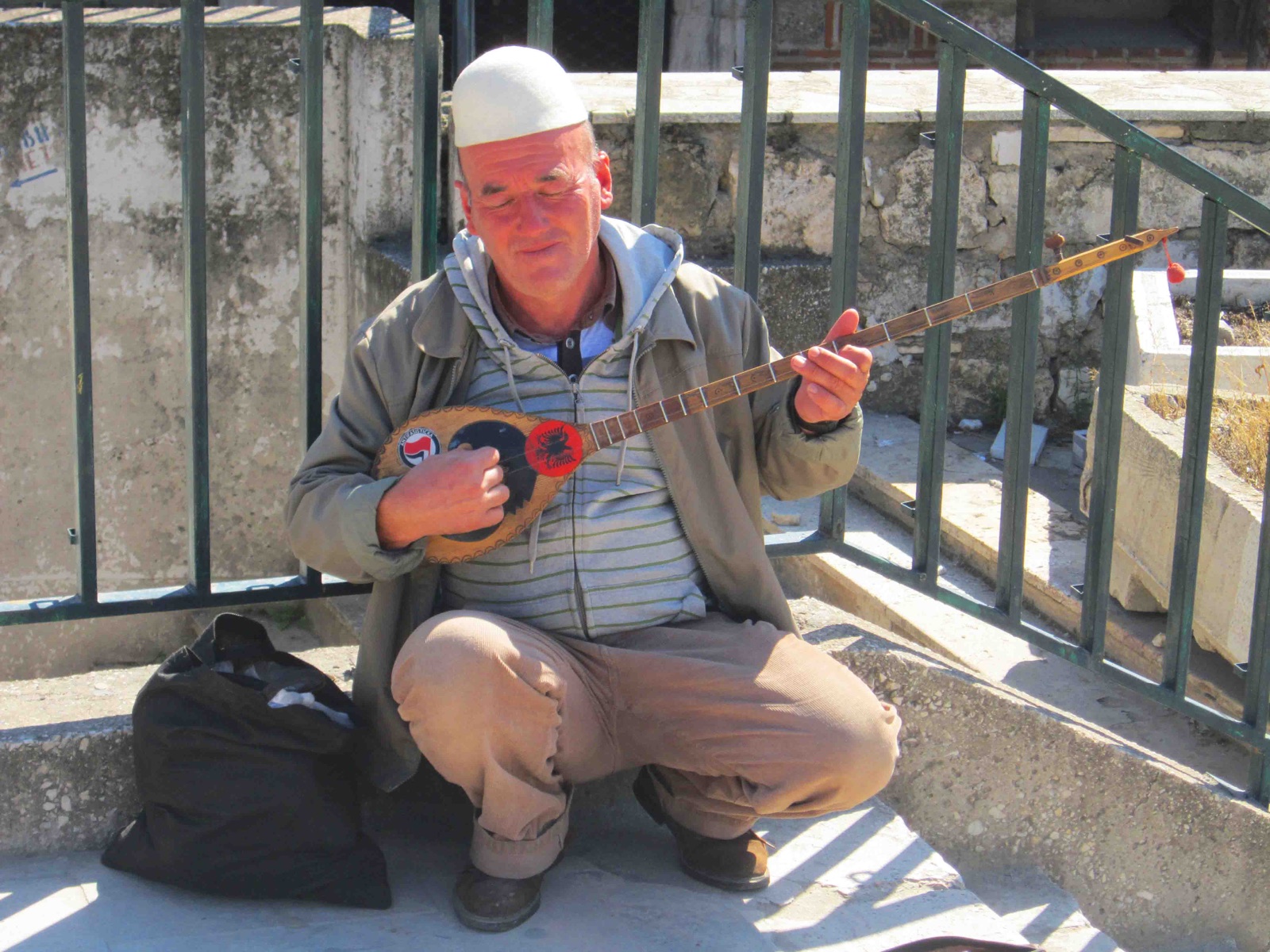 Çifteli — the two-string Gheg lute. One string drones, one carries the melody. Photo: Wikimedia Commons, CC BY-SA.
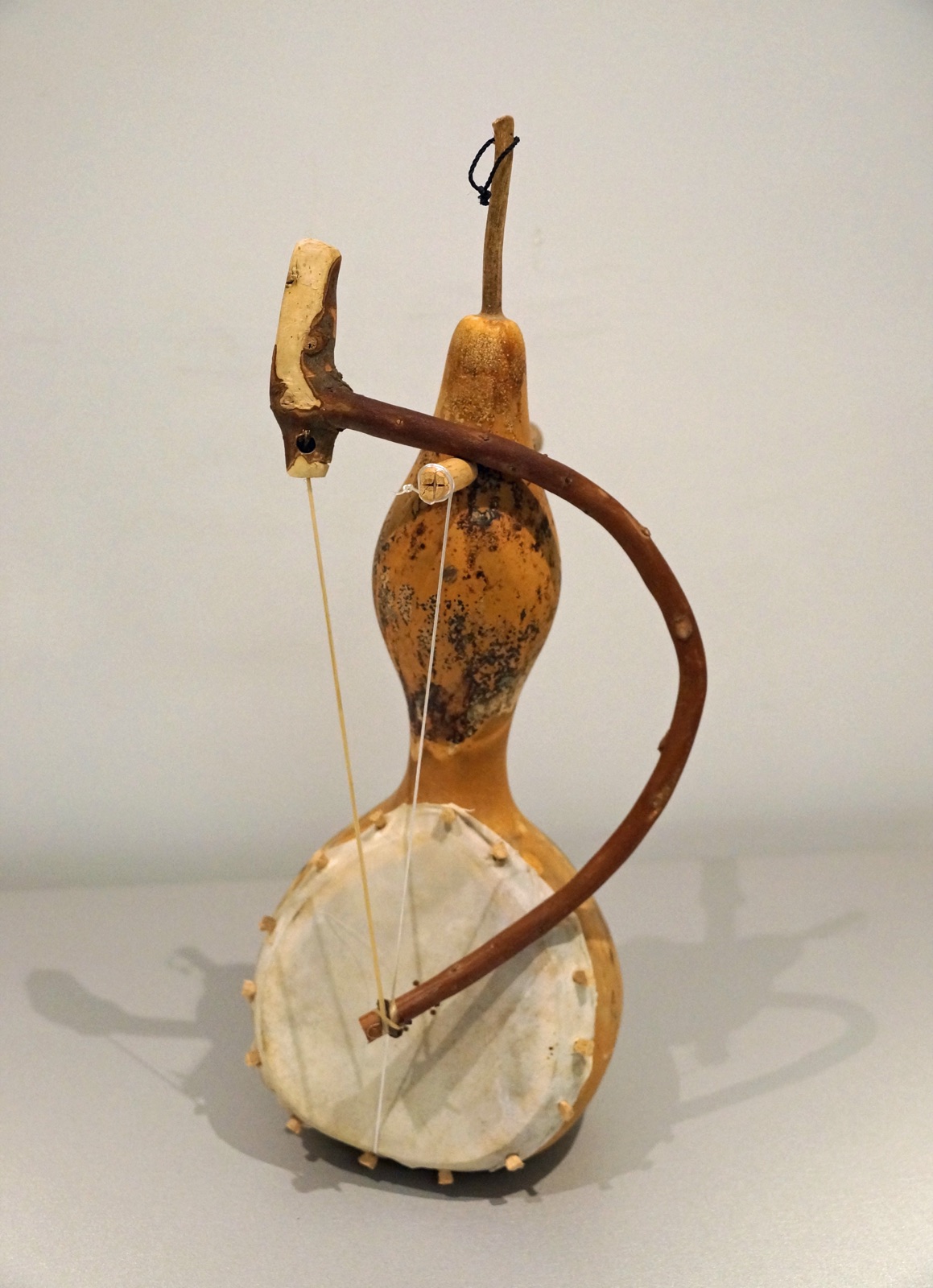 A lahutë from Mirditë, northern Albania — the one-string bowed fiddle that accompanies the highland epic songs. Photo: Wikimedia Commons, CC BY-SA.
- Gajde — the Albanian bagpipe, common in the south and in Kosovo, with a single chanter and a drone pipe. Used at weddings, in shepherd music, and in the valle.
- Def — a frame drum with metal jingles, similar to a tambourine. The percussion backbone of sazi ensembles and women’s folk groups.
- Kavalli — a long open-ended shepherd’s flute, played without a reed. Associated with pastoral music in the southern highlands.
- Fyell and zumarë — smaller flutes and a double-pipe reed instrument used by shepherds.
Most of these instruments are still made by hand in Albania and Kosovo, often by individual luthiers in Shkodra, Tirana, and Prizren. Folk ensembles in the diaspora — in New York, Boston, Detroit, and the Bronx — usually carry at least one çifteli, one lahutë, and a def player.
Kângë kreshnikësh — the heroic frontier songs
The Gheg north has its own distinct tradition: the kângë kreshnikësh, the “songs of the frontier warriors.” These are long sung epic poems performed by a soloist — the rapsod — accompanying himself on the lahutë.
The poems describe a heroic age set on the kreshnik (frontier) borderlands of medieval Albania, where Albanian heroes contend with Slavic warriors, supernatural beings, and the codes of besa (sworn honor) and gjakmarrja (blood feud). The two central heroes are the brothers Mujo and Halili of Jutbina — figures who are also central to the parallel South Slavic epic tradition, and whose stories scholars have studied as comparative material with Homer.
The performance is austere. A man sits with his lahutë, draws the bow across the single string, and sings. Verses are decasyllabic. The melody is narrow in range — the lahutë can only do so much — and the music’s power comes from the sustained, modal accompaniment under a declamatory voice. A full epic can run several hours.
The tradition is still active in the Albanian highlands of Malësia, Dukagjin, Mirdita, and the Rugova region of Kosovo. The Albanian Institute of Folklore has recorded thousands of hours, and the Lord-Parry collection at Harvard holds a major early archive. Younger Albanian rapsodë continue to perform — most notably Isa Elezi of Lekbibaj — though the practice has narrowed sharply since the 1960s.
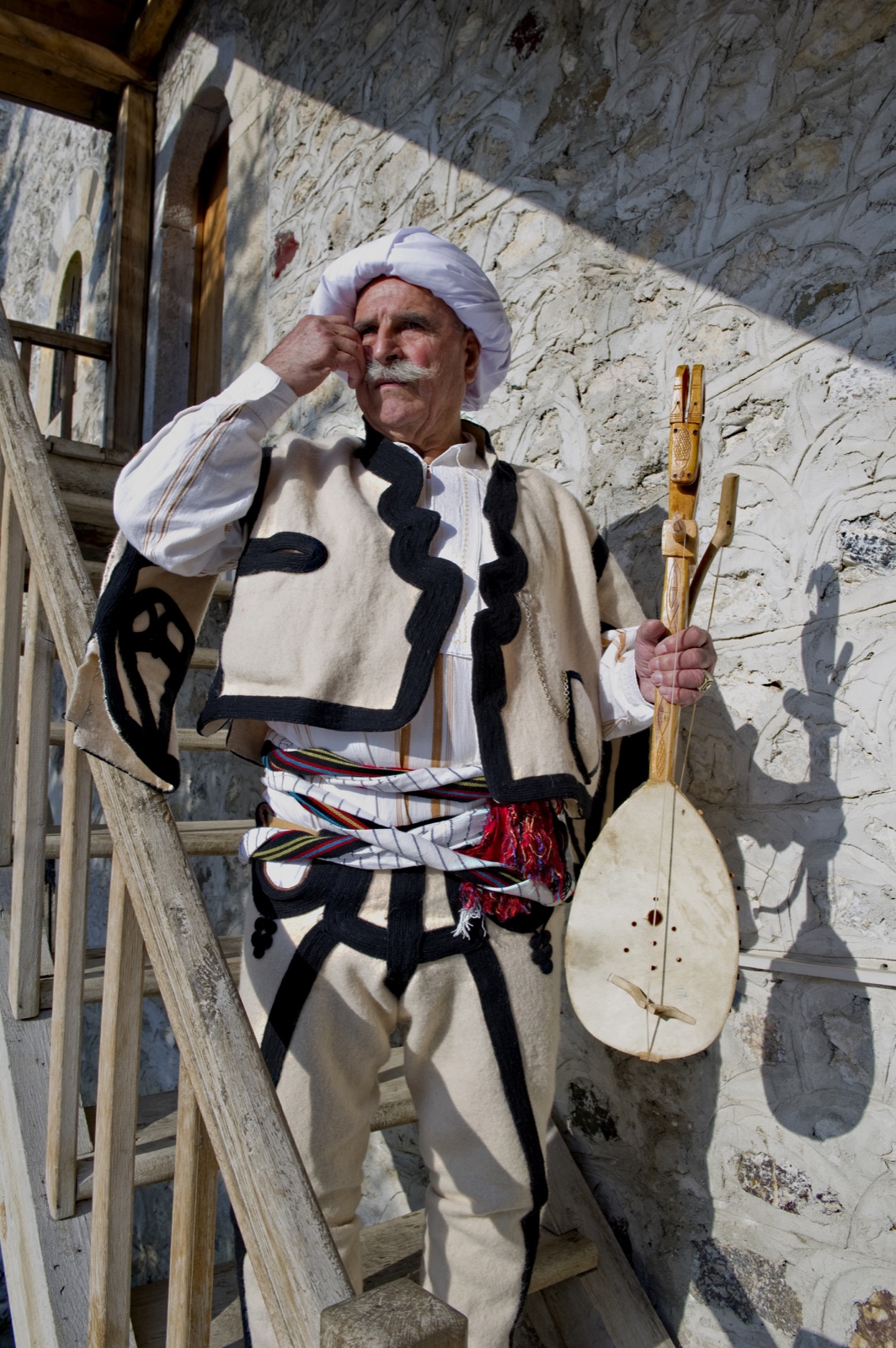 A lahutar (rapsod) in highland dress — the bowed lahutë across the knee, the format of the kângë kreshnikësh tradition. Photo: Wikimedia Commons, CC BY-SA.
Sazi music — the Tirana urban folk sound
If iso-polyphony is the music of the southern village and kângë kreshnikësh is the music of the northern highlands, sazi is the music of the Albanian wedding hall.
Sazi (from the Ottoman Turkish saz, “instrument”) is the instrumental ensemble music of Tirana and central Albania. The classic ensemble is built around the clarinet (the lead voice, traditionally with heavy ornamentation and slides), the violin, the accordion, the def frame drum, and often a lute or llautë. Some lineups add the goblet drum (qypi) and the bass drum.
The repertoire spans the Albanian kaba — a slow, improvised, mournful instrumental form built around clarinet and violin — and faster wedding tunes that drive the valle line dances. The kaba in particular is the high art of sazi, with master clarinetists like Laver Bariu (1929-2014) treated as cultural patrimony.
Sazi is the standard wedding sound in Albania and across the diaspora. At an Albanian-American wedding in Yonkers or Worcester or Sterling Heights, the live band — if there is one — is usually a sazi ensemble, sometimes augmented with electric keyboards. The sound is unmistakable: a clarinet line that cries and bends across a steady accordion drone.
Iconic 20th-century Albanian artists
The 20th century produced a recognizable canon of Albanian recording artists — first under the urban-song tradition that emerged in the 1930s, then through the communist-era Festivali i Këngës, then through Kosovar pop and the early Italian-Albanian diaspora. Ten figures who shaped that canon:
Tefta Tashko-Koço (1910-1947)
The first major Albanian operatic soprano. Born in Egypt to an Albanian family from Korçë, trained at the Conservatoire de Montpellier and in Paris, Tashko-Koço made the first recordings of Albanian urban art song in 1937 in Milan — bringing village melodies into the lyric soprano repertoire. She died of tuberculosis at 36 in Tirana. The Tefta Tashko-Koço music school in Korçë is named for her.
Vaçe Zela (1939-2014)
The communist era’s “diva of Albanian song.” Born in Lushnjë, Zela won the Festivali i Këngës a record eleven times between 1962 and 1990 and was the public face of Albanian popular music for nearly three decades. Her songs — “Zambaku i Prizrenit,” “Sa mirë me ty” — are still standards at every Albanian wedding. Awarded the title Artist i Popullit in 1977. After 1991 she emigrated to Switzerland, where she lived until her death.
Parashqevi Simaku (b. 1950)
Folk-pop legend of the late communist and early post-communist era. Born in Kavajë, Simaku built a career around the lyrical Tosk-southern repertoire, with hits like “Sa shumë të dua” that became standards across the Albanian-speaking world. Her recordings are the bridge between the studio orchestra sound of the 1970s and the synth-pop production of the 1980s.
Aleksandër Gjoka (b. 1956)
The voice of Albanian emigration. Born in Tirana, Gjoka rose to fame at Festivali i Këngës in the 1970s and 1980s and is identified with a specific subgenre — the kurbet ballad, songs about leaving Albania for work abroad. The genre exploded after 1991 as hundreds of thousands of Albanians left, and Gjoka’s catalogue became the soundtrack to a generation’s diaspora experience.
Sabri Fejzullahu (1947-2016)
The first major Kosovar folk-pop crossover artist. Born in Pristina, Fejzullahu fused Kosovar folk melodies with electric instrumentation in the 1970s, producing recordings that traveled across the entire Albanian-speaking world despite the Yugoslav-Albanian border. His son Ermal Fejzullahu is now one of the biggest pop stars in Kosovo.
Nexhmije Pagarusha (1933-2020)
Kosovo’s “nightingale.” Born in the village of Pagarusha near Malisheva, she became the defining voice of Kosovar Albanian song from the 1950s through the 1980s. Her signature recording — “Baresha” (“The Shepherdess”), a melody written for her by composer Rexho Mulliqi — is arguably the most-loved Kosovar Albanian song of the 20th century. State funeral honors when she died in 2020.
Adelina Ismaili (b. 1979)
Kosovar pop-rock pioneer. Born in Pristina, Ismaili emerged in the late 1990s as one of the first Kosovar Albanian artists to bring Western pop-rock production and explicit feminist lyrics into the mainstream. Her career bridges the wartime Kosovar music industry and the post-2000 commercial era.
Ermal Meta (b. 1981)
Albanian-Italian singer-songwriter. Born in Fier, Meta moved to Bari in southern Italy at 13 and built his career in Italian. With Fabrizio Moro, he won the Big Artists section of the Sanremo Music Festival 2018 with the anti-terrorism song “Non mi avete fatto niente,” and the duo represented Italy at Eurovision 2018. The most successful first-generation Albanian artist in the Italian music industry.
Eda Zari (b. 1969)
Modern jazz and world-music fusion. Born in Tirana to a family of classical musicians, Zari trained in Albania and Germany and built an international career around jazz reinterpretations of Albanian folk repertoire. Her records bring the Albanian iso-polyphonic vocabulary into a contemporary jazz idiom — closer to Hidden Beach or ECM than to Albanian pop. Based in Frankfurt.
Inva Mula (b. 1963)
Operatic soprano. Born in Tirana to a family of musicians, Mula won the Toti Dal Monte and Plácido Domingo competitions in the early 1990s and has performed at La Scala, the Opéra National de Paris, and the Royal Opera House. She is the uncredited Diva voice in Luc Besson’s The Fifth Element (1997) — the soaring aria that scores Diva Plavalaguna’s performance is Mula’s voice. One of the highest-profile classical Albanian artists alive.
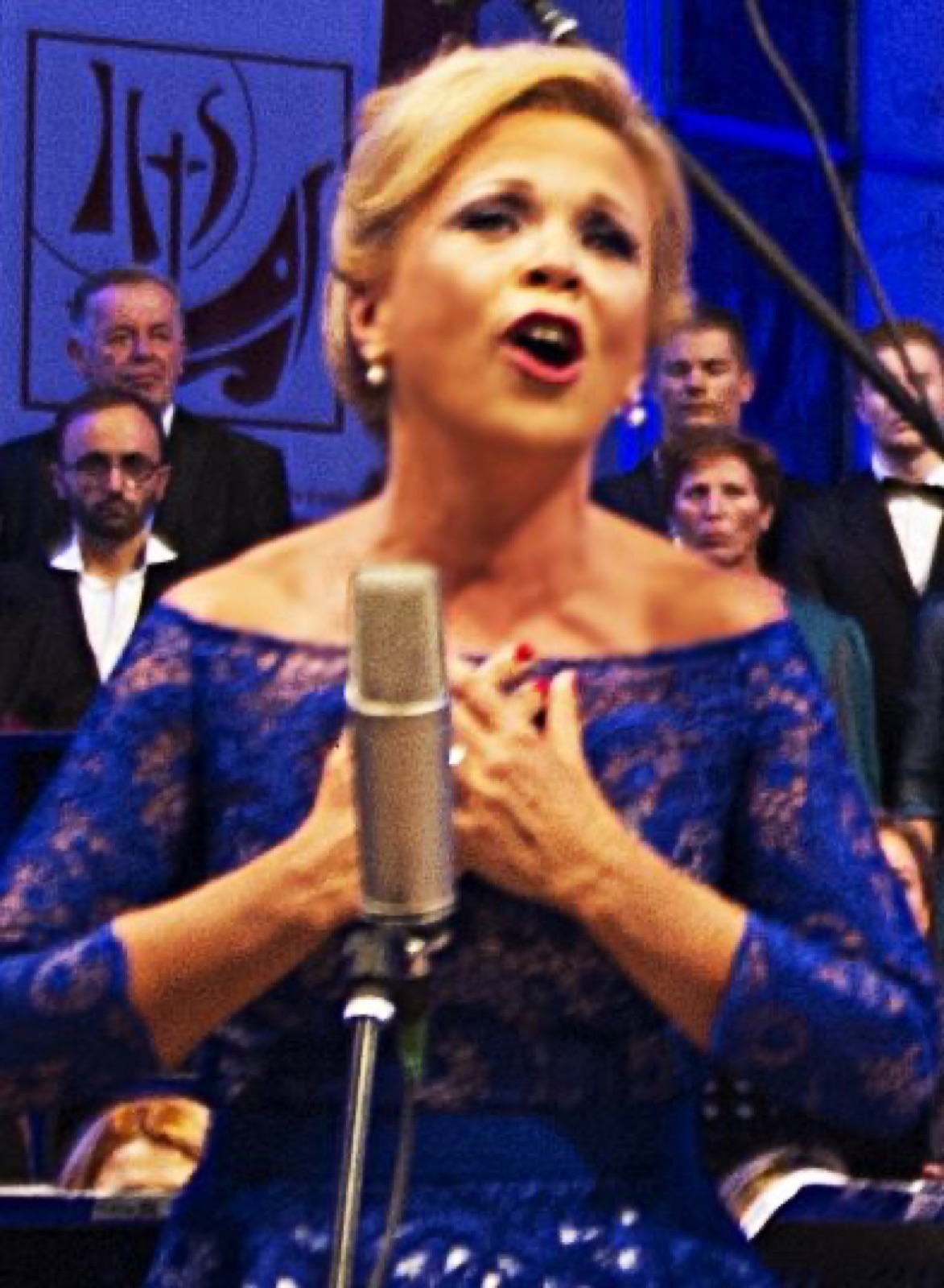 Inva Mula (b. 1963, Tirana) — the uncredited Diva voice in Luc Besson’s The Fifth Element. Photo: Wikimedia Commons, CC BY-SA.
Modern Albanian pop and hip-hop — the diaspora superstar generation
The Albanian-speaking population of perhaps 7-10 million has produced an outsized share of the 21st-century pop and hip-hop charts. Most of these artists are diaspora — born or raised outside Albania, often performing in English — and their visibility has reshaped how Albanian young people see their own cultural reach. Ten figures:
Dua Lipa (b. 1995)
The biggest Albanian pop artist of the 2020s. Born in London to Kosovo-Albanian parents from Pristina, Dua broke through with her 2017 self-titled debut and “New Rules” (UK number one), then made the leap to global stardom with Future Nostalgia (2020) and Radical Optimism (2024). Three Grammy wins, multiple UK number-one albums, named one of the best-selling female artists of 2018 by the IFPI. President Bajram Begaj granted her Albanian citizenship in 2022, and she has performed in Pristina and Tirana to crowds in the tens of thousands.
Rita Ora (b. 1990)
The Pristina-born British pop star. Rita Sahatçiu Ora was born in Pristina and moved to London at age one as her family fled the disintegrating Yugoslavia. She broke through in 2012 with the UK number-one single “R.I.P.” and has scored 13 UK top-ten singles since, alongside acting roles in Fifty Shades and Beauty and the Beast. Married to filmmaker Taika Waititi. She has consistently spoken about her Kosovar-Albanian heritage in UK and US press.
Bebe Rexha (b. 1989)
Brooklyn-born pop hitmaker. Born Bleta Rexha (“Bleta” means “bee” in Albanian) to Albanian parents from Debar and Gostivar in North Macedonia, Rexha co-wrote Eminem and Rihanna’s Grammy-winning “The Monster” (2013) before launching her own career. Hits include “Meant to Be” with Florida Georgia Line (2017) — number one for 50 weeks on Billboard’s Hot Country chart — and “I’m Good (Blue)” with David Guetta (2022). She has been one of the most consistent Albanian-heritage advocates in US pop, regularly speaking Albanian in interviews and performing in Tirana.
Action Bronson (b. 1983)
Queens-born rapper and chef. Born Ariyan Arslani in Flushing, Queens to an Albanian-Muslim father and an American-Jewish mother, Bronson worked as a cook at his father’s Mediterranean restaurant in Forest Hills, Queens, before a kitchen leg injury pushed him to focus on rap in his late twenties. His mixtape Blue Chips (2012) and major-label debut Mr. Wonderful (2015) made him a fixture in New York rap, and he hosted F*ck, That’s Delicious on Viceland. He wears the Albanian flag publicly — including a tattoo on his hand — and has spoken about Albanian identity across his career.
Era Istrefi (b. 1994)
Pristina-born singer. Istrefi broke through in 2016 with “Bonbon”, a Albanian-language pop track that crossed over to international charts, hit the top 40 in multiple European countries, and earned her a deal with Ultra Music in the US. She co-performed the official 2018 FIFA World Cup song “Live It Up” with Will Smith and Nicky Jam. Her older sister Nora Istrefi is also a major Kosovar pop artist.
Noizy (b. 1986)
The biggest Albanian-language rap star. Born Rigels Rajku in Sukth, a town in Durrës County, and raised in London after his family emigrated in the late 1990s, Noizy returned to Tirana to launch his rap career and built OTR (On Top Records) into the largest Albanian hip-hop label. His albums Living Your Dream and Alpha set the modern Albanian rap template. Has collaborated with international acts including French Montana.
Capital T (b. 1991)
Kosovo-Albanian hip-hop pioneer. Born Trim Ademi in Pristina, Capital T was among the first wave of Albanian-language rappers to push beyond underground status into commercial radio play in the early 2010s, breaking through with the albums Replay (2010) and KAPO (2012). His single “Akull” reached number two in Albania. Frequent collaborator across the Albanian-language pop and rap scene, including Elvana Gjata and Ledri Vula.
Tayna (b. 1996)
The most prominent female Kosovar Albanian rapper. Born Doruntina Shala in Prizren, Kosovo, Tayna broke through in 2018 with chart-topping hits like “Columbiana” and “Shqipe” that combined trap production with sharp Albanian lyrics. She has been the breakthrough female voice in a male-dominated Albanian rap scene and is a fixture on Kosovar and Albanian-American playlists.
Elvana Gjata (b. 1987)
Albanian-language pop superstar. Born in Tirana, Gjata is the most consistent Albanian-domestic pop hitmaker of the past 15 years, with hits like “Mamës,” “Off,” and “Dyll’” that anchor wedding playlists across the diaspora. She has been a recurring entrant in the Festivali i Këngës — the Albanian-language Sanremo equivalent that selects the country’s Eurovision act — finishing runner-up in 2019 with “Me tana” and second again in 2024 with “Karnaval,” though she has not yet been selected to represent Albania at Eurovision itself.
Kidda (b. 1997)
Swedish-Kosovar rapper. Born Mërgim Kida in Gävle, Sweden, to an Albanian family from Gjakovë, Kosovo, Kidda signed to Sony Music and built a following in the Albanian-speaking world with hits like “Malli” and “Cataleya,” both top-20 in Albania, and “Magji” (featuring Capital T), which reached number two. His career reflects the growing Nordic Albanian diaspora.
Wedding music — what plays at Albanian-American weddings
For most Albanian Americans, the most direct contact with Albanian musical tradition isn’t iso-polyphony or kângë kreshnikësh — it’s a wedding.
The Albanian-American wedding follows a predictable arc. After the religious ceremony (Catholic, Orthodox, Muslim, Bektashi — the structure is the same), the reception opens with a sazi ensemble or a DJ programmed to sound like one. The clarinet leads. The accordion drives. The def keeps the rhythm. And from the first bar, guests link arms or hold handkerchiefs and form the valle — the line dance that is the centerpiece of every Albanian celebration.
There are dozens of regional valle. The valle e Tropojës is fast and stamping. The valle e Lunxhërisë is graceful and southern. The valle e Devollit is brisk. The valle e burrave (“men’s dance”) is performed by men with handkerchiefs and includes solo acrobatic breaks. Most American weddings cycle through several over the course of a night — the band leader picks them, the older guests teach the younger guests, and by the third valle the floor is full.
After the valle round, the music typically moves to modern Albanian pop: Elvana Gjata, Ermal Fejzullahu, Aurela Gaçe, Tayna, Noizy, Era Istrefi. Then to mainstream US pop and hip-hop for the under-30 guests. By the end of the night the rotation is back to the sazi for one more round of valle.
This is the canon most Albanian-American kids inherit — the dance, not the recording. It is the most durable form of Albanian musical transmission in the US diaspora.
Where to listen
Putting Albanian music in your earbuds is easier than it has ever been:
- Spotify — search “Shqip” for the Albanian-language algorithmic mix; the official Top Hits Shqip and Albanian Music playlists are updated weekly. Curated artist pages exist for every artist named above.
- YouTube — RTSH Muzikë (the Albanian state broadcaster’s music channel), Top Channel Albania, and Klan Kosova archive an enormous catalogue of historical performances and the full Festivali i Këngës archive going back to the early 1960s.
- TVALB — the Albanian-American satellite and streaming network — carries music programming aimed specifically at the US diaspora.
- Apple Music — has a strong Albanian catalogue thanks to the major-label deals signed by Dua Lipa, Rita Ora, Bebe Rexha, and Era Istrefi.
- Smithsonian Folkways and the UNESCO archives carry field recordings of iso-polyphony and kângë kreshnikësh — the closest thing to a definitive academic library.
For a starter listen, we’d recommend opening with one Lab polyphonic recording, one Vaçe Zela song, one Sabri Fejzullahu track, and one Dua Lipa single — in that order. It’s a tour through the four eras of Albanian music in under twenty minutes.
Why this matters for the diaspora
Music is one of the most durable forms of cultural continuity in any diaspora. Recipes pass down. Language frays. Music holds.
In the US, the gap between 230,000 Albanian Americans counted by the most recent ACS and the roughly one million community estimate is partly a story about who claims their heritage publicly. Visibility moves the count. When Dua Lipa accepts Albanian citizenship in Tirana, when Bebe Rexha speaks Albanian on stage at a Brooklyn show, when Action Bronson shows the flag tattoo on a podcast, the cost of saying “I’m Albanian” falls a little for every other Albanian American watching.
If you’re Albanian American — full, half, by grandparent, by Arbëresh great-grandparent — the registry is the place where that public claim becomes a counted one. You don’t need to know every valle or recognize every Vaçe Zela song. You need 2 minutes.
Get counted at /register — the National Albanian Registry’s free, encrypted, community-led roster. We mint a recognition certificate. We don’t sell anything. We never share data.
The community-led count of Albanian Americans starts with you adding your name.