

Anti-Albanian prejudice has a history that predates the modern Albanian state. It shows up in 19th-century Western travel writing, in Balkan nationalist programs, in wartime propaganda, and in the media coverage that followed the fall of communism in 1991. For Albanian Americans, it surfaces in subtler forms — the assumption that Albanian means criminal, the casual conflation of an entire people with a handful of organized-crime headlines, the blank stare when you say where your family is from followed by the only reference point the person has.
This article sets out the documented record. It is not a grievance catalog — it is a factual account, sourced to the Carnegie Endowment’s 1914 Balkan Wars commission, Human Rights Watch and Committee to Protect Journalists reporting from the Kosovo War period, academic research on media framing, and the Wikipedia articles on anti-Albanian sentiment, the Vlora ship, and the expulsion of the Cham Albanians. For the broader conflict histories that form the backdrop, see NAR’s articles on Serbs and Albanians and the ethnic conflicts in Yugoslavia.
The “wild mountaineer” trope
Western European travelers who visited the Albanian lands during the Ottoman period left accounts that established a durable stereotype: the Albanian as a wild, warlike mountain tribesman — brave but lawless, loyal to clan but hostile to outsiders. Edith Durham, the British artist and ethnographer whose High Albania (1909) remains the best-known Anglophone travelogue of the Albanian highlands, documented the Kanun customary law, blood feuds, and the burrnesha (sworn virgins). Her work was sympathetic — she later reported on the 1912 Balkan Wars — but it fixed the “tribal highlander” image in the English-speaking world for a century.
The brigandage stereotype had real roots in real economic conditions. Historian Frederick F. Anscombe, in “Albanians and ‘Mountain Bandits’” (2006), argues that much of the extralegal violence attributed to Albanian “bandits” in the late Ottoman period was driven by economic desperation and state weakness: discharged mercenaries unpaid by the Ottoman army, pastoralists with no arable land, and a central government too weak to provide alternatives. The Albanian mountain bandit crisis of 1770–1800 peaked precisely when the Ottoman state was at its least capable of paying or feeding the irregular soldiers it relied on.
The trope survived because it was useful. For Ottoman administrators, it justified military campaigns. For Balkan nationalist movements, it cast Albanians as uncivilized — and therefore undeserving of the territories they inhabited. For Western audiences, it fed the broader “wild Balkans” narrative that still colors coverage today.
State violence: the Balkan Wars and the Čubrilović memorandum
The transition from stereotype to state policy happened during the Balkan Wars of 1912–1913. When Serbian, Montenegrin, and Greek armies advanced into Albanian-populated territory, they did not simply occupy it. The Carnegie Endowment for International Peace sent an international commission to the region in 1913. Its report, published in 1914 and then overshadowed by the outbreak of World War I, documented systematic atrocities intended to alter the ethnic composition of Albanian-majority areas: civilians killed, villages burned, and large-scale expulsions of Albanian populations from territories the new Balkan states claimed.
The expulsions did not end the ambition. On 7 March 1937, Vaso Čubrilović — a Serbian historian who had been, as a teenager, a member of the South Slav nationalist group Young Bosnia, which carried out the 1914 assassination of Archduke Franz Ferdinand — delivered a lecture to the Serbian Cultural Club that was also submitted to the Yugoslav government as a secret memorandum. Its title was “The Expulsion of the Albanians.” It recommended burning Albanian villages and city quarters, economic exclusion, “persecution for trivial offences,” and forced mass deportation to Albania and Turkey. Čubrilović framed force as “the only solution.” He was never prosecuted. He later served as a government minister in Tito’s Yugoslavia.
A parallel episode played out in Greece. Between 1944 and 1945, Greek resistance forces — notably EDES under Napoleon Zervas — carried out the expulsion of the Cham Albanians from Chameria in northwestern Greece. Estimates range from 14,000 to 35,000 Chams expelled, with at least 1,200 to 5,000 killed. More than 68 villages were destroyed. A 1945 Greek law authorized expropriation of Cham-owned land and property. Greek nationalist narratives have pointed to Axis collaboration by a subset of Chams during the occupation as justification; the scale of collective punishment applied to the broader population remains contested between Athens and Tirana.
Kosovo War propaganda
The Kosovo War (1998–1999) brought anti-Albanian prejudice into the domain of modern state propaganda. Serbian state media, under direct government control, served as the primary news source for most Serbs during the conflict. According to a Human Rights Watch report from 1999, the propaganda apparatus withheld information about atrocities against Kosovo Albanians from Serbian audiences while saturating coverage with imagery of NATO bombing damage.
The language was deliberate. Milošević-aligned media escalated use of “Šiptar” — a clipped Slavicization of the Albanian self-designation “Shqiptar” that had acquired an openly pejorative connotation over the second half of the 20th century. The term had been used officially by the Communist Party until Kosovo’s 1974 constitutional autonomy, after which Albanian leaders pushed for “Albanci” as the standard term. By the 1990s, “Šiptar” functioned as a recognized ethnic slur. In 2018, Belgrade’s Supreme Court ruled the term racist and discriminatory.
The Committee to Protect Journalists documented that in March 1998, five independent Serbian newspaper editors were charged with disseminating misinformation for referring to dead Albanians as “people” rather than “terrorists.” Serbian state television reported that refugees filmed fleeing into Macedonia were “paid Albanian actors” staging a NATO propaganda film. Albanian-language newspapers were forcibly closed after the NATO air campaign began in March 1999.
The 1990s migrant crisis in Europe
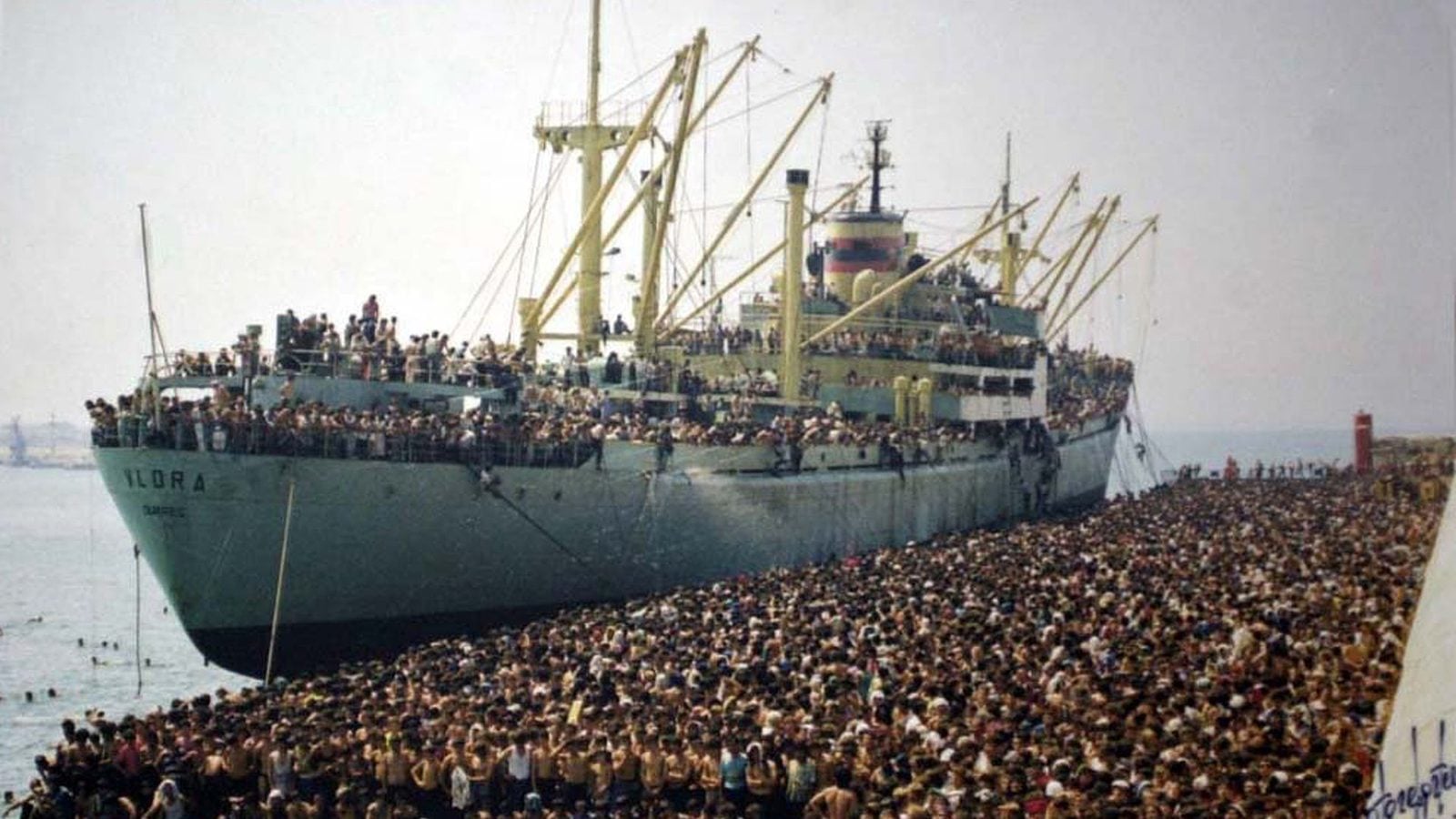
The fall of communism in Albania in 1991 produced one of the largest single mass-migration events in postwar European history. On 8 August 1991, approximately 20,000 Albanians boarded the freighter Vlora at Durrës and sailed to Bari, Italy. The Italian authorities detained the arrivals in a sports stadium and attempted mass deportation. Clashes broke out, and police opened fire on some migrants.
Italian media initially framed the 1991 arrivals sympathetically, as political refugees from a collapsing dictatorship. By the mid-1990s, the framing had shifted: Albanians were “illegal immigrants” tied to “grave transnational crimes.” A Balkan Insight investigation documented how police, clergy, academics, and left-leaning journalists converged on identifying Albanians with criminality. On 28 March 1997, the Italian corvette Sibilla, enforcing a naval blockade against Albanian migrant boats, collided with the Albanian vessel Kater i Radës in the Strait of Otranto, killing at least 84 people, including women and children.
In Greece, which shifted from a net-emigration to a net-immigration country almost overnight in the early 1990s, Albanians became the first mass immigrant group — and the primary target of media criminalization and xenophobic discourse. Academic research has documented institutional discrimination from police and border authorities, housing-market discrimination, labor exploitation of undocumented workers, and mob attacks on Albanian workers. The derogatory term “Tourkalvanoi” (Turco-Albanians), aimed especially at Muslim Albanians, echoed an older Greek nationalist habit of conflating Albanian identity with Ottoman-era “Turkishness.”
The “Albanian mafia” myth
The phrase “Albanian mafia” entered popular media vocabulary in the 1990s and has stayed. Academic research tells a different story. A study published in The Conversation, drawing on offender interviews, court records, and ethnographic fieldwork, concluded that Albanian-linked criminal groups abroad are typically loosely coordinated — not a monolithic organized syndicate. The researchers characterized the “highly organized global Albanian mafia” framing as a media-perpetuated myth that fuels diaspora-wide stigma and reduces opportunities for law-abiding Albanian immigrants.
The most recent high-profile case is the UK’s “small boats” panic of 2022–2023. Between May and September 2022, 11,102 Albanians arrived in the UK by small boat across the English Channel — more than a quarter of all small-boat arrivals that year. Politicians called the arrivals an “invasion” of people “joining criminal gangs.” Then-Home Secretary Suella Braverman described it as an “invasion on our southern coast.”
The rhetoric omitted that Albania has consistently been the most common nationality referred to the UK’s National Referral Mechanism for trafficking victims, and referrals of Albanian nationals rose further in 2022 — meaning a substantial share of the vilified population were likely trafficking victims themselves. Albanian Prime Minister Edi Rama responded that “targeting Albanians as the cause of Britain’s crime and border problems makes for easy rhetoric but ignores hard fact.” Academic analysis from Discover Society concluded that coverage of Channel crossings criminalized “not only newly arrived people, but the entire Albanian immigrant community in the UK.”
What the diaspora still encounters
For Albanian Americans — roughly one million strong by community estimates, though only 230,000 are captured by the U.S. Census — anti-Albanian prejudice takes quieter forms than the European examples above. It is the assumption that Albanian equals dangerous. It is the only reference point being a crime headline or a Taken movie. It is the blank look followed by “is that near Russia?”
Research by the European Consortium for Political Research has studied perceptions of ethnic Albanians in New York City, finding that stereotypes contribute to social exclusion and, in some cases, create conditions that push marginalized community members toward the behaviors the stereotypes predict. The Regional Cooperation Council’s Balkan Barometer — an annual survey of roughly 6,000 respondents across the Western Balkans — found in its 2025 wave that “historical mistrust” (38%) and “prejudices” (26%) remain the top-cited barriers to regional cooperation.
The stereotypes are not only about Albanians, and they are not one-directional. But the Albanian share of them is documented, durable, and consequential.
What the record says
The record says that anti-Albanian prejudice has identifiable origins, documented architects, and measurable consequences. It was not inevitable. It was built — by travel writers looking for color, by nationalist governments looking for justification, by media outlets looking for a villain, and by politicians looking for a scapegoat.
The record also says the prejudice has never gone unanswered. The Carnegie Commission documented the Balkan Wars atrocities in 1914. Belgrade’s own Supreme Court ruled “Šiptar” discriminatory in 2018. Academics have systematically examined the “Albanian mafia” narrative and found it does not hold up to evidence. Diaspora organizations — including the Albanian American Civic League, Vatra, and the National Albanian American Council — have lobbied, published, and organized for decades.
NAR’s work is narrower: count Albanian Americans, and publish what we count. But the count itself is one kind of answer. When the U.S. Census records 230,000 Albanian Americans and the community knows the real number is closer to a million, the gap is partly a measurement problem — and partly the residue of a community that learned, over generations, to keep its head down. Getting counted is one way to stop doing that.