
Between June 1991 and August 2001, the Socialist Federal Republic of Yugoslavia came apart in stages. Six republics became six recognized states. One of those states, Serbia, lost effective control of one of its two autonomous provinces, Kosovo, which declared independence in 2008. Roughly 140,000 people were killed across the decade according to figures summarized in the Wikipedia article on the Yugoslav Wars, drawing on the Humanitarian Law Center and the ICTY. Several million were displaced.
This article is the diaspora-facing version of that history. It walks the timeline neutrally, names the major actors and events, and lands at why the Albanian chapters — Kosovo from 1989 to 1999 and the 2001 insurgency in what was then called Macedonia — matter for Albanian Americans today.
We cite the major reference articles inline. Where casualty figures are contested, we report the ranges and the sources. Where Serbian, Albanian, and international narratives diverge on responsibility, we present each. The ICTY, the tribunal that prosecuted war crimes from these conflicts, returned findings against actors on multiple sides; that work is the closest thing to a neutral evidentiary record.
A note on names. We use “Kosovo” rather than “Kosova” in keeping with English convention. We use “North Macedonia” — formally renamed in 2019 from “Macedonia” under the Prespa Agreement with Greece — for the post-2019 country, and “Macedonia” for events before the renaming.
The fault lines: six republics, two provinces, six peoples
The Socialist Federal Republic of Yugoslavia formed in 1945 under Josip Broz Tito and took its final structural shape in the 1974 Constitution. That constitution organized the country as a federation of six republics — Serbia, Croatia, Slovenia, Bosnia and Herzegovina, Montenegro, and Macedonia — and gave Serbia two autonomous provinces inside its borders: Vojvodina in the north and Kosovo in the south. Each republic had its own parliament, court system, and police. The two provinces had similar institutions and a vote on federal bodies. Six peoples were recognized as constituent nations: Serbs, Croats, Slovenes, Macedonians, Montenegrins, and, after 1971, Bosnian Muslims (now Bosniaks).
Albanians and Hungarians were the largest of the recognized “nationalities” rather than “nations” — a distinction that mattered constitutionally. A nation had a republic as its home; a nationality did not. Albanians, the largest of those nationalities, were the majority population of Kosovo and a significant minority in western Macedonia. The 1974 settlement gave Kosovo near-republic status without the title, including its own constitution, supreme court, and a vote on federal bodies equal to the republics on many questions.
Tito died in May 1980. The collective rotating presidency that succeeded him held the federation together through the early 1980s but did not solve the underlying tensions over the distribution of economic resources between richer northern republics and poorer southern ones, the status of Kosovo, and the long-running argument about how much power Belgrade should hold relative to the republics. By the late 1980s, Slovenian and Croatian leaders were arguing for confederation or independence, and Serbian leader Slobodan Milošević was arguing for recentralization under Belgrade. Those two positions were not reconcilable inside one state.
1989-1991: Kosovo’s autonomy revoked, Slovenia and Croatia leave
The first political rupture of the decade happened in Kosovo. In March 1989, the Serbian parliament under Milošević moved to amend the Serbian constitution to strip Kosovo and Vojvodina of most of the autonomy granted in 1974. The amendments passed under heavy police presence in Pristina. Kosovo Albanian deputies were sidelined or removed. Strikes and protests followed. The constitution of Serbia was finalized in September 1990, formally subordinating both provinces. The Kosovo Assembly, in turn, declared Kosovo a republic of Yugoslavia in July 1990 and then declared independence in September 1991 — a declaration recognized only by Albania.
Slovenia and Croatia held their first multi-party elections in spring 1990. Both produced governments committed to either confederation or independence. After failed federal negotiations, both republics declared independence on June 25, 1991. The Yugoslav People’s Army (JNA) intervened in Slovenia within days. The Slovenian conflict — the so-called Ten-Day War from June 27 to July 7, 1991 — was the shortest of the Yugoslav wars. Several dozen people died — soldiers on both sides plus Slovenian civilians and foreign nationals caught in the fighting — with sources differing on the exact total, according to figures cited on the Wikipedia article on the Ten-Day War. The JNA withdrew under the Brioni Agreement of July 7, brokered by the European Community. Slovenia was, in practical terms, out.
Macedonia held its independence referendum on September 8, 1991 — the date it still marks as Independence Day — and the Assembly’s formal declaration of independence followed on September 25, 1991. The JNA withdrew from Macedonia peacefully in spring 1992. Bosnia and Herzegovina followed with a referendum in February-March 1992 and a declaration on March 3, 1992. The two republics that left peacefully — Slovenia and Macedonia — are not the heart of this story. The two that did not — Croatia and Bosnia — defined the international image of the Yugoslav Wars and set the precedent for what would happen later in Kosovo.
The Croatian and Bosnian Wars: the precedent
The Croatian War of Independence ran from 1991 to 1995. After Croatia’s June 1991 declaration, Serb-majority areas in eastern and central Croatia, supported by the JNA, declared their own breakaway entity — the Republic of Serbian Krajina. The siege and shelling of Vukovar in fall 1991 and the shelling of Dubrovnik became defining international images. The war killed roughly 20,000 people according to figures cited in the Wikipedia Yugoslav Wars article. Croatia regained most of its territory in two 1995 offensives, Operation Flash in May and Operation Storm in August. The ICTY indicted senior figures on both sides; some convictions and some acquittals followed in later years.
The Bosnian War, from April 1992 to December 1995, was the bloodiest of the wars. Bosnia’s three constituent peoples — Bosniaks (Bosnian Muslims), Bosnian Serbs, and Bosnian Croats — fought a multi-sided war that included the siege of Sarajevo, ethnic cleansing campaigns across multiple regions, and the July 1995 killing of more than 8,000 Bosniak men and boys at Srebrenica. The ICTY and the International Court of Justice have both found that the Srebrenica killings constituted genocide. Total deaths in the Bosnian War are estimated at roughly 100,000. The war ended with the Dayton Agreement on December 14, 1995, which created today’s complex Bosnian state.
These two wars are not the Albanian story. They are referenced here because they set the precedent — both legal and diplomatic — for what the United States and NATO would do in Kosovo four years later. Dayton showed that a Yugoslav-era conflict could be ended through Western-led negotiations backed by ground troops. The ICTY, established by UN Security Council Resolution 827 in May 1993, became the institution that would later produce evidence used to indict actors from all sides in Kosovo.
Kosovo 1989-1998: Ibrahim Rugova and the parallel state
What was happening in Kosovo during the Croatian and Bosnian wars is the prologue to the Kosovo War. After autonomy was revoked in 1989 and the Kosovo Assembly was disbanded in 1990, Kosovo Albanians under the leadership of the Democratic League of Kosovo (LDK) chose a strategy of nonviolent parallel institutions. The LDK was founded in December 1989. Its president, Ibrahim Rugova, became the public face of Kosovo Albanian resistance through the 1990s.
The parallel state Rugova built was a functioning shadow government. Kosovo Albanian children who had been pushed out of state schools attended a parallel network of Albanian-language schools in private homes, basements, and improvised buildings. A parallel healthcare system operated alongside the boycotted state system. Parallel elections held in May 1992 produced a Kosovo Assembly and a presidency that the Albanian community recognized as legitimate. None of this was recognized internationally. Albania alone recognized Kosovo’s 1991 independence declaration. The international community treated Kosovo as an internal Serbian matter.
Rugova’s strategy held through the Bosnian war years. He argued that armed resistance would invite a Bosnia-scale catastrophe and that international recognition would eventually come through patience and visibility. The strategy frustrated younger Kosovars who saw economic collapse, mass unemployment, and steady emigration to Germany, Switzerland, and the United States while Belgrade continued to consolidate. Dayton in 1995 was a turning point. The agreement covered Bosnia but said nothing about Kosovo. Many in Kosovo concluded that nonviolence had failed to put the question on the international table.
The shift to armed struggle followed. The Kosovo Liberation Army (Ushtria Çlirimtare e Kosovës, UÇK) emerged in 1995-1996, drew funding from the diaspora and from elements in northern Albania, and conducted its first claimed armed actions in 1996. By 1997, after Albania’s pyramid-scheme collapse opened up the weapons stockpiles of the Albanian army to anyone willing to walk in, KLA capabilities expanded rapidly. The conflict that became the Kosovo War was underway by early 1998.
The Kosovo War 1998-1999
The Kosovo War is conventionally dated from February 1998 to June 1999. Yugoslav and Serbian security forces conducted counter-insurgency operations against the KLA across rural Kosovo, in particular in the Drenica region. The first widely reported civilian casualties were the killings of members of the Jashari family compound near Prekaz in early March 1998. The KLA, in turn, conducted attacks on Serbian police and on Albanians it identified as collaborators. The ICTY would later indict figures on multiple sides for actions during this phase.
International diplomacy intensified through 1998. The UN Security Council passed Resolution 1199 in September 1998 demanding a ceasefire. The Holbrooke-Milošević agreement of October 1998 created the OSCE Kosovo Verification Mission, an unarmed civilian monitoring operation led by US ambassador William Walker. The mission was authorized for up to 2,000 monitors, though the number on the ground never rose much above 1,300. It is the body that would, in January 1999, name the Račak killings publicly.
On January 15, 1999, Serbian and Yugoslav security forces conducted an operation in and around the village of Račak (Reçak in Albanian) in central Kosovo. Walker and the verifiers entered the village the next morning and counted 45 dead Kosovo Albanian civilians. Walker held a press conference at the scene on January 16 and described what had happened as a massacre and a crime against humanity, attributing responsibility to Yugoslav forces. The Yugoslav government rejected the framing and declared Walker persona non grata; the order was suspended under international pressure. A Finnish-led EU forensic team under pathologist Helena Ranta later confirmed that the dead were unarmed civilians without using the word “massacre” in its formal findings. The political consensus held with Walker’s framing. (See the NAR profile of William Walker for the longer account.)
The Rambouillet talks of February-March 1999 attempted to produce a negotiated settlement. The Kosovo Albanian delegation eventually signed the proposed framework; the Yugoslav delegation did not. NATO began an air campaign against the Federal Republic of Yugoslavia on March 24, 1999. The campaign ran 78 days, until June 10, 1999, and targeted military and infrastructure sites in Serbia, Kosovo, and Montenegro. NATO acted without explicit UN Security Council authorization, citing humanitarian grounds. The campaign remains legally contested — the UK and US justified it on humanitarian grounds; Russia, China, and several other states characterized it as unauthorized aggression. The Independent International Commission on Kosovo, chaired by Justice Richard Goldstone, concluded in 2000 that the intervention was “illegal but legitimate.”
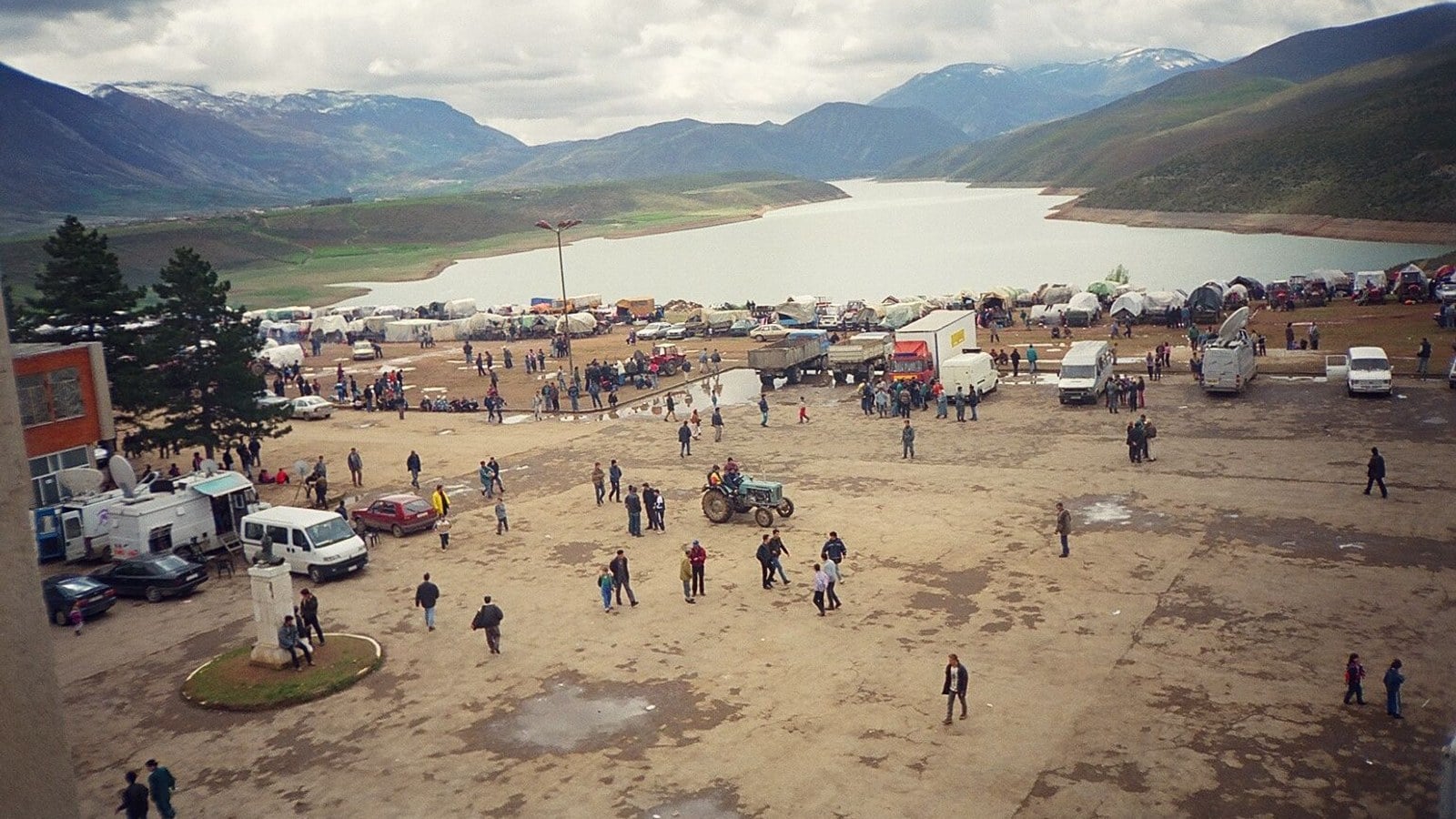
The war’s deadliest phase ran in parallel with the air campaign. Yugoslav forces conducted large-scale deportations of Kosovo Albanians across the borders into Albania, Macedonia, and Montenegro. The UNHCR registered approximately 862,000 Kosovo Albanian refugees during the campaign, with several hundred thousand more displaced internally. The ICTY, in its later judgment against six senior Yugoslav officials in 2009, found that Yugoslav and Serbian forces had conducted “a broad campaign of violence directed against the Kosovo Albanian civilian population” and convicted five of six defendants of crimes against humanity including deportation and forced transfer. The KLA was also the subject of ICTY indictments; some KLA-era abuses, including post-war reprisal killings against Kosovo Serbs and Roma and a smaller-scale set of wartime abuses, were documented in indictments and judgments against figures including Ramush Haradinaj, Fatmir Limaj, and others. The ICTY’s record across both sides is the closest the international community has to an evidentiary baseline.
Casualty figures, as compiled by the Humanitarian Law Center and summarized on the Wikipedia article on the Kosovo War, place total deaths at approximately 13,500. The HLC’s Kosovo Memory Book breakdown is approximately 8,676 Albanian civilians and 1,196 Serb civilians killed, alongside fighters on both sides and 489-528 civilians killed in NATO airstrikes. These are the figures most often cited in academic and policy literature.
The war ended on June 9, 1999 with the Kumanovo Agreement, in which Yugoslav forces agreed to withdraw from Kosovo. NATO-led KFOR ground forces entered the territory on June 12. UN Security Council Resolution 1244, passed on June 10, 1999, placed Kosovo under interim UN administration and authorized KFOR. Resolution 1244 did not resolve the final status question; that ambiguity is still a point of contention in the Belgrade-Pristina dialogue today.
The 2001 insurgency in North Macedonia
The shortest and least-known of the post-Yugoslav conflicts was the 2001 insurgency in what was then called the Republic of Macedonia (formally renamed in 2019 from Macedonia under the Prespa Agreement, which resolved a long-running naming dispute with Greece). The country had declared independence in 1991 and avoided the violence of the early 1990s. Ethnic Albanians were a significant minority — roughly a quarter of the population, concentrated in the northwest. Tensions over language rights, local government representation, and education had been building through the late 1990s.
In January 2001, an armed ethnic-Albanian group calling itself the National Liberation Army (Ushtria Çlirimtare Kombëtare, NLA) — sharing initials and several individual members with the Kosovo Liberation Army — began operations in the Tetovo region. Fighting expanded over the spring and summer, with major engagements near Tetovo, Aračinovo (a village near Skopje), and along the Kosovo border. The Macedonian government deployed regular military and police. The conflict killed fewer than 250 people according to figures compiled by international monitors and summarized in the Wikipedia article on the 2001 insurgency. Tens of thousands were displaced, mostly Albanian villagers, with a smaller number of Macedonian Slav families also displaced.
International intervention was rapid and diplomatic rather than military. The European Union, NATO, and the United States pressed both sides toward negotiation. The Ohrid Framework Agreement was signed on August 13, 2001, in Skopje — after negotiations at Lake Ohrid — by the leaders of the four largest Macedonian and Albanian political parties. The agreement expanded Albanian-language rights, raised the threshold for several types of legislation to require a “double majority” (overall majority plus a majority of minority-community legislators), expanded local government authority in Albanian-majority municipalities, and committed to proportional minority representation in public institutions. NATO’s Operation Essential Harvest disarmed NLA fighters between August and September 2001.
The 2001 insurgency was distinct from Kosovo on every important axis. Its scale was an order of magnitude smaller. Its duration was seven months versus seventeen. Its outcome was a negotiated reform of the existing state rather than international administration or independence. Most importantly, the country it took place in did not break apart. Macedonia, and later North Macedonia, has held together as a multi-ethnic state under the Ohrid framework. Albanians have served in cabinet, in parliament, in the constitutional court, and as deputy prime minister. The post-Ohrid arrangement is not without strain — disputes over the application of the agreement continue — but the model of negotiated power-sharing has held for more than two decades.
The diaspora’s role: Albanian Americans in 1998-1999
For the Albanian-American community in the United States, the Kosovo War was the largest single mobilization in the community’s history. Diaspora organizations that had been quietly active for decades — Vatra in Boston, the Albanian American Civic League founded by Joseph DioGuardi, the Albanian American National Organization, the National Albanian American Council — moved into sustained advocacy on Kosovo from 1998 onward. Fundraising for KLA equipment and for humanitarian aid passed through diaspora networks. Volunteer enlistments in the KLA’s diaspora-recruited Atlantic Battalion drew Albanian Americans, mostly from New York, Michigan, and Massachusetts, to the conflict zone.
The political side of the mobilization is what shaped policy. The Congressional Helsinki Commission — where Representative Chris Smith of New Jersey was a leading voice on the issue — held repeated hearings on Kosovo and pressed the Clinton administration for action. US Representative Tom Lantos of California, the only Holocaust survivor to serve in Congress, was a vocal congressional voice on human-rights concerns during the same period. Former Senate Majority Leader Bob Dole, who had been a long-standing advocate for Kosovo Albanians since meeting Rugova in the early 1990s, made multiple trips to the region and was visible in pre-war diplomacy. US Ambassador Frank Wisner — covered in a separate NAR profile — had been part of the diplomatic team that engaged Milošević on Bosnia and contributed institutional memory to the Kosovo phase. The diaspora’s lobbying, channeled through these figures, helped move Kosovo from a back-burner issue in 1997 to a top-tier foreign policy item by spring 1999.
The refugee phase produced the largest single resettlement in Albanian-American history. Operation Provide Refuge, the US program that ran from April through July 1999, evacuated roughly 14,000 Kosovo Albanians — out of the 20,000 the government had authorized — from camps in Macedonia and Albania, with Fort Dix in New Jersey as the main reception center. From Fort Dix, families were placed in communities across the country. New York, Michigan, Massachusetts, and Texas were among the largest receiving states. Family-reunification migration continued for years afterward. The pipeline from camps in Macedonia and northern Albania through Fort Dix to neighborhoods in the Bronx, Detroit, Worcester, and Dallas is one of the load-bearing chapters of how today’s roughly 230,000-person Albanian-American community (2024 American Community Survey) was assembled.
For Albanian Americans of Macedonian background, the 2001 insurgency mobilized smaller and quieter networks. The North Macedonian Albanian community in the United States is sizable in Michigan, particularly metro Detroit, and the 2001 events produced fundraising for humanitarian aid and political pressure for a negotiated settlement. Because the conflict ended fast and without large-scale displacement, the 2001 chapter did not produce a comparable refugee resettlement.
Aftermath: recognition, the ICTY record, and the unfinished dialogue
The decade after 2001 was the legal and diplomatic settlement phase. The ICTY, headquartered in The Hague, conducted trials of senior figures from across the conflicts through its closure in 2017. The tribunal indicted 161 individuals total. Convictions and acquittals fell on figures associated with the Bosnian Serb leadership (Radovan Karadžić and Ratko Mladić were convicted of genocide and crimes against humanity), the Serbian leadership (Slobodan Milošević died in 2006 during his trial, before judgment), Croatian generals (some convicted, some acquitted on appeal), Bosnian Muslim figures (some convicted, some acquitted), and KLA figures (Haradinaj acquitted twice, Limaj acquitted, others convicted on lesser charges). The tribunal’s record is uneven and was criticized from multiple directions; it is also the most extensive evidentiary record the international community has produced on a recent armed conflict.
Kosovo declared independence on February 17, 2008. Recognition, as covered in the NAR explainer on does Russia recognize Kosovo (it does not), is partial: roughly 100 to 115 UN member states recognize Kosovo (the count fluctuates), and Serbia, Russia, China, and several others do not. The International Court of Justice ruled in 2010 that Kosovo’s declaration of independence did not violate international law. Kosovo is not a UN member state. The EU-facilitated Belgrade-Pristina dialogue, ongoing since 2011, has produced agreements on integrated border management, license plates, energy, and the status of Serb-majority municipalities in northern Kosovo, with implementation contested by both sides.
North Macedonia became a NATO member in 2020 after the Prespa Agreement resolved the naming dispute with Greece. It is an EU candidate. Domestic politics around the Ohrid framework continue to be a live issue. The wider question of Albanian-Slav coexistence in the western Balkans is most often answered, today, through the EU accession process and through bilateral arrangements rather than territorial change.
For the Albanian-American diaspora, the decade 1991-2001 produced two things that are still load-bearing. The first is a community that is substantially larger than it would have been without the war years. The 1999 resettlement and the surrounding family-reunification migration are why entire neighborhoods in the Bronx, Staten Island, the Detroit suburbs, and parts of north Texas have Albanian-speaking populations today. The second is a politically active first generation that retains a direct memory of the war — the people who collected donations at parish halls and Vatra branches in 1999 are the same people now serving as community organizers, parents of US-born teenagers, and elders in the diaspora institutions.
The community that came out of that decade is now the community NAR exists to count. A comprehensive community-led count of Albanian Americans is, at its heart, a project of putting the people who arrived during and after these wars — and their children and grandchildren — into a single set of numbers that the community itself controls. If you are part of that history, you can get counted at /register. The certificate you receive is recognition only; it is not government ID and not citizenship. The point is the count.