
Ask an older relative from southern Albania or the northern highlands when their name day is, and you may get an answer faster than you’d get their birthday. For generations, in many Orthodox and Catholic Albanian families, the day that honored the saint behind your name was a real occasion — sometimes a bigger one than the day you were born.
This is one of those traditions that is easy to overstate. Name days are genuinely Albanian, but they were never universal across all Albanians the way besa or hospitality were. They belong, above all, to the Christian half of the picture, and they look different in the Orthodox south, the Catholic north, and among Muslim and Bektashi families. This explainer walks through what a name day is, why it sits inside the calendar of saints, how the custom varies by faith and region, which common Albanian names carry which saints, and what happens to all of it in the United States.
What a name day is
A name day honors the saint, or biblical figure, that your name comes from. The logic is old and shared across much of Christian Europe: in the church’s calendar of saints, nearly every day of the year is dedicated to at least one saint. If you are named after a saint, that saint’s feast day becomes your day too.
The tradition runs strongest in places where Orthodox, Catholic, and Lutheran Christianity shaped daily life — across Eastern Europe, the Balkans, Scandinavia, and parts of Latin America. Albania sits squarely inside that map on its Christian side. The custom has nothing to do with the day you were born and everything to do with the saint you were named for. Two cousins born months apart, both named Gjergj, share a single name day — the feast of Saint George.
The reason this matters is simple. A name day ties a person to something older than their own life: a saint, a story, a date the wider community already keeps. That is a different kind of marker than a birthday, which belongs to you alone.
It also explains why naming carried weight in the first place. In a society where a child was given a saint’s name at baptism, the name was not just a label — it set the day the family would gather, the icon they would keep, and the figure the child was, in a sense, placed under. The communist period in Albania cut hard against this. The state pushed “pure Albanian” and secular names and, for a stretch, restricted religious naming outright, which means some families have a generation or two where the saint-name thread was deliberately broken. That history is part of why the tradition is uneven today, even among families who would call themselves Orthodox or Catholic.
Name day versus birthday
In strict Christian tradition, the birthday once carried a faint suspicion — it marked the body’s arrival, while the name day marked your place in the communion of saints. Where the custom was strong, the name day was the day people came to your door.
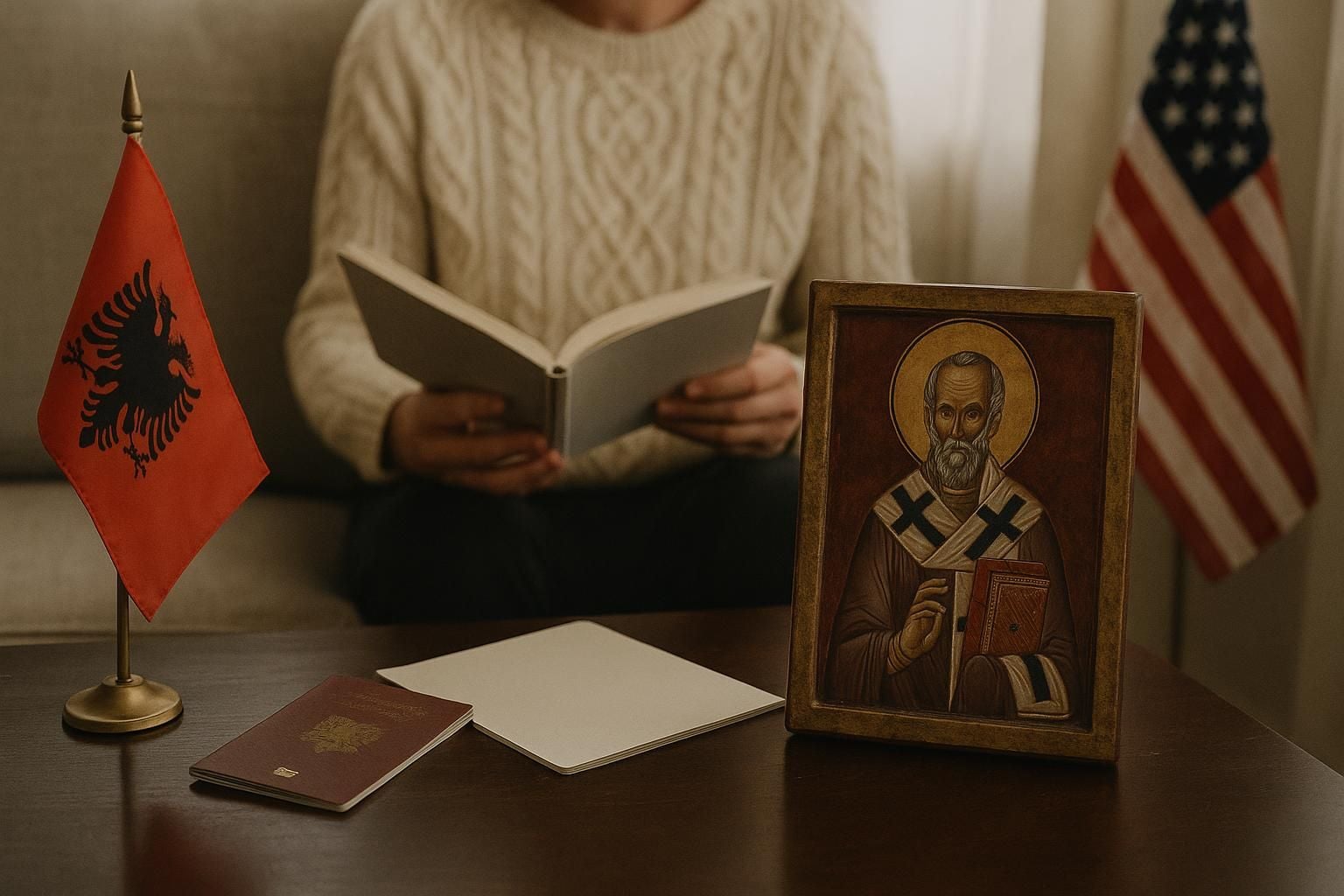
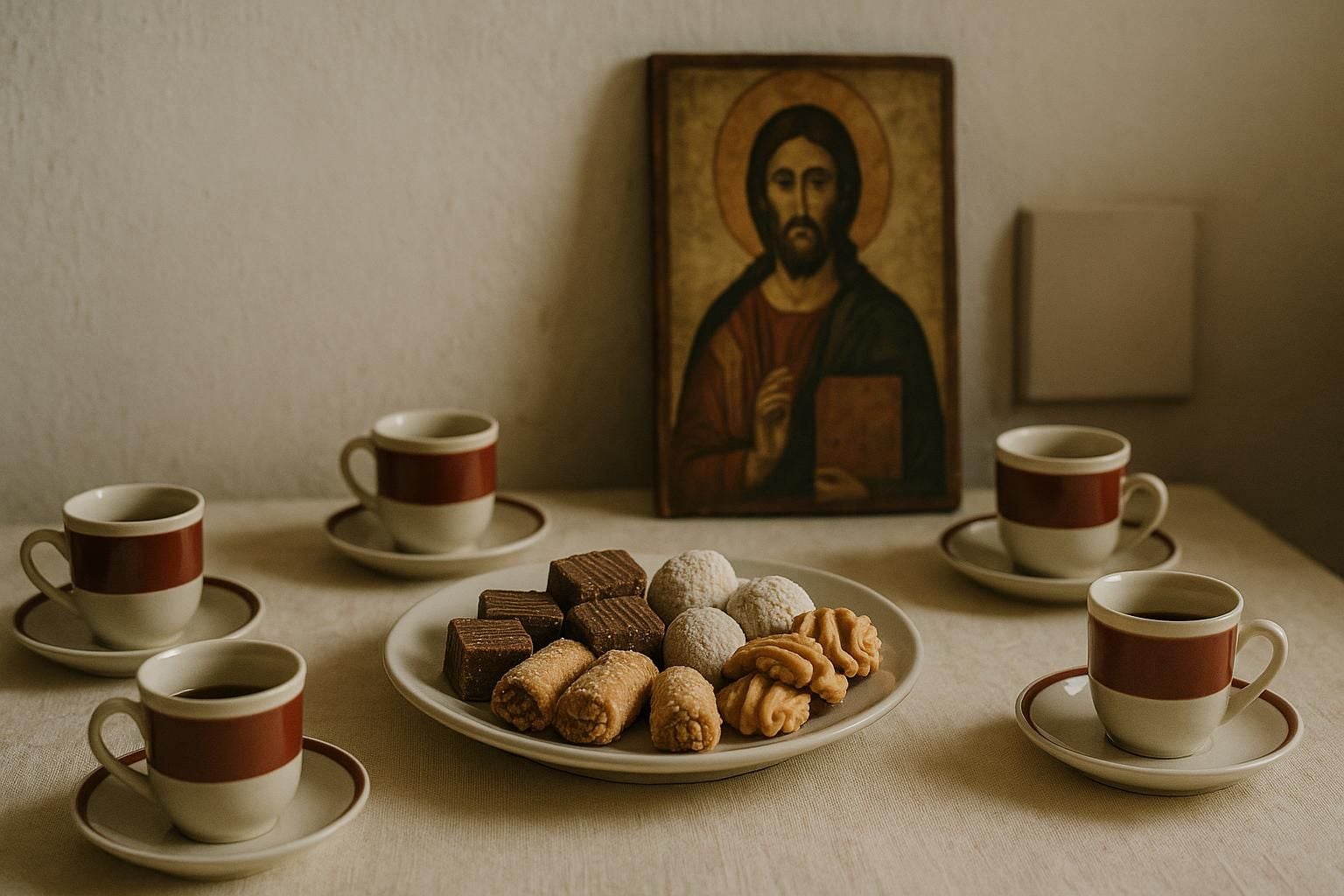
In practice, most Albanian families who keep name days today celebrate both. The birthday is the modern, civil, child-centered event with a cake. The name day is the quieter, older one: church in the morning if the family is observant, the saint’s icon set out where guests can see it, a meal, and an open house. The defining feature is that you don’t send invitations. People who know your name know your day, and they come to you.
That open-door logic is part of why the tradition feels so Albanian even though its roots are shared across Christendom. It runs on the same hospitality reflex that shows up everywhere else in the culture: the guest arrives, and the house is ready. The host does not wait to be asked who is coming; the day itself is the invitation. A visitor brings a short blessing for the saint and the household, sits for coffee and something sweet, and moves on — a rhythm of small visits across an afternoon rather than one scheduled party.
There is also a practical reason the custom held on. Before written records were common in rural areas, exact birth dates were often hazy, but a saint’s feast was fixed and public — everyone in the village already knew when Saint Nicholas’s day fell. Anchoring the celebration to the church calendar made it durable in a way a private birth date was not.
Religion and region: who keeps it
Here is where honesty matters more than a clean story.
Orthodox Albanians, concentrated historically in the south, keep name days in the fullest form. The Orthodox calendar assigns a saint to nearly every day, baptismal names are saints’ names, and the name day — festa e emrit — follows the saint’s feast. Names like Vasil (Basil), Dhimitër (Demetrius), Kostandin (Constantine), Thoma (Thomas), and Maria carry their saints with them.
Catholic Albanians, concentrated historically in the northern highlands and around Shkodër, and the Arbëresh communities of Italy, also keep the custom through the Catholic saints’ calendar. Northern Catholic names lean on saints heavily: Gjon (John), Pjetër (Peter), Pal (Paul), Mark (Mark), Ndue or Ndoc (Anthony), Zef (Joseph), Nikollë (Nicholas), Lekë (Alexander).
Muslim and Bektashi Albanians generally do not keep name days in the saint-feast sense. Their names — Mehmet, Ali, Ibrahim, Fatime, Ajshe and many others — come from a different tradition that does not work through a feast-day calendar in the same way. It would be wrong to imply every Albanian household lights a candle for a patron saint; many do not, and that is part of the real picture.
What complicates the neat division is shared seasonal days. Shëngjergji — Saint George’s Day, observed in early May — is the clearest example. In Albania and Kosovo it has long been celebrated well beyond Orthodox circles, with bonfires, water rituals, and spring blessings kept by Muslim and Christian families alike. It overlaps with the broader spring festival the region knows as Hıdërllëz. A day like that is less a personal name day than a communal one — proof that the line between “Christian saint” and “Albanian custom” was always more porous than a textbook would suggest.
Common Albanian names and their saints
Because so many Albanian names are local forms of saints’ names, the link is often hiding in plain sight. A short, non-exhaustive map:
- Gjergj, Gjok — Saint George
- Nikollë, Kollë, Niko, Koço — Saint Nicholas
- Gjon, Gjin, Jani, Janaq — Saint John
- Pjetër, Pjeter, Petraq, Petro — Saint Peter
- Pal — Saint Paul
- Mark, Marko — Saint Mark
- Vasil, Vaso — Saint Basil
- Dhimitër, Mitre — Saint Demetrius
- Kostandin, Kostika — Saint Constantine
- Thoma — Saint Thomas
- Mihal — Saint Michael (the Archangel)
- Maria, Marie, Meri — the Virgin Mary
A few cautions are worth stating plainly. The exact date a given family keeps can shift depending on whether their church follows the Gregorian or the older Julian calendar — that gap is why some feasts land on different days. A handful of names connect to more than one saint, so two families with the same name may keep different days. The most widely recognized anchors are easy enough to name — Saint Nicholas in early December, Saint George in early May — but for a specific household, the only reliable source is that family’s own parish. We are not going to assign a fixed calendar date to a name we can’t verify for you; the tradition is real, and the safest way to honor it is to ask your own family and church.
The tradition in the diaspora
In the United States, the name day runs into the same forces that reshape every imported custom: distance from a home parish, mixed marriages, kids raised on birthday parties, and the slow drift of a second and third generation.
The result is a spread, not a single outcome. Some Albanian-American families keep the name day in full — they go to church, set out the icon, cook, and leave the door open the way it was kept back home. Others fold it into a birthday so there’s one celebration instead of two. Plenty mark it lightly, with a phone call and a “gëzuar festën” — happy feast — to whoever shares the name. And in some families the day simply fades, not by decision but by neglect, until no one is sure which saint a name even points to.
A few diaspora habits help the custom survive even when church attendance does not. Older relatives often still know the name days of everyone in the family and will call without being prompted; that living memory is the real archive, and it is worth recording before it goes. Some families keep a shared note of who is named for whom. Others time a visit or a meal to the nearest weekend, trading the exact feast date for the chance to gather at all. The form bends; the point — honoring the name and the family behind it — does not have to.
None of those outcomes is a failure. A tradition that bends to fit a new country is doing what living traditions do. But the difference between adapting a custom and losing it often comes down to one small act: writing down which saint your name honors, and on what day, so the next generation has something to inherit besides a vague sense that “we used to do something.”
That is also the quiet case for getting counted. The National Albanian Registry exists so that Albanian-American names — and the families and traditions behind them — are on the record rather than fading into rough estimates. Your name carries a saint, a region, a history. Adding it to the count is a small way of saying that history is still here. If you haven’t yet, add your name to the registry — it takes about 2 minutes, and it helps the community see its own size honestly.