

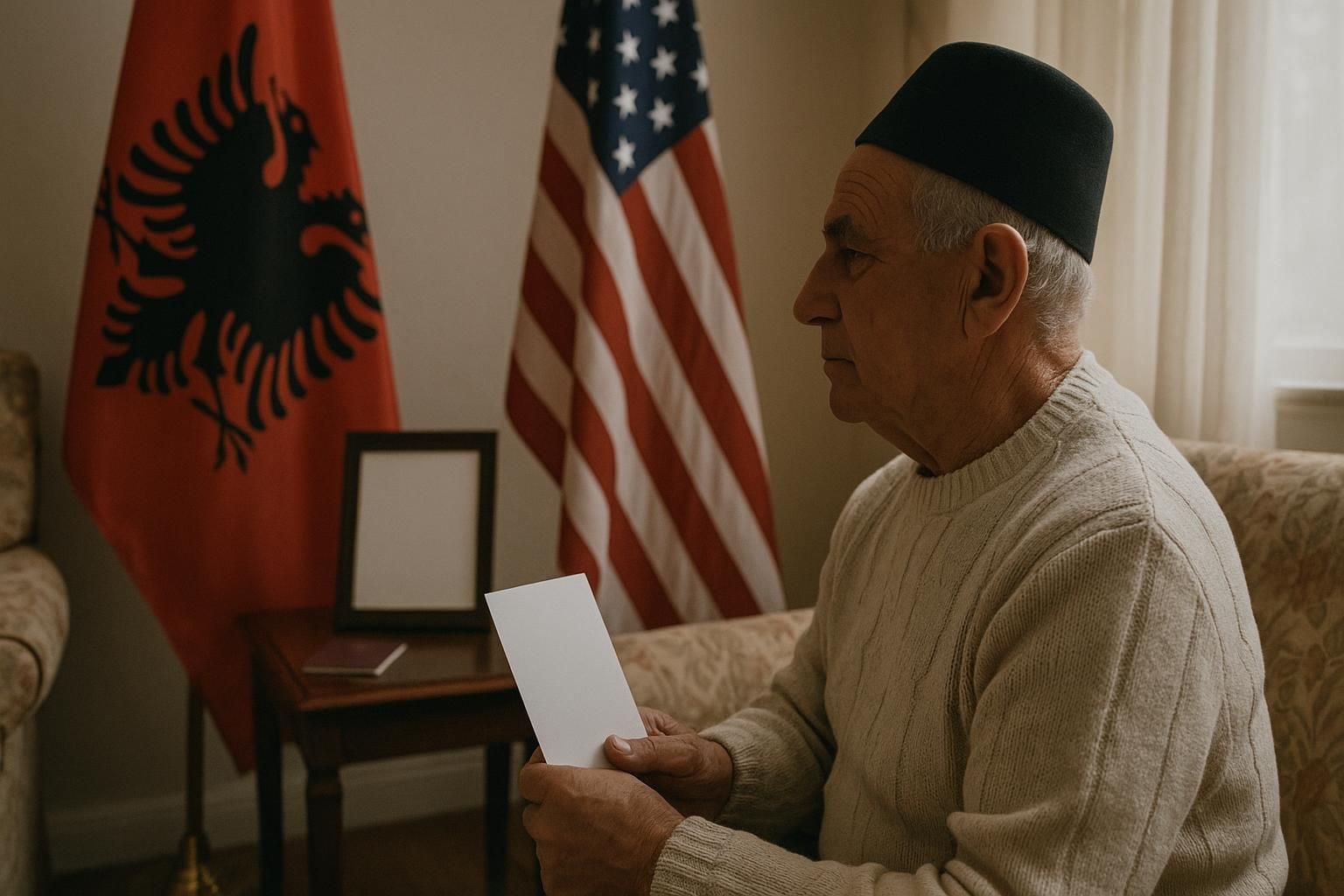
The Albanian proverb says it plainly: Shqiptarët vdesin dhe besën nuk e shkelin — Albanians die before they break their word. That sentence is not poetry. It is a description of how Albanian society has enforced its most important social contract for at least 600 years.
Besa — translated as “faith,” “pledge,” or “word of honor” — sits at the center of Albanian customary law, Albanian identity, and Albanian community life. It predates the modern Albanian state by centuries. It crosses religious lines: Albanian society includes Sunni Muslim, Bektashi, Catholic, and Orthodox communities, and besa applies to all of them. It survived 45 years under Enver Hoxha’s dictatorship, which tried to dismantle every institution of traditional Albanian life but could not erase this one.
For Albanian Americans, besa is not an abstract value listed in a textbook. It is the reason a phone call from a cousin carries the weight of a contract. It is the reason Albanian business owners in New York, Michigan, and Massachusetts still close deals on a handshake, backed by the understanding that the handshake is binding. And it is the reason why, when asked what makes Albanian identity more than a census checkbox, the answer often returns to a single word.
What besa means
The word comes from a deep Indo-European root shared with the Latin fides — the same root that gave Romance languages the word for “faith.” Albanian split the two meanings early: religious faith became feja, and the older ethical meaning — the binding of one’s word — stayed in besa.
In practical terms, besa operates as a verbal contract that is stronger than a written one. When someone gives their besa, they place their reputation, their family’s name, and their descendants’ standing on the line. Breaking a besa does not carry a legal penalty. It carries a social one — and in Albanian culture, the social penalty is worse.
The strongest form is besa-besën — “pledge to pledge” — a mutual oath between equals. When Haxhi Zeka organized 450 Kosovo notables in 1899 to form the League of Peja, he organized them under exactly this term: a besa-besën that bound them to a common cause while suspending blood feuds among themselves.
The Kanun and besa’s role
Besa does not exist in isolation. The Kanun of Lekë Dukagjini, the customary law that governed Albanian highland society — and, in practice, large parts of lowland Albanian life — for centuries, rests on four pillars. Besa is not counted among them; it functions alongside nderi as the code’s cornerstone, the pledge that gives every pillar its binding force.
The four pillars:
- Nderi — personal and family honor. A person’s standing in the community, measured by how faithfully they keep their obligations.
- Mikpritja — hospitality. The obligation to receive guests, feed them, protect them, and guarantee their safety under your roof.
- Sjellja — right conduct. The rules governing how a person behaves toward others in daily life.
- Fis — kin loyalty. The bonds and obligations owed to one’s extended family and clan.
Besa is the pledge behind all four: without it, none of the pillars would carry any binding force.
The Kanun contains 1,262 articles. It was transmitted orally for generations before the Catholic priest Shtjefën Gjeçovi began writing it down in the early 1900s — published posthumously in 1933, after Gjeçovi’s assassination in 1929. The code regulated everything from property inheritance to marriage, from blood feuds to guest protection. But it has no court, no police force, no prison. Its enforcement is besa and the social consequences of breaking it.
When someone violated the Kanun, the question was not “did you break the law?” but “did you break your besa?” The two were treated as the same thing.
Two forms of the pledge
Albanian customary practice distinguishes two forms:
Besa e dhënë — the given word. A promise you make to another person. Once given, it cannot be retracted, and it transfers to your heirs. If you die with an unfulfilled besa, your son inherits the obligation.
Besa e marrë — the received word. A guarantee of safety you extend to someone else — a guest, a traveler, even a former enemy during a truce. Under besa e marrë, the person under your protection is as safe as a member of your household. An attack on them is treated as an attack on you.
The Albanian proverb captures the weight: Besa e shqiptarit nuk shitet pazarit — the honor of an Albanian cannot be sold in the bazaar.
Besa in Albanian history
Besa’s most visible historical appearances mark turning points in Albanian national life.
In 1878, during the Great Eastern Crisis, Albanian leaders gathered in Prizren, Kosovo, and swore a besa to form the League of Prizren — a political alliance to prevent the partition of Albanian-inhabited lands by neighboring Balkan states. The besa bound leaders from different regions, different clans, and different religious communities to a single cause. It was one of the earliest collective Albanian political acts, and it was framed not as a political agreement but as a besa — because in Albanian culture, a besa carries more weight than a treaty.
Twenty-one years later, Haxhi Zeka convened the League of Peja in 1899 under a besa-besën of 450 notables, binding Kosovo Albanian leaders to resist Ottoman partition while suspending internal feuds. The doubled form — “pledge to pledge” — signaled mutual obligation at the highest level.
Besa and the rescue of Jews in WWII
During World War II, besa produced its most tested outcome. Albania, a country of roughly 1 million people at the time, sheltered approximately 2,000 Jews fleeing Nazi-occupied Europe. Albania began the war with about 200 Jewish residents. It ended the war with about 2,000 — the only country in Nazi-occupied Europe whose Jewish population increased during the Holocaust.
The rescuers were ordinary Albanian families — Muslim, Catholic, and Orthodox. They hid Jewish refugees in their homes, in mountain villages, in shops. They forged identity papers. They moved people from house to house when the risk of detection grew. In 1943, the Albanian population refused to comply with Nazi orders to turn over lists of Jews residing in the country.
When the American photographer Norman Gershman traveled through Albania decades later to document the rescuers, the explanation he heard was consistent across every family: besa. A guest in your home is under your protection. There is no Albanian honor, no Muslim honor, no Christian honor — there is only honor, and once someone is in your house, their life is yours to defend. Gershman’s photographs were exhibited at Yad Vashem, at the United Nations headquarters in New York, and at the European Union headquarters in Strasbourg.
Yad Vashem has recognized 75 Albanians as Righteous Among the Nations — rescuers who came from all three of the country’s faith communities, Muslim, Catholic, and Orthodox alike.
For a longer treatment of besa’s role in the WWII rescue, see Besa: The Albanian code of honor and WWII rescue.
How besa operates in Albanian-American families today
The U.S. Census counts roughly 230,000 Albanian Americans. Community estimates put the real number closer to 1 million, including ethnic Albanians from Kosovo, North Macedonia, and Montenegro, plus second- and third-generation Americans whose families never checked the Albanian box on a census form.
In these families, besa is not a word people define on command. It is a standard they invoke when it matters.
The given word is still binding. When an Albanian-American parent tells a child të jap besën — “I give you my word” — it is not a figure of speech. It means the promise will be kept. When the phrase is used between adults — between business partners, between community members, between a neighbor and someone asking for help — the expectation is the same. The word was given. The word will be honored.
Hospitality is an obligation, not a choice. An Albanian-American household that turns away an unexpected guest has failed a basic test. The guest gets fed. The guest gets coffee. The guest does not pay for anything consumed under your roof. This is not generosity as Americans typically understand it — it is a rule, inherited from the Kanun’s mikpritja, and enforced by the knowledge that your neighbors will hear about it if you fail.
Family obligations carry the weight of pledges. Weddings, funerals, baptisms, hospitalizations — these are not events you attend if convenient. They are obligations you meet because your presence is a form of besa to the family. Missing a funeral without serious cause damages the relationship between the families. Attending — and attending with the appropriate financial contribution, which is noticed and remembered — maintains it.
Godparent duties are contractual. In Albanian culture, the kumbarë (godparent) relationship is a binding one. The kumbarë is expected to contribute financially to major life events — weddings, births, first communions — for the rest of the relationship. It is not a ceremonial title. It is a social contract that Albanian-American families still honor, often across decades.
Besa in Albanian-American business
Albanian-American business networks — concentrated in New York (~52,000 Albanian Americans), Michigan (~30,000), Massachusetts (~21,000), Connecticut, and New Jersey — have operated with a besa-shaped trust layer for generations. Construction, restaurants, real estate, pizza franchises: these are industries where Albanian immigrants concentrated, and where word-of-mouth reputation was the primary capital.
A recommendation from a respected Albanian community member carries weight that a resume does not. A handshake on a deal, between two people whose families know each other, is treated as binding. The legal contract may come later, but the commitment was made at the handshake. The formal paperwork documents the agreement; the besa preceded it.
This is not sentimentality. It is a practical system. In immigrant communities where access to formal institutions — banks, lawyers, established credit history — was limited, trust networks built on personal reputation filled the gap. Besa was the operating system for those networks. It worked because the cost of breaking it was known: a person labeled pa besë lost access to the network entirely.
Pa besë: the social cost of breaking the code
Pa besë — “without honor” or “without a pledge” — is the worst label Albanian culture can attach to a person. It does not wash off. A person called pa besë is someone who broke a serious promise, betrayed a trust, or failed a guest. The label extends to the family. It affects marriage prospects, business relationships, and standing in the community.
In traditional Albanian society, a person who was pa besë was treated as socially dead. The Kanun did not prescribe a punishment for breaking besa — it prescribed exclusion. No one would do business with them. No one would give them their daughter in marriage. No one would vouch for them. In a society with no police force and no courts, this was the most severe consequence available.
Among Albanian Americans, the mechanism is softer but the principle persists. A community member who fails to honor a commitment — who takes money and does not deliver, who makes a promise to a family and does not follow through — earns a reputation. The community is small enough and information travels fast enough that reputation is visible. In Albanian-American business, a referral carries implicit besa: the person who made the referral is vouching for the person being referred. A failure reflects on both.
Besa across generations
For first-generation Albanian Americans — those who arrived from Albania, Kosovo, or North Macedonia — besa is the water they grew up in. They do not need the concept explained. They absorbed it from family life, from village norms, from the way their parents treated guests and honored promises.
For the second and third generation — born and raised in the US, often English-dominant — besa is something they experienced at home but may not have a single word for. They know the expectations: you show up for family events, you keep your promises, you feed anyone who walks through the door, you do not bring shame on the family name. They may not use the word besa, but they follow the code.
The tension shows up in small, recognizable ways. A second-generation Albanian American explains to a friend why skipping a cousin’s wedding is not optional. A third-generation college student feels the pull of family obligations that peers from other backgrounds do not share. The word may not be spoken. The weight is there.
Whether that weight survives into the fourth and fifth generation depends on whether the community maintains the structures — families, organizations, gatherings — that transmit it. A code of honor is only as durable as the community that enforces it.
Why besa matters for the count
The Albanian-American community is one of the most undercounted in the United States. The U.S. Census records roughly 230,000 Albanian Americans. The real number is closer to a million — when you include ethnic Albanians from Kosovo and North Macedonia, plus second- and third-generation families who were never counted.
Why the gap matters is a besa question. If Albanian Americans are not counted, they do not appear in the data that drives federal funding, political representation, and community resources. Getting counted is an act of responsibility to the community — the kind of obligation besa has always governed.
The ask is familiar: show up for your community. Keep the obligation your parents kept, and their parents before them. Be counted — because the count is what makes the community visible, and visibility is what turns a scattered population into a recognized constituency.