

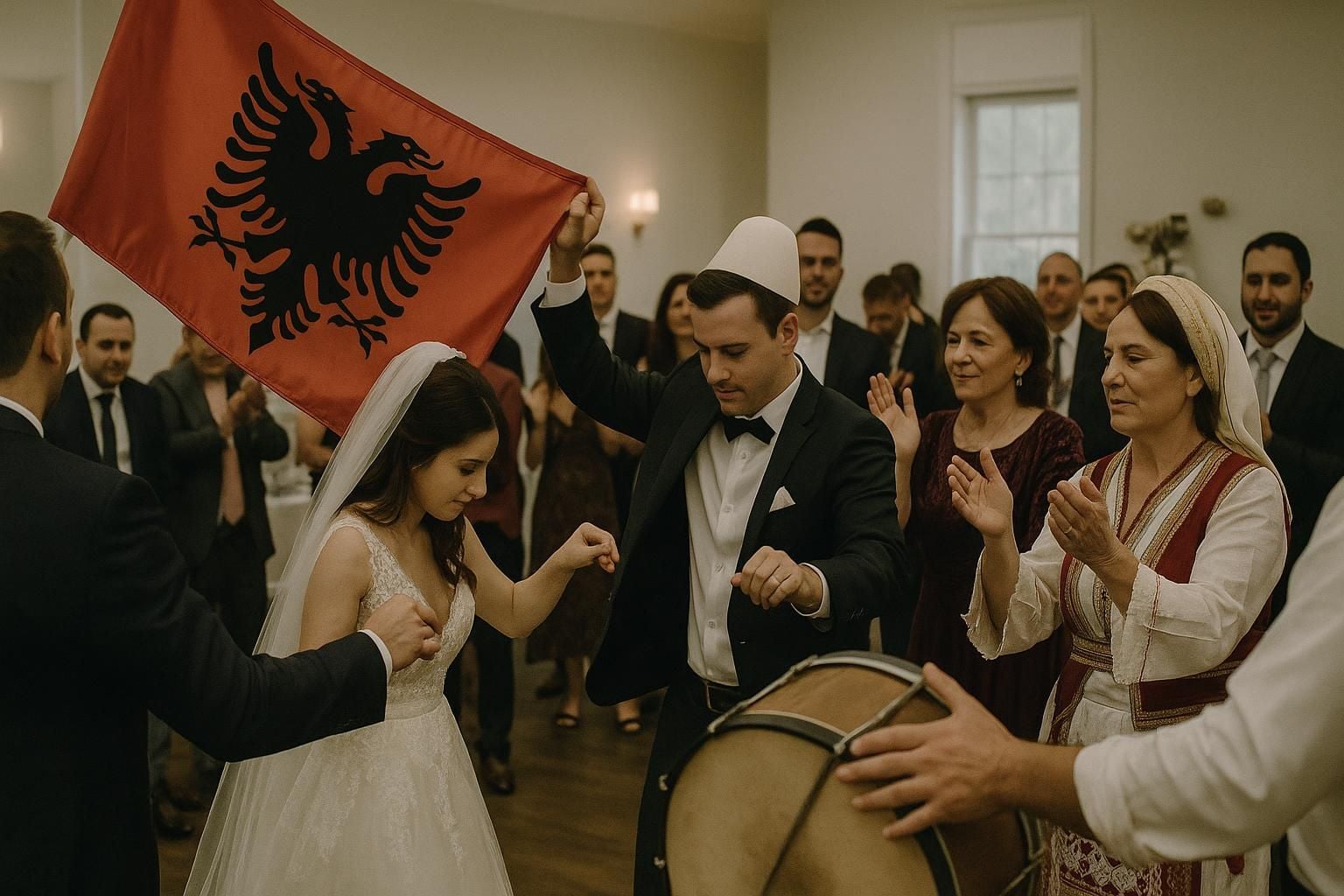
The Albanian word for wedding is dasma. The word carries more weight than its English equivalent — it refers not just to the ceremony but to the entire multi-day sequence of obligations, rituals, and celebrations that surround a marriage.
In rural northern Albania and Kosovo, a traditional dasma could last a full week: from the dough day when women gathered to bake the wedding bread, through the henna night, the bride’s procession, the ceremony itself, and the post-wedding visits. Each day had its own name, its own purpose, and its own rules about who could participate. Even in the 1980s, under Enver Hoxha’s regime — which banned religious ceremonies and suppressed clan-based customs — Albanian families found ways to keep the core rituals alive in private.
Today, the format has compressed. Urban weddings in Tirana might last a single evening. Diaspora weddings in Detroit, New York, or Waterbury run until 2 a.m. in a rented banquet hall. But the underlying structure persists: an Albanian wedding is still a public, communal, multi-generational event. Guest lists of 300 to 500 people are standard. A “small” Albanian wedding has 100 guests — anything fewer and the families feel they’ve failed a social obligation.
This guide covers the major rituals in order, what they mean, and how Albanian-American families adapt them in the US.
The engagement: fejesa
The Albanian engagement — fejesa — is where the two families formally commit. In traditional practice, the groom’s father or uncle visited the bride’s family to ask for her hand, often accompanied by a delegation of male relatives. The visit itself was negotiated in advance through intermediaries; showing up unannounced would have been a serious breach.
What made the fejesa distinctive was its legal weight under customary law. The Kanun of Lekë Dukagjini, the code that governed northern Albanian highland society for centuries, treated the engagement as a binding contract between families — not between individuals. Breaking a fejesa brought shame on the entire household. Customary law also addressed the bride’s çejz (dowry), which her family assembled and typically included clothing, jewelry, and the duvak (bridal veil) — though the exact contents varied by region and family means.
Today, Albanian engagements are celebrations in their own right. In many regions, the engagement party is nearly as large as the wedding itself. Both families gather for a banquet where the couple exchanges rings — worn on the right hand during the engagement period and transferred to the left hand at the wedding ceremony. The groom’s family traditionally brings gold jewelry for the bride: necklaces, bracelets, and watches.
For Albanian Americans, the fejesa often doubles as the first time extended family from both sides meets in one room. Families fly in from Albania, Kosovo, or other US cities. The event functions as a trust-building exercise — especially when the two families come from different regions, different religious backgrounds, or different waves of immigration.
Pre-wedding rituals: dough day and henna night
Traditional Albanian weddings included several named preparation days, each with specific tasks and participants.
Dough day (dita e bukës) was the day women and girls gathered at the groom’s family home to sift flour and knead dough for the wedding bread. Participation was restricted: only women and girls whose parents were both still alive could handle the dough, a superstition meant to transfer good fortune to the couple. The bread baked on dough day was not ordinary bread — it was ceremonial, distributed to guests as part of the wedding feast.
Wood day preceded dough day in some regions — women (and occasionally men) went to gather firewood for the cooking that the wedding would require. In a multi-day celebration feeding hundreds of guests, the logistical scale was significant.
Henna night (nata e kanës or nata e kënaçës) is the ritual that has survived most intact, both in Albania and in the diaspora. Held the night before the wedding at the bride’s family home, it is a women-only gathering. An older woman from the groom’s family — traditionally the mother-in-law — applies henna paste to the bride’s hands and sometimes feet. The henna symbolizes fertility, protection, and the transition between households.
The atmosphere of henna night is both celebratory and emotional. Women sing traditional songs — some joyful, some mournful. The bride’s female relatives often cry openly. The tears are not theatrical; in traditional Albanian society, marriage meant the bride leaving her family’s home permanently. She was, in a real sense, being given away. The Albanian folk expression “vajza është peshqesh” — “a daughter is a gift” — captures the weight of the moment. The bride’s family was losing a household member; the groom’s family was gaining one.
Among Albanian Americans, henna night is common in families with roots in Kosovo and northern Albania. Some families in the US have adapted it into a more social gathering — closer to a bridal shower — while keeping the henna application as the centerpiece.
The bride’s procession: krushqeria
The most visually dramatic moment in a traditional Albanian wedding is the krushqeria — the groom’s procession to the bride’s home to fetch her.
The groom’s delegation — the krushqit — consists of his uncle (who leads the group), close male relatives, musicians, and sometimes a young child carrying flowers. At the front of the procession walks the bajraktar, the flag-bearer, carrying the Albanian flag. The procession moves through the village or neighborhood accompanied by music, gunfire (in rural areas), and singing.
When the krushqit arrive at the bride’s home, there is a ritual exchange. The flag-bearer reaches the flag to a representative of the bride’s family. Gifts are exchanged. The bride’s father and grandfather walk her out of the house — a public symbol of approval and, in the traditional reading, of her permanent departure from the household.
The bride traditionally wore a duvak, a red veil symbolizing modesty, fertility, and hope for the continuation of the family line. Red, not white, was the traditional Albanian bridal color — white wedding dresses arrived later, influenced by Western fashion after the fall of communism in 1991.
In the US, the full krushqeria is rare. But the car procession survives: a convoy of decorated vehicles, horns blaring, Albanian flags mounted on the lead car, sometimes blocking intersections in Brooklyn or the Bronx on a Saturday afternoon. Albanian-American neighborhoods in New York, Michigan, and Connecticut recognize the sound immediately.
Music and the valle
Music is not background at an Albanian wedding. It is the organizing structure of the celebration. A wedding without live musicians is, in the traditional view, not a wedding at all.
The instruments vary by region. Northern Albanian and Kosovo weddings feature the çifteli (a two-stringed plucked instrument), the lahutë (a one-stringed bowed instrument), and the tupan (a large double-headed drum). Southern Albanian weddings lean toward clarinets, accordions, and the def (frame drum), reflecting a musical tradition closer to the broader Balkan and Mediterranean sound. In both regions, the zurna (a loud double-reed wind instrument related to the oboe) has been a wedding staple for centuries.
The central musical event is the valle — the Albanian circle dance. Guests join hands and form a large ring, moving in unison through steps that differ by region and family tradition. The person at the head of the line — the kryevallxhiu — sets the pace and often spins a handkerchief overhead as a signal. The valle can be slow and stately or fast and physically demanding; in some northern variants, dancers drop to their knees and leap back up.
What makes the valle significant is its inclusiveness. It is not a performance — it is participation. Grandparents, teenagers, children, and guests who have never danced before all join the circle. The physical act of holding hands in a ring, moving together, is the moment when the wedding becomes communal rather than familial. Albanian Americans who grew up in the US and never learned the steps are pulled into the circle anyway; someone on either side guides them through.
Albanian wedding bands in the US — based primarily in the New York and Michigan metro areas — play a mix of traditional folk songs and modern Albanian pop. The tallava genre, rooted in Roma and Turkish musical traditions and popular in Kosovo, has become a common feature at Kosovo-Albanian weddings in the US, especially among younger guests.
Food, raki, and the wedding table
The Albanian wedding table is not a menu — it is a display of the host family’s capacity to provide. A sparse table reflects poorly on the family; an abundant one signals generosity and means.
A traditional Albanian wedding feast follows a set progression:
- Cold starters: white cheese (djathë i bardhë), olives, cured meats, roasted peppers, and salads
- Hot appetizer: byrek (phyllo pie with cheese, spinach, or meat), fergese (a baked dish of peppers, tomatoes, and cheese), or stuffed peppers (speca të mbushur)
- Main course: roasted lamb (qengj i pjekur), veal, or goat — whole-roasted in rural weddings, carved and plated in urban and diaspora settings
- Desserts: baklava, trilece (a tres leches–style milk cake), sheqerpare (syrup-soaked semolina cookies), or revani
Raki — Albanian grape or plum brandy — is served throughout and accompanies every toast. The toasts themselves follow a loose hierarchy: the groom’s father speaks first, followed by the bride’s father, then elder relatives and honored guests. Each toast receives a communal “gëzuar!” (cheers) and a drink.
Albanian-American weddings in banquet halls typically add a cocktail hour before the reception, and a Western-style wedding cake appears alongside the traditional desserts. But the structure of the meal — cold to hot to roast to sweet, punctuated by raki — remains Albanian.
The money shower
When the bride and groom take the floor for their first dance, the guests begin throwing money.
This is not metaphorical. Cash — bills, not coins — is tossed onto the dance floor, pinned to the couple’s clothing, or tucked into pockets and hems. The tradition predates modern banking; it was the community’s way of giving the new household its starting capital. Guests do not typically buy gifts from a registry at an Albanian wedding. Cash is the expectation, and the amount a family gives is public, remembered, and reciprocated at the next wedding in the cycle.
The custom works as social accounting. If your family gave $500 at someone’s child’s wedding, you can expect roughly the same when your child marries. The system creates a web of mutual obligation that reinforces family ties across generations.
In the US, the money tradition continues in full. At Albanian-American weddings in Michigan, New York, and Connecticut, the dance floor fills with flying bills during the couple’s first dance, when the band often shifts into an upbeat number that cues the heaviest round of throwing. Some families collect the cash in a decorated box or bag; others let it accumulate on the dance floor and gather it after the song ends.
Bread and honey at the threshold
When the bride arrives at the groom’s family home — or in modern practice, at the reception venue — the groom’s mother waits at the door. She feeds the bride bread dipped in honey: half for the bride, half for herself. The symbolism is direct — the relationship between bride and mother-in-law should be as sweet as honey.
In some traditions, the groom’s mother eats half the sweetmeat first and gives the other half to the bride, then offers a dish of honey into which the bride dips two fingers and wipes them on the doorstep. The gesture marks the threshold: this is the bride’s new home, and her first act in it is one of sweetness.
A related custom involves a young boy — usually a nephew or cousin of the groom — removing the bride’s shoes upon her arrival. The bride has hidden money inside the shoes beforehand. The boy finds it, and then sits on the bride’s lap — a ritual meant to bless the couple with a male firstborn. The custom is less common today than it was a generation ago, but it survives in families with strong ties to northern Albania and Kosovo.
What the diaspora keeps and what it changes
Albanian-American weddings are condensed but not diluted. A week of ritual in Albania becomes one long night in a US banquet hall — but the emotional and social weight is the same.
What stays:
- Guest lists of 300 to 500. Albanian Americans do not have small weddings. The invitation list includes extended family, family friends, parents’ colleagues, and community members from the local Albanian mosque, church, or cultural center. Guest lists under 100 would be considered a slight.
- Live Albanian music. A DJ alone is not sufficient. Albanian-American wedding bands play five- to six-hour sets mixing folk songs, modern Albanian pop, and valle dance numbers.
- The valle. No Albanian wedding in the US ends without at least one extended circle dance. It is the single tradition that every generation participates in, regardless of how Americanized the rest of the celebration is.
- Money-throwing. Cash on the dance floor, pinned to the couple — unchanged from Albania.
- Raki toasts. The father-of-the-groom toast, the father-of-the-bride toast, the elder-relative toasts — all delivered with raki in hand.
What changes:
- The multi-day structure compresses. Dough day, wood day, and the formal krushqeria procession are rare in the US. Henna night survives in Kosovo-Albanian families but is less common among Toskë-background families from southern Albania.
- White wedding dresses replaced the red duvak. Most Albanian-American brides wear Western-style white gowns, though some incorporate traditional embroidered elements or wear a traditional dress for the henna night.
- The dowry (çejz) is effectively gone. In Albania, the custom was already fading before the fall of communism; in the US, it is not practiced.
- Venue replaces the family home. Traditional rituals that depended on the physical space of the family house — the threshold bread-and-honey, the shoe ritual — are adapted to banquet hall settings, sometimes performed at the reception entrance.
The adaptation is not random. Albanian-American families keep the rituals that express identity (the valle, the music, the scale) and drop the ones that depended on a village social structure that does not exist in the US (the multi-day format, the krushqeria on foot, the çejz negotiation). The result is a wedding that is recognizably Albanian to anyone who has attended one — but compressed to fit an American calendar and an American venue.
Why it matters for the count
Albanian weddings are one of the few remaining institutions where the Albanian-American community gathers in numbers large enough to see itself. A wedding in Detroit with 400 guests is, for one evening, a census of a local Albanian community — three generations in one room, from grandparents who arrived in the 1970s to children born in Michigan who have never been to Albania.
The National Albanian Registry exists because the official count of Albanian Americans — 230,000 per the 2024 American Community Survey — does not reflect the community that shows up at these weddings. The real number is closer to a million. The gap between the two is precisely the gap the registry is designed to close.
If you attended an Albanian wedding in the last year, you already know the community is larger than the Census says. Be counted.