
Michigan holds roughly 30,000 Albanian Americans by American Community Survey estimates (Wikipedia: Albanian Americans), the second-largest state-level count in the country after New York. The community is concentrated in metropolitan Detroit, particularly across Macomb, Oakland, and Wayne counties — Sterling Heights, Warren, Farmington Hills, Troy, West Bloomfield, Harper Woods, and Taylor. Community estimates that include ethnic Albanians from Kosovo, North Macedonia, and Montenegro, plus US-born descendants, put the real metro Detroit number well above 75,000 once intermarriage and ancestry-question gaps are accounted for.
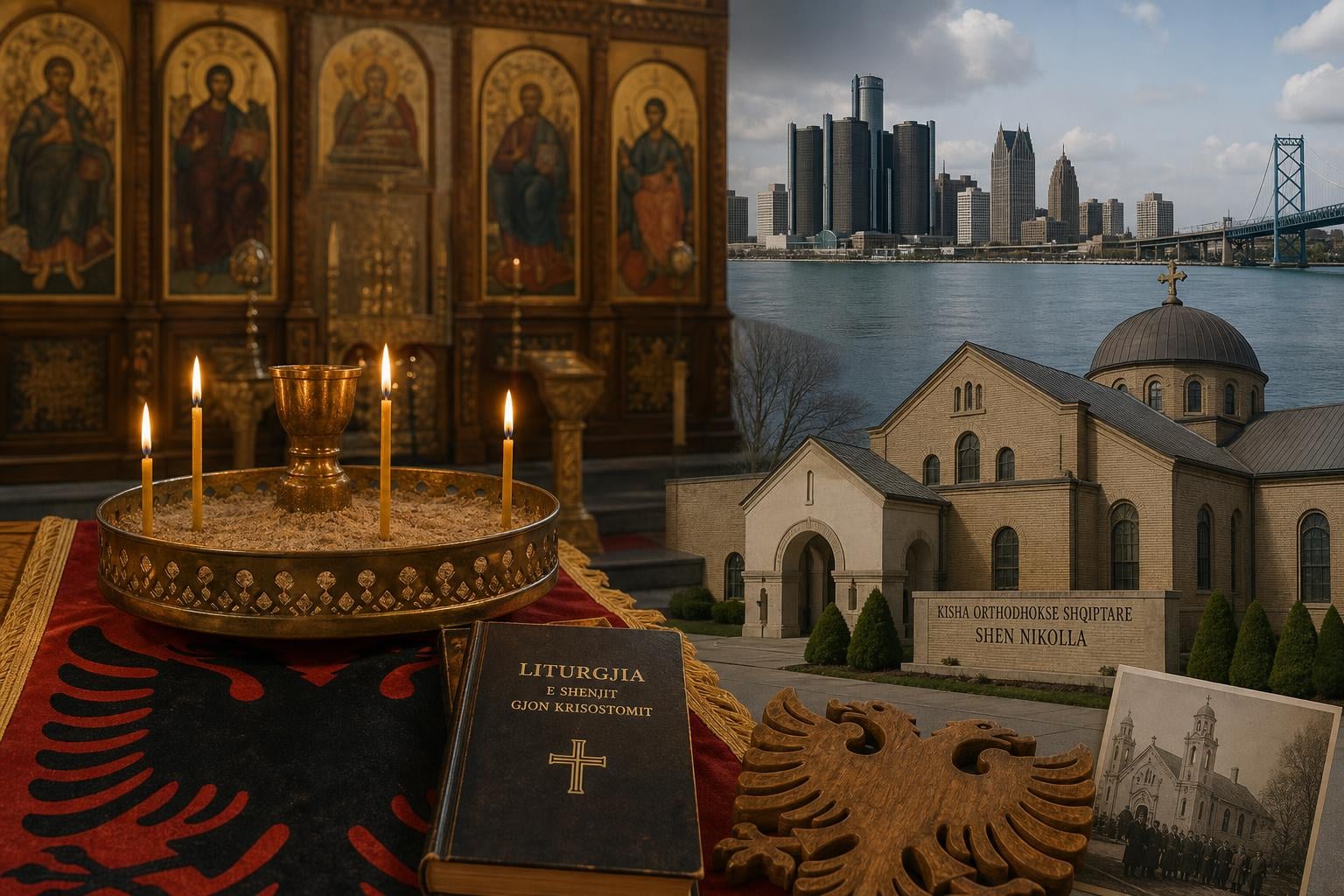
That community is religiously plural in a way few other US Albanian populations match. Metro Detroit holds one of the country’s oldest and largest purpose-built Albanian-American Sunni mosques, the US headquarters of the Bektashi Sufi order, the major Albanian Orthodox parish of the Great Lakes Deanery, and an established Albanian Catholic population that worships at parishes across the metro. The institutions are not a footnote to the community — they are the load-bearing infrastructure that holds it together across generations, dialects, and regions of origin. Kishë (church), xhami (mosque), and teqe (Bektashi lodge) sit within a thirty-minute drive of one another in a way that doesn’t repeat anywhere else in the US except the Bronx.
This piece is a community-information guide to that religious geography. It covers the demographic picture, the auto-industry pull that brought the community to the metro in the mid-twentieth century, the four denominational anchors and the buildings that house them, and the role these institutions play as wedding hall, funeral home network, Albanian-language Saturday school, and civic meeting space alongside their primary function as houses of worship.
How many Albanians live in Michigan?
American Community Survey estimates put roughly 30,000 Albanian Americans in Michigan, placing the state second nationally behind New York (~52,000) and ahead of Massachusetts (~21,000) — the New York and Massachusetts figures come from demographic research citing Nedelkoska (2015) rather than the ACS itself. Those three states together account for roughly 46% of the ~230,000 Albanian Americans the 2024 ACS records nationwide.
The ACS figure is real, and it is also a floor. The American Community Survey asks a single ancestry question and counts the first one or two answers a respondent writes in. That methodology undercounts in three predictable ways: it misses ethnic Albanians from Kosovo, North Macedonia, or Montenegro who answer with their country of origin instead of “Albanian”; it misses third- and fourth-generation Americans whose first answer is “American”; and it undercounts post-1990 arrivals still adjusting their immigration status.
For Michigan, the second and third gaps are large. A substantial share of metro Detroit Albanian families arrived from Yugoslav-controlled North Macedonia and Kosovo from the 1960s onward, and many of those families’ children and grandchildren show up in the ACS under “Macedonian,” “Yugoslavian,” or “American” rather than “Albanian.” Parish rolls at St. Thomas Albanian Orthodox in Farmington Hills, congregation counts at the Albanian Islamic Center in Harper Woods, and the visible commercial footprint along Hall Road in Sterling Heights all suggest the real metro Detroit Albanian-American count is closer to 75,000–90,000.
Inside the state, the geography is concentrated. Roughly nine in ten Michigan Albanians live in the seven-county metro Detroit region. The densest residential clusters are in Macomb County (Sterling Heights, Warren, Macomb Township, Shelby Township) and Oakland County (Farmington Hills, Troy, West Bloomfield, Bloomfield Hills), with a long-established Wayne County footprint anchored by Harper Woods, Hamtramck, Taylor, and parts of the city of Detroit itself. Outstate Michigan — Grand Rapids, Lansing, Ann Arbor, Kalamazoo — holds smaller Albanian populations.
Why Michigan? The Detroit auto-industry pull
Michigan’s Albanian story is, first and foremost, an industrial one. The earliest sustained Albanian arrival in the United States — small numbers of southern Albanians from the late Ottoman and early independence era — settled mostly in New England industrial cities like Boston and Worcester. Detroit pulled later, and it pulled differently.
Albanian arrivals to metro Detroit began in measurable numbers in the early 1900s, drawn by the auto industry’s hiring of immigrant labor for factory and food-service work. By the late 1940s, several hundred Albanian Muslim families had settled in the metro. The community organized formally in 1949, when Imam Vehbi Ismail — born in Shkodër, trained at the Islamic Seminary in Tirana and at Al-Azhar in Cairo — arrived in Detroit and founded the Albanian American Moslem Society. That organization, and the mosque it eventually built in Harper Woods, is the institutional spine of mid-century Albanian Detroit.
The much larger wave came after World War II. From the late 1950s through the 1980s, Albanian families left Yugoslav-controlled North Macedonia (especially Tetovo, Gostivar, and the Polog and Kičevo regions) and Kosovo under sustained political and economic pressure. Most spoke Gheg, the northern Albanian dialect. Many were Sunni Muslim with smaller Catholic and Bektashi minorities. Detroit had what they needed: union factory wages, family-sized housing in Macomb and Wayne counties, an Albanian Muslim community that was already organized, and chain-migration networks that pulled cousins, in-laws, and village neighbors over the next two decades.
A second wave came after 1991, when post-communist Albania opened its borders. A third surge followed the 1999 Kosovo war, when refugee resettlement programs placed Kosovar families with relatives already in the metro. The resulting population is layered by region and generation. A typical Sterling Heights or Warren Albanian block today holds families with roots in Tetovë, Gostivar, Kërçovë (Kičevo), Pejë, Gjakovë, Tropojë, Shkodër, Tirana, and Korçë.
Albanian Orthodox in Michigan: St. Thomas in Farmington Hills
The major Albanian Orthodox parish in Michigan is St. Thomas Albanian Orthodox Church in Farmington Hills, Oakland County. The parish is part of the Great Lakes Deanery of the Albanian Orthodox Archdiocese in America (AOAA), the body Fan S. Noli founded in Boston in 1908 and that has been part of the Orthodox Church in America (OCA) since October 1971.
The Detroit-area Orthodox community is the third major Albanian Orthodox population center in the United States, after Greater Boston (anchored by St. George Cathedral in South Boston, the Archdiocese’s mother church) and Worcester (St. Mary’s Assumption, organized in 1911). The Michigan parish anchors the Great Lakes Deanery alongside smaller Albanian Orthodox communities in New York and Ohio. Sunday Divine Liturgy is celebrated in a mix of Albanian and English. The major festal days — Pashkë (Easter), Krishtlindja (Christmas), Saint George’s Day, the parish patronal feast of St. Thomas — draw the largest crowds of the year.
The Orthodox share of metro Detroit’s Albanian community is smaller than the Sunni and Bektashi populations, but it carries deep institutional history. Many of the Orthodox families in Oakland and Macomb counties trace their roots to southern Albania — Korçë, Berat, Gjirokastër, the southern Tosk dialect zone — and arrived either in the early-twentieth-century mill-town wave that later relocated to the auto metros, or in the post-1990 wave from independent Albania.
The parish hall functions, as Orthodox parish halls do across the Archdiocese, as a community institution: weddings (the crowning ceremony, the Common Cup, the Dance of Isaiah), baptisms, name-day commemorations (emërdita), post-funeral receptions, the forty-day memorial, and the civic events that pull metro Detroit’s Albanian Orthodox community together with Albanian Catholic, Sunni, and Bektashi families for Independence Day, Flag Day, and scholarship galas.
Albanian Catholic Michigan: Detroit-area parishes
Michigan’s Albanian Catholic community is substantial and historically under-described. A meaningful share of metro Detroit’s Albanian-American population is Roman Catholic, drawn primarily from the Gheg north — Shkodër, Mirdita, Lezhë, the Malësia highlands — and from the Catholic Albanian populations of Kosovo (especially the Has, Gjakova, and Peja regions) and North Macedonia (especially around Skopje and the Polog area).
Albanian Catholics in metro Detroit historically worshipped at Roman Catholic parishes across the Archdiocese of Detroit, often in shared arrangements with diocesan churches that offered occasional Albanian-language Mass or pastoral coverage from visiting Albanian priests. Unlike the Albanian Orthodox, who have a dedicated jurisdiction and parish, Albanian Catholics in the US do not operate a separate Albanian Catholic jurisdiction — the Albanian Catholic Church is Latin-rite, in full communion with Rome, and Albanian Catholic communities sit inside the structure of the local Roman Catholic diocese wherever they worship.
The metro Detroit Albanian Catholic community is anchored in Sterling Heights, Warren, and the northern Macomb suburbs, alongside the heavily Albanian Sunni population there. The community supports Albanian-language Mass at rotating Roman Catholic parishes, an Albanian Catholic religious-education program, and the major feast-day calendar of northern Albanian Catholicism — Krishtlindja (Christmas), Pashka (Easter), the Feast of Our Lady of Shkodra (the patroness of Albanian Catholicism, especially venerated by the northern community), and the Feast of St. Anthony of Padua, particularly important among Kosovar and Mirdita-origin families.
For Michigan Albanian Catholics tracing family roots, parish records from Shkodër, Lezhë, Mirdita, Sapë, and Pult — the historic Albanian Catholic dioceses — can sometimes reach back to the 1700s, a paper trail that is unusually deep by Balkan standards and useful for Albanian citizenship by descent applications.
Sunni Muslim Albanian congregations in metro Detroit
Metro Detroit holds the largest organized network of Albanian-American Sunni Muslim institutions in the United States. The flagship is the Albanian Islamic Center at 19775 Harper Avenue, Harper Woods, founded by Imam Vehbi Ismail and consecrated on November 3, 1963 — one of the first purpose-built Albanian-American Sunni mosques in the country, and among the largest. The building was designed by architect Frank Beymer with a distinctly Balkan-Ottoman silhouette — minaret, dome, arches, color palette — chosen to feel like home for Albanians who remembered the xhamia of Shkodër, Tirana, and Durrës.
Imam Ismail led the Harper Woods center and the broader Albanian Muslim community in North America for more than fifty years, publishing more than thirty-five books on Islam and Albanian religious life and helping to organize the Presidency of Albanian Muslim Community Centers in 1992, an umbrella body that today coordinates a network of thirteen-plus Albanian Sunni centers across the US and Ontario. He died in 2008. The Harper Woods congregation today serves several thousand Albanian Muslim families across Macomb, Oakland, and Wayne counties.
The Harper Woods center is not the only Albanian Sunni xhami in the metro. The post-1990s wave of Albanian Muslim arrivals — heavily concentrated in Sterling Heights, Warren, Macomb Township, and Shelby Township — supports additional congregations and prayer halls in northern Macomb County, often operating under names like the Albanian American Islamic Society or the Albanian Cultural Islamic Center.
Friday xhumaja (Friday prayer) is delivered in Albanian with English translation, tilting more bilingual or English-first at congregations whose membership skews toward the second and third generation. Weekend Albanian-language schools, iftarë during Ramadan, and bajram (Eid) banquets bring the broader community together.
Bektashi in Michigan: the Taylor headquarters
Metro Detroit is home to the First Albanian Bektashi Tekke in America, located in Taylor, Michigan in Wayne County. Founded by Baba Rexheb in 1954, it is the first Bektashi teqe — Sufi lodge — ever built in the United States and remains one of the most important Bektashi sites outside Albania. The Taylor teqe functions as the institutional center of Bektashi religious life in the United States and serves Albanian Bektashi families across metro Detroit and beyond.
The Bektashi order is a Sufi tradition with deep historical roots in Albanian religious life. Globally, the order is headquartered at the Kryegjyshata Botërore Bektashiane (World Bektashi Headquarters) in Tirana, where it relocated in 1929 after Atatürk’s 1925 ban on Sufi orders forced it out of Turkey. The Bektashi clerical hierarchy — the baba (father), the dervish, and the kryegjysh (head father) — is distinct from Sunni mosque structures. Bektashis traditionally make up a meaningful minority of Albanian Muslims, with a 1937 reference recording around 27% of the Muslim population in Albania identifying as Bektashi.
Baba Rexheb (1901–1995) is one of the central figures of twentieth-century Albanian-American religious history. Born in Albania, trained in the Bektashi tradition, exiled by the communist takeover, he arrived in the Detroit area in the early 1950s and oversaw the founding and construction of the Taylor teqe. He led the community for more than forty years and wrote a major book on Islamic mysticism and Bektashism. His grave is at the teqe, and the site is a pilgrimage destination for Bektashi families from across the diaspora.
The Taylor teqe is not a Sunni mosque, and Bektashi and Sunni institutions in metro Detroit are organizationally distinct. Both communities are cooperative at the civic level — Sunni imams and Bektashi baballarë sit at the same head table at Flag Day banquets alongside Catholic priests and Orthodox clergy — but the religious institutions, clergy training, calendars, and liturgical practice are separate. NAR does not take a position on Sunni-versus-Bektashi theological classifications that scholars themselves disagree about; both traditions are part of the Albanian-American religious story.
How the churches anchor the community: weddings, funerals, language schools
Across all four traditions — Orthodox, Catholic, Sunni, Bektashi — the metro Detroit Albanian religious institutions function as community institutions at least as much as houses of worship. The Sunday liturgy or Friday prayer is the visible part. The load-bearing work happens through the calendar.
Weddings. Sunni xhamis, Bektashi teqes, Orthodox parish halls, and Catholic parish halls all function as wedding and reception venues, often booked months in advance. The Sterling Heights and Macomb County banquet-hall industry — much of it Albanian-owned — handles the overflow. Valle (circle dancing), the çifteli (Albanian stringed instrument), traditional kanagjegj henna-night customs, and Albanian-language liturgical and civic ceremony all run through these spaces.
Funerals and memorials. Metro Detroit supports a small network of Albanian-American funeral homes that serve all four religious traditions, often with bilingual staff. The forty-day memorial (dyzet ditët) and the one-year memorial are observed across traditions; the parish hall, xhami, or teqe is typically the venue.
Albanian-language Saturday schools. Each major institution runs or supports a weekend Albanian-language program for children. The dominant home dialect in metro Detroit is Gheg; standard literary Albanian, finalized in 1972, is the form taught in schools and used in writing. Saturday schools at the religious institutions carry most of the language transmission outside the home.
Civic and cultural programming. Flag Day (November 28), Independence Day for Albania and Kosovo, scholarship galas, and Albanian-American chamber of commerce meetings routinely run through religious-institution halls. The shared identity is Albanian first; the institution is the venue, not the boundary.
Immigrant integration. Post-1990 and post-1999 arrivals leaned heavily on the Harper Woods mosque, the Taylor teqe, and the Catholic Albanian community for housing referrals, English-language class connections, employment leads, and translation help.
How Michigan fits into the broader diaspora picture
Michigan is the second-largest Albanian-American population center in the country by state-level population estimates, after New York and ahead of Massachusetts. The three states together hold roughly 46% of the ~230,000 Albanian Americans the 2024 ACS records nationally. The community estimate that includes ethnic Albanians from Kosovo, North Macedonia, and Montenegro, plus US-born descendants, puts the national figure near one million.
Three things distinguish the Michigan community from the other major US Albanian populations.
First, the religious mix. Metro Detroit is the most heavily Sunni and Bektashi Albanian-American population in the country. The Harper Woods mosque is the institutional flagship of Albanian-American Sunni Islam; the Taylor teqe is the institutional flagship of Albanian-American Bektashi practice. Boston is heavily Orthodox; New York is religiously plural; Detroit’s center of gravity is Sunni Muslim with a significant Bektashi minority and meaningful Orthodox and Catholic communities.
Second, the regional-origin mix. Metro Detroit’s Albanian population draws heavily from Yugoslav-era North Macedonia and Kosovo, especially Tetovo, Gostivar, Kičevo, and the western Kosovo districts. New York is religiously and regionally more mixed; Boston is historically rooted in southern Albania and the early-twentieth-century Orthodox wave. Detroit’s Gheg-speaking, Macedonia-and-Kosovo-anchored profile is the distinct one.
Third, the suburban geography. New York’s Albanian community is dense and urban. Boston’s is a mix of urban and inner-suburb. Metro Detroit’s Albanian community is overwhelmingly suburban — Sterling Heights, Warren, Farmington Hills, Troy, West Bloomfield, Harper Woods, Taylor — with the corresponding pattern of single-family housing, drive-everywhere geography, and banquet-hall-anchored civic life.
How NAR counts Michigan Albanians
The National Albanian Registry runs a community-led, opt-in count of Albanian Americans nationwide. The Michigan share of that count is one of the largest — the metro Detroit community is dense, institutionally rich, and well-networked across religious lines, which is exactly the condition that makes a community-led count work.
Registration is free, takes about three minutes, and the data stays private. NAR is not a government agency, and the certificate is a recognition document, not citizenship or legal ID. The registry asks no question about religion. Sunni, Bektashi, Orthodox, Catholic, mixed, and secular Albanian Michiganders all belong in the same count, and the institutions that anchor each tradition — St. Thomas in Farmington Hills, the Albanian Islamic Center in Harper Woods, the Bektashi teqe in Taylor, the Albanian Catholic community across Sterling Heights and Warren — are part of the same community story.
Get counted, regardless of faith
The US Census records about 230,000 Albanian Americans. The real number is closer to a million, because the count misses most of us for reasons we’ve documented at length: mixed country-of-birth answers, skipped ancestry write-ins, and whole branches of a family the form never reaches.
NAR exists to count Albanian Americans across the country — Sunni, Bektashi, Orthodox, Catholic, secular, mixed-heritage, every region of origin and every wave. Michigan is one of the densest parts of that map. Get counted →
Sources: Wikipedia — Albanian Americans; Wikipedia — Albanian Orthodox Archdiocese in America; Wikipedia — Islam in Albania; Wikipedia — Bektashi Order; Building Islam in Detroit (University of Michigan, LSA); America’s Islamic Heritage Museum — Imam Vehbi Ismail; the Orthodox Church in America (oca.org). Where dates or congregation sizes are approximate, we’ve said so plainly.