
Albania and Yugoslavia were neighbors for 73 years and never the same country.
That’s a sentence that surprises people, including people who grew up in Albanian-American households. The two states sat on the same Balkan peninsula, shared a long mountainous border, spoke languages with deep mutual contact, and contained large populations of each other’s nationals. From outside the region — and from a generation of American history textbooks that grouped “the Balkans” into a single foggy cluster — it can look like Albania should have been part of Yugoslavia, the way Slovenia or Macedonia or Bosnia were.
It wasn’t. The reasons are concrete, dated, and named. Albania declared independence in 1912, six years before any version of Yugoslavia existed. The Great Powers drew its borders in 1913. Tito and Hoxha came close to a federation in the late 1940s, then broke apart over Stalin. Kosovo, which is Albanian-majority, did end up inside Yugoslavia — and that fact is the bridge between this history and the Albanian-American community today.
This article walks the timeline neutrally, names the people involved, and lands at why this matters for diaspora identity in the United States. We use “Kosovo” rather than “Kosova” in keeping with English convention.
Two countries, two stories: how Albania and Yugoslavia formed
The most important fact in the whole question is the order of the dates.
Shqipëria (Albanian for “Albania”, literally “Land of Eagles”) declared independence on 28 November 1912. The Kingdom of Serbs, Croats and Slovenes — the first Yugoslav state — was proclaimed on 1 December 1918. By the time Yugoslavia existed, Albania had already been a recognized state for six years, fought through the First Balkan War, survived the First World War as occupied territory, and held a seat at international forums.
The Kingdom of Serbs, Croats and Slovenes was the product of South Slavic nationalism, specifically the ambition to gather the South Slavic peoples — Serbs, Croats, Slovenes, and later Macedonians, Bosniaks, and Montenegrins — into a single state after the collapse of Austria-Hungary. It was a Slavic project, organized around shared linguistic family and overlapping religious traditions (Orthodox, Catholic, and Muslim). Albanians are not South Slavs. The Albanian language is its own branch of Indo-European, with no close living relatives. The cultural and linguistic logic that brought Belgrade, Zagreb, and Ljubljana under one roof did not extend to Tirana.
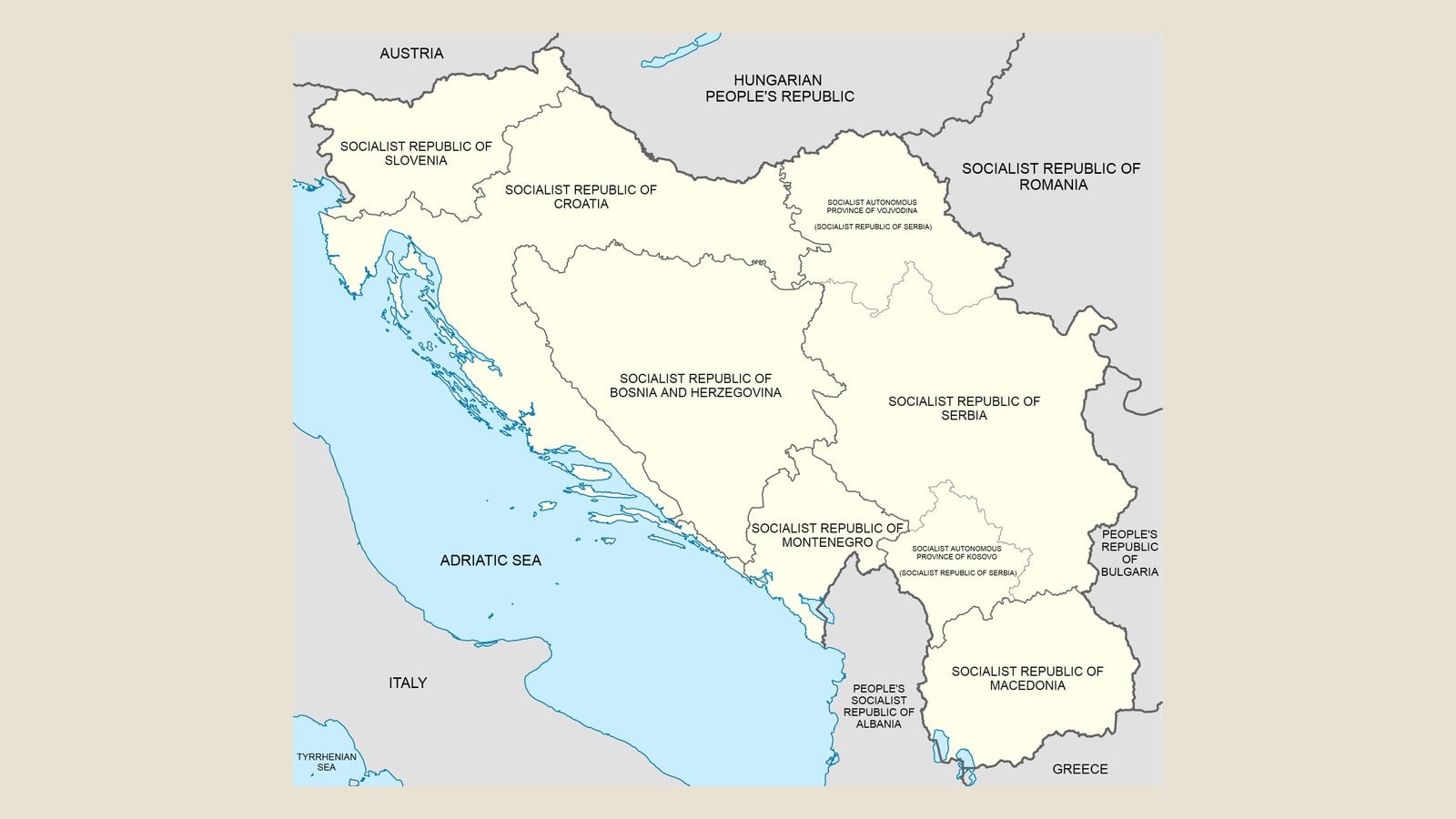
The state was renamed the Kingdom of Yugoslavia in 1929 under King Aleksandar I, who centralized power in Belgrade and dissolved the historic regions in favor of administrative banovinas. Yugoslavia was reconstituted after the Second World War as the Federal People’s Republic of Yugoslavia in 1945, then renamed the Socialist Federal Republic of Yugoslavia in 1963. Its six constituent republics were Serbia, Croatia, Slovenia, Bosnia and Herzegovina, Montenegro, and Macedonia. Two autonomous provinces — Vojvodina and Kosovo — sat inside Serbia.
Albania was never on either list.
Albania’s 1912 independence — the door that closed before Yugoslavia opened
The Albanian declaration of independence happened against a clock.
By autumn 1912, the Ottoman Empire was collapsing in Europe. Serbia, Montenegro, Bulgaria, and Greece had launched the First Balkan War in October. Their armies advanced into Ottoman territory, and Albanian-inhabited regions — Kosovo, parts of Macedonia, and the Albanian highlands — were being divided up by treaty between the victors. Without a recognized state, Albanians faced partition.
Ismail Qemali, an experienced Ottoman statesman of Albanian origin, traveled from Bucharest through Trieste and Durrës to Vlora, a southern coastal city that was still outside the advancing Serbian and Greek lines. On 28 November 1912 he raised the double-headed eagle flag and read the Declaration of Independence to a gathering of delegates from across the Albanian lands. The assembly set up the Provisional Government of Albania, with Qemali as its head, six days later on 4 December 1912, once delegates from other regions had arrived.
Recognition was harder than declaration. The Great Powers — Austria-Hungary, Russia, Germany, France, the United Kingdom, and Italy — convened the Conference of London in December 1912 to manage the post-Ottoman map. They formally decided to establish a sovereign, independent Albania on 29 July 1913, but the borders they drew were narrower than the Albanian-inhabited zone. Kosovo, the Preševo Valley, parts of present-day North Macedonia, and the Çamëria region of northwestern Greece all remained outside the new state. By most historical estimates, roughly a third of the ethnic Albanian population lived outside Albania’s 1913 borders.
This is the load-bearing fact for the Yugoslavia question. By 1913, Kosovo had been awarded to Serbia as a war prize. When Serbia became part of the Kingdom of Serbs, Croats and Slovenes in 1918, Kosovo went with it. The Albanian-Yugoslav border was set before either of those states existed in modern form, and it cut through Albanian-inhabited territory. Albania’s foreign policy for the next century would be shaped by that line.
The new state spent 1913-1914 trying to consolidate. Prince Wilhelm of Wied was installed as ruler in March 1914 and lasted six months before fleeing the country during the chaos of the First World War. Albania was occupied by multiple armies — Italian, Austro-Hungarian, French, Serbian — through 1918. It was admitted to the League of Nations in 1920, anchored its independence under King Zog I in 1928, and was invaded by Fascist Italy in April 1939.
The Tito-Hoxha years and the federation that almost happened
The closest Albania ever came to joining Yugoslavia was the years between 1944 and 1948.
The Albanian Communist Party (later renamed the Party of Labour of Albania) was founded in November 1941 under Yugoslav guidance. Two Yugoslav emissaries, Miladin Popović and Dušan Mugoša, were instrumental in organizing scattered Albanian Marxist groups into a single party. Enver Hoxha, a 33-year-old former teacher, emerged as general secretary. The party became the political backbone of the Albanian partisan movement against Italian and German occupation, and Yugoslav material support flowed across the border throughout the war.
Tito’s partisans liberated most of Yugoslavia by late 1944. Hoxha’s forces took Tirana on 17 November 1944, after a hard-fought battle for the city; the country-wide liberation from German occupation followed on 29 November 1944 — a separate date from Albania’s 28 November flag day. Both new communist governments were Yugoslav-aligned and dependent on Soviet recognition.
What followed in 1946 and 1947 was a steady deepening of integration. A treaty of friendship and mutual assistance was signed in July 1946. A customs union between Albania and Yugoslavia followed. Albanian and Yugoslav economic plans were coordinated. Yugoslav military and civilian advisors arrived in Tirana. Albanian officers trained at Yugoslav academies. The Albanian lek and the Yugoslav dinar were tied at fixed parity. Koçi Xoxe, Albania’s powerful Interior Minister and head of the Sigurimi (Albania’s communist-era secret police), became the leading pro-Yugoslav voice in the Albanian leadership.
Hoxha’s own position was more cautious. The historical record, as summarized in the Wikipedia article on the People’s Socialist Republic of Albania, shows Hoxha publicly supporting the Yugoslav alignment while privately resisting full absorption. Tito’s plan, encouraged by Bulgarian leader Georgi Dimitrov, was a Balkan Federation that would merge Yugoslavia, Bulgaria, and Albania into a single socialist state. In some versions Albania would enter as the seventh republic of an expanded Yugoslavia. In others it would join a wider three-state federation as a co-equal member.
The plan was real enough that in early 1948, Yugoslav troops were preparing to deploy to southern Albania under the cover of joint defense. Stalin saw the federation talks the same way he saw most independent communist initiatives: as a threat to Moscow’s primacy.
The 1948 split: when Albania chose isolation
The break came fast.
In February 1948, Stalin summoned Yugoslav and Bulgarian delegations to Moscow and dressed them down for proceeding with the federation without Soviet authorization. Tito refused to back down. The Cominform, the Soviet-led coordinating body of European communist parties, expelled Yugoslavia on 28 June 1948.
Hoxha had a choice and made it within days. Albania sided with Stalin against Tito. Yugoslav advisors were expelled. The Albania-Yugoslavia treaties were abrogated. Soviet aid replaced Yugoslav aid almost overnight. Mehmet Shehu, Hoxha’s hard-line ally, replaced the Yugoslav-aligned faction in the security apparatus. Koçi Xoxe was arrested, tried in May 1949 on charges of “Titoism” and treason, and executed.
Two analytical points are worth naming clearly.
First, the 1948 split saved Albania from absorption. If Stalin had backed Tito instead of breaking with him, the Balkan Federation likely would have moved forward, and Albania would have been the smallest and most economically dependent of its three members. The political logic was already in place. The Tito-Stalin split removed it.
Second, Hoxha personally benefited. The pro-Yugoslav faction inside the Albanian party — Xoxe and his allies — represented a real challenge to Hoxha’s leadership. The 1948 break gave Hoxha an external enemy (Yugoslavia, now treated as a “revisionist” state) and an internal purge target (the Yugoslav-aligned cadres). He used both. The pattern would repeat in 1961 with the Soviet Union and in 1978 with China.
From 1948 forward, Albania and Yugoslavia were hostile neighbors. The border was closed. Albanian state media spent decades calling Tito a traitor to socialism. Yugoslav media returned the favor.
Kosovo: the Albanian-majority land that did end up in Yugoslavia
The mirror image of “why isn’t Albania in Yugoslavia” is “why is Kosovo.”
Kosovo had been part of the Ottoman Empire until 1912, when Serbian forces took it during the First Balkan War. The 1913 Conference of London awarded Kosovo to Serbia despite its Albanian-majority population, partly because the Great Powers wanted to compensate Serbia for not gaining Adriatic coastline, and partly because the principle of self-determination was applied unevenly across the Balkan map. When Serbia merged into the Kingdom of Serbs, Croats and Slovenes in 1918, Kosovo went with it.
Under inter-war Yugoslav rule, Kosovo’s Albanian population faced restrictions on language and education and a state policy of Serbian colonization. Land was redistributed to Serb settlers; Albanian schools were closed. The same pattern continued, in altered forms, after the Second World War.
Tito’s 1945 Yugoslavia made Kosovo an autonomous region within Serbia. The 1974 federal constitution upgraded it to an autonomous province with substantially expanded self-government — its own parliament, government, supreme court, and seat on the federal presidency. Albanian-language schools and the University of Pristina flourished in this period. Kosovo was, by the late 1970s, the most autonomous Albanian-administered territory in any Yugoslav arrangement, even if final sovereignty rested in Belgrade.
The reversal began in 1989. Slobodan Milošević, then Serbian Communist Party leader, used the rhetoric of Serbian grievance to revoke Kosovo’s autonomy. The 1989 amendments to the Serbian constitution stripped the province of self-government. Albanian-language instruction at the University of Pristina was suspended. Tens of thousands of Albanian professionals were dismissed from state employment. The Albanian writer and pacifist Ibrahim Rugova organized a parallel state — schools, clinics, taxes — under the Democratic League of Kosovo, attempting non-violent resistance through most of the 1990s.
That approach reached its limit in 1998 when the Kosovo Liberation Army (KLA) opened armed resistance, Serbian forces responded with mass expulsions, and the NATO intervention of March-June 1999 ended Yugoslav military control of Kosovo. The territory passed to United Nations administration under UNMIK. Kosovo declared independence from Serbia on 17 February 2008. According to Wikipedia, it is recognized today by approximately half of UN member states, including the United States.
The shorthand for this whole arc: Kosovo is the part of the Albanian world that ended up inside Yugoslavia in 1918, lived through the entire Yugoslav century, and emerged from it as a separate state — not as part of Albania, but not as part of Yugoslavia either.
Hoxha’s self-isolation and the Sigurimi state
The 1948 break with Yugoslavia was the first of three. The pattern says something about why Albania never rejoined any larger structure, including its own neighbors.
After 1948, Albania was a Soviet client. Soviet aid, Soviet advisors, Soviet doctrine. The 1956 Hungarian Revolution and Khrushchev’s de-Stalinization speech alarmed Hoxha. He was a doctrinaire Stalinist; Khrushchev’s reformist line was a personal threat. The break came in 1961. The Soviets withdrew aid and advisors; Albania left the Warsaw Pact in 1968.
China replaced the Soviet Union as the patron. Albania became “China’s only ally in Europe” and received substantial Chinese aid through the 1960s and 1970s. That arrangement collapsed too, after Mao’s death in 1976 and Deng Xiaoping’s rapprochement with the United States in 1978. Hoxha denounced China as revisionist. Aid was cut.
By the late 1970s, Albania had no major foreign patron. Hoxha turned that necessity into doctrine. The constitution was amended in 1976 to ban foreign loans and foreign investment. Religion was outlawed in 1967 — Albania declared itself the world’s first atheist state. Foreign travel was restricted to a handful of officials. Tourism was minimal and tightly controlled. The country built hundreds of thousands of concrete bunkers along its borders, coastline, and interior — among the densest fortification of any country in Europe — under a doctrine of permanent national defense against simultaneous Yugoslav, Soviet, NATO, and Greek invasion.
The internal apparatus was the Sigurimi. By the 1980s, the Sigurimi maintained an extensive informant network and ran labor camps at Spaç, Burrel, and elsewhere. Estimates of political prisoners and victims vary by source; the post-1991 Institute for the Study of Communist Crimes documented thousands of executions and tens of thousands of internments across the 45-year period.
Hoxha died in April 1985. Ramiz Alia succeeded him and managed a slow opening through the late 1980s. The communist regime collapsed in 1991-1992, ending with Albania’s first multi-party elections and the emergence of the Republic of Albania as it exists today.
Through this entire sequence — 1948 to 1991 — Albania remained on its own. Not part of Yugoslavia, not part of the Warsaw Pact after 1968, not part of China’s orbit after 1978, not part of NATO or the EU until well after the regime’s fall. The choice to stay separate, made in 1948, became the operating principle of the state for four more decades.
The Yugoslav wars and the Albanian American story
The end of Yugoslavia and the survival of Albania happened in the same five-year window, and both fed the modern Albanian-American community.
The Socialist Federal Republic of Yugoslavia broke apart between 1991 and 1992. Slovenia and Croatia declared independence in June 1991, Macedonia in September 1991, Bosnia and Herzegovina in March 1992. The wars that followed in Croatia (1991-1995) and Bosnia (1992-1995) drew the world’s attention. The Dayton Agreement ended the Bosnian war in November 1995.
Kosovo’s war came later. The 1998-1999 conflict produced more than 800,000 Kosovar Albanian refugees at its peak, according to UN figures, with hundreds of thousands sheltering in Albania, North Macedonia, and Montenegro. The United States led Operation Provide Refuge in spring 1999, admitting about 14,000 Kosovar Albanians (out of 20,000 authorized) directly to American military bases (notably Fort Dix in New Jersey) before transitioning them into long-term communities.
This is the third major wave of Albanian migration to the United States, after the early 20th-century arrivals from southern Albania (the Korçë and Devoll communities that built Vatra in Boston in 1912) and the post-1990 Albanian arrivals after the fall of communism. Each wave came from different political circumstances; together they produced today’s diaspora.
The U.S. Census American Community Survey counts roughly 230,000 Albanian Americans (2024 ACS). Community estimates including ethnic Albanians counted under other ancestries — Italian (Arbëresh), Greek (Arvanites), and Kosovo-origin Americans who reported “Yugoslav” or “Serbian” ancestry — push the total closer to one million. The top three states are New York (~56,000), Michigan (~27,000), and Massachusetts (~21,000), with substantial communities also in Texas, Illinois, Pennsylvania, and Florida.
Kosovar Albanians are concentrated in different cities than Albanians from Albania proper — the Bronx and Yonkers areas of metro New York, the Detroit suburbs, Worcester and the Boston suburbs in Massachusetts. Some second-generation Albanian Americans have parents from Albania and grandparents from Kosovo, or vice versa, and the family histories carry the weight of both stories.
What Albanian Americans take from this history
The reason this matters in 2026, in a community Facebook group or at a wedding in Westchester, is identity.
Albanian Americans whose families left Albania in the 1990s tell a story of escape from communism and self-isolation. Albanian Americans whose families came from Kosovo tell a story of escape from Yugoslav rule and Serbian repression. Italian Arbëresh families trace back to migrations five centuries earlier. The Greek-Albanian Çam community tells a story of expulsion in 1944-1945. These are different histories, but they live in the same neighborhoods and the same WhatsApp threads, and their political attachments — to Albania, to Kosovo, to American politics — overlap rather than separate.
The Yugoslavia question is one of the points where the histories meet. For Albanian-Albanians, Yugoslavia is the neighbor that was almost a partner and then became the closed border to the north. For Kosovar Albanians, Yugoslavia is the country whose disintegration finally allowed Kosovo to become its own state. Neither group spent the 20th century inside Yugoslavia as a willing constituent — but the structures of that century, including the borders drawn in 1913, shaped where they ended up and which passport they now carry.
The diaspora has practical consequences from this history that show up in everyday American life. The 2020 Albanian citizenship law (Law 113/2020) allows citizenship by descent up to a great-grandparent, which matters for the descendants of pre-communist emigrants who never naturalized in Albania. Kosovo offers separate citizenship pathways. Many Albanian Americans now hold dual citizenship with one or both, and the legal standing to do so is a direct consequence of which state their ancestors were inside when borders moved.
Every Albanian American counted is one more data point in a community whose century was defined by closed borders and divided sovereignty. Get counted at /register, or read more at /blog/albanian-history and /blog/kosovo-vs-albania.