
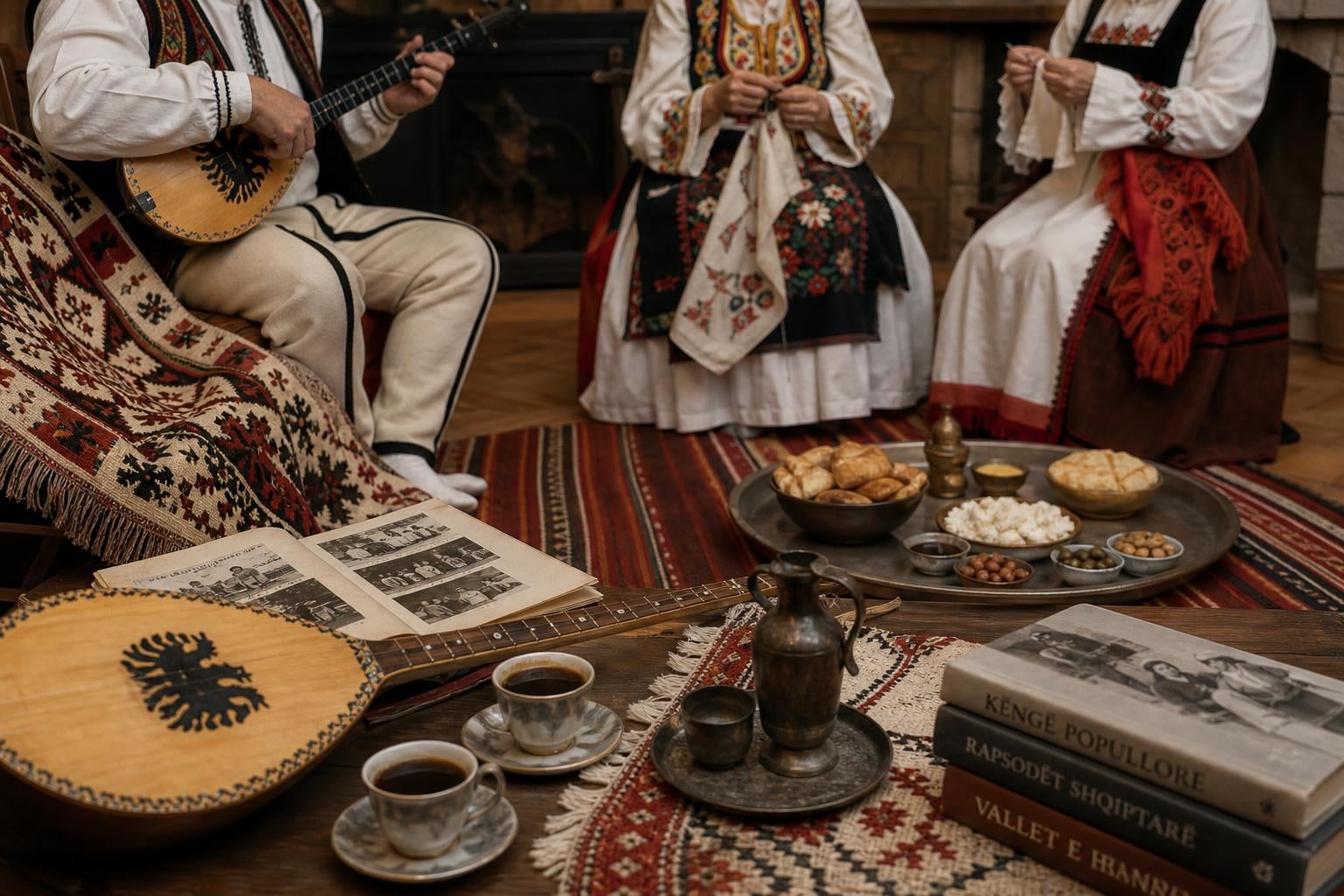
An uncle picks up a çifteli (two-string long-necked lute) at a cousin’s wedding. A grandmother hums a ninull (lullaby) over a sleeping baby. An aunt who barely speaks English at the buffet table leads forty cousins into a valle (line-dance) that nobody had to be taught. This is where the canon lives for most Albanian American kids — in a wedding hall, a grandparent’s apartment, the corner of a christening party — long before it shows up in a classroom.
These moments are the canon. Traditional Albanian songs in the US don’t arrive through institutions. They arrive through people — the grandparent who remembers every verse of Moj e bukura Moré, the cousin who can still tune a lahutë (one-string bowed fiddle), the family elder who insists the toast at a 50th-anniversary dinner be sung, not spoken.
This guide is the long version of what an Albanian American family is already hearing. We cover the major song categories: heroic epic, iso-polyphony, wedding songs, lullabies, valle music, patriotic songs, communist-era classics from Festivali i Këngës, and the Kosovar canon that Vaçe Zela and Nexhmije Pagarusha shaped. We name the instruments behind the sound and the channels — weddings, saze bands, YouTube, family gatherings — that keep these songs alive in New York, Michigan, Massachusetts, and the rest of the US diaspora.
If you grew up around this music and never had words for it, this is the article. If you’re raising kids who haven’t yet, this is the starter list.
What counts as a traditional Albanian song
Traditional Albanian song is a regional phenomenon, not a national genre. What ties the tradition together is geography, dialect, and function — songs grew out of specific mountain valleys, specific dialect zones, and specific social moments.
The first divide is dialectal. North of the Shkumbin river you find the Gheg-speaking regions — northern Albania, Kosovo, western North Macedonia, Montenegro. Their song tradition leans on solo and duo singing, declamatory delivery, and accompaniment by the lahutë or çifteli. South of the Shkumbin you find Tosk, Lab, and Çam regions. Their song tradition is polyphonic, sung by groups, anchored by a drone bass.
The second divide is occasion. Kângë kreshnikësh (heroic frontier songs) are storytelling pieces, performed at length by a soloist for an audience. Wedding songs and valle are communal. Ninulla (lullabies) are intimate, sung by one person to one child. Vajtim (dirges or laments) are performed at funerals, often improvised by women, often unaccompanied.
The third divide is era. There’s the deep folk canon that predates recording. There are 20th-century communist-era classics produced for state radio and the Festivali i Këngës stage. And there are diaspora-pop arrangements of older songs that travel through cassette mixes, weddings, and YouTube. For a US-Albanian family teaching kids, all three eras live on the same playlist.
Kângë kreshnikësh — the northern epic tradition
Kângë kreshnikësh — songs of the frontier warriors — is the northern epic tradition. Long narrative songs, sung by a single performer accompanied by the lahutë, telling stories of legendary heroes named Mujo and Halili, of border raids and besa-keeping and impossible feats. The tradition spans Gheg-speaking northern Albania, Kosovo, and Albanian-populated areas of Montenegro.
The form is old. Scholars working in the 1930s, including Albert Lord and Milman Parry from Harvard, recorded oral epic performances in the region and used them to develop their theory of oral-formulaic composition — the same framework later applied to Homer. Many of the surviving recordings sit in the Milman Parry Collection at Harvard and are now accessible online.
The hero cycle revolves around the Jutbinas brothers. Mujo is the older, gigantic strength figure. Halili is the younger, beautiful, more agile one. The songs deal with cattle raids, single combat, marriage by abduction, magical horses, zanas (mountain fairies), and the ethical code of besa (the Albanian word of honor). Individual songs run dozens of minutes; a full cycle in performance could fill an evening.
For an Albanian American family, the practical entry point is the recordings of postwar rhapsodists like Isë Elezi-Lekgjekaj and Halil Bajgora, plus the field recordings from the Parry Collection. The lahutë itself is a single horse-hair string bowed across a small wooden body — thin, nasal, and unforgettable, and the closest thing the diaspora has to a direct line back to medieval Albanian oral memory.
Iso-polyphony — the UNESCO-listed southern tradition
The southern counterpart to kângë kreshnikësh is iso-polyphony, a multi-part unaccompanied singing tradition practiced in the Tosk, Lab, and Çam regions south of the Shkumbin river. UNESCO proclaimed it a Masterpiece of the Oral and Intangible Heritage of Humanity in 2005 and formally inscribed it on the Representative List of the Intangible Cultural Heritage of Humanity in 2008, and it’s the most academically distinctive form Albanian culture has produced.
The architecture is precise. A marrës (taker) begins the melody. A kthyes (turner) answers. A hedhës (thrower) adds rhythmic, often falsetto, ornament above. A small group of singers holds the iso — a sustained drone bass — underneath. Four parts, no instruments, often performed by men in groups of four to six.
The Lab variant is sharper, more rhythmic, with hard falsetto cries. The Tosk variant is more lyrical and flowing. The Çam variant — historically from the region around Filiates and Paramythia, now mostly in exile — carries the deepest melancholy in its repertoire, songs of displacement and ancestral land.
We cover the form in depth at /blog/albanian-music. The short version: this is the Albanian music form that surprises people on first hearing, and the one most likely to convince a skeptic that Albanian culture has produced something with no close European parallel. The Lab Polyphonic Group of Pilur and the male and female ensembles at the Gjirokastër National Folklore Festival are the canonical reference recordings.
Wedding and family-celebration songs
A traditional Albanian wedding is essentially a structured sequence of songs. The pre-wedding natë e kanagjeqit (henna night) on the bride’s side, the morning of the procession, the moment the bride leaves her parents’ home, the welcome at the groom’s house, the long meal, the valle — each moment carries its own song.
Moj e bukura Moré — the Arbëresh lament for the lost Morea (Peloponnese) — turns up at weddings as a slow, ceremonial opening or as a sentimental late-night number. Tana — the well-known southern valle song — is one of the most danceable items in the canon and turns up at almost every diaspora wedding. Baresha (The Shepherdess) — Nexhmije Pagarusha’s signature song, composed by her husband Rexho Mulliqi — is a Kosovar standard and gets played as both a slow-dance piece and an emotional centerpiece. O sa mirë me qenë shqiptar (How good it is to be Albanian) is the standard mid-evening anthem that gets the entire hall on their feet.
The wedding band itself is usually a saze ensemble or a modern DJ working from a saze template. Saze is the urban folk ensemble that grew out of Tirana, Elbasan, and Korçë — typically a clarinet leading the melody, violin echoing it, accordion filling harmony, llautë (lute) on rhythm, and daire (frame drum) holding time. In the US, full saze lineups still play weddings in the Bronx, Staten Island, Yonkers, Detroit, and Worcester, often led by veteran clarinetists who came over in the 1990s.
The valle itself isn’t one dance — it’s a family of line and circle dances. Guests link arms or hold handkerchiefs and circle the floor in a slow-to-fast progression. Valle e Tropojës, Valle e Devollit, Valle e Pogradecit, Valle e Rugovës — each is a regional variant with its own tempo, footwork, and song repertoire. We cover the dances themselves at /blog/albanian-dances and the broader wedding sequence at /blog/albanian-wedding.
Lullabies and home songs (ninulla)
Ninulla — the Albanian lullaby — is the most intimate song form and often the first traditional song an Albanian American child hears. They’re short, repetitive, and almost always sung solo by a mother or grandmother. Many have no fixed title; they exist as family variants.
The standard refrain nani nani, biri nani (sleep, sleep, my son, sleep) is the most common opening. Variants exist for bija (daughter), grandchildren, and even nieces and nephews. The melodies tend to sit in a narrow vocal range and use a slow swaying meter that matches the rocking of a cradle.
There are also more elaborate composed lullabies in the modern canon. Nina nana by various Festivali i Këngës performers, lullaby arrangements recorded for state radio in the 1970s and 1980s, and contemporary Kosovar children’s-album versions all circulate on YouTube and Spotify and are easy for a diaspora family to find.
Beyond cradle songs, there’s a wider category of home and work songs sung at the loom, at the bread oven, or while preparing a feast. Many are now archival, but a 90-year-old grandmother in Detroit or Worcester may still know the song her own grandmother sang — worth a phone voice memo before that knowledge passes.
Patriotic and national songs
Albanian patriotic song is its own category, and it’s the music most likely to come up at a 28 Nëntori (Independence Day) gathering, a US Albanian community event, or a flag-day program at an Albanian American cultural center.
Himni i Flamurit (The Anthem of the Flag) is the national anthem of Albania, adopted in 1912 at independence. The text is by Aleksandër Stavre Drenova; the melody is by the Romanian composer Ciprian Porumbescu. Kosovar Albanians also know and sing Himni i Flamurit, alongside Kosovo’s own state anthem.
O sa mirë me qenë shqiptar — already mentioned in the wedding section — is the most-used informal patriotic song in the diaspora. It travels across regions and generations and works equally well at a wedding, a youth-group gathering, and a national holiday event.
Marshi i Bashkimit (The March of Unity) and other 19th-century Rilindja-era compositions — songs from the Albanian National Awakening — make up a smaller but still-active patriotic repertoire. Many of these were popularized by community choirs in the diaspora as much as in Albania itself. Boston’s Albanian American community in the early 20th century was a notable hub for this repertoire, partly through the work of Fan Noli’s Pan-Albanian Federation Vatra.
The patriotic canon also includes songs about Skanderbeg — Gjergj Kastrioti, the 15th-century Albanian national hero who held off Ottoman armies for 25 years. Songs naming Skanderbeg, his standard, and his fortress at Krujë turn up across the Albanian-speaking world and are particularly strong in the Kosovar repertoire.
Communist-era classics and Festivali i Këngës
Festivali i Këngës — the Festival of Song — is the Albanian state song festival, broadcast on national radio and television from 1962 onward. Hosted by Radio Televizioni Shqiptar (RTSH), it ran annually through the communist era and continues today as Albania’s selection competition for Eurovision. For roughly 60 years it has been the central filter through which a working Albanian musician’s career passed.
The defining voice of the communist-era festival was Vaçe Zela (1939–2014). She won the festival eleven times between 1962 and 1980 and became the closest thing Albania had to a national diva. Her standards — Sytë e nënës (Mother’s eyes), Vajzë e valeve (Girl of the waves), Këngë për mëmëdheun (Song for the motherland) — are still the radio memories most Albanian households carry. After the regime fell she moved to Switzerland, where she lived until her death.
Other essential names from the communist-era festival: Parashqevi Simaku, Bashkim Alibali, Tonin Tërshana, Luan Zhegu, Sherif Merdani, Justina Aliaj, Mariza Ikonomi (later-era), and Liljana Kondakçi. Each holds a slot in the kitchen-radio canon that an older Albanian American relative will recognize instantly.
The communist-era lyric constraints — required references to homeland, party, productive labor — produced a particular kind of song. The good ones still travel because the melodies are strong and because singers found ways to write love, mother, and longing songs inside the form. The propaganda-heavy material has largely faded from rotation. Post-1991, the festival pivoted toward Eurovision selection; the 2018 entry Mall (Longing) by Eugent Bushpepa is one of the most-respected Albanian Eurovision performances of recent decades.
Songs Kosovar Albanians grew up on
The Kosovar Albanian song canon is part of the same tradition but emphasizes different voices and different instruments. The northern Gheg dialect, the çifteli and sharki as primary accompaniment, and a strong patriotic-and-family thread shape what comes out of Kosovo, western North Macedonia, and the Albanian-populated areas of Montenegro.
Nexhmije Pagarusha (1933–2020) is the foundational name. Born in Pagarushë near Malishevë, she sang for Radio Pristina for decades and became the most-recognized female voice in the Kosovar tradition. Baresha (The Shepherdess), recorded with composer Rexho Mulliqi, is her signature piece — a melodically wide, emotionally direct song that almost every Kosovar Albanian household knows.
Shkurte Fejza is the other essential name. Active from the 1980s onward, she became a defining patriotic voice of the Kosovo war years and the early postwar period. Po vjen Adem Jashari and her broader catalogue of family- and homeland-themed songs are central to Kosovar-Albanian identity in the diaspora.
Other names a Kosovar-Albanian American family will know: Qamili i Vogël (the çifteli master), Ilir Shaqiri, Sabri Fejzullahu, Ramë Lahaj, and the long line of Pristina-radio-era performers. Patriotic songs about Adem Jashari and Kosovo’s independence in 2008 are part of the active repertoire — framed here as cultural history, not partisan commentary.
For an Albanian American family with Kosovar roots, a household playlist mixing Pagarusha, Fejza, and the Festivali i Këngës canon keeps the picture honest — the two traditions are one tradition.
Religious chant and ceremonial song
A complete account of traditional Albanian song has to include religious chant. Albania is historically and currently a religiously plural country — Sunni Muslim, Bektashi, Orthodox Christian, Roman Catholic — and each tradition contributes its own ceremonial repertoire.
Byzantine chant in the Albanian Orthodox tradition has a continuous history, with parish liturgies in Korçë, Berat, and Gjirokastër maintaining the form. In the US diaspora, parishes of the Albanian Orthodox Archdiocese — founded by Fan Noli in 1908 in Boston — still sing portions of the liturgy in Albanian.
Catholic liturgical singing is strongest in the northern highlands and in the Albanian Catholic parishes of Detroit, the Bronx, and Connecticut. Sufi and Bektashi ilahis — devotional songs in Albanian, Turkish, and Arabic — are practiced in the Bektashi teqe network and at the US Bektashi center in Taylor, Michigan.
We mention this category briefly because it’s structurally important — these are traditional Albanian songs in the most literal sense — but each branch deserves its own deeper guide.
Instruments behind the songs (lahutë, çifteli, sharki, daire)
The instrumental palette of Albanian folk music is small, distinct, and worth knowing by name. A US-Albanian household that wants to teach kids the tradition can usually find each of these at an Albanian-American cultural center or at a wedding band’s setup table.
The lahutë is the northern one-string bowed fiddle used to accompany kângë kreshnikësh. Single horse-hair string, small carved wooden body, played upright on the knee. Thin, nasal, instantly recognizable. It’s not built for melody — it’s built to lay a drone and rhythmic figure under a long sung narrative.
The çifteli is the two-string long-necked lute — çift means pair — common to Gheg-speaking northern Albania and Kosovo. One string carries melody, one carries drone. It’s the instrument most often associated with patriotic and shepherd songs, and the easiest folk instrument for a beginner to pick up.
The sharki is the larger fretted lute — typically four to six strings in courses — used in both northern Albanian and Kosovar music. It’s louder than a çifteli and supports more complex melodic playing.
The daire (or def) is the round frame drum with metal jingles — the rhythm engine of southern saze ensembles and many valle dances. It’s the easiest entry point for a child: hand-played, immediately responsive, and built for the long communal songs.
Southern saze ensembles add clarinet (the lead voice in modern weddings), violin (echoing the clarinet), accordion (harmony and fill), and llautë (a long-necked lute used for rhythm). The clarinet-led saze sound — popularized by virtuosos like Laver Bariu of Përmet — is what most Albanian American wedding guests now hear as “Albanian music.”
How these songs survive in the US diaspora
Roughly 230,000 people identified as Albanian in the 2024 American Community Survey (ACS) — a figure most community organizations consider an undercount of an actual Albanian American population closer to one million when ethnic Albanians from Kosovo, North Macedonia, Montenegro, and the older Arbëresh diaspora are counted. Across that population, traditional songs survive through four channels.
The first channel is the family. Grandparents who arrived in the US in the 1990s, the 1970s, or in some Bronx and Boston cases even earlier carry the songs in muscle memory. Kitchen radio, car rides, name-day dinners, christenings, funerals, and 28 Nëntori family gatherings are where most diaspora children first hear Sytë e nënës or Baresha. The single most useful preservation step a family can take is recording an elder on a phone — five minutes of a grandmother singing a ninull is irreplaceable.
The second channel is the wedding. A US Albanian wedding still books a saze band or a DJ working from a saze template, and the valle set remains the moment of the night that signals the celebration is fully underway. Wedding bands in New York, Michigan, Massachusetts, Connecticut, New Jersey, and Texas pass the standard repertoire from one generation of players to the next.
The third channel is the cultural center and the community organization. The Albanian American Civic League, the Albanian American National Organization, Vatra in Boston (founded 1912), parish-affiliated folk groups, and regional Albanian American cultural centers maintain choirs, dance ensembles, and youth programs that teach the traditional repertoire. You can find many of these institutions through our community organizations listings.
The fourth channel is YouTube. This is, candidly, the dominant archive now. Festivali i Këngës performances from the 1960s, Pagarusha’s Radio Pristina recordings, field recordings of kângë kreshnikësh from the 1980s, valle music from every region, and contemporary Kosovar pop arrangements of folk songs all sit a search away. A diaspora parent who wants to build a household playlist for kids can do it in a single evening.
The songs travel because the community keeps singing them. Being counted is one of the ways we make sure that community is recognized — in census records, in funding decisions, in public understanding. Get counted at the National Albanian Registry.