
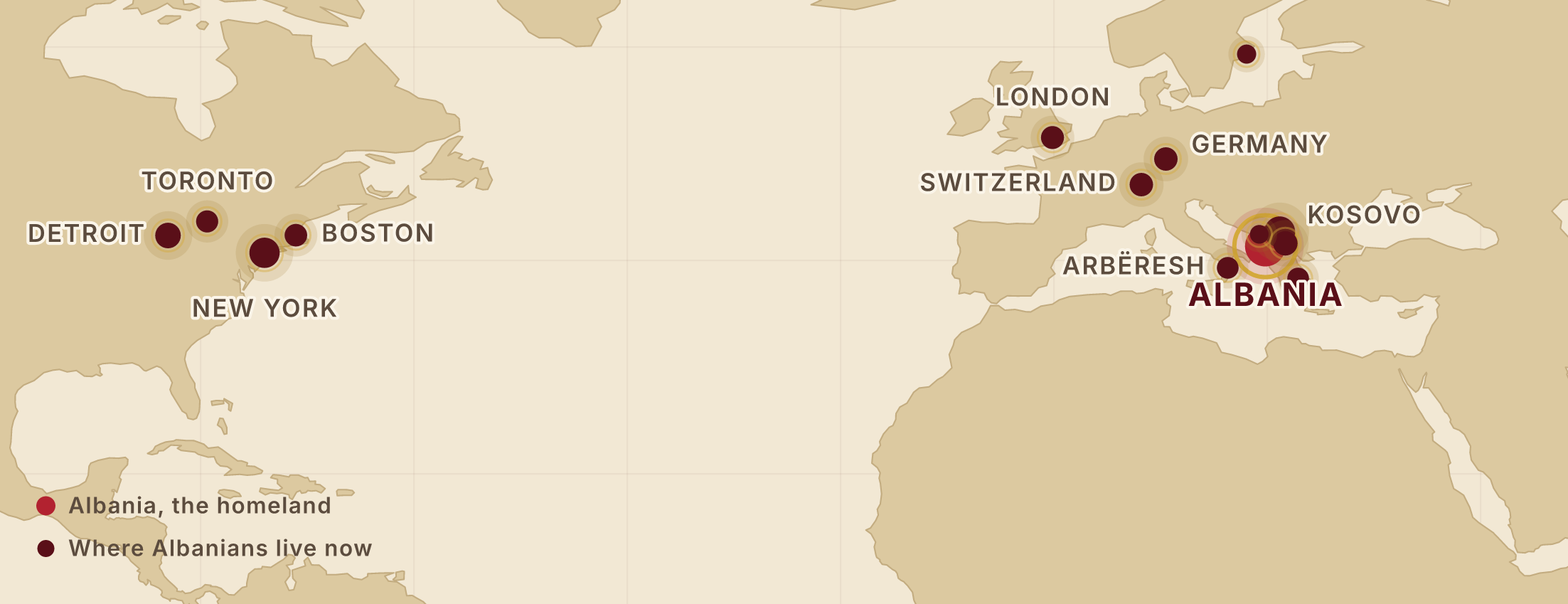
Albania the country holds about 2.4 million people. That is the figure from the 2023 INSTAT census, down about 15 percent from 2011, and about 2.18 million of those residents declared Albanian ethnicity. Now hold that number next to the other one: the world’s ethnic Albanians are usually counted at somewhere between 7 and 10 million. The arithmetic is the whole story. Most Albanians alive today do not live in Albania.
You can check the claim before you trust it. Kosovo’s 2024 census recorded 1,585,566 residents, 91.8 percent of them ethnic Albanian, which is close to 1.45 million people. That is the largest Albanian population anywhere outside Albania itself. Put Albania and Kosovo together and you get somewhere around 3.6 to 3.9 million. Even that leaves a very large share of the Albanian world living beyond both borders.
If you grew up Albanian in America, none of this is news to your gut. You always knew Shqiptaria, the word for Albanianness itself, was bigger than a map. You had cousins in three countries and a grandmother who spoke a dialect no atlas explained. What you may never have seen is the figure that makes the feeling literal. And here is the thread worth pulling: the reason that worldwide number is a range instead of a fact is the same reason it can feel invisible. No single authority has ever counted all Albanians. Being uncounted is not a footnote to the story. It is the story.
A people the border was drawn around
The state is younger than the people. Independence was declared on 28 November 1912 at Vlorë by Ismail Qemali. But Albanians did not draw their own borders. The London Conference of Ambassadors recognized Albania on 29 July 1913, and under Serbian and Greek pressure it handed roughly half the claimed territory to Albania’s neighbors. Estimates of how many Albanians were left outside the new state vary, and they should be treated with care, since counts from that era were themselves disputed. The standard accounts of the partition put it at 30 to 40 percent of the total Albanian population; the popular framing rounds it to “about half.” Call it 30 to 50 percent and you are being honest about the uncertainty.
Either way, the result baked in overnight. Kosovo, western Macedonia, southern Montenegro, the Preševo Valley, Chameria: Albanians divided across five states not by anyone moving, but by a line drawn in a room in London.
It was foreseen. The League of Prizren, founded on 10 June 1878, was the first organized Albanian national movement, formed precisely to resist the partition of Albanian-inhabited lands then split across four Ottoman provinces. The scattering was named, resisted, and imposed anyway.
Scattered for centuries, never once counted whole
The dispersion runs deeper than 1913. The Arbëreshë of southern Italy descend from Albanians who crossed the Adriatic as Ottoman power closed in after Skanderbeg died in 1468 and the strongholds of Krujë and Shkodër fell in 1478 and 1479. Around fifty of their communities still speak an archaic form of Albanian after roughly 550 years, entirely outside any Albanian state. The Arvanites of Greece settled south earlier still, in waves from roughly the 13th to the 15th centuries, the first of them before Ottoman rule reached the region. Both are branches of the Albanian-speaking world. Both, today, identify overwhelmingly with the countries they live in rather than as Albanians. They are history’s proof of how old the dispersion is, and of how completely assimilation can absorb it.
Then the modern seal. Under Communism, from 1944 to 1991, leaving Albania was a criminal act. The border was mined and patrolled with shoot-to-kill orders, and ordinary citizens could not get passports for almost the entire period. Forty-one years froze the population in place, which is the plain reason the Western diaspora is so young. When the dam broke it broke fast: somewhere between 300,000 and 350,000 people left Albania from 1990 to 1995. They stormed foreign embassies in July 1990. In August 1991 the cargo ship Vlora carried about 20,000 of them across the Adriatic to Bari. The 1997 collapse of the pyramid schemes sent another wave out. Italy and Greece absorbed most of them.
Every one of those landings has the same shape. Each wave arrived somewhere that did not record Albanians as Albanians. Dispersion and uncounting are one story told twice.
What crossed every border intact
The scattering never broke the identity, and it is worth being specific about what survived. Start with the language. Albanian, shqip, is its own branch of the Indo-European family with no close living relative. It holds together across five and more countries with no state to contain it, split into Gheg in the north and Tosk in the south, sharing about 90 percent of its vocabulary, standardized at the 1972 Congress of Orthography.
Then there is besa, the given word that cannot be broken, a code enforced by reputation rather than by any government, which is exactly why it travels with a stateless people. You do not have to romanticize it to respect it. The hard evidence is on the record: Albania ended the Second World War with more Jews inside it than before, and Yad Vashem honors 75 Albanians as Righteous Among the Nations, nearly all of them Muslim, for hiding Jewish families when the machinery of Europe was doing the opposite.
The flag carries the same lineage. The black double-headed eagle on red traces to Skanderbeg’s 15th-century war banner, revived at the 1912 declaration and still flying today, a marker older than every border it now crosses. And the identity was never built on a single faith. Pashko Vasa wrote the line that became the keystone: “Feja e shqiptarit është shqiptaria,” the religion of the Albanian is Albanianism. A people who are Muslim, Catholic, Orthodox, and Bektashi could never be defined by one confession, only by each other.
The overflow even has a face the whole world knows. Mother Teresa was born Anjezë Gonxhe Bojaxhiu in Skopje in 1910, an ethnic Albanian who never lived a day in the Albanian state and identified as Albanian her entire life. India, North Macedonia, Albania, and Kosovo all claim her. That shared claim is not a footnote either. It is the contested-belonging story in miniature.
The Albanian America you can’t fully count
Bring it home. Albanian America arrived in three waves: the labor migrants of the early 1900s who settled New England and the Great Lakes, the Cold War refugees after the Second World War, and the large wave after 1990 that included Kosovo-war refugees and diversity-visa arrivals. Albania alone took 44,806 diversity-visa immigrants between fiscal 1995 and 2016, an extraordinary number for a country its size.
The institutions came early. Fan Noli celebrated the first Albanian-language Orthodox liturgy in Boston on 22 March 1908, edited the newspaper Dielli, which is still published, and helped found Vatra, the Pan-Albanian Federation, on 28 April 1912. Vatra lobbied for Albanian independence at the 1919 Paris Peace Conference. The map that grew from all this still holds: New York, with the Bronx’s Belmont and Arthur Avenue as its institutional heart, metro Detroit around Troy and Sterling Heights, and greater Boston hold the bulk, with Waterbury, Chicago, Paterson, Florida, and Cleveland behind them.
And here is the single statistic that contains the entire thesis. The Census Bureau’s 2024 American Community Survey counts about 230,000 people of Albanian ancestry in the United States. Community estimates run from 750,000 to a million. That is a gap of four or five to one, and it is not a mystery. The ancestry question is a single voluntary write-in line. Albanians from Kosovo, Macedonia, and Montenegro often get coded under other nationalities. Recent and undocumented arrivals get missed. And the ACS is a sample, not a headcount. The 230,000 is a floor, not a count. Treat it that way, and treat the million as the community’s ceiling, not a government’s finding.
Uncounted is not an accident either
Widen the lens and the pattern is everywhere. No host country runs an ethnic-ancestry census where Albanians are numerous. Greece last recorded Albanian-speakers in 1951 and has kept no ethnic category since, which quietly erased a centuries-old population from its statistics. Turkey’s Albanian-descended population is estimated at anywhere from 500,000 to several million, a spread so wide that it is the single biggest reason the world total swings. Never cite the high end as fact; use it to understand why an honest total has to be a range.
Where a count does exist, it tends to be contested and weaponized. North Macedonia’s 2021 census put Albanians at 24.3 percent of residents, just above the 20 percent threshold in the Ohrid Framework that unlocks official language rights. That number is legal status as much as demography. And the clearest proof of all comes from Serbia. Preševo Valley Albanians boycotted the 2011 census, and Preševo municipality recorded just 5,809 of them. When they took part in 2022, roughly 100,000 Albanians were enumerated across Preševo, Bujanovac, and Medveđa. The earlier figure was never reality. It was a suppressed count.
A line in London, an assimilation with no census box, a boycott, a single voluntary write-in: the mechanism changes, the effect does not. Albanians are chronically undercounted almost everywhere, which is why 7 to 10 million is a conservative floor rather than a tidy fact. Honesty about that is the point, not a weakness. The Arvanites and most Arbëreshë do not call themselves Albanian now. Some of the higher figures come from advocacy sources. The American undercount shares its mechanics with other white-European ancestries, where “German” and “Irish” also slid toward “American” on the same voluntary line. Saying all of that out loud is precisely what separates a count from a claim.
A people can count itself
So the feeling you always had was right. Shqiptaria was always larger than Albania. You just had never seen the figure that proved it.
There is a quieter way to read all of this uncounting. Every state that failed to count Albanians did so on its own terms and for its own reasons, and none of them was ever going to count you whole. That is not a wound so much as an opening.
A people no state fully counts can still count itself. That is the entire premise of a registry: not a border, not a government, not a claim on anyone, just Albanians choosing to be recorded as Albanians. The world total is a range because no one has ever added it up from the inside. The distance between 230,000 and a million is not a puzzle waiting on a bureaucracy. It is a number that only closes one name at a time.