
Albanian Americans often hear the same one-line origin story at the kitchen table — we come from the Illyrians. The line is true in the broad sense and incomplete in the specifics. The Illyrians were not one people. They were a family of tribes (fis in Albanian, fiset in the plural) spread across the western Balkans, with their own kings, currencies, fortresses, and foreign wars. Some of them appear in Greek histories as early as the sixth century BCE. A few sit on the cultural overlap with the modern Albanian-speaking lands and carry most of the weight in the modern debate over Albanian origins.
This piece is the tribe-level companion to our wider survey of Illyrian culture. Where that article covers daily life, religion, art, and the Roman wars at the level of the Illyrian world as a whole, this one walks the named groups themselves: Dardani, Taulantii, Ardiaei, Enchelei, Labeates, Parthini, Bylliones, Pirustae, Liburni, Iapodes, and the dozen-plus other tribes whose names survive in classical sources.
We move geographically — south to north, coast to interior — rather than chronologically, and we name what is contested. The point is not to assemble a national pedigree but to give a US-based reader a sourced, careful, tribe-by-tribe map that can sit alongside the bumper-sticker version without contradicting it.
Who the Illyrians were, briefly
The Illyrians (ilirët, in modern Albanian) were a cluster of Indo-European peoples who occupied the western Balkans from the early Bronze Age through late antiquity. They are not a tight ethnic category in any modern sense. Greek and Latin authors used Illyrii and Illyrioi as a regional label for the non-Greek, non-Italic, non-Thracian populations of the eastern Adriatic and its inland mountains. Inside that label sat dozens of named tribes with their own kings, coinages, and shifting alliances.
What unified them, as far as the archaeology shows, was a shared cultural sphere — related Indo-European dialects, tumulus burial, hilltop fortresses with cyclopean walls, distinctive bronze fibulae and helmets, a polytheistic religion with regional patron deities. What divided them was nearly everything else: geography, allegiance to Macedon or Rome, alliances with Greek colonial cities, internal feuds. The Illyrian world functioned more like the Celtic world of the same period than like a unified state. “Illyrian” is a sphere of related peoples, not a nation — the tribes are the unit that matters.
Where the tribes lived
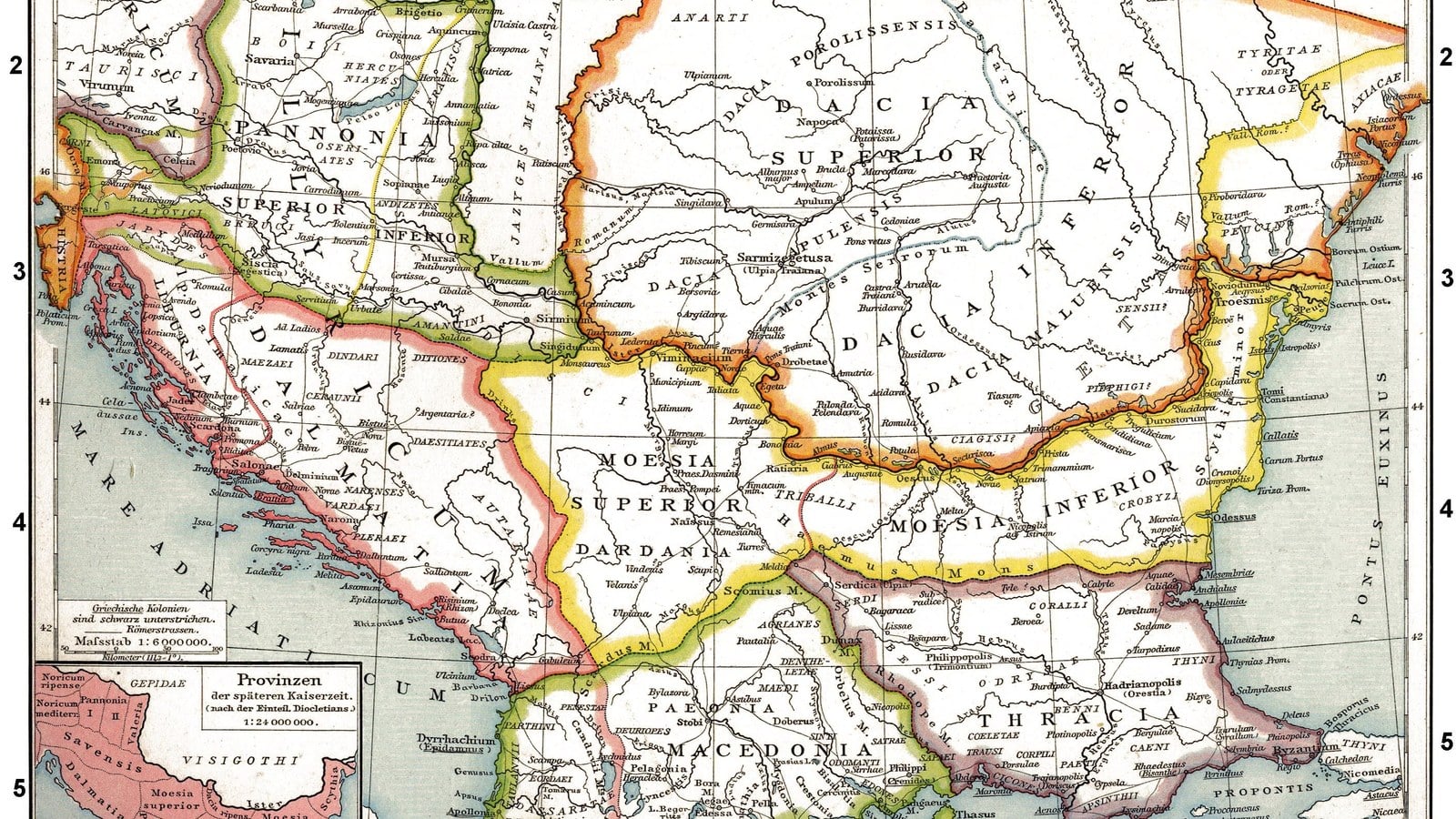
The Illyrian zone covered most of the western Balkans. Mapped against modern borders: present-day Albania in full, Kosovo, most of Montenegro, Bosnia and Herzegovina, western parts of North Macedonia, the Dalmatian coast and inland regions of Croatia, parts of Slovenia and northwestern Greece, and stretches of western and southwestern Serbia. The northern boundary blurred into Pannonia (modern Hungary, eastern Croatia, northern Serbia). The southern boundary blurred into Epirus, where the line between Illyrian and Greek-speaking populations was always porous.
Geography drove tribal organization. The Adriatic coast carried trade, piracy, and pressure from Greek colonies — Epidamnos (Roman Dyrrhachium, modern Durrës), Apollonia, Lissus, Issa, Pharos. The interior, dominated by the Dinaric Alps and the Albanian Alps further south, hosted hilltop fortresses and the kingdoms that grew up around them. River valleys — the Neretva, the Drin, the Vjosa, the Mat, the Bojana — carried inland trade.
Three broad zones organize the tribal map. The southern Illyrian zone sat in modern Albania, Kosovo, southern Montenegro, and western North Macedonia — Taulantii, Parthini, Labeates, Enchelei, Bylliones, the southern Dardani. The central and northern coastal zone ran up the Dalmatian shore through Croatia and Bosnia — Daorsi, Ardiaei (in their early phase), Dalmatae, Liburni. The interior and Pannonian zone covered the Bosnian highlands and the Pannonian basin — Iapodes, Pirustae, Daesitiates, Pannonii proper.
The southern Illyrian tribes
The southern tribes sit on the geography that matters most for the modern Albanian story. Their fortresses, their cities, and in many cases their place names continue under Albanian sound clothing into the present.
The Taulantii occupied central-coastal Illyria, anchored on the Greek colonial city of Epidamnos (later Dyrrhachium, today Durrës). They appear in Greek sources from the fifth century BCE and emerge as a major kingdom under Glaucias (reigned c. 335 to c. 295 BCE), who fought against Alexander the Great’s general Cassander, sheltered the infant Pyrrhus of Epirus after a coup, and intervened in the wars of Alexander’s successors. The Taulantii were, in their century, the principal southern Illyrian power.
The Parthini sat inland from Durrës, in the river valleys behind Epidamnos. They aligned variously with Rome, with Macedon, and with the Ardiaean kings depending on the decade. After the Roman intervention in the Illyrian Wars they fell into Rome’s protectorate zone and were eventually absorbed into the province of Macedonia.
The Bylliones held the area around the city of Byllis in central Albania (modern Hekal, Fier district), an inland Hellenistic-period city that still preserves substantial walls, a theater, and a basilica complex. The Bylliones were Hellenized early — by the fourth and third centuries BCE they minted their own coins in Greek style and engaged in Greek-style civic life — but their Illyrian linguistic and cultural substrate is clear in onomastic and archaeological evidence.
The Atintanes were a smaller southern group whose territory straddled the modern Albania-Greece border. Their classification is contested — some classical authors treat them as Illyrian, others as Epirote (within the Greek cultural sphere). The most cautious modern reading places them on the Illyrian-Epirote boundary, with elements of both.
The Chaonians are similar but more clearly Greek-leaning. Ancient sources sometimes group them with the Illyrians and sometimes with the Epirote Greeks (alongside the Molossians and Thesprotians, who are also Epirote). The dominant modern view classifies the Chaonians as Epirote rather than Illyrian, though Chaonia’s territory in modern southern Albania makes the question relevant for any tribe-level map. Read this one with care — it is the most-disputed classification on the list.
These southern tribes share two features with later Albanian history: their territory overlaps closely with the southern Albanian-speaking zone today, and their place names have continuous attestation through to modern Albanian forms.
The Dardani: Kosovo’s ancient core
The Dardani (in Albanian, Dardanët) occupied the territory that now makes up Kosovo, the northwestern corner of North Macedonia, and stretches of southern Serbia. They first appear in Greek sources in the fourth century BCE and remained a major regional power for the next four hundred years.
Their classification is one of the live debates in Paleo-Balkan studies. The mainstream Albanian position, supported by toponymic and archaeological work, treats the Dardani as core Illyrian. The older Yugoslav historiography — notably N.G.L. Hammond in A History of Macedonia (1972) — treats them as a Thraco-Illyrian or mixed Paleo-Balkan group with Thracian elements in the east. Bulgarian and some Serbian scholarship has at times pushed the Thracian classification harder. The honest synthesis: the Dardani were a Paleo-Balkan people who sat on the Illyrian-Thracian cultural boundary, sharing features with both, with the western and southern Dardani more clearly Illyrian and the eastern Dardani showing more Thracian markers.
The Dardani’s main political figure in the sources is Bardyllis (c. 448 to 358 BCE), variously classified as Dardanian or as ruler of a southern Illyrian confederation that included Dardanian territory. Bardyllis defeated the Molossian Greeks and the Macedonians in turn, holding the upper hand against both kingdoms for decades. In 358 BCE, the young Macedonian king Philip II — father of Alexander the Great — defeated and killed the by-then 90-year-old Bardyllis at the Battle of the Erigon Valley, ending Illyrian dominance over Macedon.
After Bardyllis, the Dardani reorganized as a more localized kingdom in the highlands of modern Kosovo. They clashed repeatedly with Macedon through the third and second centuries BCE, generally aligning with Rome against the Macedonian kings. They were progressively brought under Roman administration through the first century BCE, with the territory eventually organized as the province of Moesia Superior, including a smaller administrative unit called Dardania.
For diaspora readers with Kosovar family roots, the Dardani are the ancient anchor. Modern Kosovo’s name itself does not derive from “Dardania” — the etymology runs through medieval Slavic — but the territorial continuity from the Dardanian heartland to modern Kosovo is clean, and the toponym Dardania has been revived periodically in Albanian and Kosovar political discourse.
The Ardiaean kingdom and Queen Teuta
The most powerful Illyrian kingdom in the historical record was Ardiaean. The Ardiaei (in Albanian, Ardianët) originated around the Neretva valley in modern Herzegovina, expanded south along the Adriatic coast through the third century BCE, and built a navy that controlled the eastern Adriatic from roughly the Bay of Kotor to the Greek islands.
The Ardiaean kingdom’s imperial phase ran roughly 250 to 168 BCE. King Agron (reigned c. 250 to 231 BCE) built the navy and defeated an Aetolian Greek army sent to relieve the besieged city of Medion in 231 BCE. Agron died shortly after the victory and the regency passed to his widow, Queen Teuta.
Teuta is the most famous Illyrian ruler in classical literature. She pushed the kingdom’s piracy to its furthest extent, with Ardiaean ships operating against Greek merchants as far south as the Peloponnese and against Italian shipping as far west as the Italian shore. According to Polybius, Rome sent the brothers Gaius and Lucius Coruncanius as envoys to demand restraint; Teuta refused and one of the envoys was killed on the way home. The First Illyrian War (229 to 228 BCE) followed, forcing the kingdom into a treaty that restricted Illyrian warships south of Lissus (modern Lezhë).
The kingdom contracted but survived. Under later rulers — Pleuratus, then Genthius (the last king of consequence) — its center of gravity shifted to the Labeatean lake basin around Scodra (modern Shkodër). The Third Illyrian War (168 BCE) ended the kingdom outright when Genthius allied with Perseus of Macedon against Rome, was defeated in roughly thirty days by Roman praetor Lucius Anicius Gallus, and was paraded through Rome in a triumph (Livy, Ab Urbe Condita, books 44 and 45). The Ardiaeans, originally a Herzegovinian people, ended their political existence as a Shkodër-centered kingdom — which is why so much of their story sits inside modern Albanian historical memory.
The Enchelei, Labeates, and the lake systems
Two tribes anchor the Illyrian story around the great lakes of the southern western Balkans — Lake Ohrid and Lake Shkodër.
The Enchelei (in Albanian, Enkelejtë) are among the oldest-attested Illyrian groups in Greek sources, appearing in mythology as the people Cadmus and Harmonia ruled at the end of their lives after migrating from Thebes. The mythic story sits over a real Iron Age population in the Lake Ohrid basin — in modern terms, the borderlands of southeastern Albania, southwestern North Macedonia, and northwestern Greece. The Enchelei engaged in early conflict with the Macedonian kingdom and were progressively absorbed into the Macedonian and then the Roman political orbits through the fourth and third centuries BCE.
The Labeates (in Albanian, Labeatët) held the basin of Lake Shkodër, on the modern Albania-Montenegro border. Their territory included Scodra itself, the late Illyrian royal capital, and the fortress system around the lake — Meteon, Ulcinj, Doclea. The Labeates supplied the core territory of the final Ardiaean-Labeatean kingdom; when Roman sources speak of the “Illyrian kingdom” after about 200 BCE, they are largely describing Labeatean ground with Ardiaean kings sitting on top of it. After 168 BCE the Labeates were absorbed into the province of Illyricum and later Praevalitana.
Both Enchelei and Labeates built dense fortress networks around their lakes, and both left material assemblages (the Komani-Kruja culture’s earliest phases overlap with the Labeatean zone) that bridge into the medieval period. For diaspora readers, the Shkodër basin in particular is the geographic core where the late Illyrian story unfolds — and where the modern continuity case has its strongest archaeological footing.
Northern and western tribes
The northern half of the Illyrian zone produced its own kingdoms and a century-long resistance to Rome. Several groups in this band sit at the edge of “Illyrian” as a category.
The Dalmatae of central Dalmatia gave the region its enduring name and were the dominant power in the central Adriatic from roughly the second century BCE forward. They fought Rome repeatedly — campaigns in 156 to 155 BCE, 119 to 118 BCE, 78 to 76 BCE, and finally during the Bellum Batonianum (Great Illyrian Revolt) of 6 to 9 CE. The Dalmatae were the last large Illyrian polity to be effectively pacified, only fully absorbed under Augustus and Tiberius.
The Iapodes occupied the inland highlands of modern western Croatia and northwestern Bosnia. Roman authors usually class them as Illyrian, but the Iapodes show clear Celtic influences in material culture and onomastics — likely the result of Celtic migrations into the region in the fourth and third centuries BCE. Most modern scholars treat them as Illyrian-adjacent: part of the same cultural sphere, but with Celtic admixture that sets them apart from the southern core. Octavian campaigned against the Iapodes personally in 35 BCE in a famous siege of Metulum.
The Liburnians held the northern Adriatic coast and islands, from the Istrian peninsula down through modern Croatia’s Kvarner region. They were famous Adriatic sailors — the Roman liburna, a fast warship later adopted by the Roman navy, takes its name from them. Their classification is debated. Older scholarship grouped them firmly as Illyrian; more recent work treats them as a distinct Paleo-Balkan people with Venetic and Italic features alongside Illyrian elements — the northwestern, Italic-influenced edge of the Illyrian sphere.
The Pirustae lived in the highlands of modern Montenegro and northern Albania, around silver and lead mines that mattered to the Roman provincial economy. After conquest, whole Pirustae communities were deported to Roman mining operations in Dacia after Trajan’s conquest there in 106 CE.
The Daesitiates of the central Bosnian highlands led the Bellum Batonianum alongside the Breuci of Pannonia — a four-year war that Suetonius called the most serious external threat Rome had faced since the Punic Wars. The Daesitiate king Bato fought Roman forces under the future emperor Tiberius for four years before surrendering in 9 CE.
The Pannonii were the Illyrian-affiliated population of the Pannonian plain — modern eastern Croatia, northern Serbia, parts of Hungary and Slovenia. Their classification mirrors the Iapodes question: Roman sources call them Illyrian, while modern scholarship reads them as a related but distinct Pannonian-Illyrian group with Celtic and later Germanic admixture.
Romanization and the Illyrian emperors
By 9 CE the entire Illyrian zone was under Roman administration. What followed was three centuries of Romanization — the slow absorption of Illyrian aristocracies into Roman provincial life, Latin-speaking colonies along the major roads (the Via Egnatia across modern Albania and North Macedonia), and the conversion of hilltop fortresses into Roman municipia. Illyrian as a spoken language gradually contracted to the highlands and to a substrate underneath developing local varieties of Latin.
But the Illyrian provinces — Dalmatia, Pannonia, Moesia, Praevalitana, Epirus Nova, Dardania — produced something unexpected in the third and fourth centuries CE: a string of Roman emperors. Claudius II Gothicus (reigned 268 to 270 CE), born in Sirmium or nearby in Pannonia. Aurelian (reigned 270 to 275 CE), the soldier-emperor who reunified the Empire after the Crisis of the Third Century. Probus (reigned 276 to 282 CE), also born in Sirmium. Diocletian (reigned 284 to 305 CE), born around 244 CE near Salona in Dalmatia (modern Solin, Croatia), the emperor who restructured the Roman state through the Tetrarchy. Constantine the Great (reigned 306 to 337 CE), born around 272 CE at Naissus (modern Niš, Serbia) in the eastern Illyrian zone.
Historians describe this cluster as the “Illyrian emperors.” The label is regional and provincial more than strictly ethnic — by the late third century, “Illyrian” meant “from the Illyrian provinces” as much as it meant ethnic descent from any specific tribe. But the geographic continuity with earlier Illyrian populations is real. Diocletian in particular has a place in modern Albanian and Croatian heritage memory: he retired to his native Dalmatia in 305 CE and built the palace at Spalatum (modern Split) that still stands as the core of the city.
The continuity question: from Illyrian tribes to Albanians
This is the part the diaspora reader most wants to know about, and it is also the part where careful historians slow down.
The mainstream scholarly position, accepted by most Albanian, Western, and many Balkan historians and linguists, runs roughly this way. Modern Albanians descend at least partially from a Paleo-Balkan population, most likely Illyrian or closely related to it. The evidence rests on four pillars.
First, geographic continuity. The southern Illyrian zone — Taulantii, Labeates, Parthini, Enchelei, southern Dardani — overlaps closely with the historically and currently Albanian-speaking lands. There is no archaeological or textual evidence of a large migration into this territory between the Illyrian period and the medieval Albanian period.
Second, toponymic continuity. Pre-Roman place names survive into Albanian under predictable sound changes. Scodra becomes Shkodër. Dyrrhachium becomes Durrës. Lissus becomes Lezhë. Olcinium becomes Ulqin. The rivers Drin and Mat keep their pre-Roman names. The pattern points to a continuously-spoken language in the region transmitting these names across two thousand years.
Third, linguistic isolation. Albanian is a unique branch of Indo-European with no surviving close relatives. The closest documented relative is extinct Messapic, spoken in southeastern Italy by populations widely believed to have crossed the Adriatic from the Illyrian zone in the early Iron Age. Such isolation implies long, continuous presence in or near the western Balkans.
Fourth, archaeological continuity. The Komani-Kruja culture (roughly fourth through ninth centuries CE), spread across central and northern Albania, southern Montenegro, and western North Macedonia, is widely read as a transitional assemblage bridging late-antique Illyrian-Roman provincial society and the early medieval Albanian population.
The Thraco-Dacian counter-hypothesis, associated with scholars including Gottfried Schramm and elements of older Bulgarian and Romanian historiography, argues that Albanian descends instead from a Thracian or Daco-Moesian population that migrated west into the historically Illyrian zone in late antiquity. Proponents point to certain features of Albanian vocabulary, some place-name parallels in the eastern Balkans, and the relatively late appearance of the Albanian ethnonym (the first secure attestation is in Byzantine historian Michael Attaleiates around 1078 CE). The Thraco-Dacian hypothesis is a minority view but not a fringe one, and it remains under active debate.
What linguists agree on: Albanian is Indo-European, a unique branch with no living close relatives, the closest known relative is extinct Messapic, and Latin loanwords in Albanian show patterns consistent with early contact with western (not eastern) Roman Latin. What they do not agree on is whether the underlying Paleo-Balkan substrate was specifically Illyrian, Thracian, Daco-Moesian, or some related Paleo-Balkan group whose name is no longer recorded. Direct comparison — Illyrian sentences against Albanian sentences — is not possible, because Illyrian sentences are not preserved beyond fragments and proper names.
Origin questions in the Balkans are never just academic. The careful posture is to hold the Illyrian-continuity view as the most likely working hypothesis, take the partial nature of the evidence seriously, and be skeptical of both nationalist overreach and politically motivated revision.
What this means for the diaspora today
For Albanian American families, the tribal map does a kind of work the broad “Illyrian” label cannot. It puts the deep past in the same geography the family knows.
A second-generation kid in Yonkers whose grandparents came from Shkodër can point to the Labeates. A family from Berat or Fier sits inside old Bylliones territory. Kosovar Albanian Americans in Westchester or Michigan trace to the Dardanian heartland. Albanians from the Lake Ohrid region of North Macedonia sit on Enchelei ground. Tropojë and the northern Albanian highlands overlap Pirustae territory. Italian Arbëresh families, whose ancestors crossed the Adriatic in the fifteenth century after Skanderbeg’s death, are walking the same crossing the Messapic-speaking populations made two and a half millennia earlier.
No modern Albanian family is “descended from” one specific tribe in any traceable sense — the genetic and demographic record is far too tangled. But the ancestral landscape has named contours. Where do we come from? gets a more specific answer than the Illyrians: it gets named tribes on a real map, in a geography that connects modern Durrës to ancient Dyrrhachium, modern Shkodër to ancient Scodra, modern Prizren to ancient Dardania.
The US Census recorded about 230,000 Albanian Americans in the 2024 American Community Survey, with community estimates including second- and third-generation and ethnic Albanians running closer to one million. Most of those families came from villages and towns sitting on territory that two thousand years ago was Taulantian, Labeatean, Dardanian, Enchelean, Parthinian, or one of the dozen other named groups in this article. The continuity is not literal lineage — it is the same patch of earth, recorded for a very long time.
If you want to be counted in that record, add yourself to the count. Every registration is a small claim on a place in the count of Albanian Americans whose roots run back to these tribes and to the mountains and lake basins they fortified.