

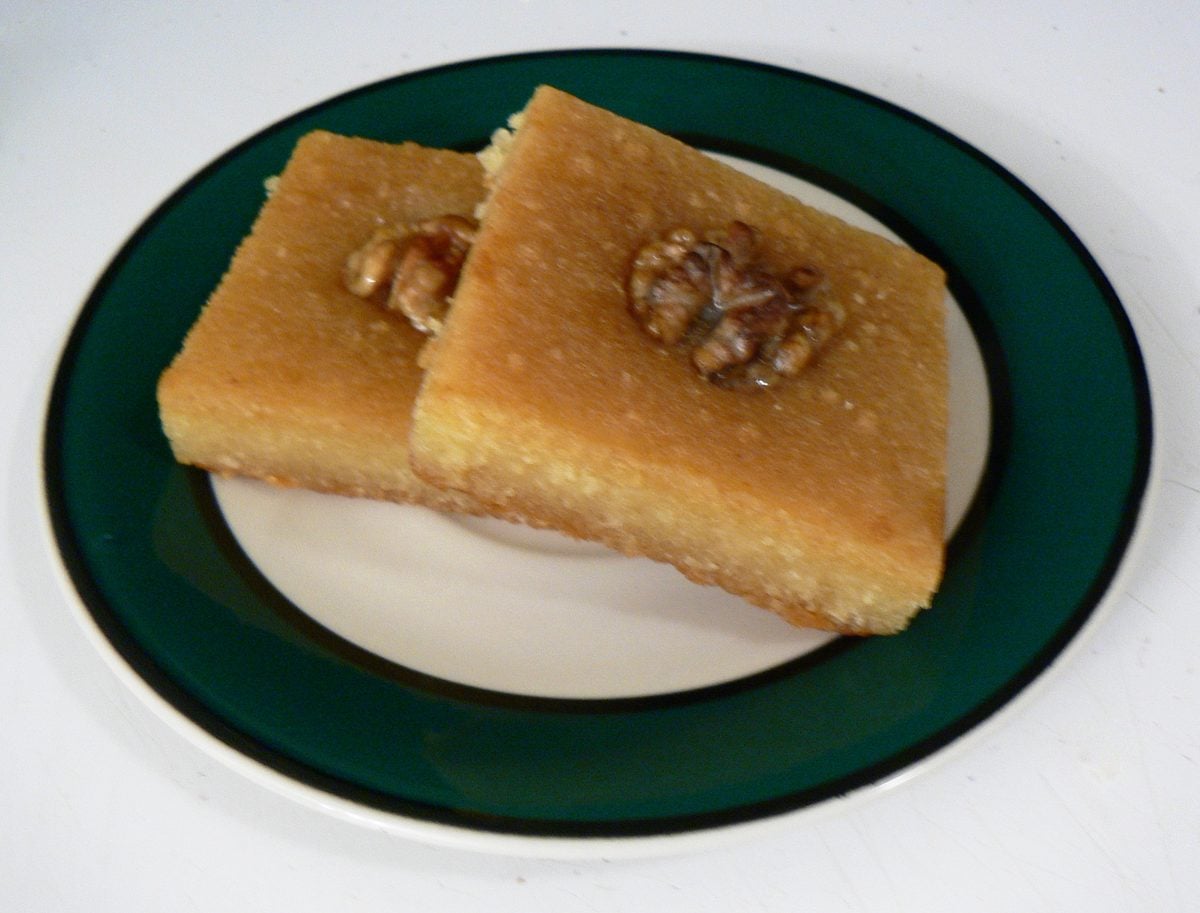
Revani is the Albanian semolina syrup cake — a batter of fine semolina, yogurt, eggs, and sugar, baked dry in a pan, scored into diamonds, then soaked through with a cool lemon-scented sugar syrup until the coarse crumb turns moist and glossy. It is not a frosted layer cake and not a milk-soaked sponge. It is its own category: a cake built to drink syrup, eaten cold or at room temperature, cut into small pieces with a fork or fingers.
This guide is for the Albanian-American cook who remembers a square of revani on a holiday tray and wants the method written down, and for the second- or third-generation cook who has only ever bought it from a Balkan bakery and wants to bake it at home. The recipe is short. The variables are the ones that decide everything — the grind of semolina you can find in a US store, the ratio of syrup to cake, and the single most important rule in the whole tradition: which goes on hot and which goes on cold.
A note on the count: NAR is the National Albanian Registry, a 501(c)(3) building a community-led count of Albanian Americans. Recipes like this one are part of the cultural record we are documenting. If your family carries a revani recipe forward — soaked the way your grandmother soaked it — we want to know who you are and where you settled. More on that at the end.
What Revani Is
Revani is a semolina cake soaked in sugar syrup. That one sentence does most of the work of defining it. The cake itself is baked stiff and a little dry on purpose — the syrup is what finishes it. Pour the syrup, wait an hour, and the dry crumb you pulled from the oven becomes moist, dense, and faintly sandy on the tongue from the semolina grains that never fully dissolve.
The Albanian version leans on yogurt in the batter. The acidity tenderizes the crumb and reacts with the baking powder to give a little lift, so the cake is not as heavy as a plain semolina pudding. Eggs carry the structure; sugar sweetens the cake before the syrup arrives; butter or neutral oil keeps it from drying. The finished piece is cut into the diamond shape that runs across the Ottoman dessert world — the same lozenge you see on a tray of bakllava.
Color, when it is right, is pale gold on top and slightly deeper at the edges. The texture is the tell. A good revani holds its shape on a fork, gives a small resistance, then releases its syrup. It should never be soup. It should never be dry in the center. It sits exactly between cake and pudding, which is the whole point of the format.
Revani is also nut-free and dairy-light by the standards of the Albanian sweet table, which makes it the safe pick when there are walnut allergies in the room or when the heavier cakes feel like too much. It travels well, keeps for days, and serves cold — three reasons it became a fixture on holiday and bakery tables.
How Revani Differs from Other Albanian Cakes
The Albanian cake table is not one cake; it is a sweet table with several soaked desserts that look related but are not. Revani’s closest-looking cousins are the ones it is most often confused with, so it is worth being precise.
The clearest contrast is with trilece. Both are soaked cakes cut from a 9x13 pan, but the soak is everything. Revani is a coarse semolina cake soaked in a clear lemon-and-sugar syrup, so it eats firm and shelf-stable. Trilece is a fine-flour sponge soaked in three milks and topped with caramel, so it eats wet and custardy and has to stay cold. Different grain, different liquid, different finish. If you bite something firm and sandy with a lemon edge, it is revani; if you bite something that collapses into milk under amber caramel, it is trilece.
Revani also differs from shendetlie, the honey-and-walnut cake. Shendetlie carries ground walnuts in the crumb and a honey-lemon syrup, which makes it darker, denser, and nuttier than revani’s pale, plain semolina base. Shendetlie reads as a cold-weather, walnut-forward holiday cake; revani reads as a lighter, year-round one.
And revani is not bakllava, even though both wear the diamond cut and the syrup soak. Bakllava is built from layers of paper-thin pastry and ground nuts, a phyllo construction. Revani is a single homogeneous batter, no layers, no nuts required. They share a syrup tradition and a serving shape, nothing more.
The plain takeaway: when someone hands you “Albanian cake,” ask what is in it and what soaked it. Semolina plus clear lemon syrup means you are eating revani.
Where Revani Comes From
Revani is an Ottoman-era dessert that spread with the empire and was kept by every kitchen the empire touched. It is shared across Turkey, Greece — where it is usually spelled ravani — the Balkans including Albania, and parts of the Middle East, with small adjustments at each border (Revani, Wikipedia). The Albanian version is one branch of a wide family tree, not the trunk, and the honest framing is that no single country owns it.
The name has more than one origin story and none is settled. The most-repeated account ties revani to Revan, the Ottoman Turkish name for Yerevan, the city in present-day Armenia that Sultan Murad IV captured in the 17th century — the dessert reportedly named to mark the victory. A competing account credits a 16th-century Ottoman poet named Revani. A third traces the word to a Persian root meaning “flowing” or “the precious.” These are folk etymologies layered on a long history; the dish itself predates any tidy origin tale.
In Greece, the city of Veria became so associated with ravani that the name and the city are linked in many Greek minds, a popularization usually dated to the late 1800s. Turkish revani is marked by yogurt in the batter; Greek ravani often leans on honey in the syrup and sometimes coconut or almonds in the cake. The Albanian version sits close to the Turkish prototype — yogurt in the batter, a clear lemon-sugar syrup — which makes sense given the centuries of shared Ottoman kitchen vocabulary across the southern Balkans.
For the diaspora cook, the lineage matters less than the result. Whatever route it took to your family’s table, revani arrived as a known quantity: semolina, syrup, the diamond cut, the cold serve.
Ingredients
For one 9x13 pan, twelve to sixteen pieces.
For the cake:
- Semolina — 1.5 cups (255 g). Medium-grind is the target. In US stores, Bob’s Red Mill semolina flour or plain bagged semolina near the specialty grains is the easiest find. (Notes on grade below.)
- All-purpose flour — 0.5 cup (60 g). Some households go all semolina; a little flour softens the crumb and helps it hold together.
- Plain whole-milk yogurt — 1 cup (240 g). Greek or regular both work; whole-milk gives the best crumb. Not flavored, not low-fat.
- Eggs — 3 large, room temperature
- Granulated sugar — 0.75 cup (150 g) for the batter
- Unsalted butter, melted — 0.5 cup (115 g), or neutral oil (sunflower, canola)
- Baking powder — 2 teaspoons
- Baking soda — 0.5 teaspoon (works with the yogurt’s acidity)
- Salt — 0.25 teaspoon
- Vanilla extract — 1 teaspoon
- Lemon zest — from 1 lemon
For the syrup:
- Granulated sugar — 2 cups (400 g)
- Water — 1.5 cups (355 ml)
- Lemon juice — 2 tablespoons (this keeps the syrup from crystallizing and brightens the cake)
- A strip of lemon peel — optional, for scent
- A cinnamon stick or 1 clove — optional, common in some households
Optional finishes, depending on the household:
- A handful of shredded coconut over the top (more common in Greek-influenced versions)
- A few blanched almonds pressed into each diamond before baking
- A spoon of rosewater or orange-blossom water in the syrup (a Middle Eastern touch some Albanian cooks adopted)
A Note on Semolina Grades in US Stores
Semolina is the one ingredient that trips up diaspora cooks, because the US grocery store sells several things under nearby names and they are not interchangeable.
What you want is medium-grind semolina — coarse enough that you can feel grains between your fingers, fine enough that it hydrates fully in the batter. Bob’s Red Mill labels theirs “semolina flour”; it is the medium grind despite the word “flour.” Most Italian and Middle Eastern groceries sell bagged semolina at the right grind for less money.
Cream of Wheat and other farina cereals are finely milled wheat and will work in a pinch, but the crumb comes out softer and less characteristically sandy. If that is all you can find, use it, and accept a lighter, more cake-like result.
Avoid two extremes. Very fine semolina rimacinata (the twice-milled flour for pasta and bread) hydrates into something closer to a plain cake and loses the texture that makes revani revani. Coarse durum meal or polenta-grade semolina goes the other way — gritty, slow to soften, and prone to a sandy-in-a-bad-way center even after soaking. Medium is the whole game.
If you can only find fine and coarse, blend them roughly half and half to fake the medium grind. The cake is forgiving about most things; it is particular about this one.
The Method, Step by Step
The equipment list is short: a 9x13 inch baking pan at least 2 inches deep, a large mixing bowl and a whisk, a medium saucepan for the syrup, a zester for the lemon, a skewer for testing doneness, and a sharp knife for scoring the diamonds. No stand mixer, no thermometer — revani batter is stirred, not whipped, which is part of why it survived the trip across the ocean intact.
Step 1 — Heat the oven and prep the pan
Heat the oven to 350°F (175°C). Butter the 9x13 pan or line the bottom with parchment and butter the sides. The cake stays in the pan through soaking and serving, so a clean release matters less than even sides.
Step 2 — Mix the wet ingredients
In a large bowl, whisk the eggs and the 0.75 cup sugar until pale and slightly thickened, about a minute by hand. Whisk in the yogurt, the melted butter (or oil), the vanilla, and the lemon zest until smooth.
Step 3 — Add the dry ingredients
In a separate bowl, stir together the semolina, flour, baking powder, baking soda, and salt. Add the dry mix to the wet and stir just until combined and no dry pockets remain. Do not overmix — a few lumps are fine, and beating it hard makes the crumb tough. The batter will be thick and a little grainy. Let it rest 10 minutes; the semolina drinks some of the liquid and the batter settles.
Step 4 — Score and bake
Pour the batter into the pan and smooth the top. Before baking, run a knife lightly across the surface to mark the diamond pattern — this makes the syrup soak evenly and the pieces cut clean later. Bake 30 to 35 minutes, until the top is pale gold, the edges pull slightly from the pan, and a skewer in the center comes out clean. Underbaking is the most common cause of a gummy center, so trust the skewer over the clock.
Step 5 — Make the syrup while the cake bakes
Combine the 2 cups sugar, 1.5 cups water, lemon juice, and any optional peel or spice in a saucepan. Bring to a boil, then simmer 8 to 10 minutes until it thickens slightly — it should coat a spoon but still pour freely. Take it off the heat and let it cool. The syrup must be cool when it meets a hot cake (see the next step). Fish out the peel and spice.
Step 6 — Soak: hot cake, cold syrup
This is the rule the whole dessert turns on. The moment the cake comes out of the oven, ladle the cool syrup evenly over the hot surface, working slowly and letting each pass absorb before the next. The temperature gap pulls the syrup straight down through the crumb. Use most or all of the syrup; the cake will look flooded and that is correct. (The reverse method — cold cake, hot syrup — also works; just never pour hot syrup on a hot cake or cold on a cold one, or it pools on top instead of soaking in.)
Step 7 — Rest, cut, serve
Let the soaked cake sit at room temperature at least 1 hour, ideally 2 to 3, so the syrup distributes fully. Cut along the scored diamonds. Serve at room temperature or cold. Revani is better after a few hours and better still the next day.
Doneness and Soak Cues
Two moments decide whether a batch works, and both are about reading the cake rather than the timer.
Doneness before soaking. The cake must be fully baked before any syrup touches it. The cues: the top is set and pale gold, not wet or jiggly; the edges have pulled a hair away from the pan walls; a skewer pushed into the center comes out with no raw batter clinging to it. A center that is even slightly underdone will turn to paste once the syrup arrives, because raw semolina batter plus hot syrup equals glue. When in doubt, give it another three minutes.
The soak. Right after pouring, the surface should look flooded — a shallow pool of syrup sitting on top with the cake visible underneath. Within fifteen to twenty minutes that pool should be mostly gone, drawn down into the crumb. If the syrup is still pooling after half an hour, the cake was too cool, the syrup was too cool, or both, and you have lost the temperature contrast. If the syrup vanished instantly and the top looks dry, the cake was overbaked and thirsty; a little extra syrup spooned over fixes it. The finished texture you are aiming for is moist and firm — wet enough that a piece glistens at the cut, firm enough that it holds its diamond shape on the plate.
Serving, Storage, and the Diaspora Table
Revani is served cold or at cool room temperature, cut small, often with a cup of strong coffee. It does not need cream, ice cream, or any garnish, though a few cooks scatter coconut or a single almond on each piece. On an Albanian-American holiday table it shares the tray with trilece, bakllava, and the rest of the Albanian sweet table — the lighter, plainer option that lets a guest who has already eaten heavier desserts take one more square without regret.
It keeps well, which is half of why it endures in the diaspora. Cover the pan loosely and leave it at cool room temperature for up to two days; the sugar syrup acts as a preservative and the cake actually improves overnight as the soak settles. Past two days, move it to the refrigerator, then let pieces come back to room temperature before serving so the crumb relaxes and the syrup loosens. Soaked revani also freezes for up to two months — wrap it well and thaw covered overnight in the refrigerator.
In US kitchens, revani shows up most reliably at the moments that gather the family: holiday meals, name days, the dessert tray a relative carries to someone else’s house. It is also a common case-display item at Albanian, Greek, and Turkish bakeries across the high-density areas — New York, Michigan, Massachusetts — usually shelved near the bakllava and sold by the diamond. Because the format is shared across those three traditions, a Greek or Turkish bakery will often have a near-identical ravani when an Albanian bakery is not within driving distance.
Common Failure Modes
Three problems account for nearly every revani that disappoints, and each has a clear fix.
Gummy or wet center. Almost always underbaking, sometimes compounded by too much syrup. Raw batter in the middle never set before the syrup hit it, so it turned to paste. Bake until the skewer is clean and the edges pull from the pan, and measure the syrup rather than eyeballing it. If your oven runs cool, give the cake the full 35 minutes and check again.
Syrup not absorbing. The temperature rule was broken. If both cake and syrup were warm, or both cold, the surface sealed and the syrup sat on top. Pour cool syrup on a just-out-of-the-oven hot cake (or hot syrup on a fully cooled cake) and let the steam do the pulling. Scoring the diamonds before baking also opens channels for the syrup to follow.
Dry cake. Usually too little syrup, or syrup cooked so long it reduced to a thick glaze that coated the surface instead of soaking in. The syrup should coat a spoon but still pour freely — if it strings or sheets like honey, it went too far; thin it with a splash of hot water and try again. Overbaking dries the crumb too, so a dry, thirsty cake often points back to the oven as well. A correctly made revani is moist and firm, never dry and never soup.
Why Documenting Recipes Like This Matters
Albanian-American kitchens carry knowledge that lives nowhere on paper. A grandmother in Worcester or the Bronx or Sterling Heights bakes revani from memory — her grind of semolina, her ratio of syrup, the exact moment she judged the cake done before pouring. When she stops cooking, that version of the recipe usually goes with her. Published cookbooks cover the broad strokes; they rarely capture whether her family soaked the cake hot or cold, or whether they finished it with coconut the way the family across the street did.
NAR is building a community-led count of Albanian Americans — the registry side of the work. The recipe side is part of the same effort. Every dish that travels from a Balkan kitchen to a US one is a thread in the diaspora’s cultural record, and writing it down is how a tradition survives across an ocean and three generations.
If your family bakes revani — or any dish passed down through generations — we would like to count you. Adding your name to the registry helps us document who we are, where we come from, and what we carry forward. Get counted →