
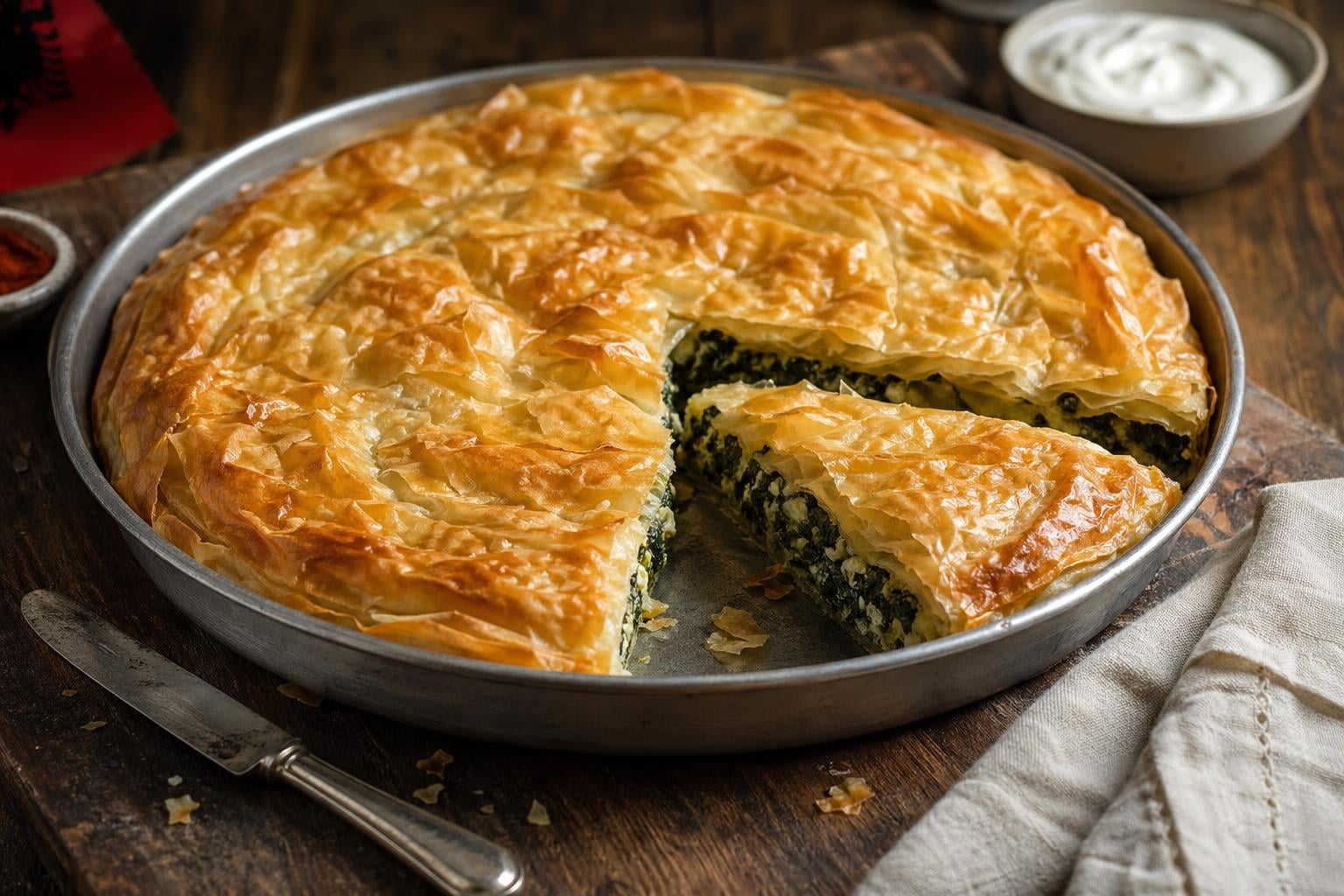
Ask an Albanian grandmother in Worcester, Sterling Heights, or the Bronx what “Albanian cake” means and the answer is rarely one cake. It is a sweet table — ëmbëlsira (em-bel-SEE-rah), the Albanian word for the whole category — and on a holiday or wedding Sunday the table holds four or five at once. A tray of trilece (three-milk cake) chilling in the refrigerator. A square pan of shendetlie (honey-walnut cake) cut into diamonds. Bakllava (Albanian-style baklava) drenched in syrup. Revani (semolina syrup cake) cooling under a tea towel. A plate of gurabija (butter cookies) for the coffee.
This is the cake culture the diaspora carried over. It sits at the crossroads of three traditions — Mediterranean, Ottoman, and Balkan — and the diaspora kitchen kept all three on the same table. The Albanian sweet repertoire is older than the country’s modern borders; its building blocks (semolina, honey, walnuts, phyllo, syrup, fresh milk) ran across the region for centuries before the 1912 independence that drew Albania’s modern lines.
This guide walks the full set: what each cake is, where it comes from, how it lands in the Albanian-American kitchen, and where to find the ones that are hardest to bake at home. The framing throughout is the US diaspora — the immigrant grandmother’s recipe card, the second- and third-generation cook trying to reproduce a holiday memory, the family that wants to know what to bring to an Albanian wedding.
What “Albanian cake” means in Albanian kitchens
The English word “cake” is narrower than the Albanian sweet repertoire it has to cover. American English cake is usually a flour-based, leavened, frosted layered round. Albanian sweets include layered cakes, but they also include sponge cakes soaked in syrup or milk, semolina puddings baked and cut into squares, phyllo desserts, fried sweets, and wheatberry-based puddings — all of which sit alongside cake on the dessert table and are referred to by the same general category words.
Three Albanian words do the work of “cake” depending on the household. Kek (kek) is the borrowed English-via-modern-Albanian word for cake in the Western sense — used for birthday cakes, sponges, the trilece. Tortë (TOR-teh) is the older word for a layered or formed cake, closer to the German Torte or the Italian torta. Ëmbëlsirë (em-bel-SEE-reh; plural ëmbëlsira) is the broader category — sweet, dessert — used for anything from baklava to a poached pear.
Pronounce them once in front of an Albanian grandmother and the wrong word is corrected gently. Trilece is a kek. Bakllava is an ëmbëlsirë, not a kek — it is a phyllo pastry. Shendetlie sits between: it is shaped like a kek (baked in a pan, cut into squares) but the syrup soak puts it on the ëmbëlsirë side of the menu in many homes.
Regional vocabulary matters. The northern Albanian and Kosovar tradition leans on walnut-and-honey sweets (the shendetlie family, the heavier bakllava with walnuts). The southern Albanian tradition draws more from Mediterranean and Ottoman lines — almonds, semolina, fresh cheese, lighter syrups. Diaspora kitchens in the US tend to blend both, because the diaspora itself blends Gheg (northern) and Tosk (southern) roots within the same families and same neighborhoods. The cake table in Astoria looks different from the one in Worcester only in the proportions, not the cast of characters (Albanian cuisine (Wikipedia)).
Trilece: Albania’s modern signature
Trilece (tree-LECH-ay) is the cake most non-Albanians meet first. A tall vanilla sponge soaked completely through with three milks — evaporated, sweetened condensed, and whole milk or heavy cream — topped with a thick layer of amber caramel, cut into squares and served cold from a 9×13 pan. It is the default celebration cake in modern Albania and the most-served dessert at Albanian-American weddings.
The origin is recent and contested. The cake is a Balkan adaptation of the Latin American tres leches, which itself developed in Nicaragua and Mexico in the early-to-mid 20th century, likely from European sponge-cake traditions brought across the Atlantic (Tres leches cake (Wikipedia)). The Albanian version arrived in the early 2000s — the most-cited account credits an Italian chef in Tirana who had visited a friend in the Dominican Republic; another theory has Albanian cooks reverse-engineering the cake from Latin American soap operas. Either way, the border-crossing runs the opposite direction from what people often assume: Turkey’s own trileçe trend didn’t take off until around 2014, a decade after Albania’s, so if the cake traveled at all, it more likely went from Albania to Turkey than the reverse. It was adopted so quickly by Tirana cafés that within a decade it became the country’s default cake. The diaspora picked it up at the same time, and now most US Albanian families bake it for weddings, holidays, baptisms, and Sunday dinners.
What sets the Albanian version apart is the finish. Latin American tres leches is typically topped with whipped cream and cinnamon. Albanian trilece almost always carries a poured caramel layer — sugar cooked to a deep amber, poured over the chilled cake, set to a glossy sheet. The caramel is what makes the trilece read as Albanian on sight. Some Tirana cafés add a dusting of crushed pistachio or cinnamon over the caramel; the home version is usually plain.
Texture is the second tell. A well-made trilece gives no resistance to a fork — the sponge has surrendered completely to the milk soak and holds the liquid in suspension like a wet custard. The caramel top adds a thin snap on the spoon, then melts. The flavor runs in two directions: the deep caramelized top, the milky vanilla underneath, with the evaporated milk lending body and the condensed milk lending sweetness.
Albanian-American families argue about the ratios more than the ingredients. Some households use equal parts evaporated, condensed, and heavy cream. Others substitute whole milk for the cream to keep it lighter. Albanian Kosovar cooks sometimes spike the soak with a splash of brandy or rum. The caramel is universal; the rest is negotiable. (For the full traditional recipe and method notes, see the dedicated trilece guide.)
Shendetlie: the honey cake of weddings and holidays
Shendetlie (shen-det-LEE-ay) is the older, more grandmotherly Albanian cake — a honey-and-walnut sponge baked in a pan and soaked while warm with a cool honey-lemon syrup. The name carries a wish. Shëndet (shen-DET) is the Albanian word for health; shëndetlie literally means “for health” or “of health,” and the cake is what a family bakes when a wish needs to land on a table.
Where trilece is the modern signature, shendetlie is the ancestral one. Honey-and-nut cakes run deep through Albanian, Greek, and Turkish baking, and the Albanian version sits closer to the older traditions — denser than revani, less paper-thin than bakllava, walnut-forward where bakllava can lean almond or pistachio. It is the cake of cold-month holidays, name days, memorial meals (për shpirt — “for the soul” plates), and Christmas dinners in Catholic and Orthodox Albanian households.
The texture is the point. Ground walnuts replace some of the flour in the sponge, so the crumb is heavier and more deeply flavored than a plain vanilla cake. The syrup is poured cool over a hot cake — the temperature contrast draws the syrup evenly through the crumb without sealing the surface. By the second day, the soak has settled and the cake is better than it was on the day it was baked.
In the diaspora, shendetlie is less common at weddings than trilece (its denser, drier texture reads more “home cake” than “celebration cake”) but it remains the holiday standard in many Kosovar and northern Albanian households across the US. Older grandmothers tend to bake it for the family Christmas table or for the night before a wedding, alongside the trilece that will go out the next day. The full traditional recipe, syrup ratios, and walnut technique are covered in the dedicated shendetlie guide.
Revani and the semolina-syrup tradition
Revani (reh-VAH-nee), also spelled ravani, is the Ottoman-rooted semolina syrup cake that runs across the entire former Ottoman world — from the Balkans through Anatolia to the Levant — with small adjustments at every border. The Albanian version is a yogurt-and-semolina sponge, baked in a pan, soaked warm with a cool lemon-scented sugar syrup, cut into diamonds.
The name comes from the Ottoman court — revani was reportedly created to celebrate Sultan Murad IV’s 17th-century capture of Yerevan — and the recipe spread along the same trade and pastry routes that gave the region bakllava and trilece. The Albanian revani hews closely to the Turkish prototype: fine semolina (sometimes mixed with flour), yogurt, eggs, sugar, and butter, with the lemon-and-sugar syrup poured over the moment it leaves the oven.
What makes the Albanian version distinct is the proportion and the company it keeps. Albanian cooks often add a higher ratio of semolina to flour, which gives the cake a coarser, slightly sandy crumb that drinks syrup faster than a finer Turkish-style revani. Some households add ground almonds; some add coconut to the top. In Kosovo and southern Albania, revani is a standard café offering alongside trilece — sold by the square, served cold, plated with a small cup of Turkish coffee. In the US diaspora it is less of a household cake and more of a “we have a Balkan grocer nearby” cake, often bought rather than baked.
For diaspora cooks who want to bake it from scratch, the technical bar is low — semolina (sold in US supermarkets as farina, cream of wheat, or Bob’s Red Mill semolina) is the only ingredient that requires more than a routine grocery run. The cake is shelf-stable for several days, holds well refrigerated, and serves cold. It is also nut-free, which makes it the safer choice when there are walnut or pistachio allergies at the table.
Bakllava and the phyllo desserts
Bakllava (the Albanian spelling of baklava) is the phyllo-and-nut-and-syrup pastry that anchors the Albanian holiday sweet table. Layers of paper-thin petë dough (the Albanian equivalent of Greek phyllo and Turkish yufka), brushed with butter, alternated with ground walnuts, baked until deep gold, then drenched in a sugar-and-lemon syrup spiked with cloves or rosewater. Cut into diamonds and served at room temperature.
The full Ottoman lineage of baklava runs back through the Topkapı Palace kitchens, with deeper roots in the layered breads of Central Asia and the nut-and-honey pastries of the ancient Mediterranean (Baklava (Wikipedia)). The Albanian version sits in the same family as Greek baklava and Turkish baklava — same architecture, different proportions. Albanian bakllava typically uses more nuts (walnuts in the north, walnuts and almonds in the south) and slightly less syrup than the Turkish version, so the texture sits drier and the nut flavor reads stronger.
Bakllava is the universal Albanian wedding-table dessert. Where trilece is the modern entry, bakllava is the constant — present at almost every Albanian-American wedding, Eid table, Christmas dinner, and baptism. The diaspora has also kept the phyllo-pastry tradition broader than bakllava alone: kataif (shredded-phyllo bird’s-nest pastries), trileçe me bakllava (a rare hybrid found in a few Tirana cafés), and the savory byrek (which shares the dough technique). The full bakllava history and the technique-level differences from Greek and Turkish versions are covered in the dedicated bakllava guide.
Pandispanj, kabuni, hashure, and the cake table’s edges
Beyond the four pillars — trilece, shendetlie, revani, bakllava — the Albanian cake table holds a constellation of less-famous sweets that fill specific slots.
Pandispanj (pan-dis-PAHN) is the Albanian sponge cake — a tall, light, egg-rich sponge with no soak, no syrup, no filling, baked in a round pan and served plain with coffee or alongside fruit and reçel (Albanian fruit preserves). The name comes from “pan di Spagna” — “Spanish bread” — the Italian/Mediterranean sponge that traveled across the region. Pandispanj is the everyday cake, the after-school cake, the cake a grandmother bakes when grandchildren visit. It is also the structural base for many of the soaked cakes — a well-made trilece sponge is essentially a pandispanj sponge.
Kabuni (kah-BOO-nee) is the sweet rice dessert that crosses the cake-pudding line. Rice cooked in mutton broth or butter with raisins, sugar, cinnamon, and sometimes pine nuts, layered in a pan, sometimes finished under a top crust. It is a southern Albanian and Kosovar specialty, more common at memorial meals and Bektashi-tradition tables than at weddings. The texture is closer to a baked rice pudding than to a sponge cake, but it lands on the ëmbëlsira tray.
Hashure or ashure (ah-SHOO-reh) is the wheatberry-and-fruit pudding-cake baked traditionally for Ashura day in the Bektashi and Sunni Muslim Albanian tradition. Wheatberries cooked soft, mixed with dried fruit, nuts, sugar, and rosewater, served cold and shared with neighbors. Its connection to the Day of Ashura makes it the most religiously specific item on the Albanian sweet table.
Petulla me sheqer (peh-TOO-lah meh sheh-CARE) is fried dough dusted with sugar — the festive carbohydrate that shows up at Bajram (Eid) breakfasts, holiday mornings, and impromptu Sunday gatherings. Closer to a fritter than a cake, but served alongside cake on the same table.
Kremshnit (krem-SHNEET) is the cream slice — a layered custard-and-puff-pastry square — that came into Kosovar bakeries during the Yugoslav era and remains a staple of Kosovar café menus. Not pre-1912 Albanian, but solidly part of the Kosovar diaspora cake table today.
Cakes for weddings, name days, Bajram, and Christmas
Different Albanian holidays call for different cakes. The diaspora calendar — which blends Albanian holidays with US ones — gives each cake its slot.
Weddings (dasma). Trilece is the modern wedding cake — usually a large slab, sometimes shaped into a tiered configuration. Bakllava is always present, cut into diamonds, served on the same table. In many Albanian-American weddings, the family also commissions a Western-style tiered fondant cake, which serves the photo-and-tradition function while the trilece and bakllava do the actual eating work.
Name days (festa e emrit). The Catholic Albanian tradition of celebrating the saint whose name you share remains alive in diaspora households from the Bronx to Detroit. Name-day cakes are usually plainer — a pandispanj with simple icing, a trilece for the closer family — because the celebration is smaller in scale than a wedding.
Christmas (Krishtlindjet). Shendetlie is the traditional Christmas cake in Catholic and Orthodox Albanian households. The honey-and-walnut flavor reads cold-weather; the shëndet wish meaning carries into the season. Many families also bake a tray of bakllava for the Christmas Eve table.
Bajram / Eid. In Muslim Albanian and Kosovar households, both Bajrams — Fitr and Kurban — are bakllava holidays. Trays of bakllava sit out for visiting neighbors and extended family across the multi-day celebration. Petulla me sheqer often shows up on the morning of the first day.
Easter (Pashka). Less cake-heavy than Christmas. The Easter table leans on dyed eggs, lamb, and kulaç (a braided sweet bread closer to Italian panettone than to cake). Trilece and bakllava sometimes appear; shendetlie is less common.
Independence Day (28 Nëntori) and Flag Day. Smaller gatherings in the diaspora, often centered on coffee and cake rather than a meal. Trilece and bakllava are the defaults; the cake itself is the celebration.
The Albanian-American cake table
The cake culture changes shape between Tirana and Tirana-via-Bronx. Some of the changes are about ingredient availability; some are about generation; some are about the diaspora’s tendency to preserve older versions of a tradition while the homeland evolves past them.
Three patterns stand out across US Albanian kitchens.
First, the diaspora often bakes more shendetlie than modern Tirana does. Albania’s café scene has tilted hard toward trilece in the last two decades, and the older honey-walnut tradition has receded somewhat in the city. Diaspora grandmothers — who left in the 1960s and 1970s, or whose mothers did — still bake shendetlie for Christmas because that is what their kitchens did before the trilece wave. Visiting Tirana, second-generation Albanian Americans sometimes notice that the cake they grew up eating in Worcester is harder to find in a Tirana pastry shop than they expected.
Second, US ingredients shifted the recipes. Heavy cream is more available, cheaper, and richer than the equivalent dairy in Albania, so American trilece often sits heavier than its Tirana cousin. Walnuts are abundant and cheap in the US (California grows nearly all US walnuts), so American shendetlie tends to push the walnut ratio higher. Frozen phyllo from a Greek grocer is the standard substitute for hand-rolled petë, so American bakllava is more uniform and slightly thicker-layered than the older homemade version. The flavor lineage is intact; the texture is sometimes denser.
Third, the cake table is bilingual. Albanian-American family tables increasingly include American crossovers — carrot cake at a baptism, an apple pie at Christmas, a tiered fondant cake at a wedding — sitting beside the trilece and the bakllava. Second- and third-generation cooks often learn to make both registers, and the cake table grows. The Albanian sweet table has always been syncretic — that is the Mediterranean-Ottoman-Balkan inheritance — and the US extension is just the latest layer.
For diaspora cooks rebuilding a grandmother’s recipe, the practical advice is consistent across cakes. Use the dairy that is sold by weight in your local Balkan or Middle Eastern grocer when you can find one. Buy walnuts shelled and recent — old walnuts taste rancid in shendetlie and bakllava. Use raw honey for the syrup, not blended supermarket honey. Bake the day before serving and let the syrup or milk soak settle overnight in the refrigerator. The cakes are forgiving on the technique side and unforgiving on the ingredient-quality side.
Where to find Albanian cake in the United States
Most Albanian-American cake travels through three channels — the home kitchen, the Albanian or Balkan bakery, and the wedding caterer. The home kitchen is the largest by volume; weddings and large family events typically bring in the other two.
Bakery clusters. The densest concentrations of Albanian and Balkan bakeries follow the densest Albanian populations: New York (the Bronx, Astoria in Queens, Yonkers in Westchester), Michigan (Sterling Heights, Warren, the broader Macomb County corridor), Massachusetts (Worcester, Boston), Connecticut (Waterbury), and the Albanian-Italian belt across northern New Jersey and southeastern Pennsylvania. Smaller clusters in Texas (the DFW area), Illinois (Chicago suburbs), and Florida (the Tampa-St. Pete corridor) often rely on a combination of one or two specialty bakeries plus Greek and Turkish bakeries for close-cousin pastries.
What to ask for. Trilece is almost universal — every Albanian-American bakery sells it by the square or the slab. Bakllava is the second universal. Shendetlie is rarer in commercial bakeries and more often a home-bake or a special-order item. Revani is occasionally on the menu, often shelved with the Turkish and Greek items. Gurabija, the butter shortbread cookies, are nearly always present, packed by the pound for coffee.
Greek and Turkish bakeries as backup. When an Albanian bakery is not within driving distance, Greek and Turkish bakeries fill most of the gap. Baklava is identical in structure across the three traditions. Revani is a Turkish staple. Kataifi (shredded-phyllo bird’s nest) is a Greek staple. The flavor proportions shift slightly between traditions, but the architectures match. The exception is shendetlie — that one is genuinely Albanian-Kosovar, harder to source outside Albanian bakeries, and the cake most often baked at home for that reason.
Wedding caterers. Most Albanian-American wedding caterers in the high-density states bundle the cake table into the catering package — a large trilece, a tray of bakllava, often a pandispanj base for a tiered Western-style cake, sometimes shendetlie and gurabija on the side. Pricing varies by region; the cake is rarely a separate line item.
A note on brand promotion: the National Albanian Registry does not endorse specific bakeries or caterers. Listings here are descriptive of where Albanian populations live and where bakery clusters have grown; the recommendation is to find the bakery your grandmother already approves of, or, failing that, the one closest to the largest Albanian church or mosque in your area.
Recipes are heritage too. The cake an Albanian grandmother bakes on Christmas Eve in Worcester is the same recipe her mother baked in Korçë in 1948, scaled to US ingredients and a US oven. The shendetlie, the trilece, the tray of bakllava that comes out at a wedding — these are not just food. They are how the diaspora kept a country in its kitchen across three generations.
The National Albanian Registry is a community-led count of Albanian Americans, and the recipes passed down in our kitchens are part of the heritage we are documenting. Register your household to be counted, and receive a Certificate of Albanian Heritage — a recognition document (not ID, not citizenship, not legal status) that names you and your family as part of the count. The cake will still be on the table; we are just making sure the family is, too.