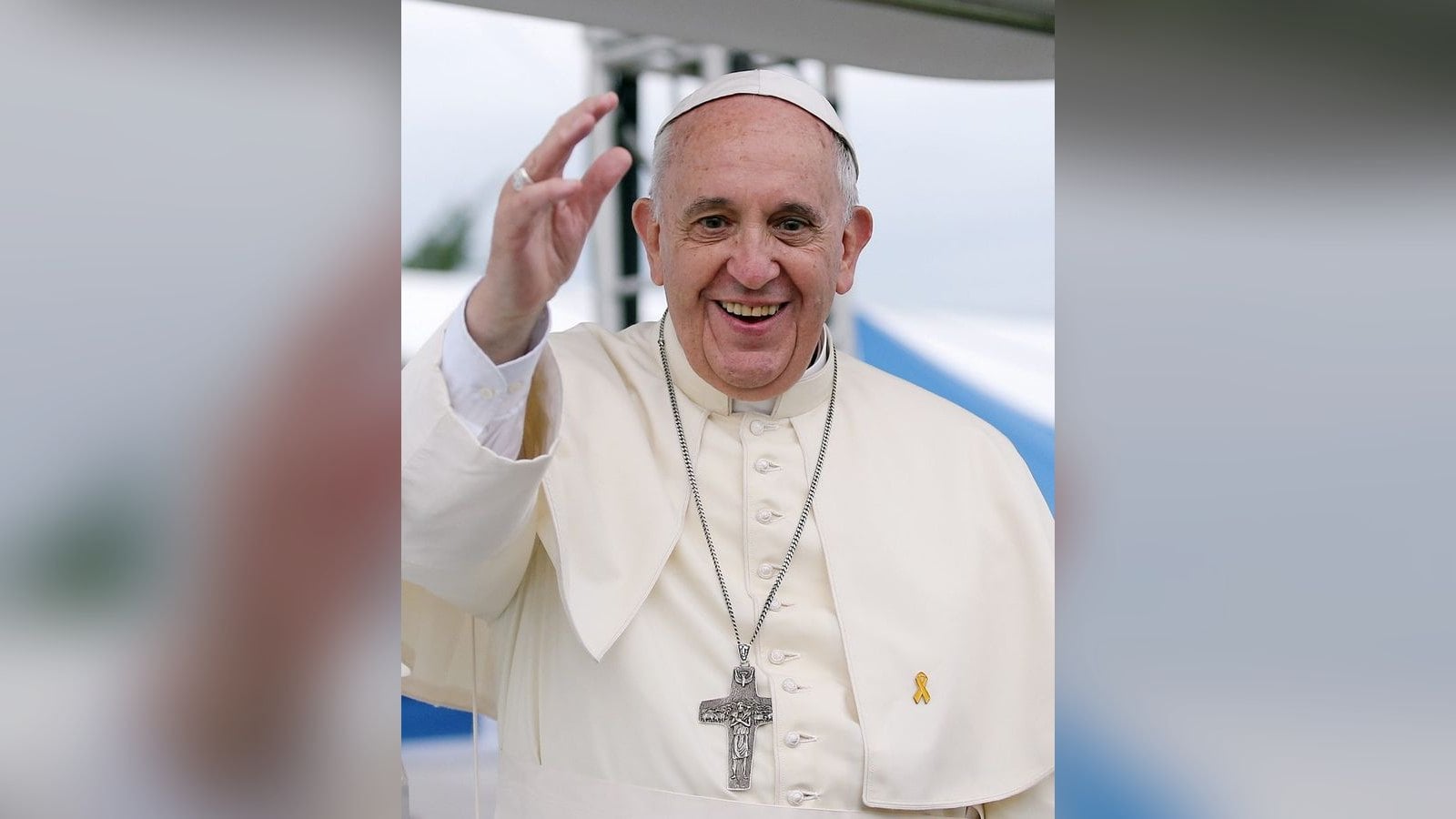
On a Sunday morning in September 2014, a white papal car rolled through central Tirana toward a square named for an Albanian nun, past crowds of Catholics, Orthodox Christians, Muslims, and Bektashi standing together. The man in the car had chosen this country on purpose. Of every nation in Europe, Pope Francis made the small Balkan republic of Shqipëri (Albania) his first.
For an Albanian American reading this years later, the visit can look like distant Vatican news. It is not. The reason the pope came is the same reason a mixed-faith Albanian-American family can sit at one Thanksgiving table without friction: a long, lived habit of religious coexistence that survived one of the harshest religious bans of the twentieth century.
That habit is not a slogan. It is an Easter call to an Orthodox cousin in Worcester, a Bajram (the Eid festival) text to a Sunni uncle in the Bronx, a Catholic grandmother in Detroit who keeps a photo of Mother Teresa next to the family icons. The September 21, 2014 visit named that habit out loud, in front of the world, and connected it to the people who paid for it under communism.
This piece covers why Pope Francis picked Albania first, the atheist-state history the visit answered, what happened that day in Tirana, the coexistence message at its center, the Mother Teresa thread, and what all of it meant for Albanian Americans across faiths. It is written for the diaspora, not for the news cycle that has since moved on.
Why Pope Francis chose Albania first in Europe
Pope Francis was elected in March 2013. His first trip abroad was to Brazil; his first trip to Europe as pope, in September 2014, was to Albania. That order was a message, and the Vatican framed it as one.
He did not begin with France, Spain, or Italy’s neighbors. He began with a country of fewer than three million people, a Muslim plurality, and a recent history of forced atheism. The choice signaled that he wanted to lift up a place most of Europe overlooks, precisely because of what it models.
What Albania models is coexistence. In a single country, Sunni Muslims, the Bektashi Sufi order, Eastern Orthodox Christians, and Roman Catholics have lived in the same towns and villages for centuries, frequently intermarrying. Pope Francis called this a “precious gift,” according to the National Catholic Register’s account of his remarks.
For Albanian Americans, the “Albania first” decision lands differently than it might for other diaspora communities. It is a rare moment of a global figure pointing at the homeland and saying, in effect, that the rest of the world has something to learn here. That is worth holding onto, whatever your own faith or lack of one.
The visit lasted only about eleven hours. Pope Francis arrived in the morning, met civil authorities, celebrated a public Mass, met religious leaders, prayed with clergy, and visited a charity center before flying back to Rome that evening. Short, dense, deliberate.
It also followed a path his predecessor had marked. Pope John Paul II became the first pope ever to set foot in Albania when he landed in Tirana in April 1993, barely three years after the religion ban was lifted, ordaining new bishops to rebuild a church that the regime had nearly extinguished. Pope Francis’s 2014 trip built on that opening — not to repair an institution this time, but to celebrate what the Albanian people had managed to keep alive across all their faiths.
The atheist state the visit answered
To understand why a papal visit to Albania carried such weight, you have to know what Albanian faith communities lived through in the twentieth century. The 2014 visit was, in large part, a public answer to that erasure.
In 1967, communist Albania under Enver Hoxha declared itself the world’s first officially atheist state. Public religious practice was outlawed entirely. By that May, roughly 2,169 religious buildings had been nationalized — accounts cite about 740 mosques, 608 Orthodox churches, 327 Catholic churches, and hundreds of Sufi teqe (lodges) and tyrbe (shrines) — many converted into warehouses, sports halls, or cultural centers.
In 1976, the regime wrote the policy into the constitution. Article 37 declared that the state recognized no religion and supported atheist propaganda. Albania remains one of the only states in modern history to constitutionally abolish religion.
The human cost fell on every faith. Thousands of priests and imams were imprisoned or executed across the decades of one-party rule. One Catholic priest, Shtjefën Kurti, served roughly seventeen years in prison after his 1946 arrest, was released in 1963, then was rearrested in 1970 and executed by firing squad in 1971 for secretly baptizing a child.
The ban held until December 1990, when religious observance was finally permitted again — in time for thousands of Albanians to attend Christmas services that had been illegal a year earlier. Many Albanian Americans alive today are one generation removed from relatives who prayed in secret, hid a Quran or a rosary, or lost a family member to a labor camp for refusing to abandon their faith. The 2014 visit spoke directly to that memory.
What happened that day in Tirana
The center of the visit was an open-air Mass in Tirana’s Mother Teresa Square on the morning of September 21, 2014. Reports put the crowd at roughly 300,000 people — most of them Catholic, but with very many Orthodox and Muslims present, in a country where Catholics are a minority.
In his homily, Pope Francis called Albania a “land of martyrs,” recalling the “atrocious suffering and harsh persecutions” endured under communism by Catholics, Orthodox, and Muslims alike. The framing mattered: he named the suffering of all three communities, not only his own church’s.
One moment from the day became its emotional core. Pope Francis met Father Ernest Simoni Troshani, an Albanian diocesan priest then in his mid-eighties who had survived roughly twenty-eight years of imprisonment and forced labor under the regime. The priest’s testimony moved the pope visibly. Two years later, in 2016, Pope Francis would make Simoni a cardinal.
The day also included an interreligious meeting at the Catholic University “Our Lady of Good Counsel,” where the pope addressed leaders of Albania’s faith communities directly. He prayed with priests, men, and women religious. And he visited the Betania charity center, run by the church to serve children and the poor — a reminder that the visit was about service on the ground, not only ceremony.
By evening, he was gone. But the images — a Catholic pope honored by an overwhelmingly non-Catholic crowd, an aged priest weeping in his arms — circulated through Albanian-American homes for weeks.
The message: faith as a source of peace, not violence
The heart of the visit was what Pope Francis said about religion itself, at the interreligious meeting in Tirana.
“Authentic religion is a source of peace and not of violence,” he said, according to coverage in America magazine and the National Catholic Register. “No one must use the name of God to commit violence. To kill in the name of God is a grave sacrilege. To discriminate in the name of God is inhuman.”
He warned that the “authentic religious spirit is being perverted” in places where “religious differences are being distorted and manipulated,” creating conditions for conflict and violence. He framed Albania’s coexistence as the opposite of that — proof that believers of different faiths can build a country together rather than tear one apart.
This was 2014. Extremist violence carried out in the name of religion was dominating headlines, and the pope’s words were widely read as a direct rebuke of it. He delivered that rebuke from a Muslim-plurality country whose own faith communities had stood beside each other through state atheism.
For an Albanian-American reader, the message is not abstract. It describes a value that runs through Albanian culture independent of any one religion — often summarized in the older code of besa (the Albanian word for a sworn promise and the honor behind it), which obligated hospitality and protection across lines of faith. The pope put a global frame around something many Albanian-American families would simply call “how we were raised.”
The Mother Teresa thread
It was no accident that the Mass took place in Mother Teresa Square. The most internationally recognized Albanian in the world is a Catholic nun, and her name sits at the center of this story.
She was born Anjezë Gonxhe Bojaxhiu in 1910 in Skopje, to an Albanian Catholic family, and spoke Albanian at home. She founded the Missionaries of Charity, received the Nobel Peace Prize in 1979, and became known worldwide simply as Mother Teresa.
When Pope Francis visited in 2014, she had been beatified but not yet canonized. Two years later, on September 4, 2016, he declared her a saint in St. Peter’s Square. For Albanian-American Catholics, that canonization was a point of quiet pride — the homeland’s daughter recognized at the highest level of their church.
But her reach in the diaspora crosses faith lines, the same way the 2014 visit did. Albanian Americans of every background claim her as Albanian first. A Muslim Albanian-American family in Staten Island and a Catholic one in Yonkers can both point to her as one of their own, without contradiction.
That shared claim is the point. Mother Teresa, the square named for her, and the pope who stood in it all pointed back to a single idea: that Albanian identity holds its faith traditions together rather than forcing a choice among them.
The communist martyrs and what came after
The 2014 visit honored the believers persecuted under communism. Two years later, the Catholic Church formalized part of that recognition in a way that resonated through the Albanian-American Catholic community in particular.
On November 5, 2016, in the northern city of Shkodër — the historic heart of Albanian Catholicism — the church beatified 38 Albanian martyrs killed for their faith under the communist regime. The group, led by Archbishop Vinçenc Prennushi, included bishops, diocesan priests, friars, a seminarian, and lay people, executed or dead in prison between 1945 and 1974. A crowd of up to 20,000 attended the beatification Mass.
Pope Francis had approved that beatification earlier in 2016. It connected directly to the “land of martyrs” theme he sounded in Tirana in 2014, turning a homily line into a formal act of the church.
For Albanian Catholics in places like the Bronx, Waterbury, and Sterling Heights, the Shkodër beatification was personal. Many had relatives who lived through the persecution, or who emigrated specifically because the homeland had outlawed their faith. Seeing those martyrs recognized publicly was a kind of restoration.
It is worth saying clearly that the persecution did not target one faith. Orthodox Christians and Muslims were imprisoned and killed under the same regime, on the same charge of believing at all. The martyrs beatified in 2016 were Catholic, but the wider memory the 2014 visit honored belongs to every Albanian faith community equally.
Coexistence as a lived diaspora value
Albania’s religious make-up is genuinely mixed, and the diaspora carries that mix to the United States intact. The 2023 census in Albania recorded a plurality of Sunni Muslims alongside sizable Orthodox, Catholic, and Bektashi populations, with a large share declaring no religion or no affiliation at all. Surveys also find that interreligious marriage is broadly accepted, even among the devout.
That is the social reality the pope was praising, and it is the one Albanian-American families know firsthand. The diaspora is not sorted into faith-separated communities the way some immigrant groups are. Albanian-American Catholics, Orthodox, Muslims, Bektashi, and secular relatives frequently sit in the same family.
So coexistence is not a value Albanian Americans admire from a distance. It is logistics. It is knowing which cousin to call on Krishtlindje (Christmas), which uncle to text on Bajram, and whose Orthodox Easter falls on a different Sunday than the Catholic one. It is a single grandmother’s funeral attended by an imam, a priest, and relatives who hold none of it.
This shows up in the institutions the diaspora built, too. Albanian-American Orthodox parishes, Catholic parishes serving communities from the northern highlands, and Albanian-American Islamic centers often sit within a short drive of each other in the same metro areas — New York, Detroit, Boston — serving people who share a language, a flag, and frequently a last name. The faith buildings are separate; the community moving among them is one.
Younger Albanian Americans tend to absorb this without naming it. They grow up assuming that being Albanian and belonging to a particular faith are two different facts about a person, neither one canceling the other. That assumption is exactly what the 2014 visit affirmed on a global stage.
The 2014 visit gave that ordinary arrangement an extraordinary witness. A pope flew to Albania, stood before a quarter-million people of every faith, and said that this — believers of different traditions building one community — is the model, not the exception.
For Albanian Americans, the takeaway is not religious. It is about identity. The thing that makes someone Albanian was never one church or one mosque. It is a language, a history, a code of honor, and a stubborn habit of staying family across faith lines. That is what Pope Francis flew to Tirana to honor, and it is what the diaspora keeps alive every time it refuses to let religion divide one people.
Being counted in the National Albanian Registry is its own version of that same act — recording a shared Albanian-American identity that holds Catholic, Orthodox, Muslim, Bektashi, and secular families together as one community.