

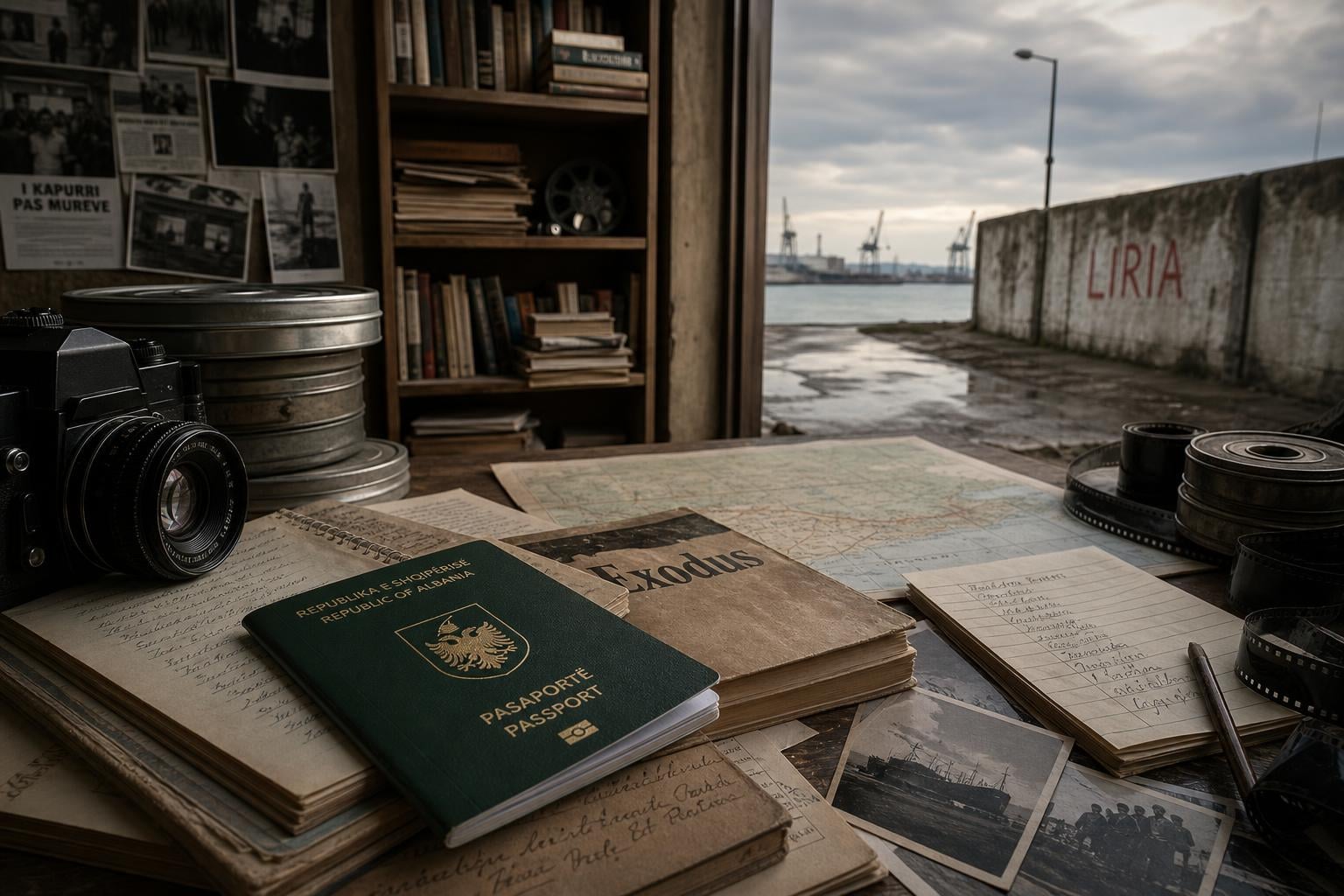
On July 2, 1990, a man drove a truck through the rear wall of the West German embassy in Tirana. Within ten days more than 5,000 Albanians had climbed the gates of the German, Italian, French, Greek, and Czechoslovak missions in the capital, refusing to leave until ferries took them across the Adriatic. The Berlin Wall had fallen eight months earlier. Albania’s wall fell that week, in a single neighborhood, on television, with diplomats watching from upstairs windows (HuffPost: Albania 1990 Embassy Storm).
A year later, on August 7, 1991, the cargo ship Vlora limped into the Italian port of Bari with somewhere between ten thousand and twenty thousand Albanians on board, many hanging from ropes and ladders for the seven-hour crossing (Wikipedia: Vlora ship). The captain, Halim Milaqi, had been forced to sail because the alternative was a mutiny on a vessel without working radar, water, or refrigeration.
Out of those two scenes, and the decade that followed, came an Albanian cinema obsessed with the pasaportë — the passport — and what it cost to get one. A work cited in Albanian-language sources under the short name Pasaporta, or in full as Pasaporta e Gjelbër (The Green Passport), is said to belong to that wave — though we were unable to independently confirm its existence, director, or release date in any English-language film database, Wikipedia’s list of 1990s Albanian films, or the Albanian Cinema Project’s own records. This is a guide for Albanian Americans to the emigration-cinema wave the title represents, to what about it is well documented (the director’s other, verifiable work; the historical events it draws on) and what is not (the film itself), and why the era still matters in a US diaspora that grew because of the events it depicts.
The film and its 1994 attribution
The 1990s were the worst possible decade in which to make Albanian films, and one of the most necessary. The state studio that had produced almost everything Albanians had watched for forty years — Kinostudio “Shqipëria e Re” in Tirana — lasted until 1992, when it was reorganized and replaced by Albafilm-Tirana (Wikipedia: Cinema of Albania). Production volume that had averaged 13 features a year between 1975 and 1990 collapsed.
What survived was small, scrappy, and personal. Filmmakers worked with shoestring budgets, often co-produced with Italian or French partners, and turned the camera on the only subject anyone could think about: leaving.
Pasaporta e Gjelbër sits inside this cycle. It is associated with director Albert Minga, an Albanian filmmaker born in Vlorë in 1946 whose verifiable filmography includes Agimet e stinës së madhe (1981), Ditë të qytetit tim (1982), and the post-communist Porta Eva (1999) (IMDb: Albert Minga). Detailed English-language records of Pasaporta e Gjelbër — cast lists, runtimes, production credits — are thin. We say so plainly. Albanian cinema of the early 1990s was made under conditions that did not produce well-archived press kits, and a great deal of work from the period waits in the Albanian Central State Film Archive for restoration.
What the film’s title carries, on the other hand, is unmistakable. After 1992, the new Republic of Albania issued passports with green covers. Pasaportë is the Albanian word for passport; e gjelbër is the feminine form of green. A “green passport” was the document a citizen of the new Albania needed to cross any border legally. For most of the country, in most of the decade, it was either impossible to obtain or useless without a visa stamped onto its first blank page.
A film about the green passport is a film about the gap between the document and the life it was supposed to permit.
Director Albert Minga and Albanian cinema after 1991
Minga belongs to the generation of Albanian filmmakers trained inside Kinostudio whose careers had to be reinvented after the system that made them collapsed. The state apparatus that had funded, distributed, and exhibited Albanian films was gone. International festivals were uninterested in Albania. Domestic audiences could not afford tickets, and many of the country’s cinemas were sliding into disrepair.
What replaced Kinostudio was the National Center of Cinematography (Qendra Kombëtare e Kinematografisë), a state agency that issued small grants to support feature production. The decade’s output was thin and uneven. The films that did get made tended to be intimate, allegorical, and obsessed with departure.
Minga’s work fits this pattern. Porta Eva (1999), his best-documented post-communist feature, follows two young Albanian women who set out across the sea in search of happiness — the same emigration impulse, framed as a quest narrative (Filmweb: Porta Eva). The thread is consistent across his post-1991 work: leaving, the cost of leaving, and what is left behind.
Other names from the same decade are worth knowing. Fatmir Koçi made Tirana Year Zero (2001), a Venice-selected film about a young couple in post-communist Tirana whose girlfriend wants to move to Paris. Gjergj Xhuvani made Slogans (2001), the first Albanian feature ever invited to the Director’s Fortnight at Cannes (Wikipedia: Slogans). Together with Minga and a handful of others, they form the small but durable core of post-communist Albanian cinema.
The historical backdrop: the 1990 embassy wave and the 1991 Vlora exodus
To watch any 1990s Albanian emigration film without knowing the underlying history is to miss most of it. The two anchoring events:
The Tirana embassy storm, July 1990. On July 2, a truck crashed through the German embassy wall and roughly 3,000 people poured through the breach in the next hours. By the second week of July more than 5,000 Albanians were inside foreign missions in Tirana, and the Communist regime — still in power eight months after the Berlin Wall fell — eventually agreed to bus them to Durrës for ferries to Italy (HuffPost: Albania 1990 Embassy Storm). Trains then carried them onward to Germany, France, and beyond, escorted by the Red Cross. The image of families scaling embassy walls became the visual shorthand for late-communist Albania.
The Vlora ship, August 1991. The communist regime collapsed in March 1991 amid food shortages, strikes, and the first multi-party election. By summer the country was hollowing out. On the night of August 7, between ten and twenty thousand Albanians boarded the Vlora in the port of Durrës — the captain estimated 20,000, several other accounts settle around 10,000 to 15,000 — and forced the ship to sail for Italy (Wikipedia: Vlora ship). Italian authorities, with the prefect and superintendent on holiday, were unprepared. Most of the passengers were eventually repatriated. About 3,000 had been sent back within days. The Pope criticized the treatment; the Italian government defended it as deterrence.
By the end of December 1991, more than 200,000 Albanians had left the country since the exodus began that summer. By the early 2000s roughly half a million Albanians, out of a pre-exodus population of about 3.3 million, had emigrated.
These are the events behind every shot of every 1990s Albanian emigration film: the embassy walls, the overcrowded ship, the queue at the consulate, the family member already abroad whose remittances kept everyone else fed.
The green passport as metaphor
The passport in these films is never just a document.
Under the previous regime, a foreign trip required permission from multiple state organs and was almost never granted to ordinary citizens. Possession of a foreign passport — or even a foreign-currency note — could be evidence in a criminal case. The old Albanian travel document was a deep blue or maroon booklet that, for most of the population, functioned as proof of internal status rather than as a key to the outside world.
The green passport that replaced it after 1992 carried a different freight. It was issued by the new Republic. It was theoretically usable. It said, on its cover, that Albania had become a country whose citizens could travel. In practice, the document was the beginning of a much longer process: a visa application, a consular interview, a sponsor letter, a refusal, sometimes another refusal, sometimes finally a stamp.
The metaphor that 1990s Albanian filmmakers built on top of this physical object did several things at once.
It separated freedom from mobility. A citizen could be free in law and still be unable to leave. The green passport made that gap visible.
It made the family the unit of emigration, not the individual. A passport was something parents argued over, queued for, lost, replaced, hid, sold. Films about pasaporta are almost always films about families.
It pulled the West into the room. The destination — Italy, Germany, Greece, the United States — was always offstage in 1990s Albanian films, conjured by a phone call, a videotape, a remittance, an address. The passport was the only piece of the West that ever made it into the frame.
This is the emotional terrain that Pasaporta e Gjelbër and the films around it work.
Reception in Albania and among the diaspora
Reliable contemporary box-office numbers for Albanian films of the early 1990s essentially do not exist. Domestic cinema infrastructure had collapsed. Many of the decade’s features played in a handful of cinemas in Tirana and Shkodër, on Albanian state television, and at small festivals abroad. International press coverage of Albanian cinema before Slogans (2001) was scarce.
Within the Albanian-speaking world, however, the films of the 1990s emigration cycle traveled through informal channels: VHS copies passed between families, screenings organized by diaspora associations in Italy and Greece, later by community centers in the Bronx, Westchester, and metropolitan Detroit. A film about the green passport had a built-in audience among the people who had spent years trying to obtain one.
The diaspora reception was less about cinema as art than about cinema as recognition. To watch an Albanian film about embassy walls or boats or visa queues, in a New York or Worcester living room in the mid-1990s, was to see a piece of recent personal history rendered on screen by someone who had also lived it. The films were memory aids before they were anything else.
International festivals largely missed the period. The big breakthroughs for Albanian cinema came in the 2000s with Slogans at Cannes Director’s Fortnight and Tirana Year Zero at Venice (Wikipedia: Tirana Year Zero). The 1990s emigration films, including Pasaporta e Gjelbër, were precursors that the festival circuit would only later catch up with.
Why the film resonates with Albanian Americans today
The US Albanian-American population grew sharply in the 1990s. The Diversity Visa lottery, established by the 1990 Immigration Act and first available to Albanian applicants in the mid-1990s, sent thousands of families across the Atlantic (Balkan Insight: Albania, the Balkans’ Biggest Believers in the American Dream). Family reunifications, asylum cases tied to the 1997 pyramid-scheme collapse, and the Kosovo refugee admissions of 1999 added more.
The result is that a meaningful share of Albanian-American adults today — roughly the cohort now in their forties and fifties — are direct products of the same emigration moment that Pasaporta e Gjelbër and the films around it depict.
That changes how the films land. For a US-born Albanian-American watching one of these features, the green passport is a piece of family history. It is the document a parent or grandparent stood in line for. It is the thing whose absence kept relatives apart, and whose presence made the move to the Bronx or to Sterling Heights possible. The on-screen anxiety about visa stamps and consular interviews is the anxiety of dinner-table conversation a generation later.
For first-generation arrivals, the recognition is more direct. The films capture a specific texture of the early 1990s — the hyperinflation, the bread queues, the relatives already in Italy phoning in static, the older people who refused to leave — that is hard to transmit to children born in New Jersey or Massachusetts.
That transmission is the use case. Pasaporta e Gjelbër and its peers are family-history primary sources. They are also, considered together, a counterweight to the Hollywood Albanian — the Taken villain, the cable-news caricature — that the US media environment manufactures by default. A film made by Albanians, in Albanian, about the actual decision to leave, is a different artifact than anything produced about Albanians from the outside.
The broader 1990s Albanian emigration cinema canon
A short reading list of the films that frame Pasaporta. Watch one. Watch all of them if you can.
Lamerica (1994), directed by Gianni Amelio. The international reference point. Two Italian con artists arrive in 1991 Albania to set up a shell company; the elderly Albanian figurehead they recruit turns out to be an Italian deserter from World War II who has been hiding in Albania for half a century. The film ends on a boat to Italy, packed with Albanian refugees, with the old man believing it is bound for America (Wikipedia: Lamerica). Amelio won the Golden Osella for Best Director at Venice. The title is what one of the Albanian characters writes, in a single word, when asked his destination. It is the most internationally acclaimed film about Albanian emigration ever made — and notably, it is Italian.
Tirana Year Zero (2001), directed by Fatmir Koçi. A young couple in post-communist Tirana drift apart over the question of whether to leave. Klara wants to model in Paris. Nik does not. The film captures the texture of late-1990s Tirana — half-built, traffic-clogged, exhausted — better than any documentary.
Slogans (2001), directed by Gjergj Xhuvani. Set in late-communist Albania, not the post-communist period, but essential context. A young teacher is sent to a village school where the work consists partly of arranging stones into ideological slogans on the hillsides. The first Albanian feature invited to Cannes Director’s Fortnight, and the film that launched modern Albanian cinema’s international visibility.
Anglophone parallels. The closest English-language reference points are El Norte (Gregory Nava, 1983) on Central American migration to the US, and In This World (Michael Winterbottom, 2002) on the Afghan refugee route to Europe. Neither is Albanian, but both share the same camera position: low to the ground, inside the crossing, refusing the documentary distance of news footage.
The Albanian films of the 1990s do not yet have an international canon the way Romanian New Wave does, or the way the Czech New Wave once did. They will get there. The Albanian Central State Film Archive in Tirana has been working with international partners on restoration; the Albanian Cinema Project has been organizing screenings; the National Center of Cinematography has been issuing small production grants. The work continues.
Where to watch and how to access
Honest answer: it is hard. Pasaporta e Gjelbër in particular is not currently distributed on a major streaming platform. Many Albanian films of the early 1990s are held in 35mm prints at the Albanian Central State Film Archive (Arkivi Qendror Shtetëror i Filmit) in Tirana and have not been digitally restored.
A few practical avenues:
The Albanian Cinema Project (albaniancinemaproject.org) tracks restoration and distribution news and occasionally organizes screenings in the United States. It is the best single English-language resource on the state of Albanian film preservation.
YouTube and Vimeo. A surprising amount of older Albanian cinema has been uploaded informally, sometimes by the original filmmakers, sometimes by fans, sometimes by relatives. Quality and legality vary. Searching the Albanian title — Pasaporta e Gjelbër — yields more than the English translation.
Albanian community film nights. Organizations in New York, Boston, Detroit, and Worcester occasionally host screenings of older Albanian features, particularly around Flag Day (November 28) and Independence Day events. The Arbëresh and Kosovar diaspora communities in the US run their own programming as well.
The Lincoln Center and BAM repertory programs in New York have occasionally programmed Albanian and Balkan retrospectives. Watch their schedules.
For Lamerica specifically, which is widely available, several streaming services carry it in rotation, and the Criterion Collection has discussed (without yet announcing) a release. It is the easiest entry point if a viewer wants to start somewhere in the cycle.
The harder cases — Minga’s Pasaporta e Gjelbër, his Porta Eva, Koçi’s Tirana Year Zero — require some patience and some informal networks. The community is not large. Asking around usually finds a copy.
What this has to do with NAR
The National Albanian Registry exists because the community that the 1990s Albanian emigration films depict is not yet fully counted. The 2024 American Community Survey records roughly 230,000 Americans of Albanian ancestry. The community estimate, including ethnic Albanians from Kosovo, North Macedonia, Montenegro, the Çamëria region, the Arbëresh, and the second and third generations now born in the US, is closer to one million.
A film about a passport from that era is, in a real sense, a film about the people who would later answer to a US census taker, register a child for kindergarten in Westchester, open a small business in Sterling Heights, or fill out a registration form on a community website. Counting them now is one way of completing the story the films started.
If your family arrived in the US during or after the events these films depict — or if you carry the descent and have never been counted — register with NAR. It takes about 60 seconds and returns a recognition certificate. It is not a government document and it confers no citizenship. It is what a community-led count looks like, and the count matters.