
Albanian folk dance is full of named figures, but only a handful give their name to a dance that the entire repertoire still carries. Osman Taka is one of them. The 19th-century Çam Albanian warrior and dancer is remembered today not in monuments or government records but in a single solo dance — Vallja e Osman Takës, “the dance of Osman Taka” — performed at folk festivals in southern Albania, on stages in Tirana and Pristina, and at Albanian-American community gatherings from the Bronx to Boston to Worcester.
The legend is direct. Tradition holds that Osman Taka, condemned to death by Ottoman authorities, asked his executioners for one final favor: a dance. They gave it to him. He danced. They executed him. The dance was watched, remembered, and passed down — a male solo that begins slow and weighted, builds into sharper figures, and ends with the dancer holding the floor alone.
This article covers what we know about Osman Taka the historical figure, the Tanzimat-era pressures of his lifetime, the Çamëria (the historically Albanian-inhabited region of coastal Epirus, today divided between southern Albania and northwestern Greece) context that produced him, the structure of the dance itself, and how the form has traveled with the Albanian diaspora to the United States. Treatment is matter-of-fact: this is a 19th-century folk-historical figure, not a contemporary political symbol.
For Albanian American families, the relevance is specific. The dance is one of the durable forms of cultural transmission across the Atlantic — a piece of southern Albanian folk repertoire that several generations of US Albanians have learned at parish recitals and ensemble rehearsals. If you have heard it, this is the longer story behind it.
Who Osman Taka Was
Osman Taka is remembered in Albanian folk tradition as a Çam Albanian warrior and dancer of the mid-19th century, from the Konispol-Filat area on the southern reach of the historic Çamëria. The Konispol part of that belt sits today inside the Republic of Albania, near the Greek border; the Filat (in Greek, Filiates) part sits today inside northwestern Greece, in the regional unit of Thesprotia. In Osman Taka’s lifetime, both were Ottoman territory and inside the same continuous Albanian-speaking coastal stretch.
The exact dates of his birth and death are not consistently fixed in the surviving record. Albanian folkloric sources, ethnographic writing, and 20th-century scholarship place him in the middle decades of the 19th century — usually in the 1820s to 1860s range. What survived was not a notarized biography but a name, a home region, a manner of death, and a dance.
What is consistent across the sources is the social profile. Osman Taka was a member of the Muslim Cham Albanian community of the southern Çamëria coast. He was reputed to be a strong, athletic man — the kind of figure who could carry a male solo dance in front of a village audience and hold it. He refused Ottoman authority on certain points, in a way that put him in direct conflict with the local representatives of the Sultan’s government. The conflict ended in his execution.
The Çamëria he came from is described elsewhere in our coverage at chameria. For Osman Taka’s story, three features of the region matter. First, it was Albanian-majority and Albanian-speaking, with a Muslim majority and a significant Orthodox Christian minority. Second, it was inside the late Ottoman Empire, governed through provincial vilayet and sanjak structures. Third, it was a frontier zone — a place where central state authority was real but uneven, and where local Albanian leaders operated with substantial autonomy until the mid-19th-century reforms began to tighten that autonomy down.
The Tanzimat Reforms and Albanian Resistance
To make sense of Osman Taka’s death, the larger Ottoman context has to come into view. The Tanzimat — the Ottoman reform program that ran from 1839 to 1876 — was the Empire’s attempt to centralize and modernize its administration in response to mounting European pressure and internal weakness. The reforms included a new conscription system, a regularized provincial bureaucracy, codified taxation, and a push to bring the Empire’s diverse periphery under tighter central control.
For the Albanian-speaking lands, the Tanzimat translated into specific local pressures. Conscription into the regular Ottoman army — the Nizam — replaced older, more flexible arrangements that had let Albanian highland and coastal communities meet their military obligations on negotiated terms. The new tax structure cut into the autonomy of local Muslim Albanian bajraktarë (clan chieftains) and agas (landed notables). Provincial governors appointed from outside the region took precedence over local Albanian leadership.
Albanian resistance across the 19th century took many forms — armed revolts, refusals to pay new taxes, refusals to surrender sons to the Nizam, and local insurrections. The Albanian uprisings of the 1830s and 1840s in the north and the long pattern of frontier resistance across the Çam coast and the southern highlands were part of that wider picture. The pattern reaches its political climax in the next generation, with the founding of the League of Prizren (Lidhja e Prizrenit) in 1878 — but the local refusals of the Tanzimat decades laid the ground for it.
Osman Taka’s confrontation with Ottoman authority belongs in this frame. Folk tradition associates his arrest and execution with resistance to the central state — variously framed as refusal of conscription, refusal to surrender to Ottoman officials, or punishment for his role in local Cham armed defense. The exact charge is not consistently fixed. What is consistent is that the Ottoman authorities tried him, condemned him, and put him to death.
The Legend of the Last Dance
The story of the last dance is the part of Osman Taka’s life that survived most clearly into the 20th century, carried by oral tradition and by the dance itself. The narrative is short. On the day appointed for his execution, the condemned man asked his Ottoman executioners for one final favor: he wanted to dance.
The request was granted. Music was provided — in some versions a clarinet and a drum, in others the village men singing without instruments — and Osman Taka danced. He performed a male solo on the ground in front of the soldiers and the gathered audience. He worked through a sequence of slow, weighted figures that built into sharper, faster movements. At the end of the dance, he stopped, faced his executioners, and was put to death.
The sequence he performed was watched and remembered. Over time it took shape as a recognizable choreographic form, taught by older village dancers to younger ones, passed from generation to generation, eventually picked up by the 20th-century Albanian state ensembles and codified for the stage. The dance entered the standing repertoire of southern Albanian folk performance under the name Vallja e Osman Takës — “the dance of Osman Taka.”
Two points are worth making honestly about this story. First, the legend is preserved in oral tradition, in folk-song lyrics, and in 20th-century ethnographic and folkloric writing rather than in a strict 19th-century documentary record. Historians treat it as a folk-historical narrative — meaningful as cultural memory whether or not every detail can be cross-checked against an Ottoman court record. Second, the dance itself is a separate matter. The choreography is a fully documented living folk form, taught by dance masters and performed on stages and at celebrations across the Albanian-speaking world. The legend explains where the dance came from. The dance does not need the legend to be real.
What the legend does, for the people who carry it, is hold a frame around the choreography. The slow start is a man composing himself before death. The build is the body asserting itself one last time. The hold at the end is the moment the music stops and the executioner steps forward. The form is read that way by every dancer who learns it.
The Dance Itself: Structure and Choreography
Vallja e Osman Takës is a male solo dance — vallja, in Albanian, simply means “the dance” — built around a single dancer working alone in front of an audience. That solo framing is the central choreographic feature and the one that distinguishes it from the line-dance valle forms that anchor most Albanian wedding repertoire.
The structure most commonly performed today follows a recognizable arc. The dance opens slow and weighted, with the dancer entering the floor in the steady, deliberate manner of a southern Albanian man’s dance — the vallja e burrave. The opening figures emphasize balance, presence, and command of the floor; the body is held upright, the arms are wide and steady, and the steps cover ground without hurry.
The middle section builds in tempo and complexity. Faster footwork, rhythmic stamps, quick turns, and sharp arm gestures replace the steady opening figures. Some performers introduce small jumps or low squats; others stay closer to the ground. The expressive register is active, sometimes defiant, with the dancer working harder physically and the music pushing him forward.
The closing section returns to the slower, weighted register, often with a more contained set of gestures than the opening. The dancer holds his ground, finishes the form, and exits or stops in place. The slow-build-slow arc runs through many southern Albanian male solo dances, but the specific figures and timing are particular to this piece.
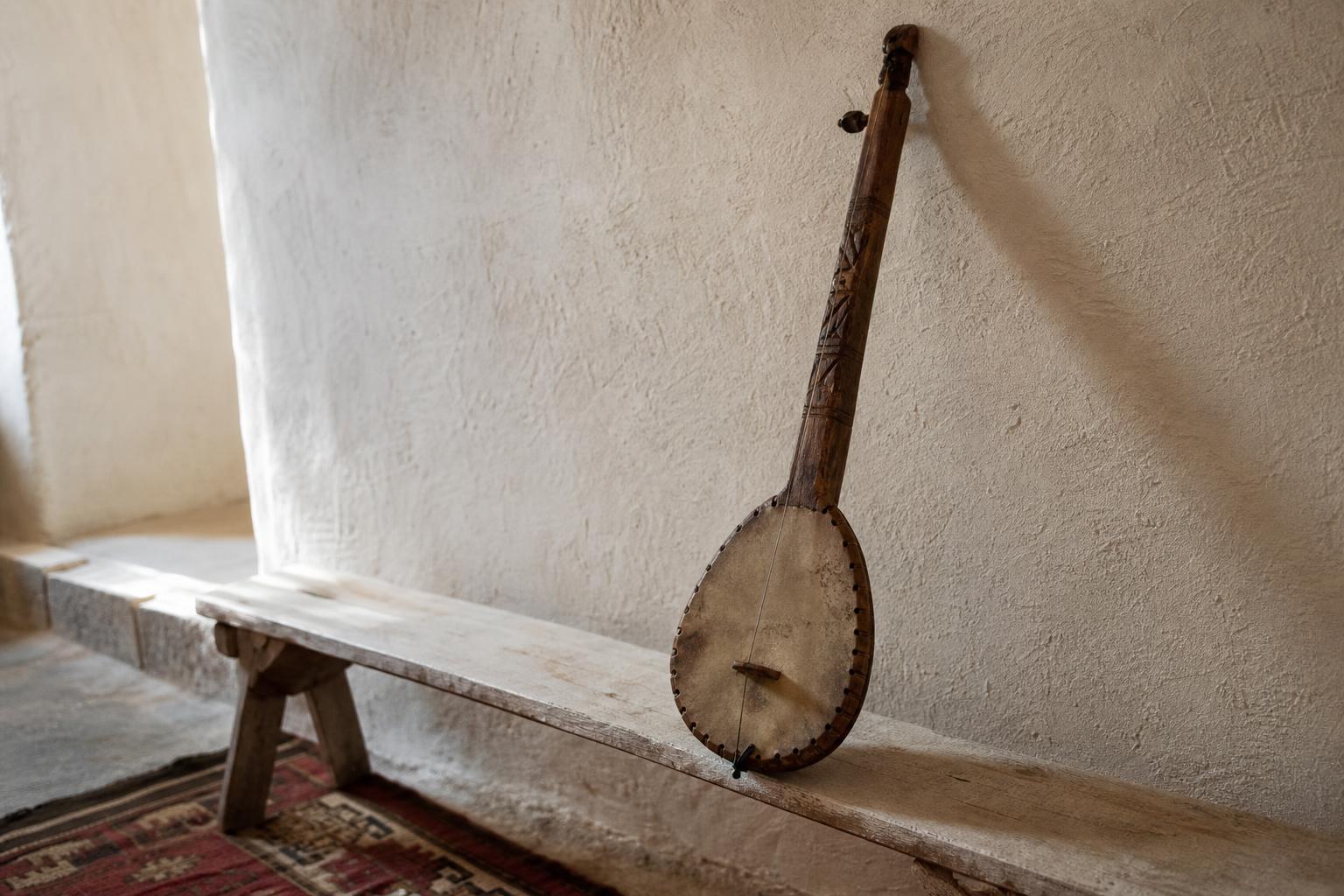
The accompaniment varies by ensemble. Folk-orchestral arrangements typically use a clarinet as the lead voice over a def (frame drum) and accordion, with the clarinet carrying the melodic line and ornamentation that drives the dancer through the build. Some ensembles use a smaller acoustic group with violin, llautë (lute), and def. Cham community settings sometimes pair the dance with vocal accompaniment in the regional polyphonic style.
The dance is physically demanding. A full performance runs several minutes; the dancer carries the entire visual weight alone, with no chorus to share the load. Master performers — the kind taught at the Albanian state ensembles in the 1960s and 1970s — were known for the precision of the slow opening, the clean line of the build, and the sustained eye contact through the closing.
Vallja e Osman Takës in Performance
The dance entered the 20th-century concert-folk stage through the network of Albanian state and regional ensembles that took shape in the post-war decades. The Albanian National Folk Ensemble in Tirana, the regional ensembles based in Gjirokastër and Vlorë, and the amatorë folk groups attached to district cultural centers across the south carried the form into the standardized repertoire that defined Albanian folk performance from the 1950s onward.
The National Folklore Festival of Gjirokastër (Festivali Folklorik Kombëtar i Gjirokastrës) — held every five years in the southern Albanian fortress city since 1968 — has been the central showcase. Vallja e Osman Takës has appeared on the festival’s stages many times, performed by ensembles representing the Çamëria community, the broader southern Albanian folk traditions, and the diaspora groups the festival has hosted in recent editions.
The dance is also part of the Cham community’s own performance tradition in Albania. Çam ensembles based in Vlorë, Sarandë, and Tirana carry the piece as part of a wider Çamëria repertoire that includes the regional polyphonic singing, costume, and the slow circle dance valle e rëndë. Anniversary commemorations, family celebrations, and community cultural programs are typical settings.
Recordings circulate widely. The Albanian state radio and television archive holds performances going back to the 1960s. Post-1991 broadcasting on RTSH Muzikë, Top Channel Albania, and Klan Kosova has produced a steady stream of new recordings, and Cham community organizations have released ensemble albums and video recordings over the past two decades. On YouTube, multiple performances by Albanian state ensembles, regional folk groups, and diaspora dance troupes are available with a search for the title.
The dance has also become a benchmark for competition and pedagogy. Folk-dance schools in Albania and Kosovo teach the form to advanced male students; festival competitions assign it as a test piece for soloists; and dance instructors in the diaspora often build it into the upper-level repertoire of their student groups.
The Dance in the Albanian-American Diaspora
The Albanian diaspora in the United States is roughly 224,000 people in the most recent ACS count, with a community estimate including ethnic Albanians and 2nd/3rd-generation descendants closer to one million. A substantial share of that diaspora traces back to the Çamëria coast and to southern Albania — the same region of origin as the dance.
In practice, Vallja e Osman Takës has traveled with the diaspora. Three settings carry it most regularly in the United States:
Albanian-American folk-dance ensembles. Community-based folk-dance groups attached to organizations such as the Albanian American National Organization (AANO) chapters, the regional Vatra federation circles, and independent dance troupes in metropolitan New York, New Jersey, Boston, Detroit, and the Bronx maintain Albanian folk repertoire as a teaching and performance program. Vallja e Osman Takës is part of the standard upper-level male solo material — a piece advanced students learn after they have grown comfortable with the line-dance valle repertoire.
Parish folk-dance troupes. Albanian Orthodox, Albanian Catholic, and Albanian Sunni and Bektashi parish communities often run youth and adult folk-dance groups as part of their cultural programming. The dance appears in the program when an advanced male soloist is available; it is rarely a beginner piece.
Cham community gatherings. Cham community organizations in the New York and Boston metro areas maintain their own cultural programming, including community festivals, anniversary commemorations, and family events that draw on the Çamëria-specific portion of the folk repertoire. Vallja e Osman Takës is one of the recognizable pieces from that repertoire and is performed at these gatherings as a marker of regional identity.
A useful distinction: the valle line dances every Albanian wedding cycles through are the mass-participation form of Albanian folk dance in the diaspora — anyone can join the line. Vallja e Osman Takës is the performance form. It needs a trained soloist, a stage or a clear floor, and an audience that knows what it is watching. The two coexist in the diaspora’s folk-dance life and do different work.
For Albanian-American families with roots in Çamëria specifically, the dance carries an additional weight. It names the regional origin out loud, in front of an audience that may not know the place, the dialect, or the history — a piece of regional cultural memory that is otherwise easy to lose in the third generation.
Cultural Memory, Emigration, and Why the Dance Holds
Folk forms travel with people. But not all of them survive the third generation in the diaspora; the ones that do tend to share certain features. They are short enough to learn in a few sessions. They are recognizable enough that older relatives can correct a younger dancer’s mistakes. They carry a story that is worth telling at the table after the performance.
Vallja e Osman Takës has all three features. It is concentrated — a few minutes — rather than the multi-hour endurance of kângë kreshnikësh (the Gheg highland epic songs) or the long evenings of southern village polyphony. It is highly recognizable: the male solo frame is unmistakable, the slow-build-slow arc is consistent, and a Cham grandparent watching at the back of a parish hall can tell whether her grandson is doing it right. And the legend is a narrative every member of the audience can carry home.
The story of the last dance also travels well across distance. It does not require you to live in a specific village or to read a specific historical document. It does not require fluency in Albanian. The shape of the legend — a man condemned to die, a request for one final dance, a performance, an execution — is portable. A second-generation Albanian-American teenager who learns the dance at a parish recital can carry the story in English to a non-Albanian friend without losing the weight of it.
This is what makes the dance a particular kind of diaspora artifact. Most cultural transmission across an ocean is lossy. Language frays — children of immigrants speak less Albanian than their parents, grandchildren often speak almost none. Religious practice frays. Geographic ties to specific villages weaken with each generation that has not visited. But certain forms hold: the wedding valle, the iso-polyphonic song, the byrek, the besa (the Albanian code of honor) as a family ethic, and a small set of named dances tied to named figures. Vallja e Osman Takës is one of those held forms.
The form also encodes a piece of regional history that is otherwise easy to flatten. The Çamëria-specific identity — distinct from Tosk southern Albanian, distinct from Gheg northern, distinct from Kosovar — is preserved through dialect, polyphonic music, and dances tied to named Cham figures and home places. For descendants of the Cham community in the United States, it is a standing reminder that their family’s regional origin has its own named tradition inside the broader Albanian one.
What the Dance Does Not Do
It is worth being direct about what Vallja e Osman Takës is not, given the political weight some readers may bring to the topic.
It is not a contemporary political instrument. The dance is a 19th-century folk form attached to a 19th-century folk figure. It predates the 1913 Treaty of London that drew the modern Greek-Albanian border, predates the founding of the modern Albanian state, and predates by a century the post-1990 diaspora. Treating it as a 21st-century symbol misunderstands its history.
It is also not a piece of sectarian programming. Osman Taka was a Muslim Cham Albanian, but the dance is not a religious form, has no liturgical use, and is performed in mixed and secular settings without controversy. Cham community life across both confessions — Muslim and Orthodox — has historically shared dialect, family ties, and large parts of the folk repertoire. The dance sits inside that shared frame.
What the dance does is narrower and more durable: it carries a name, a region, and a story across generations and across an ocean, in a form that a body can learn and a performance can transmit.
Where to See the Dance
The Festivali Folklorik Kombëtar i Gjirokastrës is the central showcase. The festival is held every five years in Gjirokastër, southern Albania, and Vallja e Osman Takës is a recurring entry on the program. Recordings of past editions are archived on RTSH (the Albanian state broadcaster) and circulate on the festival’s YouTube channel.
Albanian state and regional ensembles — including the National Folk Ensemble in Tirana and the regional ensembles of Gjirokastër, Vlorë, and Sarandë — perform the dance in concert programs and on tour. Cham community ensembles in Albania (based in Vlorë, Sarandë, and Tirana) perform it at community programs and at the annual Çamëria commemorations.
Albanian-American cultural events — folk-dance recitals organized by AANO chapters, parish folk-dance troupes, and independent diaspora ensembles in the New York, New Jersey, Boston, Detroit, and Bronx areas — feature the dance from time to time as part of advanced programs. The annual NY Albanian Parade and several large parish folk festivals are the most visible US settings.
Why the Dance Belongs to the Diaspora
A 19th-century Çam Albanian dancer’s last performance, preserved across generations as a male solo on the folk stage, is not the kind of cultural object that should survive easily into a 21st-century American suburb. The fact that it has — that advanced students at parish folk-dance schools in Yonkers and Worcester and the Bronx know the steps, that families in New York and Boston can name the figure and place the region, that Cham community gatherings open with the dance — is a small piece of evidence about how diaspora cultures actually work.
The first generation carries the form across an ocean. The second generation learns it from older relatives. The third generation gets it from a teacher at a parish hall, often with less fluency but with the form intact. The fourth generation either inherits the form or does not, depending on what the family has built around it.
For the Albanian American community specifically, the count of people who carry these forms has not been done. The ACS gives one number. Community estimates give a much larger one. The gap is partly a count-the-uncounted problem: descendants of Çamëria families, descendants of early-20th-century Albanian immigrants to Boston and New York, descendants of the post-1991 wave, and descendants of the Arbëresh Italian-Albanian communities all sit inside the larger Albanian-American story without always being counted in it.
The National Albanian Registry is a community-led count of Albanian Americans. If you have not been counted — and especially if your family carries a piece of the southern Albanian or Çamëria folk tradition — you can register here and be added to the record. The dance survived the empire that killed Osman Taka. The community that carries it is worth counting.