

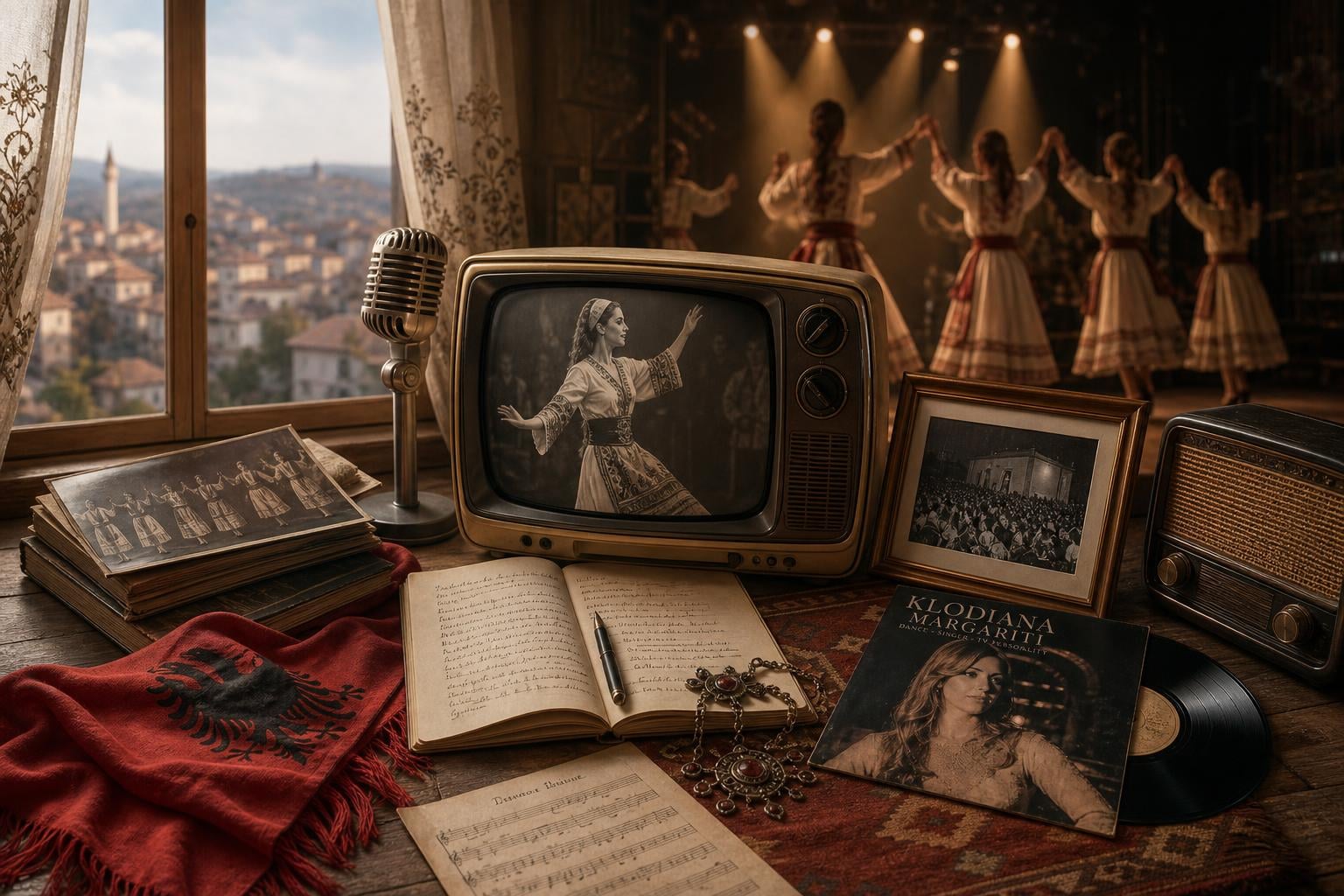
Klodiana Margariti sits in a particular slot in Albanian popular memory — the slot reserved for the dancers, singers, and television personalities whose faces a generation of Albanian and diaspora viewers grew up watching on Saturday nights, even when those same viewers couldn’t always tell you the exact production credit. She’s an Albanian valltare — dancer — and këngëtare — singer — whose work has run through Albanian commercial television in the era when Top Channel and Vizion Plus reshaped what Albanian households watched at home and what diaspora households watched by satellite and stream.
This profile is honest about a complication. English-language Wikipedia and major US-press coverage of Klodiana Margariti is sparse. The diaspora’s memory of her runs through Albanian-language television, social media, and community recognition — a kind of knowledge that doesn’t always land in an encyclopedic entry but is real and load-bearing for the audience that grew up with her work. We treat that knowledge with care here, anchoring what’s verifiable in Albanian-media context, naming the productions and networks the audience can independently confirm, and flagging community knowledge as community knowledge.
For Albanian-American readers in their 30s, 40s, and 50s who watched Albanian satellite television through the 2000s and 2010s, her name lands without explanation. For younger diaspora readers hearing it from parents, the goal of this piece is to put her on a map alongside the broader Albanian-entertainment names — Bebe Rexha, Eliza Dushku, Dua Lipa, Rita Ora — and to explain the ecosystem that produced her recognizability.
Who Klodiana Margariti is
Klodiana Margariti is identified within Albanian entertainment circles and across the Albanian-American diaspora as a dancer, singer, and television personality. Her family name Margariti is an Albanian surname with roots traceable to several regions in Albania; her first name Klodiana is a common feminine name across post-1990 Albania, a generation whose names reflect a slightly more international Mediterranean naming pattern than the Drita, Mirela, or Vjollca cohort that preceded it.
She belongs to the cohort of Albanian performers who came up after the fall of one-party rule in 1992 — a generation that grew into adult careers exactly as Albanian commercial television was being built from scratch. Before 1999, Albanian television was state broadcaster RTSH. After Vizion Plus launched on September 16, 1999, and Top Channel followed in 2001, the entire architecture of Albanian celebrity changed. Variety shows, dance competitions, music chart programs, and weekend entertainment specials needed faces — and the dancers, singers, and presenters who showed up on those shows became household names in a way that hadn’t been possible under the state-broadcaster model.
Margariti sits inside that arc. She isn’t a singular legendary figure on the order of older Albanian prima donna singers or folk stars. She’s something more characteristic of the post-1999 commercial era: a recognizable, working performer whose face attached to recurring productions, whose name circulated in Albanian celebrity press, and whose career intersected with the institutional weight of Albania’s two dominant private networks.
That description fits a working television-and-stage performer in any country. It’s worth saying plainly because it’s the honest frame. She is one of dozens of dancers and presenters whose collective work made Albanian commercial television what it became — and her individual contribution is part of why the diaspora remembers the era at all.
From dancer to television performer
The path from dance training to television is the standard route for Albanian variety performers of her generation. Albania has a deep classical and folk dance tradition — the Albanian Folk Iso-Polyphony and the broader valle tradition, the kind of foundational national-dance vocabulary covered in our Albanian dances piece — and the Tirana-based performance institutions that survived the transition out of one-party rule were the natural feeder for the commercial-TV era that followed.
Dance training in Albania typically runs through the shkolla artistike — arts schools — and through ensembles like the Theatre of Opera and Ballet of Albania, which operated continuously through the communist period and emerged into the 1990s with a generation of dancers who needed somewhere to apply their training. Some went abroad, particularly to Italy and Greece. Some stayed and worked the new commercial-TV circuit.
Performers on Albanian variety shows are typically credited and named — not anonymous chorus dancers, but recurring talent attached to specific productions. A dancer like Margariti, working consistently on television over a long stretch, accumulates name recognition through repetition. Viewers who watch a Saturday-night variety program for years see the same faces in the dance segments, learn names by association, and pass that recognition through families.
The Albanian-American diaspora absorbed this through satellite TV. By the mid-2000s, satellite packages serving Albanian households in the US carried Top Channel and Vizion Plus alongside RTSH. A Brooklyn living room watching Saturday-night Albanian TV in 2008 saw the same faces a Tirana living room saw — including the dancers and singers whose recurring presence built individual recognition.
This is the broader pattern in which Margariti’s career runs. The specifics of her individual production credits aren’t fully documented in English-language sources, and the registry isn’t going to invent them. But the structural shape — Albanian dance training, post-1999 commercial-TV opportunity, satellite distribution into the diaspora’s living rooms — is the verifiable backbone of why her name circulates the way it does.
The Top Channel and Vizion Plus era
To understand any Albanian television performer of the 2000s and 2010s, you have to understand the two networks that defined the era.
Top Channel, launched in 2001 by Dritan Hoxha, became Albania’s most-watched commercial network within a few years of its founding. Its programming mix included Portokalli — a long-running sketch-comedy show — and a calendar of music competitions, dance specials, and weekend entertainment programming. Portokalli in particular is the kind of cultural touchstone that any Albanian-American adult who watched Albanian TV through the 2000s can quote by heart. It’s the format that defines what we mean by “Albanian Saturday-night variety television.”
Vizion Plus, the older of the two private networks (founded September 16, 1999), filled a complementary slot with entertainment, lifestyle, news, and music programming. The two networks together — alongside national broadcaster RTSH and a constellation of smaller channels — built the Albanian commercial-TV ecosystem in which dancers, singers, and presenters established public profiles.
Variety productions on these networks lean heavily on choreographed dance segments. A music performance, a sketch interlude, a holiday special, a competition format — each typically involves a troupe of named, recurring dancers whose work is integral to the production. The work is also visually central: in a country where television leaned hard on the visual and the kinetic to compete with imported Italian and Greek programming, dancers were not peripheral.
For a performer of Margariti’s generation, the production cycle of the 2000s and 2010s offered repeated, named exposure — and the diaspora caught it on satellite and YouTube. Albanian-American media outlets like Illyria and Dielli occasionally cover the same entertainment cycle from a US-diaspora angle.
Her cultural footprint
The visible cultural footprint of a working dancer-singer in Albanian commercial television is different from the cultural footprint of a recording artist with a streamable discography. The metric isn’t streaming numbers. It’s recognition density inside the audience that watches the medium.
That metric is real, and for Klodiana Margariti it’s substantial inside the Albanian-American audience that watches Albanian satellite TV. The recognition operates on a few channels:
- Household memory. Diaspora parents in their 40s and 50s who watched Albanian TV in the late 2000s and 2010s recognize her name. The recognition is passed down in passing references during family conversations about Albanian entertainment.
- Social-media circulation. Clips of Albanian variety productions circulate continuously on YouTube, TikTok, Facebook, and Instagram. A performer who built recurring screen presence in that era continues to surface in clip compilations and reposts, which feeds new recognition cycles among younger viewers.
- Diaspora-event presence. Albanian-American community events — concerts, Independence Day celebrations (Dita e Pavarësisë on November 28), cultural festivals — sometimes feature performers from Albania, and Albanian-language press in the US covers those appearances.
- Albanian-language press coverage. Albanian celebrity media — Anabel, Gazeta Shqiptare’s entertainment pages, Top Albania Radio’s online presence, and Albanian-language YouTube interview channels — produce a continuous stream of coverage about working performers that the diaspora reads alongside Albanian-domestic readers.
The aggregate effect is a kind of name recognition that doesn’t depend on a Grammy or a Billboard chart entry. It depends on having been on the right shows, on the right networks, in the right years, while the diaspora was watching. That’s the cultural footprint Margariti shares with a wider cohort of Albanian performers whose recognition the English-language internet under-indexes but the diaspora carries.
Why the diaspora recognizes her
The Albanian-American population — about 224,000 by the 2024 American Community Survey, with community estimates closer to 1,000,000 including ethnic Albanians and second- and third-generation descendants — is concentrated in metropolitan New York (~56,000), Michigan (~27,000), and Massachusetts (~21,000). These households are media-active in Albanian-language programming in a way that the US population at large doesn’t see.
A typical Albanian-American household in Bay Ridge, Brooklyn, or Sterling Heights, Michigan, or Worcester, Massachusetts, has at least one of the following running in the kitchen or living room on a weekend evening:
- Top Channel via satellite package or the Top Channel app
- Vizion Plus via satellite or its own streaming
- YouTube with Albanian channels — variety clips, music videos, interviews
- Albanian radio via TuneIn or direct stream
In that household, recognition of an Albanian television performer is not abstract. It’s the literal face on the screen during dinner. A name like Klodiana Margariti carries because it’s a name attached to faces that have appeared in that media stream for years.
This is also why diaspora visibility for performers matters in a way that goes beyond celebrity culture. When a household watching Albanian variety television sees a familiar performer at a US Albanian-American cultural event — say, a Dita e Pavarësisë concert in New York or Detroit — the appearance reads as continuity between Albania and the diaspora. The performer didn’t disappear when the family emigrated; the cultural medium followed them, and the names within it remained in circulation.
The phenomenon is similar to how Italian-American households of the 1970s and 1980s followed Italian entertainment via RAI International. Different country, same diaspora-media mechanic. We’ve written about the broader Albanian-American media architecture in our Albanians in America and Little Albania in New York pieces.
Public image and what we’re not saying
The registry is careful about claims it can’t independently verify. For a working performer whose English-language documentation is sparse, that means several deliberate restraints.
We’re not going to publish a specific birth date we can’t verify. Birth-year claims floating around the Albanian-language internet for any given celebrity often vary by a year or two, and we’d rather omit a figure than print one that gets corrected later.
We’re not going to publish family, marriage, or relationship details unless they’re prominent in Wikipedia or in clearly-attributed Albanian-media coverage. Where the diaspora knows certain biographical specifics through community channels, those specifics stay in those channels. They don’t belong in an English-language profile from a 501(c)(3) registry that the subject can read on her own time.
We’re not going to attribute specific show titles, episode counts, or singing-versus-dancing credit splits without a source. Albanian commercial-TV productions are sometimes inconsistently archived online, and the registry won’t generate the kind of plausible-sounding-but-fabricated discography that bot-scraped profile sites produce.
What we will say: she’s an Albanian dancer, singer, and television personality whose work in the post-1999 Albanian commercial-television era contributes to the cohort of recognizable Albanian entertainment figures that the diaspora carries in active memory. That description is true. It’s verifiable through the broader structure of Albanian commercial television and the diaspora’s documented consumption patterns. And it’s enough to put her on the map for a younger diaspora reader hearing the name for the first time.
This is the same posture the brand profile takes with every entry in its biographical series. Real names, real productions, real networks, with restraint where the public record is thin.
Where Albanian pop culture is heading
The Albanian commercial-television era that produced performers like Margariti is also being reshaped, fast, by the same forces reshaping television everywhere.
Streaming over satellite. Top Channel and Vizion Plus have steadily migrated their distribution to direct streaming and YouTube. A 2026 Albanian-American household is more likely to watch Albanian TV on a phone or smart TV via app than via dish-and-receiver. The audience hasn’t shrunk; the delivery has changed.
Short-form clips over weekly appointment viewing. A long-running variety show used to depend on Saturday-night household scheduling. Now it depends on individual segments going viral on TikTok and Instagram Reels. A dancer who’s strong in a single 90-second clip can build recognition faster than a dancer who’s strong across a 90-minute production.
Cross-Adriatic and cross-diaspora careers. Albanian performers increasingly move between Albania, Kosovo, Italy, Greece, Germany, the UK, and the US. The careers of Dua Lipa, Rita Ora, and Bebe Rexha mark the most visible end of that pattern. The everyday end of the pattern — performers like Klodiana Margariti and her cohort — operates on the same axes at smaller commercial scale.
Diaspora as audience and production center. Albanian-American entertainment events in New York, Boston, and Detroit increasingly produce content that flows back to Albania, not only the other direction. The diaspora is no longer just a consumer of Albanian variety TV; it’s a participant in shaping which performers stay relevant.
That last shift matters specifically to the registry’s project. The diaspora the Albanian commercial-TV ecosystem cultivated — and which performers like Margariti helped build — is the same diaspora NAR is counting. The two facts run on the same set of households.
Get counted
Diaspora cultural recognition is downstream of who shows up, who claims their heritage, and who agrees to be counted. The audience that watched Klodiana Margariti on Saturday-night Albanian TV through the 2000s and 2010s is the same audience the National Albanian Registry exists to count. Get counted at /register — free, encrypted, community-led, 2 minutes.