
Albania’s borders have never contained all Albanians. For centuries, Albanian-speaking communities have existed across the Balkans and the Mediterranean — in Italy, Greece, Romania, Ukraine, and Bulgaria. The broader Albanian diaspora stretches across five continents today; what makes Mandritsa different is its age and isolation. One village, in a corner of Bulgaria where the Rhodope Mountains meet the Greek border, has spoken Albanian for nearly 400 years.
Three Brothers, One Dairy
The founding story of Mandritsa is specific enough to be credible and old enough to carry the usual caveats about oral tradition. According to local accounts passed down through generations, three Orthodox Christian Albanian brothers arrived in the eastern Rhodopes in 1636. They came from Vithkuq, a village in the Korçë region of present-day southeastern Albania — a place known for its stone churches and its skilled craftsmen.
The brothers were dairy farmers. They supplied meat and cheese to Ottoman military units passing through the region on the road to Adrianople (present-day Edirne, Turkey). The local Ottoman bey, pleased with their supply, gave them a deal: drive your herds from sunrise to sunset and settle wherever nightfall catches you. The land they claimed would be tax-exempt.
They stopped on the right bank of the Byala reka, in the hills south of what is now Ivaylovgrad. The village they founded took its name from their trade: mandra, the Albanian and Balkan word for a dairy or sheepfold. Mandritsa — the dairy village.
Growth and Prosperity
The bulk of Mandritsa’s Albanian population arrived later, likely at the end of the eighteenth century, as more Orthodox Albanian families followed the original settlers’ path out of the Ottoman Albanian lands. By 1873, the village had grown to 250 households with 1,080 Albanian residents. At its peak in the early twentieth century, Mandritsa held roughly 3,500 people — a small town by any measure.
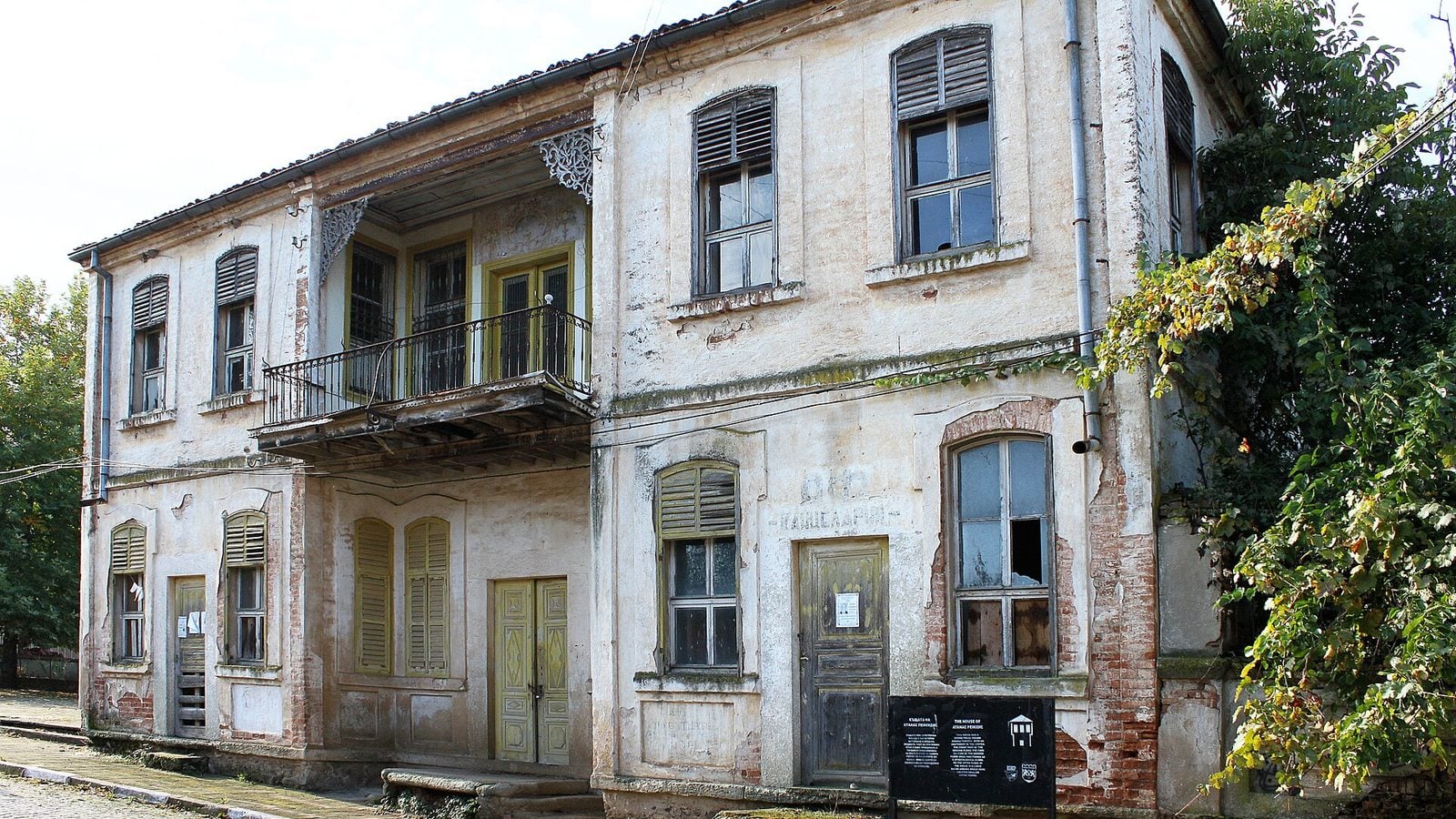
The economy was built on sericulture (silk production), tobacco growing, and trade. The village had three educational institutions — a school for boys, a school for girls, and a kindergarten — along with a bell foundry, sesame and tahini workshops, grain mills, blacksmiths, butcher shops, and even a cinema. Its three-storey houses — adobe and brick, with wood-carved ceilings, wrought iron balconies, and stone columns — followed the regional Thracian architectural style that travelers can still see in the surviving structures today.
Two Orthodox churches anchored the community. The older St Nedelya Church, beside the cemetery, is said to closely resemble the church in Vithkuq — the original homeland across the mountains. The main St Dimitar Church stands in the village centre.
The Balkan Wars and the Great Emptying
Mandritsa’s decline began with the wars that remade the Balkans in 1912–1913. The village was liberated from Ottoman rule on 15 October 1912, during the First Balkan War, by units of the First Bulgarian Army. It was briefly re-occupied by the Ottomans during the Second Balkan War before the Treaty of Constantinople ceded it permanently to Bulgaria.
The population collapsed in a single generation. Of the 480 families living in Mandritsa at the time of the Balkan Wars, only 40 remained in Bulgaria. The rest fled — first back toward Ottoman territory, then onward through Constantinople and Rodosto to Greece. About 100 families settled near Kilkis in Greek Macedonia, where they founded a village they named Mandres after the home they had left. Other families scattered across villages in Greek Macedonia and Western Thrace.
A second wave of emigration to Greece followed in 1929. By the mid-twentieth century, Mandritsa was a small village getting smaller.
An Archaic Albanian on the Edge of Greece
What survived in Mandritsa when the population did not was the language. The remaining families continued to speak Albanian — an archaic variety of the southern Tosk dialect that diverged from mainstream Albanian development sometime in the seventeenth century and was never standardized or written down.
The dialect preserves vocabulary and grammatical forms that modern standard Albanian has dropped. It is, in miniature, the same phenomenon linguists have documented in the Albanian villages of Ukraine’s Azov steppe and among the Arbëreshë communities of southern Italy: an Albanian frozen in time, kept alive by oral transmission inside a community surrounded by a different majority language.
Bulgarian Albanologist Ludmil Stankov (1949–2020) spent years recording and analyzing Mandritsa’s Albanian. His 2017 monograph, The Albanian Variety Spoken in the Village of Mandritsa, is the most comprehensive study of the dialect. Maria Hristova Georgieva-Peeva published a Bulgarian-Albanian conversational dictionary with glossary in 2015, drawing on the same living speech. Both works document a variety that has no written tradition of its own — everything that survives, survives because someone kept speaking it to their children.
The speakers are bilingual. Bulgarian is the language of the state, of school, of commerce. Albanian is the language of the kitchen table, of older relatives, of the phrases that come out when someone is startled or angry. It is the same pattern in every small diaspora community: the heritage language retreats to the private sphere and holds on there as long as the generation that carries it does.
Mandritsa Today
Bulgaria’s 2021 census recorded 34 permanent residents in Mandritsa, down from 52 in 2011. The village is quiet in winter, louder in summer when descendants return. Some of the three-storey houses still stand; others are ruins with iron balconies rusting into the hillside.
The village sits just 2 km from the Greek border, in a corner of Bulgaria that few tourists reach. Ivaylovgrad, the nearest town, is 15 km to the north. The Rhodopes here are low and rolling — tobacco country, not ski country.
Mandritsa has no diaspora lobby, no cultural centre in a foreign capital, no annual parade. It is not a community that organizes. It is a community that persists — by stubbornness, by geography, by the accident of a 1636 land grant that put Albanian-speaking dairymen on a hillside where they stayed for nearly four centuries while the borders changed around them.
For Albanian Americans tracing the full map of where Albanians ended up, Mandritsa is a data point that complicates the story. The Albanian dispersion was not only westward — to Italy with the Arbëreshë, to America with the twentieth-century waves. It was also northward, into the Slavic-speaking Balkans, where small communities held on in places the national movement never reached. Mandritsa is the last of those communities still speaking Albanian in Bulgaria. Whether it will be speaking Albanian in another generation depends on whether the 34 remaining residents have grandchildren who come back.
What Mandritsa Tells Us
The Albanian communities that survive outside Albania and Kosovo tend to fall into two categories: the large and organized (the million-strong diaspora in the United States, the Arbëreshë with their protected-minority status in Italy) and the small and forgotten (a village in Bulgaria, four villages in Ukraine). Mandritsa belongs to the second category.
It matters because it is evidence. A community that has spoken Albanian since 1636, inside Bulgaria, without institutional support or a written tradition, is proof that the Albanian dispersion across the Ottoman Balkans was deeper and more durable than the political maps suggest. The three brothers from Vithkuq who drove their herds into the Rhodopes did not plan to become a linguistic time capsule. They planned to make cheese. Their descendants, 390 years later, still carry the language of the people who arrived.