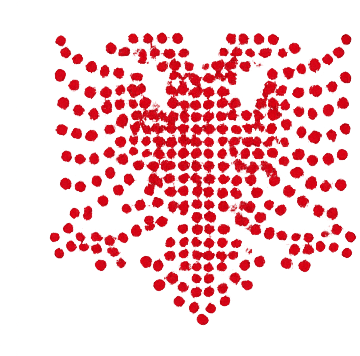


Krujë is the place where Skanderbeg planted his flag.
On 28 November 1443, Gjergj Kastrioti — the Albanian nobleman known by his Ottoman-given title Skanderbeg — rode into this mountain fortress after defecting from the Ottoman army at the Battle of Niš. He raised the Kastrioti double-headed eagle over the castle walls and declared the town the seat of his resistance. For the next 25 years, until his death in January 1468, Krujë was the capital of organized Albanian defiance against the Ottoman Empire.
The fortress held through three Ottoman sieges during Skanderbeg’s lifetime. It fell in a fourth, ten years after he died. By then it had entered the Albanian historical vocabulary as a synonym for a thing that does not break.
Today Krujë is a small town of roughly 9,000 people on a mountain ridge 32 km north of Tirana, inside the broader municipality of 51,191 (2023 census). Tourists climb to the castle, walk the Old Bazaar, visit the Skanderbeg Museum inside the walls, and look out from the ramparts over the same valley the Ottomans camped in 575 years ago. It is, after Tirana, the most-visited cultural site in Albania — and the one with the least ambiguity about why it matters.
The fortress
The castle sits on a rocky ridge at roughly 600 meters elevation, overlooking the Ishëm River valley and the coastal plain that stretches west toward the Adriatic and the port of Durrës. The fortification walls date to the 5th and 6th centuries AD — Byzantine-era construction that predates the Albanian principalities by several hundred years. The site was expanded and reinforced over successive centuries by whoever controlled it: Byzantines, the medieval Albanian noble houses, and eventually Skanderbeg himself.
The strategic logic is visible from any photograph. The ridge is steep on three sides. An army approaching from the plain below has to climb exposed ground under observation from the walls. Supply lines stretch across open terrain. The fortress commands the road between the Adriatic coast and the Albanian interior — whoever held Krujë controlled the route. This is what made it worth besieging, and what made it so hard to take.
By the time Skanderbeg arrived in 1443, the castle had changed hands multiple times. His father, Gjon Kastrioti, had controlled it as part of the small Kastrioti principality before the Ottoman vassal arrangement stripped it away. Skanderbeg’s recapture of the fortress was both a military act and a dynastic reclamation — the son recovering the family seat.
The first siege (1450)
Seven years after Skanderbeg took Krujë, Sultan Murad II came to take it back.
In May 1450, an Ottoman army estimated at 100,000 troops advanced on the fortress. Murad brought his crown prince Mehmed — the future Mehmed II, conqueror of Constantinople — along for the campaign. The Albanian resistance had been weakened by the loss of Svetigrad and Berat between 1448 and 1450, and Ottoman command expected Krujë to fall quickly.
Skanderbeg had a different plan. He placed a garrison of roughly 4,000 men inside the fortress under his trusted lieutenant Vrana Konti, with orders to hold the walls at any cost. Then he left the castle with a mobile force and operated in the surrounding mountains, conducting raids against Ottoman supply caravans and harassing the camps from positions the Ottomans could not pin down.
The siege dragged into summer. The Ottoman army could not breach the walls. Skanderbeg’s guerrilla attacks cut off supplies and made the camps unsafe. By September, disease had swept through the Ottoman ranks. Morale collapsed. Murad II ordered the withdrawal and marched back to Edirne. The Ottoman dead numbered in the thousands; the Albanian garrison had lost roughly 1,000 men.
The second siege (1466–1467)
Sixteen years later, Sultan Mehmed II — now the conqueror of Constantinople (1453) and the most powerful ruler in the eastern Mediterranean — launched a campaign to finish what his father had started. In June 1466, an Ottoman army arrived at Krujë and settled in for a long siege.
The Ottoman commander on the ground was Ballaban Badera, sanjakbey of Ohrid — himself an Albanian, taken as a child through the devshirme system and raised in the Ottoman military. The irony was not lost on contemporaries: an Albanian commanding the siege of the Albanian capital.
Skanderbeg was now over 60. He repeated the 1450 strategy — a garrison held the walls while he moved through the countryside, gathering forces and protecting refugees from the civilian areas the Ottomans attacked. The siege lasted nearly a year.
On 23 April 1467, the Ottomans broke. Ballaban Badera was killed. The army withdrew. Skanderbeg entered Krujë again.
The second siege confirmed what the first had established: the fortress was not going to fall while Skanderbeg was alive.
The third siege (1467)
Mehmed did not accept the defeat. Two months after Ballaban Badera’s army broke at Krujë, the sultan returned in person with a fresh force in the summer of 1467. This time Skanderbeg did not immediately retreat to the mountains — he confronted the Ottoman advance to buy time for the civilian population to reach safety, then withdrew toward the coast and into the highlands.
Mehmed sent detachments to raid Venetian-held Shkodër and Durrës, attempting to isolate Skanderbeg from his allies. But the siege of Krujë itself made no progress. The walls held, the garrison held, and after weeks of fruitless investment the Ottomans withdrew eastward, leaving behind a blocking force that could not compel a surrender.
Three sieges in seventeen years, all three repelled while Skanderbeg lived.
The fall (1477–1478)
Skanderbeg died on 17 January 1468 in Lezhë, likely of malaria. He was 62 or 63. Without him, the Albanian resistance fragmented. The League of Lezhë, the alliance he had held together through personal authority since 1444, could not sustain itself.
Venice, which had occasionally supported Skanderbeg as a counterweight to Ottoman expansion in the Adriatic, took nominal control of Krujë in the years after his death. But the resources were thin and the strategic calculus had shifted. When the Ottomans returned in 1477 for a final siege, there was no Skanderbeg to raid their supply lines and no unified Albanian command to relieve the garrison.
The siege lasted roughly a year. The defenders held as long as they could, but starvation broke them. Mehmed II offered terms: surrender and the garrison would go free. The fortress opened its gates in June 1478.
The terms were not honored. The Ottoman forces killed the men and enslaved the women and children.
Krujë had held for 35 years — the entire span of Skanderbeg’s rebellion plus a decade after his death. When it fell, organized Albanian resistance to the Ottoman conquest effectively ended. The next chapter of Albanian political autonomy would not begin until the pashalik period, three centuries later.
Inside the castle today
The castle walls still stand, rebuilt and restored over the centuries. Inside them, the site holds three distinct destinations.
The Skanderbeg Museum. The National History Museum “Gjergj Kastrioti Skënderbeu” was inaugurated on 1 November 1982 inside the castle grounds. The architects were Pirro Vaso and Pranvera Hoxha, Enver Hoxha’s daughter. The building is a striking piece of architecture in its own right: a Brutalist-vernacular structure that draws on traditional Albanian stone tower forms and medieval Romanesque elements. Enver Hoxha himself did not attend the opening.
Inside are weapons, maps, reproductions of Skanderbeg’s correspondence with popes and European monarchs, and a narrative of the 25-year resistance. The museum’s framing is nationalist — it was built during the communist period — but the documentary artifacts are genuine, and the presentation is more restrained than the regime’s propaganda output elsewhere.
The Ethnographic Museum. Housed in a restored Ottoman-era residence within the castle walls, the ethnographic collection covers daily life in the Krujë region: clothing, tools, household objects, and the domestic architecture of the tower houses that defined highland Albanian living.
The Dollma Tekke. A Bektashi shrine in the southern corner of the fortress, completed around 1779–1780 and designated a Cultural Monument of Albania. The Bektashi order — a Sufi Muslim tradition with deep roots in Albanian culture — maintained tekkes across the country, and several survive as protected sites. Near the summit above the castle, the cave shrine of Sari Salltik draws Bektashi pilgrims; the legendary 13th-century dervish is claimed by multiple Balkan traditions, but the Krujë shrine is one of the most visited.
The Old Bazaar
Below the castle gate, a cobblestone market street runs downhill — the Old Bazaar, dating in its current form to the Ottoman period but occupying a commercial site that Skanderbeg-era sources already describe. The shops sell handmade Albanian crafts: filigree silver jewelry, copperwork, embroidered textiles, kilim rugs, alabaster carvings, and antiques. Some stalls sell reproductions of Skanderbeg’s helmet and sword, scaled to souvenir size.
The bazaar is not a museum piece. The shopkeepers are working vendors, and the goods are made by hand in the region. For visitors coming from Tirana — it is a 40-minute drive — the bazaar is often the first contact with the Albanian artisan tradition.
Why Krujë matters
Krujë’s significance is not really about the castle. It is about what the castle proved.
Albania’s national story is built around a small number of load-bearing moments: the declaration at Vlorë in 1912, the Congress of Lushnjë in 1920, the fall of communism in 1991. But before any of those, there is Krujë — the proof that Albanian resistance, organized and led by an Albanian commander, could hold against the dominant military power of the age.
The fact that the fortress eventually fell does not diminish that proof. It fell ten years after Skanderbeg’s death, after a year-long siege, by treachery rather than assault. For the 35 years it held, it was the physical anchor of the argument that Albanian political independence was possible.
That is why the Skanderbeg Museum is in Krujë and not in Tirana. The capital has the equestrian statue in the central square, but Krujë has the walls. The castle is the place where the thing happened — where a flag went up and stayed up for a generation. Albanian Americans who visit Albania and climb to the castle are not visiting a ruin. They are visiting the original site of a story their families carried across the Atlantic.
For a guide to the cities of Albania that shaped the nation, Krujë stands alongside Shkodër, Berat, and Gjirokastër as a place where the stones still carry the history.