
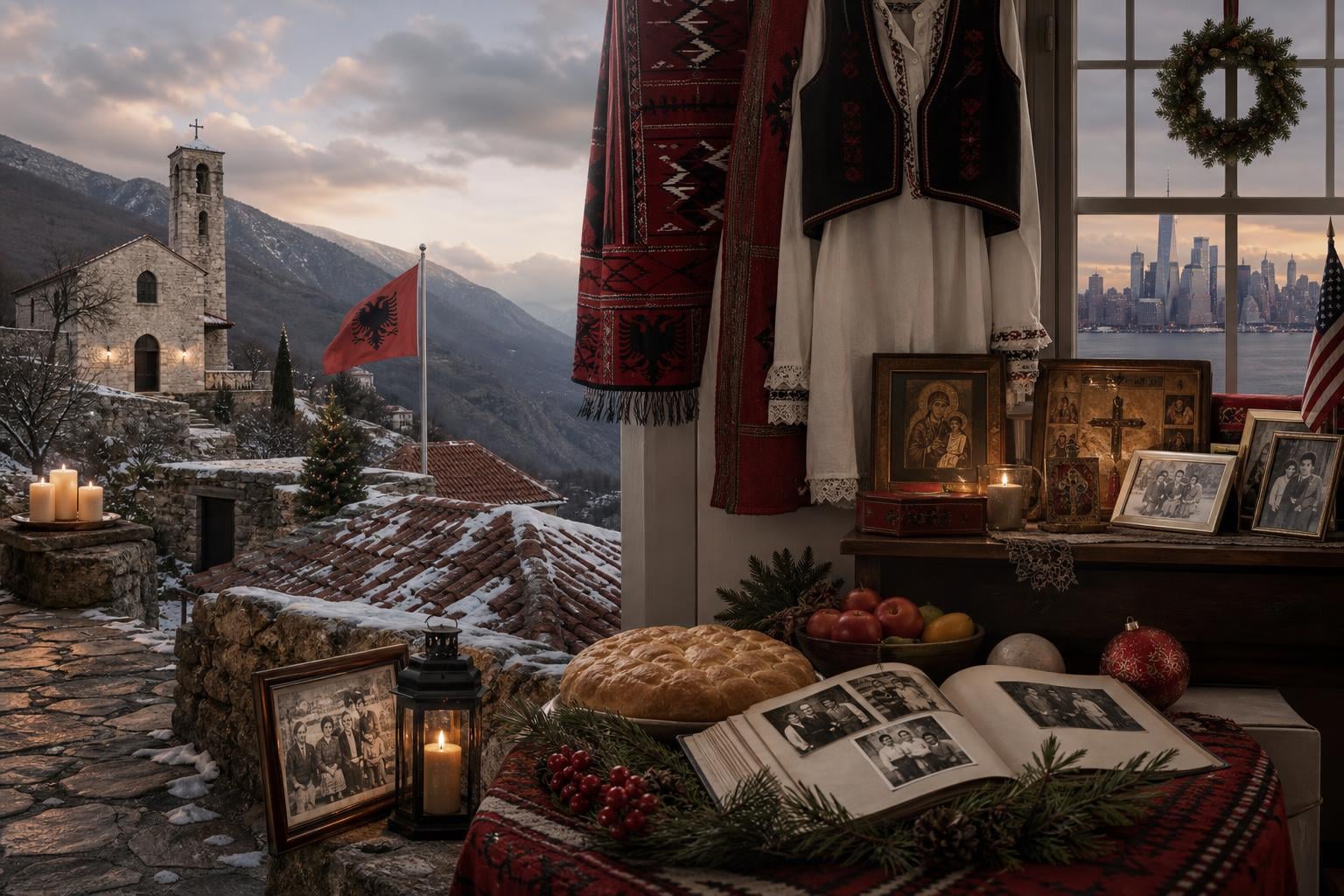
For an Albanian family in Worcester or Sterling Heights, the last week of December has a shape to it. The kitchen fills with the smell of byrek baking and walnuts being ground for bakllava. A grandmother who once could not say the word Krishtlindje out loud in her own village now sets the table for it without a second thought. The youngest grandchild is coached, gently, to say three words to every relative who walks in.
Christmas in Albanian culture is not one tidy story. It runs along two church calendars, it survived a 23-year state ban, and it sits inside one of the most religiously mixed cultures in Europe. In the United States, it also runs alongside the American Christmas the kids learn at school — Santa, the tree, the morning gifts — so the holiday a diaspora family keeps is usually two holidays braided together.
This piece is for the Albanian American who wants to understand and pass on that holiday. It covers what Krishtlindje means and how to say the greeting, the December 25 and Orthodox calendar reality, the years when Christmas was illegal in Albania, the older customs like the Buzmi, the food on the table, and how families from New York to Michigan keep all of it alive. It is community context, not religious instruction.
What Krishtlindje means and the greeting
Krishtlindje is the Albanian word for Christmas. It is a compound: Krisht (Christ) joined to lindje (birth) — literally “Christ’s birth.” With the Albanian definite article it becomes Krishtlindja (“the Christmas”), and the plural-definite form Krishtlindjet is what you see on cards, in headlines, and in the standard greeting.
That greeting is Gëzuar Krishtlindjet — “Merry Christmas.” Gëzuar, pronounced roughly guh-ZOO-ar, is the all-purpose Albanian holiday word for “happy” or “joyful.” It is the same word in Gëzuar Vitin e Ri (“Happy New Year”) and the same word raised in a toast over a glass of raki. So the phrase reads, word for word, as “[have a] joyful Christmas.”
The reply is easy. Gëzuar edhe ty — “happy to you too” — covers it between family and friends. Older relatives may add a wish for shëndet dhe paqe, “health and peace.”
One practical note for diaspora families: Christmas and New Year sit close together, and in much of Albanian practice the bigger gift-giving moment is New Year’s, not Christmas morning. Many families say Gëzuar Krishtlindjet dhe Vitin e Ri as a single breath — “Merry Christmas and Happy New Year” — because the two holidays are kept as one stretch of the calendar rather than two separate events. For US-born kids who get presents on December 25 the American way and again at New Year the Albanian way, that overlap is a feature, not a confusion.
This is the phrase worth teaching a child first. Three words, said to every aunt, uncle, and gjyshe (grandmother) at the door, and the holiday is theirs.
The two-calendar reality: December 25 and the Orthodox date
Albanians do not all celebrate Christmas on the same day, and that is normal rather than a problem to resolve.
Albanian Catholics and Western-calendar Christians celebrate on December 25, the date most Albanian Americans recognize because it lines up with the American calendar. December 25 — Krishtlindjet — is a public holiday in Albania, marked nationally regardless of which community is observing it (Public holidays in Albania, Wikipedia).
Albanian Orthodox Christians follow their own church calendar. Parishes that keep the older Julian reckoning observe Christmas on January 7 — the same date you see in other Orthodox traditions across the Balkans and Eastern Europe. The difference is not a disagreement about Christ’s birth; it is a difference between two liturgical calendars, the Gregorian and the Julian, that drifted apart over centuries.
The honest framing matters here, and it is the brand’s core value: neither date is the “real” Christmas. A Catholic family in the Bronx keeping December 25 and an Orthodox family in Boston keeping January 7 are both keeping Krishtlindjet. The culture holds both. This mirrors Albania’s two recognized Easters — Catholic and Orthodox — which fall on different dates in most years and are both national holidays.
For a diaspora reader, the practical upshot is simple. If you are inviting an Albanian-American family to a holiday gathering, the safe move is to ask which tradition they keep rather than to assume. In mixed marriages — and there are many — a household may quietly observe both, with the December table for one side of the family and a January gathering for the other.
The Orthodox parishes of America have deep Albanian roots; the Autocephalous Orthodox Church of Albania and its American communities trace organizing work to the early 20th century. Catholic Albanian communities, historically from the northern highlands around Shkodër, built their own parishes alongside them. Two calendars, one diaspora.
When Christmas was banned: the years no one could say it out loud
There is a generation of Albanian Americans for whom Krishtlindjet is not just a holiday but a recovered word, and that history is worth telling plainly.
In 1967, under Enver Hoxha, Albania declared itself the world’s first officially atheist state. The campaign closed or repurposed religious buildings across the country and made open religious practice a crime (How Albania Became the World’s First Atheist Country, Balkan Insight). The constitution of the period stated that the state recognized no religion and actively promoted atheism.
Christmas did not disappear from people’s hearts, but it disappeared from the street. Families who wanted to mark it did so behind closed doors, quietly, at real risk. One Albanian Catholic priest, Father Ernest Simoni, was arrested on December 24, 1963, after celebrating a memorial Mass for the assassinated US president John F. Kennedy. He was sentenced to death, a sentence later commuted, and served 28 years of forced labor, first in a mine and then in a sewage canal — a single name that stands in for many (Ernest Simoni, Wikipedia).
The ban held until the end of the communist period. The ban on religious observance was officially lifted in December 1990, in time for thousands of Christians to attend Christmas services that year, and churches and mosques reopened across the country in the months that followed. For more than two decades, an entire population grew up unable to celebrate Christmas — or Bajram, or Easter — in public.
This is why the holiday carries a particular weight for the immigrant generation. An Albanian who arrived in New York or Michigan in the late 1980s or the 1990s may have spent their childhood in a country where the word Krishtlindje was politically dangerous, and then found themselves in a place where Christmas is on every storefront in November. The freedom to set out a tree, to say the greeting at the door, to take children to a midnight service — that freedom is not abstract for them. It is the contrast between the village they left and the life they built.
When a diaspora family keeps Christmas loudly now, that is not only American assimilation. For many it is the deliberate use of a freedom their parents did not have.
Older customs: the Buzmi, the family table, and church
Beneath the modern, public Christmas sits an older layer of Albanian custom, and the best-known piece of it is the Buzmi.
The Buzmi is a traditional Albanian Christmas log — a relative of the Yule log found across the Balkans and much of Europe. Nata e Buzmit, “the night of the Buzmi,” centers on bringing a specially chosen log into the home and burning it on the hearth, with a set of rituals attached. Those rituals were tied to agricultural hope: a good harvest, healthy livestock, the prosperity of the household in the year to come (Albanian paganism, Wikipedia).
In some accounts of the custom, a family member carries the log toward the house and announces its arrival aloud — that the Buzmi comes “with bread, with cheese, with butter, and with everything good.” The log was sometimes welcomed almost as a guest. The richest versions of the practice were documented in the northern highlands — Mirdita, Pukë, Dukagjin, the Shkodër and Lezhë regions, and beyond — and the custom was also recorded among the Arbëreshë, the centuries-old Albanian communities of southern Italy.
What the Buzmi shows is how old the layering is. A pre-Christian agricultural ritual folded into the Christian Christmas, the way folk customs do everywhere, and survived in remote regions long after it faded from the cities. Most Albanian-American families today do not burn a Buzmi — there is rarely a hearth for it in a suburban house — but the name and the idea are part of the heritage, and worth knowing as something to tell the grandchildren.
The two customs almost every family does keep are the table and the church. Christmas centers on a long family meal, with the generations at one table, and on attending a service — Mass for Catholics, the Divine Liturgy for the Orthodox, often at the parish that anchors the local Albanian community. Children in some regions have gone door to door singing on Christmas Eve, rewarded with sweets, in a custom close to caroling elsewhere.
The Christmas table and the sweets
If there is one thing the diaspora keeps without fail, it is the food.
The savory side of the Albanian Christmas table starts with byrek — the layered filo pastry filled with cheese, spinach, leeks, or meat that appears at every Albanian gathering, holiday or not. Around it go roast meats, often lamb or pork in Christian households, plus pilaf and the seasonal vegetable dishes a particular family favors. The meal is long, the table is crowded, and the point is to keep people sitting.
The sweets are where Christmas announces itself. Bakllava — walnut filo pastry soaked in syrup — is the headline dessert, cut into diamonds and stacked on a tray. Alongside it come gurabija, the crumbly shortbread cookies that melt at the first bite, and revani, a semolina cake drenched in syrup. Trays of small pastries circulate, and there is almost always more than anyone can finish, which is the intention.
Coffee runs throughout. Albanian coffee — small cups, served slowly, the occasion to sit and talk — is its own ritual layered on top of the holiday, the medium through which the visiting actually happens. For many families a glass of raki, the grape or fruit brandy, accompanies the toasts.
None of this is unique to Christmas in isolation. The same bakllava and byrek appear at Bajram, at Easter, at weddings, at funerals. That is exactly the point worth making to a younger reader. The Albanian holiday table is a shared cultural inheritance that does not belong to one faith. What changes from holiday to holiday is the calendar and the meaning; the byrek stays.
In the diaspora kitchen, this is where the heritage transfers most reliably. A grandchild who does not speak much Albanian and has never seen a Buzmi still learns, hands-on, how to layer filo and roll bakllava — and that knowledge carries the holiday forward better than any explanation.
How the US diaspora keeps Christmas
In American homes, Albanian Christmas becomes a braid of two traditions, and the braid looks a little different in every family.
The American layer arrives through the children. They learn Santa at school — known in Albanian as Babagjyshi i Krishtlindjeve (“Grandfather Christmas”) or Babadimri (“Grandfather Winter”) — and they expect a tree, stockings, and gifts on the morning of December 25. Parents lean into it. The tree goes up, the lights go on the house, and the American Christmas runs on schedule.
The Albanian layer runs underneath and alongside it. The food is Albanian. The greeting at the door is Gëzuar Krishtlindjet. The relatives who come through are the extended family — the diaspora keeps the big-table, many-generations gathering that is harder to maintain in smaller American family structures. And the second wave of celebration at New Year, with its own gifts and its own toasts, keeps the Albanian rhythm of the season intact.
Geography shapes the details. In the New York metro area — the largest Albanian-American community, concentrated in the Bronx, Yonkers, Westchester, and northern New Jersey — Catholic families anchor Christmas around parishes like the Albanian community churches that serve the area. In Michigan, around Detroit and Sterling Heights, both Catholic and Orthodox Albanian communities keep the holiday. In Massachusetts, with its older Albanian-American roots, Orthodox tradition runs deep. Same holiday, different parishes, different exact dates.
Teaching the next generation is the live concern in most of these homes. A child born in Michigan to parents born in Albania will absorb the American Christmas effortlessly; the Albanian half takes intention. That is why the greeting, the byrek lesson, the explanation of why some cousins celebrate in January, and the story of when Christmas was banned all matter. They are how a holiday stays Albanian and not just generically festive.
Christmas inside Albania’s coexistence
The last thing worth understanding about Krishtlindjet is the religiously mixed culture it sits inside, because that shapes how the diaspora treats it.
Albania is one of the most religiously plural societies in Europe. The 2023 census recorded a population that is roughly half Muslim — Sunni and Bektashi together — alongside Catholic and Orthodox Christian minorities and a sizable share who declared no religion or did not state one (Religion in Albania, Wikipedia). Christianity, Catholic and Orthodox combined, is the second-largest grouping. These communities have lived intertwined for centuries, frequently within the same extended family.
That mixing is why Christmas in Albanian-American life so often crosses faith lines. A Muslim or Bektashi relative sending Gëzuar Krishtlindjet to a Christian cousin is not making a religious statement; it is the same family courtesy that produces a Gëzuar Bajramin text going the other direction at Eid. The greeting belongs to the language and to the family bond, not exclusively to one community inside it.
This is the brand’s steady position, and it bears repeating: Catholic, Orthodox, Muslim, Bektashi, and secular Albanians all belong to the same culture, and a holiday like Christmas is honored without any claim that it “belongs” to one group or that one calendar date is correct. Coexistence is not a slogan here; it is the lived structure of an ordinary Albanian family tree, where a Catholic grandmother, an Orthodox cousin, and a Muslim uncle may all be at different tables on different feast days through the year, and at the same wedding in the summer.
For Albanian Americans, keeping Christmas with that openness is itself part of the heritage. The holiday is real, the faith behind it is real, and the welcome extended across the family’s other traditions is just as real.
The traditions in this article survive because specific families choose to keep them — and because the community can see itself clearly enough to pass them on. Counting yourself in the National Albanian Registry is one small way to help preserve the heritage you hand to the next generation.