Kosovo is roughly 95.6% Muslim today, which is the headline most readers carry into the topic. The longer story is older. For a thousand years before Ottoman rule, the territory now called Kosovo was Christian — Catholic in the Albanian highlands, Orthodox in the Serbian-administered episcopal centers, and often both at once in border villages where the line between Rome and Constantinople ran through a single market square. The Christian thread did not vanish under the Ottomans. It thinned, went underground in places, and held on in towns whose names — Letnica, Janjevo, Decani, Pec, Gracanica — still carry the weight.
This piece covers the pre-Ottoman Catholic and Orthodox foundations, the conversion patterns that produced today’s Muslim majority, the communist-era suppression that hit Yugoslavia differently than it hit Albania, the 2011 census numbers that frame the current landscape, and the ways US Albanian parishes carry the inheritance forward. We cite Wikipedia and the Kosovo Agency of Statistics where figures are load-bearing. We stay neutral on contested questions of sovereignty and monastery jurisdiction.
NAR speaks for Albanian Americans across every tradition — Catholic, Orthodox, Sunni, Bektashi, secular. The aim is to give Christian-heritage Kosovars a clean reference and to give the rest of the community context for a piece of the Albanian story that often gets compressed into a single sentence.
The pre-Ottoman Christian foundation
Christianity reached the territory of modern Kosovo through the same Roman and early Byzantine routes that Christianized the rest of the Balkans. By the fourth and fifth centuries, an organized bishopric operated at Ulpiana (near modern Lipjan), within the territory that is now Kosovo. Nearby, in what is today the Leskovac region of southern Serbia, Emperor Justinian I founded the archbishopric of Justiniana Prima in the sixth century, with jurisdiction reaching across Dardania — the Roman province that included Ulpiana. Both were Christian episcopal centers serving a Roman population that included the ancestors of both Albanians and Slavic-speakers who would arrive later.
The Great Schism of 1054 drew a line through the central Balkans, and Kosovo sat directly on it. Catholic Latin-rite communities looked west to Rome. Orthodox Eastern-rite communities looked east, to Constantinople and, later, to the Serbian Orthodox episcopal centers that emerged with the medieval Serbian state.
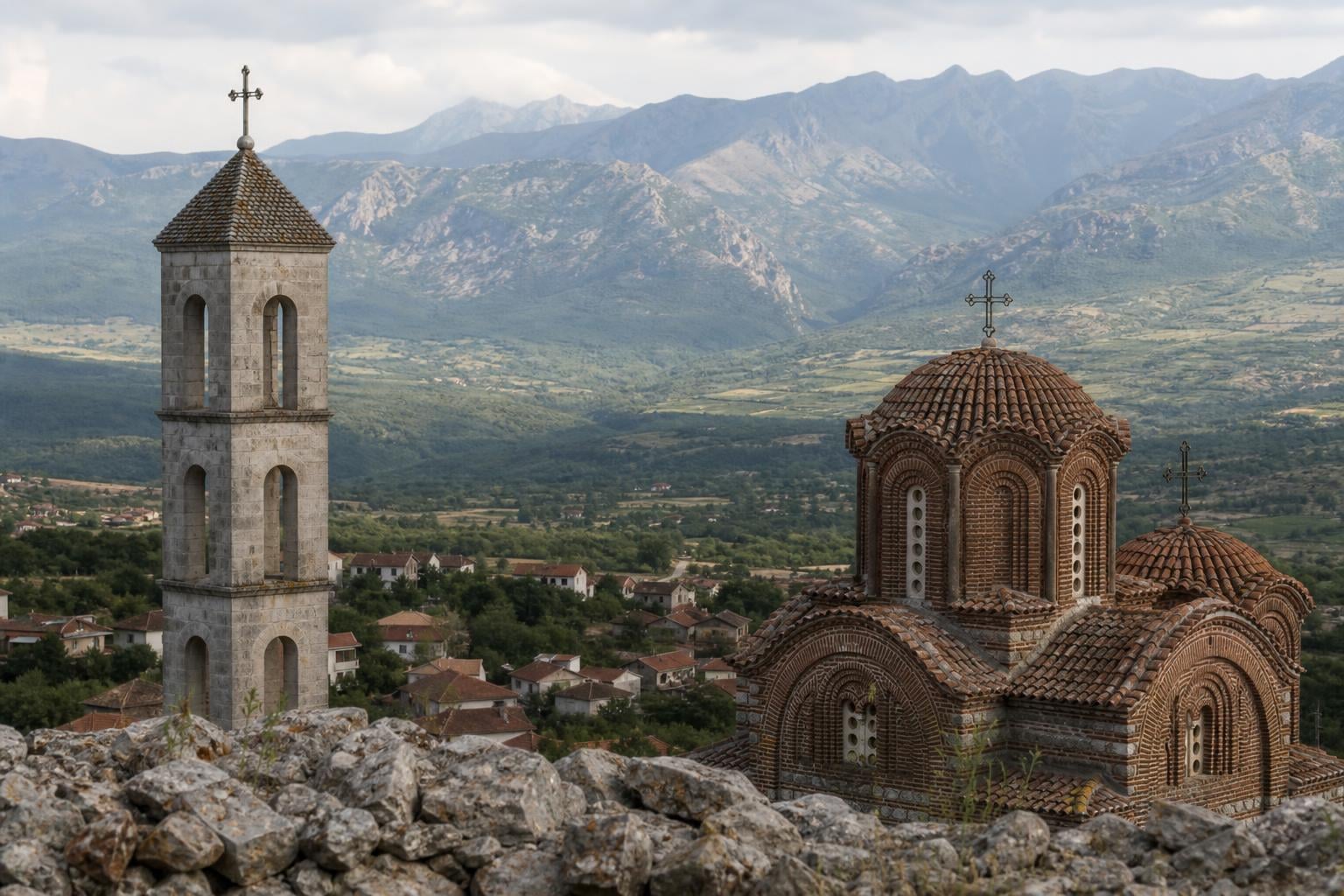
The medieval Serbian Orthodox presence became architecturally monumental in the 1200s and 1300s. The Patriarchate of Pec — Pejes in Albanian, Pec in Serbian — was elevated as the seat of the Serbian Orthodox Church in 1346 under Tsar Stefan Dushan. Visoki Decani [literally “High Decani”] was built between 1327 and 1335 under King Stefan Decanski. Gracanica monastery, near Pristina, was completed around 1321 under King Stefan Milutin. The Church of the Virgin of Ljevisa in Prizren dates to the early 1300s in its current form. All four are now UNESCO World Heritage Sites.
The Catholic presence in the same period ran along the Adriatic-facing river valleys and into the highlands. The Diocese of Prizren is documented in papal correspondence from the 1200s. Catholic Albanian families in the Has region, the Drini Valley, and the area around Janjevo formed continuous communities that maintained ties to the Holy See through Franciscan and Jesuit missions reaching inland from the coast. This is the same Catholic heritage threaded through the broader Albanian Catholic Church tradition.
The Catholic minority that survived
By the time the Ottomans completed their conquest of Kosovo in the late 1400s, the Christian map of the territory was already mixed — Orthodox episcopal centers in the lowlands and along the Serbian-administered north, Catholic communities in the highlands and the Adriatic-facing west, and a layer of village-level practice that mixed both traditions in ways that frustrated later attempts at tidy categorization.
The Catholic communities that survived the Ottoman centuries clustered in specific places. Janjevo, a village south of Pristina, is the oldest continuously Catholic settlement in Kosovo, with a community of mixed Albanian and Croatian heritage tracing back to medieval Saxon miners brought in to work the local silver deposits. Letnica, in the Vitia region of southern Kosovo, became a Marian pilgrimage center built around the Church of the Black Madonna of Letnica — a Catholic shrine that drew pilgrims from across the Albanian-speaking Balkans, including, per family accounts and the standard biographies, the Bojaxhiu family of Mother Teresa. Klina in the central Drini valley, the villages north of Pejes (Pec), and parts of the old town of Prizren preserved Catholic Albanian populations alongside their Muslim Albanian neighbors.
The Diocese of Prizren-Pristina, in its current configuration, serves roughly 60,000 Catholics across Kosovo. The cathedral seat is the Cathedral of Saint Mother Teresa in Pristina, consecrated in 2017 — one of the largest Catholic cathedrals in the Balkans and a deliberate public claim on the territory’s Christian heritage in the post-1999 period.
One distinctive feature of Kosovo Catholicism is the documented phenomenon of Laramans [literally “the variegated ones”] — crypto-Catholic families who, under Ottoman pressure, identified publicly as Muslim while privately maintaining Catholic baptismal, marriage, and burial practices. The pattern is well documented in nineteenth-century Catholic missionary reports and in twentieth-century anthropological work. Some Laraman families openly returned to Catholicism in the 1840s after Ottoman religious-tolerance edicts; others retained the dual practice into the early twentieth century.
Orthodox Christianity in Kosovo
Orthodox Christianity in Kosovo is institutionally anchored by the Serbian Orthodox Church, which has administered the territory’s Orthodox communities continuously since the medieval Serbian state. The four medieval monasteries — Visoki Decani, the Patriarchate of Pec, Gracanica, and the Church of the Virgin of Ljevisa in Prizren — together constitute the Medieval Monuments in Kosovo UNESCO World Heritage Site, inscribed in 2004 and expanded in 2006.
The frescoes inside these buildings are widely regarded as among the most important surviving examples of Byzantine-influenced medieval painting. The Visoki Decani fresco program includes more than 1,000 individual figures across the interior walls and dome. The Patriarchate of Pec was the seat of the Serbian Orthodox Church from 1346 until 1766 and remains the official seat of the Serbian Patriarch today.
UNESCO has listed all four sites on its List of World Heritage in Danger since 2006, citing political instability and security concerns following the 1999 conflict and the inter-ethnic violence of March 2004 in which several Orthodox churches were damaged or destroyed. KFOR (the NATO-led Kosovo Force) maintained protective deployments at Visoki Decani for years. Per Wikipedia’s Medieval Monuments in Kosovo article, the danger listing remains in force.
The Serbian Orthodox Church considers these monasteries part of its canonical territory. The Republic of Kosovo recognizes them under Article 9 of the Kosovo Constitution, which guarantees the protection of cultural and religious heritage and provides specific protections for the Serbian Orthodox Church under the 2008 Ahtisaari Plan that accompanied independence. The two framings — Serbian Orthodox ecclesial claim and Kosovo state constitutional protection — coexist in tension but are both documented facts on the ground. NAR’s position is neutral on the underlying dispute.
Kosovo’s Orthodox community today is largely concentrated in Serb-majority enclaves: northern Mitrovica, Gracanica, Strpce, and villages around the monasteries. The 2011 census recorded Orthodox identification at roughly 1.4% of the total population, per the Kosovo Agency of Statistics — though northern Kosovo largely boycotted the census, so real numbers are modestly higher.
Conversion to Islam under the Ottomans
The shift from Christian-majority to Muslim-majority Kosovo happened gradually, across roughly 400 years of Ottoman rule (late 1400s to 1912), through several overlapping mechanisms documented in Ottoman tax registers, Catholic mission reports, and modern scholarship.
The most consistent pressure was fiscal. Non-Muslims paid the jizya — a per-capita tax levied on adult non-Muslim men of the dhimmi (protected non-Muslim subject) status. Conversion removed the tax. For Albanian highland families with limited cash income, the cumulative incentive across generations was substantial.
A second pressure was institutional opportunity. Government office, judicial roles, military command, and tax-farming concessions were largely closed to Christians. The devshirme — the Ottoman levy of Christian boys for the Janissary corps and the imperial administration — affected Albanian communities heavily and produced a stream of high-ranking Ottoman officials of Albanian origin.
A third pressure was generational drift. In mixed-faith villages, intermarriage and the social pull of the majority produced steady, slow conversion. The Catholic missionary correspondence of the 1600s and 1700s — particularly Pjeter Bogdani’s reports — describes the hollowing-out of Catholic congregations in the Kosovo lowlands.
What stayed Christian was what was geographically defensible or institutionally rooted. The Catholic highland villages of the Has, the Marian pilgrimage center at Letnica, the mixed Catholic-Croatian Janjevo settlement, the Catholic quarters of Prizren, and the Serbian Orthodox monastery complexes — these held. By the late nineteenth century, Catholic identification in Kosovo had fallen to roughly 3-4% of the Albanian population, where it has stabilized since.
Communist-era suppression of religion
The communist period in Kosovo is often conflated with the communist period in Albania proper. The two stories differ in load-bearing ways.
Albania under Enver Hoxha (1944-1985) was the harshest religious regime in twentieth-century Europe. Hoxha declared Albania the world’s first officially atheist state in 1967, closed every mosque, church, and Bektashi teqe, banned all public religious practice, and executed or imprisoned clergy across every tradition. The ban remained in force until 1990. Pope Francis recognized 38 Albanian Catholic martyrs of the Hoxha era at a beatification ceremony in Shkoder in 2016. (See our Albanian Catholic Church and Pope John Paul II on Communism pieces.)
Yugoslavia, which administered Kosovo from 1945 to 1999, was officially atheist in the same Marxist-Leninist sense but operated under a substantially more permissive policy. Churches and mosques stayed open. Clergy were monitored by state security and occasionally imprisoned on political charges, but ordinary worship continued. Religious education was banned from public schools, but seminaries — including the Catholic seminary at Zagreb and the Serbian Orthodox seminary at the Patriarchate of Pec — continued to operate.
The Yugoslav approach combined nationalization of Church properties, restrictions on public processions and pilgrimages, registration requirements for clergy, and intermittent prosecutions of priests, hodjas, and monks on anti-state charges. Constant low-grade pressure rather than total ban.
The practical result was that institutional continuity survived. The Marian pilgrimages to Letnica continued. Catholic baptisms, marriages, and funerals went on. The Serbian Orthodox monasteries kept their resident monks. When Yugoslavia collapsed and Kosovo emerged from the 1999 conflict, the Christian institutional fabric was thinned but intact — in a way that the Albanian institutional fabric, post-1990, was not. Kosovo’s post-1999 reopening was a resumption; Albania’s post-1990 reopening was, in many places, a reconstruction from memory.
Post-1999 religious landscape and the 2011 census
The 2011 Kosovo Population and Housing Census, conducted by the Kosovo Agency of Statistics (ASK), is the most recent comprehensive religious demographic snapshot. Per the ASK data, religious identification for residents who answered the religion question broke down approximately as:
- Muslim — ~95.6% (overwhelmingly Sunni; small Bektashi and Sufi minorities)
- Roman Catholic — ~2.2%
- Serbian Orthodox — ~1.4%
- Other / none / no answer — ~0.7%
Per Wikipedia’s Religion in Kosovo summary and the ASK census report. The Serb-majority north largely boycotted the 2011 census, so the real Orthodox share is modestly higher; estimates put combined Christian identification at roughly 3.5-5% of the de facto population.
The Kosovo Constitution (adopted 2008) frames religion in Article 9: “The Republic of Kosovo ensures the protection and preservation of its cultural and religious heritage.” Article 8 declares Kosovo a secular state. The 2008 Ahtisaari Plan incorporated into Kosovo’s constitutional order provides specific protections for Serbian Orthodox Church properties, monastery zones, and cultural-heritage sites.
The Catholic Church operates through the Diocese of Prizren-Pristina, established as an independent diocese in 2018. The Serbian Orthodox Church operates the four monastery complexes plus parish networks in Serb-majority enclaves. The Bashkesia Islame e Kosoves (Islamic Community of Kosovo) administers Sunni mosques and the smaller Bektashi presence. The overall picture: a secular state with a Muslim plurality, two functioning Christian minorities, and a constitutional framework that, on paper, protects all three.
Mother Teresa as Kosovo-Albanian Catholic icon
Saint Teresa of Calcutta — born Anjeze Gonxhe Bojaxhiu in Skopje on August 26, 1910 — is the most internationally recognized figure of Albanian Catholic heritage. Kosovo’s claim on her runs through her family’s deeper origins. Her father, Nikolle Bojaxhiu, came from a Kosovo-Albanian Catholic background traced by standard biographies to the Prizren region. Her mother, Dranafile Bernai, was also from an Albanian Catholic family with Balkan roots crossing the modern Kosovo-North Macedonia border.
The Bojaxhiu family made pilgrimages to Letnica, the Catholic Marian shrine in southern Kosovo’s Vitia region, during Mother Teresa’s youth. By her own later account, she attributed part of her early sense of religious vocation to time spent at Letnica. The shrine continues to function as a Catholic pilgrimage site today, drawing Albanian Catholics from Kosovo, Macedonia, and the broader diaspora around the Feast of the Assumption (August 15).
The institutional anchor of Kosovo’s claim is the Cathedral of Saint Mother Teresa in Pristina, consecrated in 2017 as the cathedral of the Diocese of Prizren-Pristina — among the largest Catholic cathedrals in the Balkans, deliberately scaled to make a public claim on the territory’s Christian heritage. Other Mother Teresa memorials include school namings and statues in town squares from Prizren to Gjakova.
Mother Teresa identified as Albanian her entire adult life. She received a state funeral in India in September 1997. Albania, Kosovo, and North Macedonia all claim her — and none of those claims is wrong. (Our full Mother Teresa piece covers her biography in depth.)
The diaspora dimension: Christian Kosovars in America
Kosovo-Albanian emigration to the United States ran in waves through the twentieth century, with the largest single influx following the 1999 conflict. By community estimates, Kosovo Albanians make up the majority of post-1990 Albanian-American immigration, concentrated in metro New York (especially the Bronx and Westchester County), northern New Jersey, Detroit and Sterling Heights in Michigan, and Waterbury, Connecticut.
Kosovo-Albanian Catholic families often gather at the same parishes that serve broader Albanian Catholic communities. Our Lady of Shkodra Albanian Catholic Church (Zoja e Shkodres) in Hartsdale, New York, is the flagship — Mass runs in Albanian and English, and major feasts such as Christmas (Krishtlindja), Easter (Pashka), and the Feast of Saint Mother Teresa anchor the calendar.
Other US parishes with significant Kosovo-Albanian Catholic populations include the Bronx and Yonkers (the original urban core in metro NY), Waterbury (one of the older Kosovo-Albanian Catholic communities from early-twentieth-century highland migration), Detroit and Sterling Heights (Michigan’s ~27,000 Albanian Americans per the 2020 ACS include a Kosovo-Catholic share), and Garfield and Clifton in New Jersey. These parishes typically operate inside the structure of the local Roman Catholic diocese — there is no separate Kosovo-Albanian Catholic jurisdiction in the US.
Kosovo-Albanian Orthodox Christians are rarer in the US — Orthodox Albanians in America are historically rooted in the Tosk south, not in Kosovo — but the Albanian Orthodox Archdiocese in America, with its 11 parishes anchored at St. George Cathedral in South Boston, welcomes Orthodox Albanians of every origin. (See our Albanian Orthodox Archdiocese in America piece.) The Archdiocese has been part of the Orthodox Church in America (OCA) since 1971.
For second- and third-generation Kosovo-Albanian American Christians, religious identity coexists with shared ethnic identity. Catholic Kosovars and Orthodox Albanians and Sunni Albanians and Bektashi Albanians sit in the same school auditoriums and answer the same census ancestry question. Different threads of the same braid.
Christian and Muslim Kosovars in the same family tree
Religious identity in Kosovo, as in the rest of Albanian-speaking territory, has often been more porous at the household level than national-statistics summaries suggest.
Mixed Catholic-Muslim marriages were and remain common. The Laraman pattern of public-Muslim, private-Catholic identification produced families that today, three or four generations on, retain Catholic baptismal records alongside Muslim funeral customs. Christmas trees go up in Muslim Albanian homes; iftar meals are shared with Catholic neighbors during Ramadan. The nineteenth-century Rilindja writers, including Pashko Vasa, framed Albanian identity above sectarian identity — “Feja e shqyptarit asht shqyptaria” / “The religion of the Albanian is Albanianism.”
For Albanian Americans researching family roots, the implication is that Kosovo-origin family trees often contain Catholic, Muslim, and occasionally Orthodox branches within a few generations of each other. Catholic parish baptismal registers in Prizren and Klina, Ottoman tax registers reachable through Turkish archives, and Yugoslav-era civil records together build a usable picture for most Kosovo-Albanian families.
This is the inheritance: a thousand years of layered Christian and Muslim practice in the same territory, surviving Ottoman rule, surviving Yugoslav atheism, and now distributed across the diaspora alongside the language and the food.
Get counted alongside your Christian Kosovar heritage
The National Albanian Registry is building a community-led count of Albanian Americans across every region and tradition. Catholic Kosovars from Prizren, Janjevo, and Letnica; Orthodox Albanians from the broader community; Muslim and Bektashi Albanian Americans across every state — all belong in the same count. Register here and add your household to the record. The Certificate is a recognition document marking your place in the Albanian-American community. It is not a government ID or a citizenship document, but it is yours, and it carries the inheritance forward in a form that the next generation can hold.
A short note before the FAQ: the answers below are pulled from the same sourcing as the article above — Wikipedia entries on Religion in Kosovo and Roman Catholicism in Kosovo, the Kosovo Agency of Statistics 2011 census, UNESCO’s World Heritage records, and the Kosovo Constitution’s published text. Where field estimates differ from formal census figures, we note the gap.