

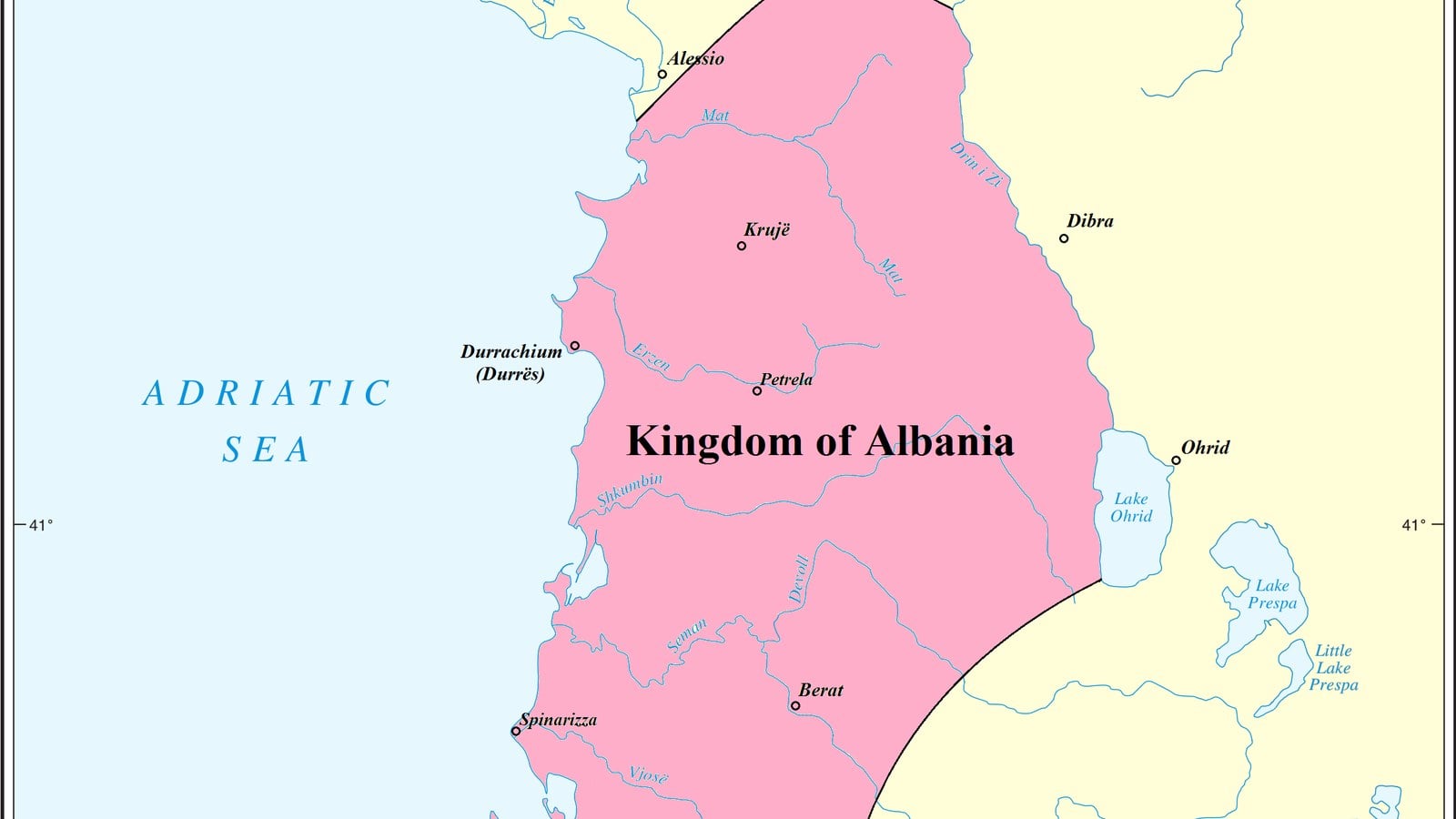
The Principality of Arbanon ended in 1257 when Nicaean forces annexed it. Fifteen years later, a different kind of Albanian state emerged — one founded not by a local lord carving out autonomy inside a weakening empire but by a foreign king claiming sovereignty at the invitation of Albanian nobles. In February 1272, Charles I of Anjou, King of Sicily, was proclaimed King of Albania. The state he created — the Regnum Albaniae — would last, in various diminished forms, for nearly a century.
It was the first time the word “Albania” appeared in a formal kingdom title. For where it sits in the longer arc of Albanian statehood, see Albanian history: a timeline from Illyrians to independence.
Before Charles: the Hohenstaufen precedent
The Albanian coastline had already been a theater of foreign ambition. In 1258, Manfred of Sicily — the Hohenstaufen king — invaded from across the Adriatic and occupied Durrës, Vlora, Kanina, and Berat. He cemented his hold by marrying Helena Angelina Doukaina, daughter of Michael II Doukas, Despot of Epirus. Her dowry consisted of territories Manfred had already taken by force.
In 1259, the combined Sicilian-Epirote-Achaean army was defeated by Michael VIII Palaiologos at the Battle of Pelagonia. Manfred lost his Balkan allies but kept the Albanian ports. He held them until February 26, 1266, when he was killed at the Battle of Benevento by Charles of Anjou — the French-born prince who had seized the Sicilian throne with papal backing.
Charles inherited Manfred’s war, his crown, and his Albanian possessions.
The Treaty of Viterbo
On May 24 and 27, 1267, Charles signed two agreements at Viterbo with Baldwin II, the deposed Latin Emperor of Constantinople, and William II Villehardouin, Prince of Achaea. The treaty gave Charles legal rights to Manfred’s former Albanian dominions, suzerainty over the Principality of Achaea, sovereignty over Aegean islands held by neither Venice nor Genoa, and a share in the claims of the defunct Latin Empire.
The Albanian provisions were straightforward: Charles now held formal title to the coastal strip from Durrës to Butrint. But holding it on paper and governing it were separate problems. The coastal fortresses were garrisoned, but the mountainous interior — where most Albanian speakers lived — was controlled by local noble families whose loyalty was transactional.
February 1272: a kingdom proclaimed
On February 21, 1272, a delegation of Albanian noblemen and citizens of Durrës traveled to Charles’s court. In two diplomas issued from the Angevin chancellery on February 20 and 21, Charles signed a treaty with the delegation, was proclaimed king “by common consent of the bishops, counts, barons, soldiers and citizens,” and promised to protect the Albanians and honor the privileges they had held under the Byzantine Empire.
The new state was titled Regnum Albaniae — the Kingdom of Albania — and was formally united with the Kingdom of Sicily under “Carolus I, dei gratia rex Siciliae et Albaniae.” Charles appointed Gazzo Chinardo as his first vicar-general (capitaneus et vicarius generalis in regno Albaniae) and began planning to use Albania as a springboard for an expedition against Constantinople.
The proclamation was a negotiated arrangement, not a conquest. Albanian nobles participated because they got something: recognition of their existing privileges, military protection against Byzantine and Epirote encroachment, and a powerful foreign patron who could not easily interfere in day-to-day governance from across the Adriatic. Charles got something too: a legal claim to a stretch of coastline that pointed directly at Constantinople.
Territory and administration
The kingdom extended along the Adriatic coast from Durrës — the capital and most important port — southward through Vlora, Kanina, Berat, and Butrint. Inland, Angevin authority was thinner. The Gropa family, lords of Ohrid and Dibra, aligned with the Angevins from 1273: on May 18 of that year, Charles granted Pal Gropa extended privileges over his territory in the Lake Ohrid basin.
Four Albanian families dominated the kingdom’s political life:
- The Thopia, first attested in a 1274 Angevin document, controlled territory between the rivers Mat and Shkumbin in central Albania.
- The Muzaka, lords of the area between the Shkumbin and Vlora, established a principality centered on Berat around 1279. Andrea I Muzaka held the Byzantine title of Sebastokrator.
- The Blinishti, based north of Lezha, contributed military commanders. Gulielm Blinishti was appointed Marshal of the Kingdom of Albania (marascallum regni Albaniae) in 1304.
- The Gropa, ruling the Ohrid-Dibra-Pogradec triangle, extended Angevin influence into the interior and maintained Catholic affiliation through the 13th century.
Charles administered the kingdom through a succession of French vicars-general — Gazzo Chinardo (1272), Anselme de Chaus (1273), Narjot de Toucy (1274), and others — who managed the coastal garrisons and collected revenue. But the arrangement scholars later described was telling: “social complexity and lack of local support prevented the house of Anjou from creating a centralized state in the image of other Angevin possessions.” The Albanian nobles cooperated when it served them and did not when it didn’t.
Michael VIII fights back
Michael VIII Palaiologos, who had recaptured Constantinople in 1261, regarded Charles as the most dangerous threat in the west. His strategy combined diplomacy, church politics, bribery, and selective military force.
First, he wrote directly to Albanian nobles, urging them to abandon Charles and return to Byzantine allegiance. Some did. In the spring of 1274, with Albanian support, Byzantine forces counterattacked and captured the strategically vital fortress of Berat and the southern port of Butrint. Charles’s troops were pushed back to their two strongest coastal positions: Vlora and Durrës. Both were besieged repeatedly in 1274–1275 but held.
Second, Michael played the church card. At the Second Council of Lyon in June 1274, he offered Pope Gregory X the reunion of the Greek and Latin Churches — a concession most Greek clergy opposed but one that placed the Byzantine Empire under explicit papal protection. Pope Gregory responded by forbidding Charles from attacking Byzantine territory. The church union was driven less by theology than by geopolitics: Michael needed the Pope to restrain Charles, and the Pope wanted the schism healed. The arrangement held until the papacy changed hands.
The Siege of Berat
In August 1279, Charles appointed the Burgundian Hugo de Sully as vicar-general in Albania and prepared to resume his offensive along the Via Egnatia toward Constantinople. The target was Berat, the inland fortress the Byzantines had retaken in 1274.
The siege began in 1280. By early December, Angevin forces had seized outlying forts and penetrated the suburbs. But the Byzantine commander, megas domestikos Michael Tarchaneiotes, avoided pitched battle. He harassed the besiegers with ambushes and raids, and resupplied the garrison by loading provisions onto rafts floated down the River Osum.
In the spring of 1281, a Byzantine relief force ambushed and captured Hugo de Sully. The Angevin army panicked and broke. The losses were severe enough that Charles never again mounted a serious land offensive toward Constantinople through Albania.
Berat was the turning point. After 1281, the kingdom existed in a defensive posture.
The Sicilian Vespers and collapse
On Easter Monday, March 30, 1282, a massacre of French residents erupted at a church outside Palermo. Within six weeks, thousands of French men and women were killed or expelled from Sicily. The Sicilians invited Peter III of Aragon to take the throne.
The uprising — known as the Sicilian Vespers — was not spontaneous. Michael VIII had spent years assembling a coalition behind the scenes: secret agreements with Hohenstaufen supporters in Sicily, an alliance with Peter of Aragon (Manfred’s son-in-law), and Genoese financial backing. Pope Martin IV excommunicated Peter in November 1282 and placed Sicily under interdict.
The effect on the Kingdom of Albania was immediate and severe. Charles redirected all military resources to the War of the Sicilian Vespers. Albanian garrisons received no reinforcement. By 1284, Vlora and the interior had been lost; Angevin holdings shrank to Durrës, Corfu, and Butrint. Charles I died on January 7, 1285, at Foggia. His son and heir, Charles II, had been captured by the Aragonese admiral Roger of Lauria at the Battle of the Gulf of Naples on June 5, 1284, and remained in custody until his release in 1288.
The kingdom that had been proclaimed with such formality in 1272 was, by the late 1280s, reduced to a few coastal strongholds and a title that outweighed the territory behind it.
After the Angevins
The formal end was slow. In 1294, Charles II passed his Albanian rights to his son Philip I of Taranto. Philip recaptured Durrës in 1304 and restored a nominal Angevin regime, but his control did not extend beyond the city walls. The title “King of Albania” continued to circulate among Angevin heirs — passing through Robert of Taranto, John of Durazzo, and their descendants — but it described a claim, not a country.
The Albanian noble families, meanwhile, had continued governing their own territories. The Thopia expanded. The Muzaka consolidated. Andrea II Muzaka ruled from the Adriatic coast to Kastoria in the east until his death in 1372.
The final act belonged to Karl Thopia. In 1368, he captured Durrës from the last Angevin authorities, ending the Kingdom of Albania. He went on to establish the Principality of Albania. What replaced it was an Albanian-ruled state — one of several principalities that would govern Albanian territory until the Ottoman conquest later that century.
Karl Thopia’s son Gjergj surrendered Durrës to the Republic of Venice in 1392. A half-century later, Skanderbeg would mount his resistance from the same central Albanian highlands where the Progoni had built Arbanon and the Angevins had garrisoned their kingdom.
What the kingdom means
The Kingdom of Albania was not an Albanian state in the way that Arbanon was. It was a foreign-ruled entity in which Albanian nobles participated on negotiated terms — keeping their lands, their privileges, and their freedom of action in exchange for nominal allegiance to a king who lived across the sea. When that king’s power collapsed, the nobles remained.
That pattern — Albanian lords maneuvering between larger powers, switching allegiances when the balance shifted, governing their own territories regardless of who held the formal title — is the thread that runs through the 13th and 14th centuries. It connects the Progoni archons who navigated Byzantine authority to the Thopia and Muzaka who navigated Angevin, Byzantine, Serbian, and eventually Ottoman authority.
For Albanian Americans, two facts from the Regnum Albaniae stand out. First, it gave the word “Albania” its first appearance in a formal kingdom title — a name that had been used for the region and its people since at least the 11th century but had never before been attached to a sovereign state with that specific designation. Second, the February 1272 treaty recognized Albanian nobles as a distinct political community capable of collective action — entering agreements with a foreign sovereign “by common consent of the bishops, counts, barons, soldiers and citizens.”
The kingdom lasted nearly a century in name. It lasted about a decade as a functioning state. But the Albanian families who built and outlasted it — the Thopia, Muzaka, Gropa, Blinishti — went on to govern the territory on their own terms, creating the principalities that would define Albanian political life until the Ottomans arrived. The Regnum Albaniae was the frame. They were the structure inside it.