
A grandmother in Worcester or Sterling Heights or the Bronx made these every Sunday for forty years, and not one of her grandchildren wrote the recipe down. When that grandchild becomes an adult with a kitchen of their own and tries to find it again, the search box does something curious. They type chofte — the way the word sounds when their gjyshe said it — and the internet says, sort of, here are some Albanian meatballs, but the spelling is wrong.
The spelling is wrong because the Albanian alphabet has a letter that English does not. The letter q in Albanian is a soft palatal sound, made with the middle of the tongue against the hard palate — not the hard k it represents in English. In the Gheg dialect spoken across the north and in Kosovo, it comes out close to the ch in cheese, which is where the ear-spelling chofte comes from. So qofte (pronounced CHOF-teh) gets retyped as chofte by every Albanian-American who learned the dish by ear rather than by reading a cookbook. Both spellings point to the same handmade meatball, eaten across Albania, Kosovo, North Macedonia, and every diaspora kitchen from Detroit to Queens.
This is a working guide to the dish: what qofte (“Albanian meatballs”) actually is, why it is not a kebab, the regional variations across Tirana, Korça, Kosovo, and the mountains, and a pan-fried recipe specific enough to cook from on a Tuesday night. The recipe is the part to bookmark. The rest gives the table around it.
“Chofte” or “Qofte”? Sorting Out the Spelling
The correct Albanian spelling is qofte. Plural and singular look the same in casual writing, though strict grammar uses qoftet for “the meatballs.”
The reason chofte exists at all is the letter q. In Albanian, q is not the kw or k it represents in English, French, or Spanish. It is a soft, almost-ch sound made with the middle of the tongue against the hard palate. English speakers who hear the word in conversation reach for the closest English letter combination they know, which is ch. Hence chofte.
Albanian-Americans, especially second- and third-generation cooks who grew up hearing the word but reading and writing in English, default to the phonetic spelling. Search engines have learned to handle both. Google treats chofte recipe and qofte recipe as roughly equivalent queries and surfaces the same set of results.
For the rest of this guide, we use qofte — the Albanian spelling — but the dish is the same one a homesick cook types as chofte at midnight.
A small note on pronunciation that helps when a recipe gets read aloud across a kitchen. The first syllable is the soft ch of cheese, not the hard k of kettle and not the kw of queen. The second syllable is teh, with a short e like in bet. CHOF-teh. The final letter is not silent the way English speakers sometimes assume; Albanian vowels almost always sound. Once the word lands properly in the ear, spotting it on a Facebook recipe post or a hand-written note in a family cookbook becomes easier — even when the spelling drifts between qofte, chofte, qofta, and the occasional kofta.
What Qofte Actually Is (and Why It’s Different From a Kebab)
Qofte is a hand-shaped meatball or meat patty made from ground meat, grated onion, garlic, egg, and a binder of breadcrumbs or soaked bread. The word traces back to the Persian root kufta, meaning pounded or ground meat. The same root produced Turkish köfte, Greek keftedes, Bosnian ćufte, and the kofta of Indian cooking.
The Albanian branch of that family is distinct in three ways. First, the herb fingerprint: dried mint and oregano, often both, where Turkish köfte leans on cumin and parsley. Second, the binder: grated raw onion in heavy quantities, not minced and sautéed, which gives Albanian qofte their characteristic sweetness and moisture. Third, the cooking method: most home qofte are pan-fried in olive oil rather than grilled on skewers.
That last point is what makes qofte not a kebab. A kebab — qebap in Albanian — is meat cooked on a skewer over open flame, usually shaped into a long cylinder around the metal. Qofte are free-standing, often round or oval, and cooked in a pan or oven. The shapes overlap in restaurants that grill qofte on skewers for service, but in a home kitchen the two dishes belong to different categories.
Across regions, qofte show up at every register of meal: a midweek family dinner, a holiday spread next to byrek (“savory layered pie”) and roasted lamb, a meze plate with white cheese and olives, or a packed lunch the next day. The dish scales from four meatballs in a pan to fifty for a wedding.
It also crosses religious lines without trouble. Catholic, Orthodox, Muslim, and Bektashi households across Albania and Kosovo all cook qofte. The dish is older than any of those communities’ arrival in the region, and the variations between a Korça Orthodox family’s recipe and a Tirana Muslim family’s recipe are about region and ingredient access, not faith. The one exception is pork — qofte are almost never made with pork in Albanian kitchens, even in non-Muslim households, because the regional preference for beef and lamb predates and outlasts any single religious rule about pork.
For diaspora cooks, the question is rarely “what is the authentic version” but “what is the version my family ate.” Those two questions have different answers, and only the second one matters at the stove.
The Core Recipe: Qofte të Fërguara, Pan-Fried Albanian Meatballs
This is the version most Albanian-American cooks make. Qofte të fërguara means “pan-fried meatballs.” The recipe makes roughly 18 to 22 meatballs and serves four people as a main course.
Ingredients
- 500 g (about 1 lb) ground beef, or a 50/50 mix of ground beef and ground lamb. Aim for 15 to 20 percent fat — anything leaner will dry out.
- 1 medium yellow onion, peeled and finely grated on a box grater
- 2 garlic cloves, finely grated or minced to a paste
- 1 large egg
- 3 tablespoons dry breadcrumbs, or about 60 g of stale bread soaked in 3 tablespoons of milk and squeezed dry
- 1 teaspoon fine sea salt
- ½ teaspoon freshly ground black pepper
- 1 teaspoon dried mint, crumbled between the fingers
- 1 teaspoon dried oregano
- ½ teaspoon sweet paprika (optional, traditional in Kosovo-leaning versions)
- 2 tablespoons finely chopped fresh parsley
- 3 to 4 tablespoons all-purpose flour, for dusting
- Olive oil for frying — enough to coat the bottom of a heavy pan to about ¼ inch deep
Method
- Grate the onion into a fine-mesh strainer set over the sink or a bowl. Press down with the back of a spoon to squeeze out as much juice as possible. The juice you drain off is what otherwise turns your qofte into a wet, loose mess. Keep the grated onion solids.
- In a large bowl, combine the ground meat, drained onion, garlic, egg, breadcrumbs (or squeezed soaked bread), salt, pepper, mint, oregano, paprika if using, and parsley.
- Mix with clean hands for about 2 minutes, until the texture is uniform and slightly tacky. Do not overwork — the meat should not turn into a paste.
- Cover the bowl and rest the mixture in the refrigerator for at least 30 minutes, preferably an hour. This step is non-negotiable. It lets the breadcrumbs hydrate, the salt distribute, and the binder set.
- Spread the flour on a small plate. Shape the chilled mixture into ovals roughly 2 inches long and about 1 inch thick — slightly flattened, not perfectly round. Roll each formed meatball lightly in flour, then tap off the excess.
- Heat the olive oil in a heavy skillet — cast iron or carbon steel works best — over medium-high heat until shimmering but not smoking. Test with a pinch of flour; it should sizzle on contact.
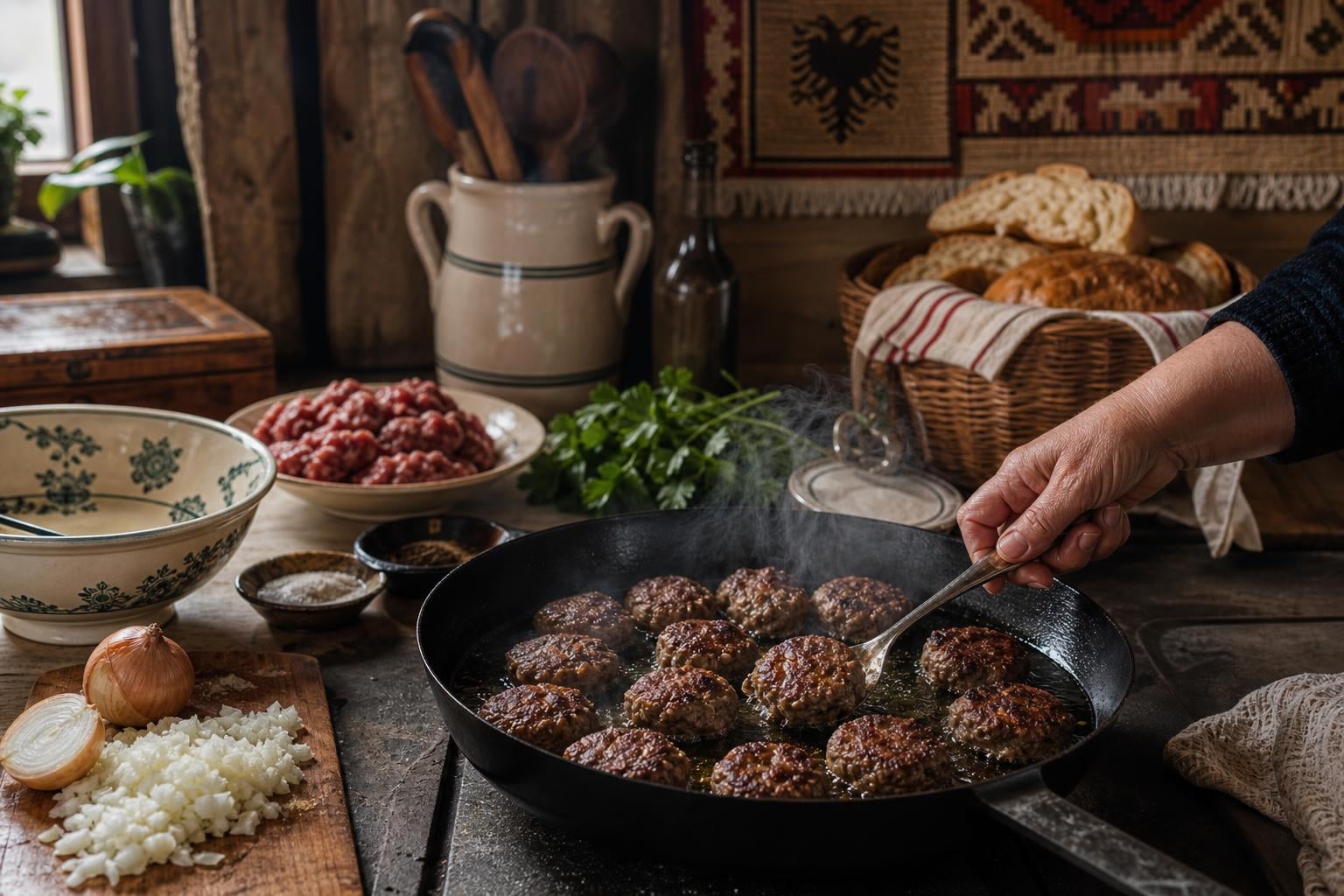
- Add the qofte in a single layer, leaving space between each one. Do not crowd the pan — work in two batches if needed. Fry undisturbed for 3 to 4 minutes per side, until deep brown and crusted. Flip once; flipping more than that breaks the crust.
- Transfer to a paper-towel-lined plate and rest for 5 minutes before serving. The carryover heat finishes the inside, and resting lets the juices redistribute.
Serve warm, not piping hot. A wedge of lemon and a small bowl of kos (“yogurt”) on the side is the standard finish.
Regional Variations: Tirana, Korça, Kosovo, the Mountains
The base recipe above is closest to a southern Albanian, Korça-style qofte. Across regions, the dish shifts.
Tirana-style. Capital-region qofte often include cooked rice in the mix — about a third of a cup of cooled rice folded in with the meat. The rice extends the meat, lightens the texture, and changes the binding from purely starch-and-bread to something a bit more pilaf-like. The seasoning leans on mint and black pepper.
Korça-style (qofte Korçare). Smaller and flatter than the standard version — about the size of a quarter — fried hot and served at room temperature as a meze. The herb is oregano-forward, the binder is bread soaked in milk, and the meat is almost always a beef-lamb mix.
Kosovo-style. Sweet paprika is heavier here, and a small share of hot red pepper or chili flake often shows up. Some Kosovo cooks add a pinch of allspice or cumin, which reads as a closer cousin to Turkish köfte. Onion is sometimes sautéed before mixing rather than added raw and grated.
Mountain-style (qofte ferrë or northern village qofte). Heavier on dried mint, often with no paprika at all, sometimes including grated potato as a binder when bread was scarce. The shape is more rustic — irregular ovals rather than uniform meatballs — and the cooking is often in a heavy pan over wood embers rather than a stove burner.
These are tendencies, not laws. A cook from Shkodër who married a cook from Prishtina ends up with a version that does not match any region cleanly. That mixing is what survives in diaspora kitchens.
Albania’s dialects split roughly along the Shkumbin river — Gheg to the north, Tosk to the south — and the cooking tracks the same line loosely. Qofte sit on both sides of it. A northern Gheg version is heavier on raw onion and lighter on herbs; a southern Tosk version puts mint and oregano forward and uses bread soaked in milk rather than dry breadcrumbs. Kosovo cooking sits inside the Gheg tradition, with extra Ottoman influence from the longer Ottoman presence in the territory.
One useful rule for diaspora cooks unsure of their own family’s regional roots: if grandmother’s qofte tasted heavily of mint and were small and flat, the recipe is southern. If they were larger, rounder, and seasoned mostly with raw onion and black pepper, the recipe is northern. Both are correct. Both are qofte.
The Tave Path: Baked Qofte and Qofte në Furrë
Qofte në furrë means “oven-baked qofte.” It is the weeknight version: same mixture as the pan-fried recipe above, shaped into ovals, arranged on an oiled sheet pan, and baked at 400°F (200°C) for 18 to 22 minutes, turning once at the halfway point.
There is also a casserole register of the dish. Qofte në tavë — “qofte in the pan” — layers raw shaped meatballs in an oven-safe dish with sliced tomatoes, sliced onions, peeled potato wedges, and a splash of olive oil and water. The whole thing bakes at 375°F (190°C) for about 45 minutes, with the meatballs giving up their fat to the vegetables and the vegetables giving up their water to the meatballs.
The baked path is leaner and less crusty than pan-fried. It also scales: a sheet pan of qofte feeds twelve people without anyone standing at a stove. Oven dishes are common across Albanian home kitchens, from casserole-style bakes to dairy-rich preparations like tavë kosi, Albania’s best-known baked dish. Qofte në furrë fits that pattern cleanly.
A useful diaspora trick: par-fry the qofte for 1 to 2 minutes per side first to set the crust, then transfer to a 375°F (190°C) oven for 10 to 12 minutes to finish. You get the brown exterior of the pan version and the hands-off finish of the baked version.
What to Serve Alongside
Qofte rarely arrive at the table alone. The standard Albanian plate around them includes a few fixed pieces.
Kos (yogurt). A small bowl of plain whole-milk yogurt, sometimes thinned with a splash of cold water and a pinch of salt, sometimes stirred with grated cucumber and a little garlic into something close to a tarator sauce. Full-fat Greek yogurt is the closest US supermarket substitute for Albanian kos.
Byrek. The savory layered pie — filled with cheese, spinach, or meat — often shows up on the same table, especially at family gatherings. A wedge of byrek next to two or three qofte is a complete plate.
Fresh vegetables. Sliced tomato, cucumber, green pepper, raw onion, and white cheese (djathë i bardhë) — the standard Balkan summer plate. In winter, pickled chilies and pickled cabbage take the place of the fresh tomatoes.
Bread. Always. A piece of bukë for sopping up the pan juices and the yogurt.
Raki. For the adults at the table, a small glass of raki (“Albanian fruit brandy”) before the meal. Grape, plum, or mulberry are the common varieties. The pour is small and the toast is gëzuar.
The point of this combination is that qofte sit in the middle of a balanced plate — fat and protein from the meatballs, acid and crunch from the salad, cool and creamy from the yogurt, structure from the bread. Pulling any one piece breaks the rhythm.
Qofte in the Albanian-American Kitchen
In US kitchens, the dish adapts. Most Albanian-American cooks reach for ground beef alone because lamb is harder to find and more expensive in mainstream grocery stores. The substitution works — the dish loses a little of its herbal carry, since lamb fat holds mint and oregano better than beef fat, but the result is still recognizably qofte.
Dried mint can be hard to find outside Mediterranean or Middle Eastern groceries. Whole Foods, Trader Joe’s, and most Italian delis carry it; if not, fresh mint chopped fine and used at twice the volume works. Albanian-American cooks in the Bronx, Sterling Heights, Astoria, Waterbury, and Paterson have local options — Albanian-owned butchers and groceries stock kos, suxhuk, gjizë, and properly dried mint.
For freezing: cool the cooked qofte to room temperature, freeze them in a single layer on a tray, then transfer to a zip-top bag. They keep for two to three months. Reheat from frozen in a 350°F (175°C) oven for 12 to 15 minutes, or in a covered skillet with a splash of water. Raw shaped qofte also freeze well — handy when half the family is coming over on a Sunday with no notice.
The weeknight version many diaspora cooks settle into: a smaller batch, all beef, baked rather than fried, served over rice with yogurt on the side. Fifteen minutes of active work, twenty in the oven, and a dish that still reads as the one gjyshe made even if every shortcut has been taken.
Recipes like this one are how the next generation hears Albanian first — through the smell of grated onion and mint on a Sunday afternoon. Counting yourself in the registry is the same idea, scaled up: a way for the community to recognize itself and be recognized. Add your name at /register.